- Strict RBI Prohibition: Under RBI Master Directives, recovery agents are legally prohibited from contacting your parents, relatives, friends, or workplace regarding your personal loan or credit card debt.
- Zero Liability for References: Emergency references or contact references listed on loan forms carry zero legal or financial obligation to pay. Banks cannot legally pursue them.
- Direct Bank Liability: As per RBI Circular (August 2022), the lending bank or NBFC is held directly accountable for any criminal intimidation, verbal abuse, or harassment committed by outsourced recovery agents.
- Instant 24-Hour Remedy: Serving a statutory Cease-and-Desist Notice citing RBI Fair Practices and filing a grievance on the RBI CMS Portal stops 95% of third-party calls immediately.
- Dignified Debt Resolution: If you are unable to repay the full outstanding amount due to financial distress, a formal One-Time Settlement (OTS) permanently caps the debt, eliminates legal notices, and secures a ₹0 No Dues Certificate.
1. What RBI Guidelines Say About Calling Family & Friends
Experiencing a financial crisis is stressful enough, but when third-party bank recovery agents begin calling your elderly parents, siblings, spouse, or friends, the emotional distress and social humiliation can feel overwhelming. Many borrowers ask in panic: "Is a bank recovery agent allowed to call my family in India? Can they publicly shame me to force repayment?"
The unequivocal legal answer from the Reserve Bank of India is NO. The apex banking regulator has established strict, binding directives prohibiting banks and Non-Banking Financial Companies (NBFCs) from using third-party intimidation or contacting non-borrowers.
"Regulated Entities (REs) and their recovery agents shall not resort to intimidation or harassment of any kind, either verbal or physical. Collection efforts must not humiliate publicly or intrude upon the privacy of family members, referees, and friends. Making threatening or anonymous calls and false representations is strictly prohibited."
— Reserve Bank of India (RBI) Circular on Outsourcing of Financial Services & Recovery Norms (RBI/2022-23/108)
Under the RBI Master Circular on Recovery Agents in Banks and the Master Direction – Fair Practices Code, regulated lenders are bound by explicit operational constraints:
- Strict Prohibition on Contacting Non-Borrowers: Agents may contact the primary borrower or legally registered co-applicant. Contacting parents, relatives, or acquaintances to reveal debt information is a severe breach of confidentiality.
- Mandatory Calling Hours: Recovery agents are legally permitted to call only between 8:00 AM and 7:00 PM. Any call made before 8:00 AM, after 7:00 PM, or on national holidays is a regulatory violation.
- No Use of Coercive or Abusive Language: Agents are prohibited from using foul language, threatening police arrest, or sending fabricated court summons.
- Principal Liability of Banks: Banks cannot deflect blame by claiming recovery agencies are independent contractors. The RBI holds the board of directors and senior management of the lending institution strictly liable for agent misconduct.
2. Reference Contacts vs Guarantors: Legal Liability
When borrowers fill out personal loan or credit card applications, banks routinely ask for two "Reference Contacts" or "Emergency Contacts". When defaults occur, unscrupulous collection agents misuse these contact numbers, calling your relatives and falsely claiming: "You are listed on this loan, and you must pay if the borrower defaults."
This is a deliberate lie designed to induce panic and social shame. Under the Indian Contract Act, 1872, there is a fundamental legal distinction between different roles:
Reference / Emergency Contact (ZERO Legal Liability)
A reference contact is provided solely for verifying the borrower's physical address or establishing contact if the borrower becomes completely untraceable. A reference never signs a loan agreement, undergoes no KYC, provides no credit consent, and has 0% financial liability. Lenders have zero legal standing to demand money from a reference.
Guarantor (Conditional Legal Liability)
A guarantor signs a formal Deed of Guarantee under Section 126 of the Indian Contract Act, 1872. A guarantor agrees to be co-extensively liable (Section 128) only if the primary borrower defaults. Standard unsecured personal loans and credit cards almost never have guarantors.
Co-Borrower / Co-Applicant (Joint Financial Liability)
A co-applicant jointly signs the primary loan agreement and submits full KYC documents. Both the primary borrower and co-applicant share joint and several liability to repay the debt.
Comparison: Permitted Bank Recovery Norms vs. Illegal Harassment Practices
| Action Category | Permitted Under RBI Fair Practices | Strictly Illegal / Actionable Breach |
|---|---|---|
| Calling Third Parties | Calling primary borrower or registered co-applicant | Calling parents, siblings, relatives, friends, or neighbors |
| Communication Hours | Strictly between 8:00 AM and 7:00 PM | Late night calls, early morning calls, or continuous spam dialling |
| Debt Disclosure | Discussing outstanding balance only with borrower | Disclosing debt details or loan amounts to family or employers |
| Workplace Visits | Sending formal letters to residential address | Creating scenes at workplace, calling HR, or threatening job loss |
| Legal Threat Representation | Issuing genuine statutory legal notices via advocate | Fake police arrest notices, fabricated court warrants, or WhatsApp threats |
3. Unmasking Illegal Tactics: Exploiting Social Pressure
Third-party collection agencies often operate on commission structures ranging from 10% to 30% of recovered funds. To maximize recoveries, untrained or rogue agents deploy psychological warfare tactics aimed at destroying the borrower's social standing. Recognizing these tactics helps you stay calm and prepare evidence:
1. WhatsApp Group Shaming & Contact Harvesting
Predatory instant loan apps and rogue agents create WhatsApp groups including your family members, colleagues, and friends, posting your photo with derogatory captions like "defaulter" or "fraudster". This is a severe criminal offense under the Information Technology Act and Indian Penal / BNS Code.
2. Caller ID Spoofing & Virtual Numbers
Agents use VoIP software and virtual number pools to call family members from hundreds of different numbers, bypassing phone call blocks and creating constant psychological harassment.
3. Fabricated Police & Court Summons via SMS
Sending fake text messages mimicking the "Delhi High Court", "Crime Branch", or local police stations threatening that a police team is en route with an arrest warrant. In civil loan defaults, police have zero jurisdiction to arrest borrowers or contact family members.
4. Legal Protections: Privacy Rights, BNS & IT Act
Borrowers facing aggressive collection harassment are protected by powerful constitutional, criminal, and civil legal frameworks in India. An unpaid civil loan is never a crime, and lenders must operate strictly within judicial boundaries:
Article 21: Right to Privacy & Debtor Dignity
In the landmark K.S. Puttaswamy vs. Union of India (2017) ruling, the Supreme Court declared privacy a fundamental right. Furthermore, in ICICI Bank Ltd. vs. Prakash Kaur (2007), the Supreme Court unequivocally ruled that banks cannot use musclemen or extra-judicial coercive tactics to recover dues, stating recovery must follow civilized due process.
Bharatiya Nyaya Sanhita (BNS) / IPC Criminal Provisions
- Section 351 BNS (Criminal Intimidation): Punishable with imprisonment up to 2 years for threatening injury to person, reputation, or property.
- Section 356 BNS (Defamation): Punishable for making false imputations to damage the social reputation of a borrower or family member.
- Section 308 BNS (Extortion): Applying illegal coercion or fear of injury to extract money.
Information Technology Act, 2000 & Digital Lending Norms
Under Section 66E (Violation of Privacy) and Section 67 (Publishing Obscene Information), transmitting private data or morphing pictures carries rigorous imprisonment of up to 3 years and heavy fines. The Digital Personal Data Protection Act, 2023 further penalizes unauthorized processing of personal data.
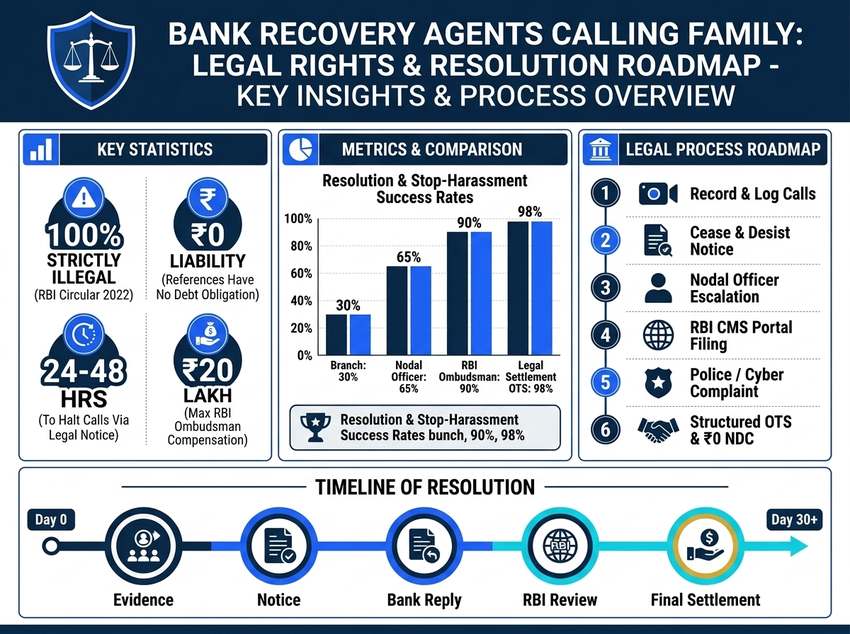
5. Emergency Protocol: Stopping Family Calls in 24–48h
If recovery agents are currently calling your parents, spouse, or friends, do not panic. Execute this proven 5-step emergency legal protocol to halt third-party interference immediately:
1Instruct Family Members to Record and Collect Caller Metadata
Brief your family and relatives calmly: "You have zero debt liability. Do not argue. Turn on call recording and ask for their Full Name, Agency Name, Bank Name, and Employee ID." If the caller refuses to identify themselves, that itself constitutes a direct violation of RBI Fair Practice norms.
2Refuse All Panic Payments to Personal Accounts or QR Codes
Unscrupulous agents often tell frightened relatives: "Pay ₹5,000 immediately to this Google Pay number to stop police arrest." This is extortion and fraud. Never pay a single rupee to personal UPI IDs or individual accounts. All legitimate loan repayments must be made strictly to your designated loan account number.
3Send an Anti-Harassment Cease & Desist Notice to the Bank Nodal Officer
Dispatch a formal legal notice via email to the bank's Principal Nodal Officer (PNO) and customer grievance cell. Attach call logs and audio recordings proving that agents contacted non-borrowers in violation of RBI Circular RBI/2022-23/108.
4Lodge a Complaint on the RBI Complaint Management System (CMS)
If the bank fails to halt third-party calls within 24 hours of your notice, immediately log onto cms.rbi.org.in and lodge a complaint under the Integrated Ombudsman Scheme, 2021. The RBI issues an electronic notice directly to the bank's compliance team, triggering an immediate stop-recovery order.
5Register a Police Complaint / Cyber Crime Report for Intimidation
If recovery agents use abusive language or issue death threats, take immediate legal action. File a complaint with your local cyber cell or online at cybercrime.gov.in under BNS Section 351 (Criminal Intimidation) and Section 66E of the IT Act.
6. Drafting Cease-and-Desist Notices & Legal Grievance Templates
Banks and collection agencies pay immediate attention when a borrower communicates in the precise language of Indian statutory law. Here is the exact structured legal draft you can customize and serve to the bank's Nodal Officer:
// FORMAL CEASE & DESIST NOTICE: RECOVERY AGENT HARASSMENT //
TO: Principal Nodal Officer & Managing Director, [Insert Bank / NBFC Name]
SUBJECT: Urgent Notice to Cease & Desist Illegal Third-Party Recovery Calls & Violation of RBI Fair Practices Code (Loan A/c: [Insert Loan Number])
Dear Sir/Madam,
1. I am the primary borrower for the above-referenced loan account. Due to genuine financial distress [state reason: e.g., job loss, medical emergency], I am currently unable to maintain regular EMI payments.
2. Collection agents acting on your behalf (Calling Numbers: [Insert Agent Numbers]) have repeatedly called my [parents / spouse / sister / friends] at [Insert Numbers Called]. They have disclosed private financial data and used coercive language.
3. This conduct is in direct and actionable violation of:
• RBI Master Circular on Recovery Agents (RBI/2007-08/296)
• RBI Master Direction on Outsourcing of Financial Services (RBI/2022-23/108)
• Article 21 of the Constitution of India (Right to Privacy & Debtor Dignity)
• Sections 351 & 356 of Bharatiya Nyaya Sanhita (Criminal Intimidation & Defamation)
4. DEMAND: You are hereby called upon to immediately instruct all collection personnel to CEASE & DESIST from contacting any third parties or non-borrowers. All future communications regarding this debt must be directed exclusively to me in writing at my registered email.
5. Failure to halt this illegal third-party contact within 24 hours will compel me to initiate formal proceedings before the RBI Banking Ombudsman and lodge a Criminal Complaint (FIR) under BNS Sections 351/308.
Yours faithfully,
[Your Full Name]
[Registered Mobile Number & Email]
Legal Roles & Financial Liability Matrix Under Indian Law
| Party Designation | Contractual Agreement Signed | Legal Repayment Liability | CIBIL Score Impact | Permitted Collection Contact |
|---|---|---|---|---|
| Primary Borrower | Primary Loan Agreement | 100% Primary Obligation | Direct DPD / Score Drop | Yes (8:00 AM – 7:00 PM) |
| Co-Applicant / Co-Borrower | Joint Loan Agreement | 100% Joint & Several | Direct DPD / Score Drop | Yes (8:00 AM – 7:00 PM) |
| Legal Guarantor | Deed of Guarantee (Sec 126) | Secondary (Upon Default) | Affected if Invoked | Yes (Post-Invocation) |
| Reference / Emergency Contact | None (Contact Info Only) | 0% ZERO Liability | ZERO Impact | STRICTLY PROHIBITED |
7. Escalating to RBI Ombudsman: CMS Portal Guide
The Reserve Bank - Integrated Ombudsman Scheme, 2021 provides a cost-free, high-speed quasi-judicial grievance mechanism for Indian bank customers. If your bank fails to resolve harassment or continues calling your family, filing a complaint on the RBI Complaint Management System (CMS) triggers immediate regulatory scrutiny:
- Navigate to the Official Portal: Visit the RBI Complaint Management System at cms.rbi.org.in.
- Select Regulated Entity: Choose your Bank or NBFC from the drop-down list and enter your loan account number.
- Select Grievance Category: Choose "Loans and Advances" → "Recovery Agents / Harassment / Violation of Fair Practices Code".
- Upload Evidence Dossier: Upload your call logs, audio recordings, text messages, and a copy of the initial complaint sent to the bank's Nodal Officer.
- Claim Statutory Compensation: Under Clause 15 of the Scheme, the Ombudsman has the authority to award up to ₹20 Lakhs for actual loss and up to ₹1 Lakh for mental agony, harassment, and loss of time.
- Tracking & Resolution: An electronic Complaint ID is generated. The bank is required to submit a compliance response to the RBI within 30 days.
Multi-Tier Escalation Matrix & Resolution Timelines
| Escalation Level | Authority / Forum | Primary Objective | Turnaround Time (TAT) | Legal Weight |
|---|---|---|---|---|
| Level 1 | Bank Branch / Customer Care | Initial logging of harassment grievance | 24 to 48 Hours | Internal Bank Record |
| Level 2 | Principal Nodal Officer (PNO) | Formal Cease-and-Desist enforcement | 3 to 7 Days | Senior Management Audit |
| Level 3 | RBI Banking Ombudsman (CMS) | Statutory sanction, fines & compensation | 30 Days | Binding Regulatory Order |
| Level 4 | Cyber Crime / Police Station | FIR for extortion, abusive threats & defamation | Immediate | Criminal Prosecution (BNS) |
| Level 5 | Consumer Disputes Commission | Damages for mental torture & deficiency | 3 to 6 Months | Judicial Award & Penalties |
8. Permanent Relief: How an OTS Ends Harassment
While stopping recovery agent harassment protects your family in the short term, the underlying unsecured loan default remains on bank ledgers, accumulating compounding penal interest and degrading your credit score. If genuine financial distress (job loss, business failure, medical catastrophe) prevents you from paying the full balance, the permanent, lawful exit strategy is a One-Time Settlement (OTS).
Under the RBI Compromise Settlement Framework (June 2023), banks and NBFCs are authorized to negotiate a compromise settlement:
Why Structured OTS is the Ultimate Shield for Distressed Borrowers:
- Huge Financial Relief: Banks routinely waive 100% of penal interest and late fees, and discount the principal balance by 40% to 70% based on hardship evidence.
- Permanent Cessation of Recovery Calls: The moment an OTS Sanction Letter is issued on official bank letterhead, the bank permanently recalls the account from all third-party collection agencies.
- Legal Immunity & No Dues Certificate (NDC): Upon payment of the settled amount, the bank issues a legally binding No Dues Certificate, confirming zero pending liability and cancelling any pending Section 138/arbitration notices.
At SettleLoans, our experienced advocates and financial negotiators step between you and the lending institutions. We halt all third-party collection harassment under RBI Fair Practices, draft formal representations to Stressed Asset Resolution Branches (SARB), and negotiate maximum waivers to help you achieve a dignified financial restart.

Settle Loan is India's trusted debt relief and loan settlement platform. We help borrowers overcome financial distress by negotiating with banks and NBFCs to legally settle personal loans and credit card debts. With our transparent, performance-based approach, you can achieve debt freedom and regain your financial peace of mind.
COMPUTER
9. Frequently Asked Questions (FAQ)
Clear, authoritative answers to the most critical questions regarding bank recovery agents contacting family members, legal rights, and immediate dispute resolution in India.
No, it is strictly illegal under Indian banking regulations. The Reserve Bank of India (RBI) explicitly prohibits contacting a borrower's family members, parents, friends, spouses, or colleagues. These rules are set out in its Master Circular on Recovery Agents and Master Direction on Outsourcing (August 2022). Agents are strictly barred from disclosing loan details, intimidating non-borrowers, or seeking recovery from third parties.
Absolutely not. Providing a reference or emergency contact on a loan application is merely for address verification or contact re-establishment when the borrower is untraceable. A reference contact does not sign a Contract of Guarantee under Section 126 of the Indian Contract Act, 1872. They have zero legal, financial, or joint liability for the loan. Any attempt by collection agents to demand payment or threaten references constitutes illegal coercion and extortion.
Key statutory directives include: 1) RBI Master Circular on Recovery Agents (RBI/2007-08/296) prohibiting public humiliation and harassment. 2) RBI Master Direction on Outsourcing (August 12, 2022) holding lenders directly liable for collection agent misconduct. 3) RBI Digital Lending Guidelines (September 2022) strictly forbidding apps from harvesting contact lists. And 4) Calling hour restrictions mandating calls only between 8:00 AM and 7:00 PM on working days.
Take these 5 immediate actions: 1) Instruct your family members to record every phone call and note caller details (name, phone number, collection agency, bank name). 2) Inform your family that references have zero liability and tell them not to make any direct UPI or cash payments. 3) Send a formal Anti-Harassment & Cease-and-Desist Notice to the bank's Principal Nodal Officer. 4) Lodge an online complaint on the RBI CMS portal (cms.rbi.org.in). 5) If agents issue threats of physical harm or defamation, register an FIR/cyber complaint under Section 351/356 of Bharatiya Nyaya Sanhita (BNS).
Yes. If agents use abusive language, issue physical threats, or circulate morphed photos, file a criminal complaint. You can report at your local police station or online via cybercrime.gov.in. Relevant provisions include Section 351 BNS (Criminal Intimidation), Section 356 BNS (Defamation), Section 308 BNS (Extortion), and Section 66E/67 of the IT Act, 2000.
Under the RBI Integrated Ombudsman Scheme, 2021, the Ombudsman holds extensive adjudicatory powers. Upon finding a lender guilty of violating recovery guidelines, the Ombudsman can order all third-party contact halted immediately. The Ombudsman can also reverse penal charges, demand written apologies, and award compensation up to ₹20 Lakhs for financial loss and ₹1 Lakh for harassment.
No, this is completely illegal. Under the RBI Digital Lending Guidelines (September 2022), all regulated lending entities and loan apps are prohibited from accessing phone contact lists, media storage, call logs, or precise location coordinates. Apps are restricted to one-time camera/microphone access solely for KYC onboarding. Any unauthorized phone contact scraping is a punishable offence under the Digital Personal Data Protection Act, 2023 and IT Act.
Yes, Indian Consumer Commissions consistently award heavy damages. Under the Consumer Protection Act, 2019, disclosing private debt details to third parties or subjecting family members to mental torment is classified as an unfair trade practice and deficiency in banking service. District and State Consumer Disputes Redressal Commissions regularly award compensation ranging from ₹50,000 to ₹5,00,000+ against banks and NBFCs for loss of reputation and psychological trauma.
SettleLoans provides comprehensive legal shielding and debt resolution: 1) Our empaneled advocates issue formal statutory Cease-and-Desist Notices to bank management and recovery agencies. 2) We file fast-tracked grievances with Principal Nodal Officers and the RBI Ombudsman. 3) We represent you in structured One-Time Settlement (OTS) negotiations to settle unsecured debts at a substantial 50%–70% waiver with a legally binding No Dues Certificate (NDC) and ₹0 balance guarantee.
Official Regulatory Sources & Legal Authorities
- Reserve Bank of India (RBI) — Master Circular on Recovery Agents & Outsourcing Directives (2022)
- RBI Complaint Management System (CMS) — Integrated Ombudsman Scheme (2021)
- Supreme Court of India — Landmark Debtor Dignity Precedents (ICICI Bank vs. Prakash Kaur)
- National Cyber Crime Reporting Portal (MHA) — Digital Harassment & Cyber Intimidation Reporting
- National Consumer Helpline (NCH) — Consumer Protection Act (2019) Unfair Trade Practice Remedies