- Strict Permitted Calling Window: Lenders and recovery agents are legally prohibited from calling borrowers before 8:00 AM or after 7:00 PM under circular RBI/2022-23/108.
- Absolute Privacy & Anti-Shaming Shield: Contacting third parties, workplace HR, relatives, or posting notices in public residential areas is strictly banned under RBI Master Directions.
- Civil Breach vs. Criminal Immunity: Inability to service debt is purely a civil contractual dispute. The Supreme Court prohibits police involvement or Section 420 IPC charges for bona fide default.
- Mandatory Written OTS Sanction: All compromise settlements require formal, board-approved written sanction letters on bank letterhead before any money is paid.
- 30-Day Mandatory NDC & Deed Release: Banks must issue a No Dues Certificate and release all original property collateral documents within 30 days or pay ₹5,000/day relief.
1. Regulatory Architecture of Borrower Rights Under RBI
In the contemporary Indian financial ecosystem, unsecured personal loans, consumer credit lines, credit cards, and micro-business credit facilities have expanded at an unprecedented pace. However, when unanticipated personal emergencies arise—such as sudden corporate layoffs, catastrophic family medical emergencies, critical supply-chain disruptions, or business insolvencies—honest borrowers frequently experience severe liquidity shortfalls. When Equated Monthly Installments (EMIs) default past the statutory 90-day threshold and become categorized as Non-Performing Assets (NPAs), institutional lenders frequently outsource recovery operations to aggressive third-party collection agencies.
Many borrowers believe that loan default forfeits their civil rights, leaving them vulnerable to harassment. In reality, the Reserve Bank of India (RBI) has established an extensive statutory framework under Section 21 and Section 35A of the Banking Regulation Act, 1949. This framework protects borrowers from abusive recovery tactics.
The RBI mandates that all Regulated Entities (REs)—including commercial banks, NBFCs, and fintech lenders—must treat borrowers with dignity. Lenders cannot subject borrowers to intimidation, humiliation, or persistent harassment in debt recovery.
Under the Indian legal framework, commercial default is governed strictly by the Indian Contract Act, 1872. A failure to make monthly installment payments constitutes a civil breach of contractual debts, for which lenders possess designated judicial and extra-judicial recovery avenues. Crucially, the law does not permit banks to disregard standard due process, deploy intimidation tactics, or convert civil defaults into extra-judicial debt collection campaigns.
2. Calling Hours (8 AM–7 PM) & Anti-Harassment Directives
Collection notices are strictly regulated. To curtail predatory tactics, the RBI issued Circular RBI/2022-23/108 on Recovery Agents. Lenders and their agencies are barred from calling before 8:00 AM or after 7:00 PM, and cannot contact third parties without consent.
Foremost among these protections is the strict restriction on notice timings. Regulated Entities and their authorized collection personnel are legally barred from contacting borrowers—via telephone calls, SMS messages, WhatsApp chats, or in-person visits—before 8:00 AM in the morning or after 7:00 PM in the evening. Persistent calling, automated dialer harassment during midnight or early morning hours, and calling on national holidays constitute explicit regulatory breaches that provide grounds for immediate grievance filing.
Calls outside the 8:00 AM to 7:00 PM window are strictly unlawful. Continuous, repetitive calling within a short timeframe designed to cause mental harassment violates the RBI Fair Practices Code.
Lenders cannot reveal loan default details to family members, workplace superiors, or friends. Reference contacts can only be contacted for location tracing, never for recovery.
Use of profane language, derogatory comments regarding caste, gender, or social standing, and threats of physical injury are punishable under IPC Sections 503, 506, and 509.
Visiting a borrower place of employment without prior written consent, creating public scenes at corporate desks, or attempting to compromise employment status is strictly barred.
also, the RBI strictly bans public humiliation and social shaming. In the landmark ruling ICICI Bank v. Shanti Devi Sharma (2007) 2 SCC 711, the Supreme Court condemned using strong-arm recovery agents and hired muscle. The court affirmed that debt recovery must follow due process of law.
3. Protections Against Criminalization: Section 420 Myth
A common intimidation tactic involves sending fake police notices or arrest warrants over WhatsApp. Recovery agents often cite Section 420 (Cheating) or Section 406 (Criminal Breach of Trust) of the Indian Penal Code (IPC), threatening imminent imprisonment.
Under Indian law, financial default arising from inability to pay does not constitute criminal cheating. To establish an offense under Section 420 IPC, fraudulent intent must be proven at the inception of the loan. In genuine default, the dispute remains purely civil.
Landmark Supreme Court Jurisprudence on Loan Defaults
Hridaya Ranjan Prasad Verma v. State of Bihar (2000) 4 SCC 168
The Supreme Court established the definitive distinction between mere breach of contract and cheating: criminal liability cannot arise unless fraudulent intent was actively present at the inception of the contract.
Dalip Kaur & Ors. v. Jagnar Singh & Anr. (2009) 14 SCC 696
The apex court unequivocally held that an essentially civil dispute arising from non-fulfillment of a monetary contract cannot be given a criminal color to exert coercive pressure on the debtor.
Prof. R.K. Vijayasarathy v. Sudha Seetharam (2019) 16 SCC 739
The Supreme Court reaffirmed that converting pure civil commercial debt claims into criminal cases represents a gross abuse of the judicial process, liable to be quashed under Section 482 of the CrPC.
so, local police stations have no legal authority to intervene in unsecured loan defaults, summon borrowers to police stations for debt talks, or threaten custodial arrest. Forged police summons or fake court notices distributed over digital messaging channels constitute criminal forgery under Section 465 and Section 468 of the IPC, rendering the offending recovery agency liable to immediate criminal prosecution.
4. Bank NPA Provisioning Dynamics & NPV Recovery Valuation
To comprehend why financial institutions use aggressive psychological pressure rather than starting legitimate court cases, one must examine institutional balance sheet mechanics. Under the Reserve Bank of India Master Directions on Prudential Norms on Income Recognition, Asset Classification and Provisioning (IRACP), scheduled commercial banks must classify delinquent loans into progressive stages:
- Special Mention Accounts (SMA-0, SMA-1, SMA-2): Monitored closely during 1 to 90 days overdue.
- Substandard NPA (90 Days to 12 Months): Mandates an immediate 15% capital provisioning deduction against bank profits.
- Doubtful Assets (D1, D2, D3): Escalates from 25% to 40% provisioning for secured portions and 100% full provisioning write-down for unsecured personal loans.
- Loss Assets: Requires 100% provisioning write-off, representing an absolute drag on institutional return on assets (ROA).
When a bank files a civil suit under Order 37 CPC, it incurs large expenses. Lenders must pay court fees, maintain legal retainers, and navigate 3 to 7 years of procedural hearings. This reality creates a strong incentive for banks to accept One-Time Settlements.
Where C_t represents estimated recoveries across time periods t, r represents the institutional cost of capital discount rate, and deductions account for protracted civil litigation costs and locked regulatory provisioning capital.
Because prolonged litigation yields a severely negative Net Present Value on unsecured retail portfolios, banking institutions possess an immense financial incentive to execute a negotiated One-Time Settlement (OTS). Under standard OTS frameworks, banks agree to large haircuts (often waiving 45% to 65% of the total ledger balance) to immediately release locked regulatory capital and recover liquid cash.
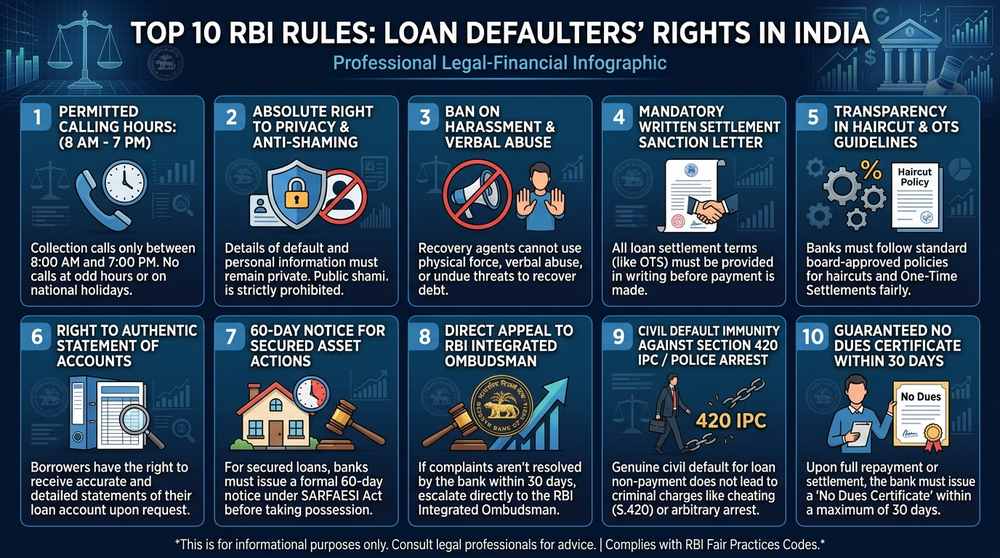
6. Breakdown of Top 10 RBI Rules for Loan Defaulters
The Reserve Bank of India has woven a comprehensive statutory tapestry across multiple master directions, circulars, and ombudsman regulations. Below is the authoritative, detailed breakdown of the top 10 statutory rules that safeguard every borrower in India:
Strict Permitted Calling Hours (8:00 AM to 7:00 PM)
Regulatory Basis: RBI Circular RBI/2022-23/108 (DOR.ORG.REC.65/21.04.158/2022-23).
Lenders and their authorized recovery agents are strictly restricted to contacting borrowers only between 8:00 AM and 7:00 PM. Calling borrowers before 8:00 AM, late at night, or persistently ringing phones during family hours is prohibited. Any violation constitutes actionable harassment under the RBI Fair Practices Code.
Absolute Right to Privacy & Anti-Shaming Mandate
Regulatory Basis: RBI Master Direction on Outsourcing of Financial Services & Digital Lending Guidelines.
Lenders are barred from disclosing loan details or default status to any third party, including family members, neighbors, friends, or workplace colleagues. Reference contacts provided during onboarding can only be contacted for location tracing when the borrower is genuinely untraceable. Publishing names in newspapers without statutory court sanction or posting default notices in housing societies is strictly illegal.
Total Ban on Physical Force, Intimidation & Verbal Abuse
Regulatory Basis: Supreme Court ruling in ICICI Bank v. Prakash Kaur & IPC Sections 383, 503, 506.
Lenders cannot employ musclemen, goons, or unverified recovery agents. Any verbal abuse, physical obstruction, threat of bodily harm, or intimidation constitutes a cognizable offense under criminal law. The bank carries direct vicarious liability for criminal conduct by its outsourced agents.
Mandatory Board-Approved Compromise Settlement (OTS) Framework
Regulatory Basis: RBI Circular RBI/2023-24/40 (DOR.STR.REC.20/21.04.048/2023-24).
All Regulated Entities must put in place board-approved policies for undertaking compromise settlements and technical write-offs. This framework establishes clear delegation of authority, objective haircut calculation benchmarks, and transparent terms, ensuring borrowers in genuine hardship have access to structured debt settlement.
Mandatory Written Settlement Sanction Letter Before Payment
Regulatory Basis: RBI Fair Practices Code & Banking Supervision Directives.
Borrowers have the absolute right to receive a formal, bank-stamped Settlement Sanction Letter on official letterhead signed by an authorized signatory before paying a single rupee. Verbal settlement assurances or WhatsApp messages from recovery agents carry zero legal validity and often represent fraudulent token collection traps.
Fair Lending Practices & Ban on Capitalising Penal Interest
Regulatory Basis: RBI Circular RBI/2023-24/53 (DOR.MCS.REC.28/01.01.001/2023-24).
Banks and NBFCs are prohibited from adding penal interest onto the core loan principal to calculate compound interest. Penalties for default must be levied strictly as reasonable, non-capitalised 'penal charges' with full disclosure, preventing predatory debt compounding.
Mandatory 60-Day Notice Before Possession on Secured Loans
Regulatory Basis: SARFAESI Act, 2002 (Sections 13(2) and 13(4)) & Security Interest Rules.
For secured loans like home or property mortgages, lenders cannot seize assets abruptly upon default. The bank must serve a mandatory 60-day demand notice under Section 13(2), consider borrower representations under Section 13(3A), and provide a subsequent 30-day notice under Section 13(4) before taking physical possession.
Direct Escalation to RBI Integrated Ombudsman with ₹20 Lakh relief Power
Regulatory Basis: Reserve Bank - Integrated Ombudsman Scheme, 2021.
If a bank fails to resolve a harassment complaint within 30 days, the borrower can escalate the dispute to the RBI Integrated Ombudsman via the Complaint Management System (CMS). The Ombudsman possesses statutory powers to penalize the lender and award relief up to ₹20 Lakhs for consequential losses and up to ₹1 Lakh for mental harassment.
Immunity from Criminal Prosecution for Honest Civil Defaults
Regulatory Basis: Supreme Court rulings in Dalip Kaur & Hridaya Ranjan Prasad Verma.
Financial inability to pay is strictly a civil breach of contract. Police officers cannot summon, harass, or register FIRs under Section 420 or 406 IPC against genuine borrowers. Any attempt by recovery agents to issue fabricated arrest notices is legally void and subject to criminal counter-action under Section 506 IPC.
Mandatory Release of Property Documents & NDC within 30 Days (₹5,000/Day Penalty)
Regulatory Basis: RBI Directive RBI/2023-24/60 (DoR.MCS.REC.38/01.01.001/2023-24).
Upon full settlement or repayment, Regulated Entities must release all original property documents and issue a formal No Dues Certificate (NDC) within 30 days. For every day of delay beyond 30 days attributable to the lender, the bank must pay mandatory relief of ₹5,000 per day to the borrower.
7. OTS Mechanics, Haircut Sizing & Sanction Letter Audit
Executing a legally secure and financially advantageous One-Time Settlement (OTS) requires understanding the internal hierarchy and decision-making apparatus of scheduled commercial banks. Settlement authority does not reside with field recovery agents; it is vested in institutional Credit Committees, Zonal Settlement Committees (ZSC), or Special Asset Management Branches (SAMB).
When an unrepresented borrower attempts to negotiate directly, recovery personnel frequently deploy psychological pressure to extract token payments. In contrast, specialized debt defense advocates construct a comprehensive Financial Hardship Dossier that formally shows the borrower genuine inability to pay. This dossier documents termination letters, medical diagnosis certificates, audited business balance sheets, or tax returns.
1. Official Bank Letterhead
Must feature official institutional logo, corporate registration details, branch code, and a unique dispatch reference number.
2. Explicit Waiver Breakdown
Must explicitly specify the ledger balance, agreed settlement amount, total haircut percentage, and installment due dates.
3. Closure & Legal Withdrawal Clause
Must state that upon receipt of the settled amount, all legal cases will be withdrawn and a stamped No Dues Certificate issued.
Borrowers must never remit funds to third-party accounts, person agent UPI handles, or collection agency accounts. Payments must be routed exclusively to the borrower dedicated loan account via traceable electronic methods such as RTGS, NEFT, or Account Payee Demand Drafts.
8. Remittance Protocols, 30-Day NDC & CIBIL Reconstruction
Once the final settlement installment is remitted in strict compliance with the sanction letter schedule, the post-settlement legal phase begins. Under RBI Directive RBI/2023-24/60, the financial institution is legally obligated to execute account closure, issue a physical and digital No Dues Certificate (NDC), and release any pledged security or original title deeds within 30 days.
also, lenders are required under CICRA, 2005 to transmit updated account records to credit bureaus. Within 30 days of receiving settlement funds, the bank must update CIBIL, Experian, Equifax, and CRIF High Mark to reflect an outstanding balance of ₹0.
Months 1 to 6: Bureau Verification
Obtain updated credit reports. Verify that the outstanding ledger balance reflects zero and all overdue DPD flags are halted.
Months 6 to 12: Secured Credit Card
Open a Fixed Deposit (FD) backed credit card. use 15%–20% of the limit and clear 100% of the statement balance monthly.
Months 12 to 18: Mandatory Cooling Exit
Surpass the RBI 12-month cooling window under the June 2023 circular. Establish a continuous 12-month flawless payment track record.
Months 18 to 24: Score Restoration
As positive repayment data accumulates, your CIBIL score progressively climbs back to 720+, unlocking regular prime lending avenues.
While a 'Settled' remark remains visible in bureau histories, its negative weighting diminishes rapidly as new positive credit lines show disciplined, responsible financial management.
9. Dispute Resolution & Regulatory Enforcement Comparative Matrix
The following matrix summarizes the jurisdictional avenues, governing circulars, and enforceable borrower protections across key stages of loan recovery and debt settlement:
| Dispute Stage | Regulatory Reference | Permitted Bank Action | Prohibited Action | Borrower Legal Remedy |
|---|---|---|---|---|
| Collection notice | RBI/2022-23/108 Circular | Calling between 8:00 AM – 7:00 PM | Calling outside window, verbal abuse, shaming | Grievance to Nodal Officer & RBI Ombudsman |
| Penal Interest Levy | RBI/2023-24/53 Circular | Reasonable, transparent penal charges | Capitalising interest into principal balance | Demand account statement rectification |
| Compromise Settlement (OTS) | RBI/2023-24/40 Circular | Board-approved haircut talks | Verbal settlement deals & cash collections | Require formal stamped Sanction Letter |
| Police FIR Threats | Supreme Court (Dalip Kaur) | Civil summary suit (Order 37 CPC) | Threatening Section 420 IPC arrest or police calls | Cease-and-desist notice & Section 506 IPC counter |
| Secured Asset Recovery | SARFAESI Act 2002 | 60-day notice under Sec 13(2) | Forcible asset possession without due notice | Section 17 DRT appeal & Lok Adalat settlement |
| Post-Payment NDC Release | RBI/2023-24/60 Circular | Deliver NDC & property deeds within 30 days | Delaying deed release or charging extra fees | ₹5,000/day relief claim via Ombudsman |
10. SettleLoans Legal Defense & Debt Resolution Shield
Navigating recovery harassment and complex banking rules requires seasoned legal advocates. SettleLoans stands as India premier legal defense and debt resolution platform. Our advocates protect your dignity by serving formal cease-and-desist notices to stop unlawful harassment. We hold abusive agencies accountable and negotiate directly with bank committees to secure maximum principal waivers backed by authentic, bank-stamped No Dues Certificates.

Settle Loan is India's trusted debt relief and loan settlement platform. We help borrowers overcome financial distress by negotiating with banks and NBFCs to legally settle personal loans and credit card debts. With our transparent, performance-based approach, you can achieve debt freedom and regain your financial peace of mind.
COMPUTER
11. FAQs: Top 10 RBI Rules for Loan Defaulters
Clear, advocate-verified answers to critical questions regarding RBI regulations, recovery limits, and borrower statutory rights in India.
What are the permitted calling hours for loan recovery agents according to the RBI?
Under RBI Circular RBI/2022-23/108 (DOR.ORG.REC.65/21.04.158/2022-23), recovery agents and bank agents are strictly restricted to contacting borrowers only between 8:00 AM and 7:00 PM. Calling before 8:00 AM, after 7:00 PM, or persistently ringing numbers during odd hours constitutes a direct regulatory violation punishable by the RBI.
Can recovery agents contact my family, friends, or workplace colleagues?
No. The RBI Master Directions on Outsourcing of Financial Services explicitly ban lenders and third-party recovery agencies from disclosing debt default information to family members, relatives, neighbors, or workplace colleagues. Reference contacts provided during application can only be used to trace an untraceable borrower, never for debt collection or social shaming.
Can police arrest a borrower or file an FIR under Section 420 IPC for loan default?
No. Inability to service an unsecured loan or credit card due to genuine financial hardship is strictly a civil breach of contract governed by civil law. The Supreme Court of India has repeatedly held that Section 420 (cheating) cannot be applied unless fraudulent intent existed at the exact moment of loan disbursement. Police cannot register an FIR or arrest borrowers for commercial default.
Is a written settlement sanction letter mandatory before making a One-Time Settlement payment?
Yes. Under RBI guidelines on Compromise Settlements (June 8, 2023), no payment should ever be made based on verbal assurances or WhatsApp messages from recovery agents. A formal Settlement Sanction Letter generated on the bank official letterhead, bearing an authorized signature, specific waiver amount, and explicit No Dues commitment, is mandatory.
What are the RBI rules on penal interest and arbitrary late charges?
Under RBI Circular RBI/2023-24/53 (Fair Lending Practice - Penal Charges on Loan Accounts), banks and NBFCs are prohibited from levying penal interest that compounds onto the principal balance. Penalties for delayed payment must be charged solely as reasonable, non-capitalised 'penal charges' without inflating the core debt.
What notice period is legally required before a bank can repossess secured property under SARFAESI?
For secured loans such as home or business mortgage loans, the SARFAESI Act, 2002 mandates that the bank must issue a formal 60-day demand notice under Section 13(2) after NPA classification. If unresolved, a subsequent 30-day possession and public auction notice under Section 13(4) is mandatory, giving borrowers statutory rights of representation.
What relief does a bank owe if it delays releasing original property documents after settlement?
Under RBI Circular RBI/2023-24/60, Regulated Entities must release all original movable or immovable property documents and remove loan charges from registries within 30 days of full loan repayment or settlement. For every day of delay beyond 30 days attributable to the lender, the bank must pay relief of ₹5,000 per day to the borrower.
How can a borrower lodge a formal complaint against recovery agent harassment with the RBI?
Borrowers should first submit a written complaint to the bank Principal Nodal Officer. If the bank fails to resolve the grievance within 30 days or rejects the complaint, the borrower can escalate the dispute to the RBI Integrated Ombudsman Scheme via the official CMS portal (cms.rbi.org.in), where the Ombudsman has the power to award relief up to ₹20 Lakhs.
What is the mandatory cooling period after completing an RBI compromise settlement?
Under the RBI Framework for Compromise Settlements (June 2023), a minimum cooling period of 12 months applies before a borrower can be considered for fresh credit facilities by regulated entities. This cooling period provides time for borrowers to rebuild their credit profile and establish disciplined repayment habits.
How does advocate representation protect borrowers during loan default and recovery?
Advocate representation immediately halts illegal collection agent harassment by serving formal cease-and-desist notices, demanding strict adherence to RBI Fair Practices Codes, handling all institutional notice, and negotiating directly with bank settlement committees for maximum principal waivers backed by authentic No Dues Certificates.