When an individual accumulates unsecured credit across multiple financial institutions, unexpected income disruptions or medical emergencies trigger a severe multi-creditor crisis. In this verified case study, a technology professional faced ₹25,00,000 in compounding liabilities distributed across 3 personal loans with HDFC Bank, ICICI Bank, and Axis Bank, alongside 4 active credit cards with SBI Card, RBL Bank, Kotak Mahindra, and Standard Chartered, resulting in acute psychological trauma and uncoordinated collection harassment.
SettleLoans executed a structured multi-bank debt defense strategy, establishing communication shields to halt recovery calls, auditing ledgers to eliminate unearned compounding finance charges, and prioritizing negotiations based on institutional provisioning timelines. Over a disciplined 180-day runway, SettleLoans engaged the Stressed Assets Resolution Branches and Credit Committees of all seven lenders, securing official One-Time Settlement sanction letters that resolved the ₹25 Lakh liability for ₹10,50,000, delivering a 58% waiver and zero-balance No Dues Certificates.
The ₹25 Lakh Multi-Bank Crisis & Client Profile
Managing simultaneous defaults across multiple lending institutions creates compounding financial and operational friction. Under the Reserve Bank of India Master Circular on Income Recognition, Asset Classification and Provisioning (IRACP), overdue credit facilities transition through Special Mention Account stages from SMA-0 to SMA-2 before being categorized as Non-Performing Assets (NPAs) at 90 days past due. When seven distinct institutions classify a borrower as an NPA simultaneously, automated recovery engines initiate concurrent demand notices, creating severe administrative distress.
However, NPA reclassification also triggers mandatory Tier-1 capital provisioning requirements under RBI prudential norms, compelling banks to set aside substantial balance-sheet reserves against unsecured retail assets. Because personal loans and credit cards lack underlying physical collateral under Section 31 of the SARFAESI Act, 2002, commercial lenders cannot execute summary property attachments. Maintaining aged unsecured NPAs creates an ongoing drag on bank profitability, establishing strong commercial incentives for credit committees to sanction realistic compromise settlements that recover capital.
Multi-Lender NPA Mechanics & Capital Provisioning
Each lending institution operates under distinct provisioning policies and risk appetites. Private sector commercial banks provision aggressively against unsecured credit defaults, frequently writing off non-performing accounts to Doubtful or Loss asset categories within 12 to 18 months. This rapid balance-sheet write-off creates immediate discretionary authority within Stressed Assets Resolution Branches to grant significant debt waivers. Conversely, public sector lenders follow conservative, committee-driven provisioning schedules that require structured multi-layer approvals.
SettleLoans capitalizes on these institutional differences by staging negotiations according to each lender's internal provisioning milestones. By demonstrating that unrecovered unsecured credit facilities yield zero liquidation value in civil execution proceedings, our legal representatives establish that immediate cash recovery through a structured One-Time Settlement delivers a demonstrably higher Net Present Value than protracted civil litigation across Indian courts.
Check Your Loan Settlement Options
Answer 2 quick questions to evaluate your settlement eligibility.
1. What type of loan do you want to settle?
Financial Audit & 7-Account Haircut Breakdown
Before opening negotiations, SettleLoans conducted a forensic audit of all seven loan ledgers. While the claimed portfolio balance stood at ₹25,00,000, the underlying principal was only ₹14,20,000, with ₹10,80,000 representing unearned 42% credit card APRs, penal interest, late payment levies, and 18% GST.
Multi-Bank Resolution Portfolio Audit
Breakdown of 7 defaulted accounts across private, PSU, and foreign lenders
By establishing that over 43% of claimed dues comprised penalty inflation, SettleLoans demonstrated to credit committees that a ₹10,50,000 lump-sum settlement exceeded the Net Present Value of pursuing prolonged civil litigation. The settlement funds were deployed across two strategic tranches, ensuring complete portfolio closure without requiring fresh debt.
Multi-Bank OTS vs Debt Consolidation Matrix
Distressed borrowers with multiple defaulted accounts frequently evaluate various debt relief options. The comparison matrix below illustrates why structured bilateral One-Time Settlements offer the most legally sound and financially viable outcome compared to traditional debt consolidation or restructuring.
| Resolution Pathway | Financial Impact | Legal Risk Level | CIBIL Recovery | Feasibility in NPA |
|---|---|---|---|---|
| Structured Multi-OTS | 40% to 65% Principal Haircut | Zero (Formal Discharge) | 18 to 24 Months Rebuild | High (RBI Framework) |
| Consolidation Loan | 100% Repayment + Fresh Interest | Moderate | Immediate if Approved | Zero (Bureau Rejection) |
| Debt Restructuring | Extended Tenure, Higher Interest | Moderate | Marked as Restructured | Low (Strict Criteria) |
| Court Litigation | Legal Expenses + Accrued Interest | Severe (Decrees/Warrants) | Indefinite Default Status | Unfavorable |
| Inaction / Default | Perpetual Compounding Penalties | Critical (Section 138/25) | Permanently Ruined (<500) | Destructive |
Unlike consolidation loans that are automatically declined once multiple accounts enter default, structured OTS achieves permanent legal debt extinction through approved bank sanction letters.
CIBIL Scoring Dynamics Across 7 Defaulted Accounts
The TransUnion CIBIL scoring model computes creditworthiness across five weighted variables: Repayment History (35%), Credit Utilization (30%), Credit History Length (15%), Credit Inquiries (10%), and Credit Exposure Mix (10%). When a consumer defaults across seven accounts concurrently, the algorithm penalizes the credit profile severely, driving scores from prime territory (780+) down to sub-550 ranges within 120 days as multiple 30-day default flags compound every billing cycle.
Executing formal compromise settlements halts this monthly degradation by updating all seven account balances to zero. Under Section 21 of the Credit Information Companies (Regulation) Act, 2005 (CICRA), lenders must reflect the 'Settled' status accurately across all four credit bureaus within thirty days. Borrowers can then rehabilitate their CIBIL score back to 750+ within 18 to 24 months by utilizing secured fixed-deposit credit cards and maintaining disciplined utilization.
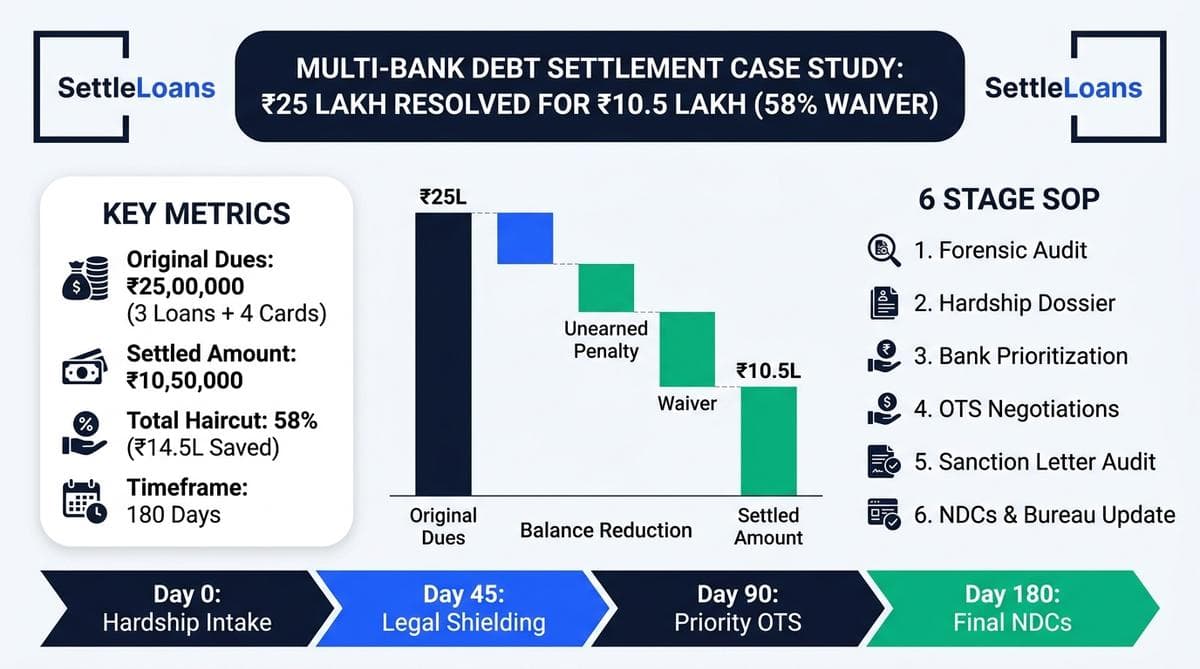
Visual Multi-Bank Resolution Blueprint
The visual infographic below details the 180-day multi-lender debt resolution roadmap, illustrating the portfolio liability breakdown, the 58% principal haircut achieved across seven financial institutions, and the chronological progression from initial crisis intake to final zero-balance No Dues Certificates.
6-Stage Prioritization & Settlement SOP
SettleLoans applies a rigorous six-stage standard operating procedure to resolve complex multi-bank debt portfolios systematically and eliminate creditor harassment.
Our financial legal team audits statement ledgers across all personal loans and credit cards, separating disbursed principal from unearned compound interest, late payment levies, and GST charges to establish the precise baseline for credit committee negotiations.
We construct an exhaustive, verifiable hardship dossier documenting medical summaries, employment termination notices, salary cuts, and 12-month bank statements, formally establishing genuine inability to pay and differentiating the borrower from willful defaulters under RBI guidelines.
We rank creditors into strategic negotiation tiers, assigning top priority to aggressive private lenders issuing statutory notices under Section 25 PSSA or Section 138 NI Act, while scheduling patient public sector lenders for secondary settlement rounds.
SettleLoans negotiates directly with the Stressed Assets Resolution Branches and Credit Committees of each institution, bypassing third-party collection agencies to secure substantial principal waivers ranging between 50% and 66% with complete penalty write-offs.
Before any settlement consideration is remitted, our legal desk conducts a strict verification of every bank sanction letter, ensuring official letterhead issuance, authorized officer signatures, complete debt discharge clauses, and explicit commitments for No Dues Certificates.
Settlement funds are deposited exclusively into official bank loan accounts. Following remittance, SettleLoans tracks statutory 30-day compliance under RBI Circular RBI/2023-24/60, securing formal No Dues Certificates and verifying credit bureau balance updates.
Statutory Notice Defense & Borrower Protections
When multiple loan defaults occur, borrowers often receive intimidating legal notices citing electronic mandate bounces and cheque dishonor. Genuine inability to service unsecured credit is strictly a civil breach of contract under the Indian Contract Act, 1872, rather than a criminal offense.
To: The Authorized Officer / Legal Counsel
Subject: Formal Reply to Notice under Sec 25 PSSA / Sec 138 NI Act
Account: Defaulted Credit Facility // Multi-Bank Stressed Portfolio

1. REBUTTAL OF MENS REA: Dishonor of automated NACH mandates occurred
   solely due to acute financial hardship and verified medical distress,
   negating any fraudulent intent or criminal mens rea.
2. CIVIL DISPUTE JURISDICTION: The underlying transaction is strictly an
   unsecured commercial credit facility governed by Indian Contract Act, 1872.
3. UNILATERAL ARBITRATION BARRED: Unilateral appointment of sole arbitrators
   is legally void ab initio pursuant to Supreme Court rulings in TRF Ltd. v.
   Energo Engg (2017) and Perkins Eastman Architects v. HSCC (2020).
4. COMPROMISE OTS INITIATION: Notice recipient hereby submits a formal
   hardship dossier requesting One-Time Settlement under RBI IRACP Framework.
Under landmark Supreme Court precedents including Perkins Eastman Architects v. HSCC (2020) and TRF Ltd. v. Energo Engineering (2017), lenders are legally barred from unilaterally appointing sole arbitrators to adjudicate loan defaults. In parallel, the RBI Master Directions on Recovery Agents (2022) provide enforceable statutory protections prohibiting recovery agent visits to borrower workplaces, restricting communication strictly between 08:00 AM and 07:00 PM, and prohibiting abusive behavior, threats, or harassment of family members, friends, and employers.
3-Tier Grievance & Ombudsman Escalation Matrix
When lenders or recovery agencies violate fair practices codes, borrowers must execute a structured three-tier administrative grievance escalation.
Tier 1: Bank Grievance Redressal Officer (GRO) // Resolution Window: 7 to 10 Days
A formal written complaint is lodged with the bank's GRO detailing unlawful recovery conduct, requiring statutory acknowledgment within 48 hours and written resolution within 10 days.
Tier 2: Principal Nodal Officer (PNO) // Resolution Window: 14 to 21 Days
If the GRO fails to resolve the grievance or harassment persists, the complaint is escalated to the PNO for executive intervention and collection agency de-escalation.
Tier 3: RBI Integrated Ombudsman // Portal: cms.rbi.org.in
Unresolved grievances are escalated to the RBI Ombudsman, which holds authority to penalize non-compliant lenders, award harassment compensation, and mandate compromise resolution.
Chronological 180-Day Resolution Timeline
The table below outlines the 180-day procedural milestone progression executed to resolve all seven defaulted facilities systematically.
| Phase & Period | Portfolio Status | Strategic Actions Executed | Key Deliverables |
|---|---|---|---|
| Month 1 (Days 1-30) | SMA-0/1 Active Defaults | Crisis intake, legal representation notices served to all 7 banks. | Harassment halted completely |
| Month 2 (Days 31-60) | SMA-2 to Substandard NPA | Hardship dossiers submitted; forensic debt audits completed. | Prioritized settlement matrix |
| Month 3 (Days 61-90) | NPA Provisioning Window | Phase 1 OTS negotiated for aggressive cards & primary loan. | 4 Sanction Letters Sanctioned |
| Month 4 (Days 91-120) | Tranche 1 Remittance | Phase 1 funds paid; Phase 2 talks opened with remaining 3 banks. | First 4 NDCs received |
| Month 5 (Days 121-150) | Phase 2 OTS Approval | Credit committees approve final 3 OTS sanction letters. | Final 3 Sanction Letters audited |
| Month 6 (Days 151-180) | Full Portfolio Closure | Final payments remitted; bureau updates tracked for zero balance. | 100% Debt Free // 7 NDCs |
Specialized Multi-Lender Case Scenarios
Multi-bank resolution strategies must adapt to the unique collection behaviors and provisioning policies of different lender categories.
Private Bank vs PSU Lender Sequencing
Aggressive private banks utilize automated notice engines and require prompt settlement, while public sector lenders follow structured compromise policies, allowing borrowers to defer PSU negotiations safely.
High-APR Credit Card Cascade Post-Layoff
Credit card balances compound rapidly at 42% APR following job loss. SettleLoans freezes penalty growth through formal hardship representation and settles cards at 35% to 45% of claimed dues.
NBFC Digital Loan App Shielding
Digital lenders using aggressive phone tactics are countered through RBI Digital Lending Guidelines and IT Act notices, compelling them to negotiate exclusively through official dispute channels.
ARC Debt Assignment Resolution
When lenders assign written-off retail loans to Asset Reconstruction Companies at steep portfolio discounts, SettleLoans leverages this low acquisition cost to secure substantial debt waivers.

Settle Loan is India's trusted debt relief and loan settlement platform. We help borrowers overcome financial distress by negotiating with banks and NBFCs to legally settle personal loans and credit card debts. With our transparent, performance-based approach, you can achieve debt freedom and regain your financial peace of mind.
COMPUTER
Frequently Asked Questions on Multi-Bank Debt Settlement
Below are authoritative legal and financial answers to the most pressing questions concerning multi-bank loan defaults, recovery agent harassment, and One-Time Settlement execution in India.
Yes. Borrowers facing genuine financial distress can settle multiple unsecured loans and credit cards across different banks. Each lender operates an independent Credit Committee, allowing SettleLoans to negotiate bilateral One-Time Settlements (OTS) sequentially.
The borrower had 3 personal loans and 4 credit cards totaling ₹25 Lakhs. SettleLoans audited the ledgers, isolated unearned penalties, and negotiated bilateral OTS sanction letters across all 7 lenders, achieving a 58% waiver.
We prioritize aggressive private lenders issuing statutory notices under Section 25 PSSA or Section 138 NI Act, followed by 42% APR revolving cards, while deferring patient public sector banks with slower provisioning cycles.
Defaulted borrowers cannot qualify for institutional consolidation loans due to low CIBIL scores. Taking high-interest unregulated loans to pay existing EMIs creates an unsustainable debt spiral that accelerates financial insolvency.
Lenders cannot initiate criminal cases for genuine civil loan default. However, bounced mandates trigger Section 25 PSSA or Section 138 NI Act notices, which our legal team defends while initiating formal OTS compromise talks.
Under RBI recovery directions, agents cannot visit workplaces, call outside 08:00 AM to 07:00 PM, or contact relatives. Borrowers can issue legal cease-and-desist notices to bank Nodal Officers and escalate to the RBI Ombudsman.
Settlement is executed in tranches. Receptive lenders offering 50% to 65% waivers are paid first to secure closure. Reluctant lenders are engaged in secondary rounds as aging NPA provisioning compels committee approvals.
Verify official bank letterhead, authorized officer credentials, exact settlement amount, full waiver of balance principal and penal interest, commitment to issue a No Dues Certificate, and withdrawal of all legal proceedings.
Accounts are marked 'Settled' with ₹0 balances, halting ongoing default reporting. Borrowers can rebuild their CIBIL score back to 750+ within 18 to 24 months using secured credit cards and maintaining disciplined utilization.
Under RBI Circular RBI/2023-24/60, all banks and NBFCs must issue the formal No Dues Certificate and update credit bureaus within 30 calendar days. Delays beyond 30 days attract statutory compensation of ₹5,000 per day.