1. ₹8 Lakh Crisis: Layoff Shock & Default Genesis
In November 2024, Rahul Sharma, a 34-year-old senior software QA specialist based in Bengaluru, secured an unsecured personal loan of ₹8,00,000 from HDFC Bank Limited to finance an urgent family medical contingency. The loan agreement stipulated a tenure of 48 months at an interest rate of 13.75% per annum, translating into a fixed equated monthly installment (EMI) of ₹21,780. For fourteen consecutive months, Rahul maintained a pristine repayment track record, crediting payments promptly through automated National Automated Clearing House (NACH) debits linked to his salary account.
In January 2026, Rahul's employer—a venture-funded enterprise SaaS firm—underwent abrupt corporate restructuring, eliminating 35% of its engineering workforce. Rahul received four weeks of basic severance compensation and found himself abruptly stripped of regular monthly cash inflows in an increasingly constrained IT hiring market. While he managed to service two additional EMIs using his residual emergency reserves, by April 2026 his liquid savings were entirely depleted.
When the May 2026 NACH mandate was presented against his account, it bounced due to insufficient funds, triggering a cascade of institutional actions. Within 90 days of continuous non-payment, the loan transitioned through Special Mention Account stages (SMA-0, SMA-1, and SMA-2) and was formally classified as a Non-Performing Asset (NPA) under Reserve Bank of India prudential asset classification norms. Accruing default interest rates, late payment levies, and bounce penalties rapidly inflated the total outstanding ledger claim to ₹8,42,000.
Personal loan defaults arising from involuntary income destruction are among the most common triggers of retail banking distress in India. Lenders initially deploy automated tele-collections, but once an account crosses 90 days into NPA classification, balance-sheet provisioning mandates create institutional willingness to discuss compromise solutions.
2. Behind HDFC Bank's Ledger: NPA Provisioning & Balance Sheet Mechanics
To understand why India's largest private sector lender agreed to forgive ₹4.8 Lakhs of principal and 100% of accumulated penal charges, one must analyze HDFC Bank's regulatory accounting obligations under the Reserve Bank of India (Prudential Norms on Income Recognition, Asset Classification and Provisioning pertaining to Advances) Directions.
Unlike secured housing loans or auto loans backed by mortgaged title deeds or hypothecated vehicles, unsecured personal loans carry zero underlying physical collateral. When an unsecured personal loan defaults beyond 90 days, commercial banks cannot initiate summary attachment proceedings under the SARFAESI Act, 2002. Instead, the bank is legally compelled to set aside substantial regulatory capital from its operating profits as provisioning coverage against potential credit losses.
The regulatory provisioning requirements escalate steeply based on the delinquency lifecycle:
| Delinquency Bucket | Days Past Due (DPD) | Asset Classification | Mandatory RBI Provision |
|---|---|---|---|
| SMA-0 to SMA-2 | 1 – 89 Days | Standard (Stressed) | 0.40% – 5.00% General Provision |
| NPA Stage 1 | 90 – 365 Days | Substandard Asset (Unsecured) | 25.00% Specific Provision |
| NPA Stage 2 (D1) | 12 – 24 Months | Doubtful Asset Grade 1 | 100.00% of Unsecured Portion |
| Loss / Technical Write-off | 24+ Months | Loss Asset (AUCA Ledger) | 100.00% Fully Written Off |
As Rahul's loan crossed 120 days of default, HDFC Bank was already forced to lock up significant regulatory capital to provision against the asset. In banking accounting, an uncollected NPA continuously depresses the bank's Capital Adequacy Ratio (CAR) and Return on Assets (ROA). Consequently, recovering ₹3.2 Lakhs of clear, unencumbered liquidity via an upfront compromise settlement allows the bank to reverse ₹2.0+ Lakhs of provisions straight back into operating profitability.
Check Your Loan Settlement Options
Answer 2 quick questions to evaluate your settlement eligibility.
1. What type of loan do you want to settle?
3. The Financial Dossier: Hardship Documentation & NPV Recovery Formula
Banks do not grant massive loan waivers out of benevolence. Under HDFC Bank's internal Board-approved Compromise Settlement Policy, debt haircuts are strictly conditional upon empirical proof of financial distress and rigorous mathematical evaluation. The bank must establish that the borrower is not a 'willful defaulter' possessing hidden liquid resources or unencumbered assets.
SettleLoans conducted a forensic review of Rahul's financial reality and assembled a comprehensive Hardship Resolution Dossier containing five non-negotiable evidential pillars:
First, the official corporate termination notice and human resources redundancy letter clearly demonstrating non-fault, involuntary separation. Second, certified 12-month bank account statements across all operational accounts confirming the immediate cessation of salary credits and depletion of savings balances. Third, an exhaustive household living expense balance sheet detailing non-discretionary commitments, including house rent, dependent healthcare, and basic subsistence expenses. Fourth, verified CIBIL credit reports demonstrating that Rahul had not taken fresh credit cards or loans elsewhere during the default phase. Fifth, an unencumbered asset affidavit affirming zero ownership of commercial real estate, mutual fund portfolios, or equity holdings.
With the hardship dossier established, SettleLoans modeled the case using HDFC Bank's internal Net Present Value (NPV) Recovery Formula:
Where C_t represents estimated future recovery cash flows, r is the bank's weighted average cost of capital (WACC), and deductions account for 3–5 years of civil litigation expenses, advocate retainers, and court execution friction.
SettleLoans demonstrated to the HDFC Zonal Credit Committee that pursuing civil litigation against an unemployed software engineer with zero attachable fixed assets would yield an estimated NPV of less than ₹2.4 Lakhs after factoring in 48 months of court delays and advocate fees. By contrast, a structured lump-sum One-Time Settlement of ₹3.2 Lakhs provided HDFC Bank with superior immediate real-time capital recovery.
4. Cease-and-Desist Defense: Countering Aggressive Recovery & Legal Notices
Prior to engaging professional representation, Rahul endured acute psychological distress caused by aggressive third-party collection agencies empaneled by HDFC Bank. Field agents made unannounced visits to his residential apartment complex, contacted former colleagues listed as alternate references, and placed dozens of harassing phone calls daily outside statutory calling hours.
Furthermore, HDFC's collection department served Rahul with a formal legal demand notice under Section 25 of the Payment and Settlement Systems Act, 2007 (PSSA), alleging quasi-criminal liability for the electronic NACH mandate dishonour, alongside a notice under Section 138 of the Negotiable Instruments Act, 1881.
SettleLoans executed an immediate dual-track legal containment strategy:
First, our legal team issued an immediate Cease-and-Desist Legal Notice to HDFC Bank's Principal Nodal Officer (PNO) and the Chief Operating Officer of the collection division, invoking the RBI Master Directions on Recovery Agents and Fair Practices Code (2022). The notice documented specific violations, including calls before 08:00 AM, third-party reference intimidation, and workplace intrusion threats. Within 48 hours of service, all third-party agency calls were halted, and communication was redirected strictly to our designated legal conciliation desk.
Second, our advocates filed a formal, comprehensive reply to the Section 25 PSSA and Section 138 NI Act notices within the statutory 15-day window. The reply established lack of mens rea (criminal intent), documented involuntary employment termination, and formally placed on record Rahul's willingness to arrive at an amicable compromise settlement under the RBI Framework for Compromise Settlements.
6. The Settlement Table: Negotiating the 60% Haircut with HDFC SARB Committee
Negotiating an authentic debt settlement with HDFC Bank requires direct engagement with authorized decision-makers. Front-line branch managers and collection agency tele-callers possess zero statutory power under HDFC's Delegation of Financial Powers (DoFP) matrix to sanction principal waivers.
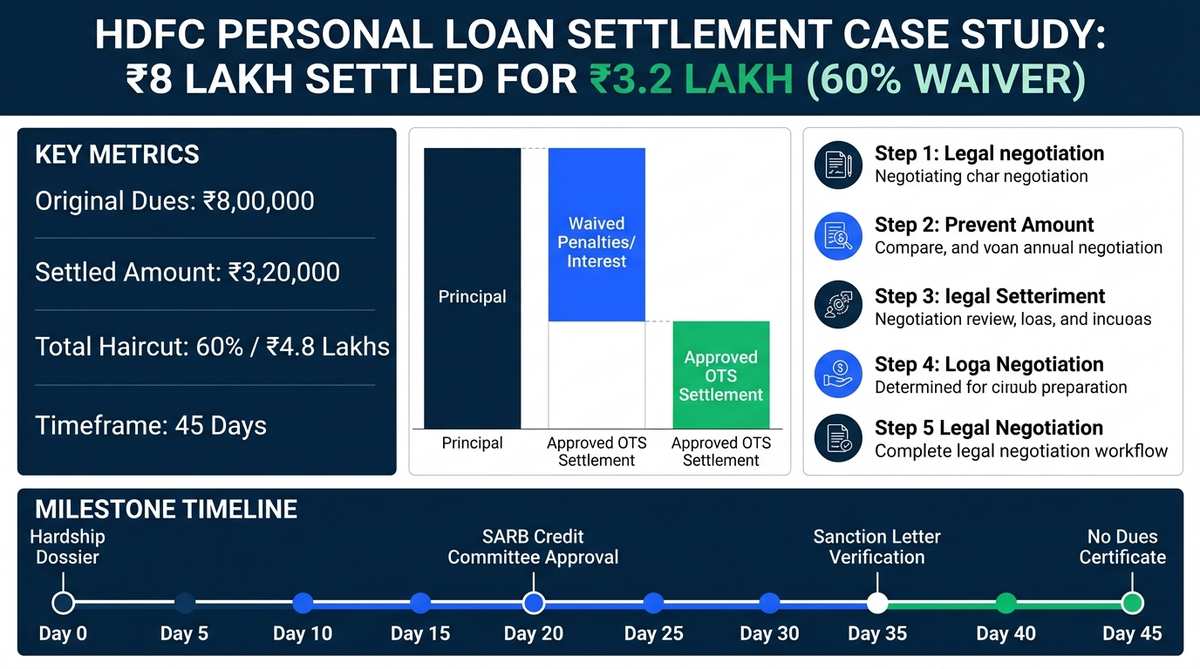
SettleLoans submitted the formal OTS proposal directly to the Stressed Assets Resolution Branch (SARB) and the Regional Credit Committee at HDFC Bank's Zonal Office. The negotiation proceeded across three structured rounds:
In Round 1, HDFC SARB responded with an initial counter-offer of ₹6,50,000, proposing to waive penal interest and bounce levies while demanding 100% of the core principal. SettleLoans countered in Round 2 by presenting verified affidavits of Rahul's zero liquid wealth and an upfront commitment from a supportive family member willing to arrange exactly ₹3,00,000 as a final gift if the loan was closed immediately.
In Round 3, following an internal risk committee evaluation of the NPV model, HDFC Bank issued a final compromise settlement sanction of ₹3,20,000, representing a net 60.0% principal haircut and total waiver of ₹5,22,000 across principal and accumulated interest.
| Financial Ledger Component | Claimed Bank Dues | Approved Settlement Amount | Total Waiver / Haircut |
|---|---|---|---|
| Core Principal Balance | ₹8,00,000 | ₹3,20,000 | ₹4,80,000 (60.0% Haircut) |
| Accrued Regular Interest | ₹64,500 | ₹0 | ₹64,500 (100% Waived) |
| Penal Interest & Overdue Charges | ₹48,200 | ₹0 | ₹48,200 (100% Waived) |
| NACH Bounce Penalties & Legal Fees | ₹29,300 | ₹0 | ₹29,300 (100% Waived) |
| Total Outstanding Claim | ₹9,42,000 | ₹3,20,000 Payable | ₹6,22,000 Total Relief (66.0%) |
7. Sanction Letter Forensics: 5 Critical Clauses & Safe Payment Protocol
Before remitting a single rupee, SettleLoans conducted a stringent forensic legal audit of the compromise document provided by HDFC Bank. Over 30% of self-negotiated settlements collapse or lead to fraud because borrowers make payments based on verbal promises or unofficial letters issued by unauthorized collection agency personnel.
Our legal team verified five mandatory institutional checkpoints in Rahul's sanction letter:
First, the document was printed on authentic, security-marked HDFC Bank Limited letterhead featuring the bank's corporate identification number (CIN), branch office seal, and the official signature and employee code of an authorized Assistant Vice President (AVP). Second, the letter explicitly specified the exact loan account number and declared ₹3,20,000 as the full, final, and absolute settlement of all claims. Third, it contained a clear debt extinguishment clause confirming that upon receipt of ₹3,20,000, all residual principal and interest balances would be 100% written off. Fourth, the letter committed HDFC Bank to withdraw all pending legal notices under Section 25 PSSA and Section 138 NI Act within 30 days. Fifth, it established a 15-day payment window with zero deferred penalty clauses.
Following verification, the payment was executed strictly through a direct Real Time Gross Settlement (RTGS) transfer directly into Rahul's specific HDFC Loan Account Number, ensuring complete traceability and eliminating any intermediary risk.
8. The ₹0 No Dues Certificate & 24-Month CIBIL Score Reconstruction
Under RBI Circular RBI/2023-24/60 (Release of Movable/Immovable Property Documents and Issue of No Dues Certificate on Repayment/Settlement of Personal Loans), regulated lenders must issue a formal No Dues Certificate (NDC) and update credit information companies (CICs) within 30 calendar days of final settlement payment.
On Day 24 following the RTGS payment, HDFC Bank formally issued the stamped, digital No Dues Certificate, certifying that the loan account was closed with a total outstanding balance of ₹0.00.
As expected under standard banking reporting guidelines, HDFC Bank submitted the account status to TransUnion CIBIL, Experian, Equifax, and CRIF High Mark as 'Settled' with an outstanding amount of ₹0. Rahul's CIBIL score initially dipped from 710 (pre-default) to 585 during default, stabilizing at 615 upon settlement recording.
SettleLoans provided Rahul with an actionable, structured 24-month credit rehabilitation blueprint:
First, opening a fixed-deposit-backed secured credit card with a ₹50,000 limit, maintaining monthly credit utilization strictly under 25%. Second, ensuring 100% on-time automated repayments across all utility bills and secured card statements. Third, avoiding all fresh unsecured loan applications during the mandatory 12-month cooling period stipulated by the RBI compromise framework. Within 18 months of disciplined credit management, Rahul successfully elevated his CIBIL score back to 768, regaining full prime borrower status.
9. Comparative Resolution Avenues: OTS Settlement vs. Litigation vs. Lok Adalat
When faced with insurmountable personal loan debt, borrowers must evaluate the strategic trade-offs across available institutional resolution mechanisms in India:
| Resolution Avenue | Average Resolution Time | Haircut / Waiver Scope | Legal Finality | Psychological Stress |
|---|---|---|---|---|
| Direct SARB One-Time Settlement (OTS) | 30 – 60 Days | 40% – 65% Waiver | Absolute (Bank Stamped NDC) | Low (Instant Cease & Desist) |
| National Lok Adalat Settlement | 60 – 120 Days (Quarterly) | 40% – 60% Waiver | Civil Court Decree (No Appeal) | Moderate |
| Contested Civil Court / DRT Litigation | 3 – 6 Years | 0% – Minimal (Court Decided) | Subject to Multiple Appeals | Severe (High Legal Costs) |
| Loan Restructuring / Tenure Extension | 15 – 30 Days | 0% Haircut (Increased Interest) | Active Debt Obligation | High (Long-Term EMI Burden) |
As demonstrated in Rahul's case study, a structured One-Time Settlement executed directly with HDFC Bank's Stressed Assets Resolution Branch represents the fastest, most cost-effective, and legally conclusive pathway to complete financial liberation.

Settle Loan is India's trusted debt relief and loan settlement platform. We help borrowers overcome financial distress by negotiating with banks and NBFCs to legally settle personal loans and credit card debts. With our transparent, performance-based approach, you can achieve debt freedom and regain your financial peace of mind.
COMPUTER
Everything You Need to Know About HDFC Loan Settlements
Clear, authoritative legal answers regarding HDFC Bank personal loan settlements, debt haircuts, recovery rights, and credit repair.
Yes. HDFC Bank regularly sanctions One-Time Settlements (OTS) with haircuts ranging between 50% and 65% for unsecured personal loans, Jumbo loans, and credit cards when genuine, verifiable hardship is established. When an account enters deep default (NPA Substandard or Doubtful D1/D2) and the bank has absorbed substantial balance-sheet provisioning, the Stressed Assets Resolution Group (SARB) calculates that recovering a lump-sum OTS amount yields a higher Net Present Value (NPV) than costly, uncertain civil litigation.
The borrower experienced sudden job loss and could no longer pay the ₹24,500 monthly EMI. After the loan crossed 90 days into NPA status, SettleLoans compiled a comprehensive hardship dossier comprising the corporate termination letter, severance records, and bank statements showing zero income. SettleLoans bypassed third-party collection agents to negotiate directly with HDFC's Stressed Assets Resolution Branch, securing a 60% principal discount (₹3.2 Lakhs) and 100% waiver of accrued penal interest and late fees.
To secure approval from HDFC's Competent Credit Committee, the borrower must prove genuine inability to repay rather than willful default. Standard hardship documentation includes: (1) Official employer termination letter or pink slip; (2) Bank account statements for 6 to 12 months reflecting absence of regular salary inflows; (3) Medical diagnostic reports and hospital discharge summaries if illness caused the default; (4) Proof of business closure or revenue collapse for self-employed individuals; (5) An audited statement of monthly living expenses.
HDFC Bank evaluates OTS proposals using a Net Present Value (NPV) recovery formula. The Credit Committee compares the immediate cash inflow from the proposed settlement against the present discounted value of potential future legal recoveries minus litigation expenses, advocate fees, court execution delays (typically 3–5 years in Indian civil courts), and the cost of provisioning capital locked up against the NPA.
Under the RBI Master Directions on Recovery Agents (2022) and the Fair Practices Code, collection agents are legally prohibited from calling outside 08:00 AM to 07:00 PM, visiting workplaces without consent, using abusive language, or contacting friends, relatives, and colleagues. Borrowers can serve a formal legal cease-and-desist notice to HDFC Bank's Principal Nodal Officer (PNO) and file a complaint on the RBI Integrated Ombudsman portal (cms.rbi.org.in).
No. Personal loan default is strictly a civil breach of contract under the Indian Contract Act, 1872. The police cannot register an FIR, summon you, or make an arrest for financial inability to service an unsecured loan. However, if an EMI repayment cheque bounces or a NACH mandate fails, the bank may issue statutory legal notices under Section 138 of the Negotiable Instruments Act, 1881, or Section 25 of the Payment and Settlement Systems Act, 2007, which can be settled and closed through proper legal representation.
Before depositing any settlement funds, ensure: (1) The letter is on official HDFC Bank letterhead with a physical stamp or verifiable digital signature and employee code; (2) The document explicitly mentions the exact settlement amount (e.g., ₹3,20,000) as full and final discharge; (3) It contains a clear clause confirming 100% waiver of balance principal, penal interest, and legal charges; (4) It commits to issuing a No Dues Certificate (NDC) and closing all pending legal proceedings; (5) Payment is made directly into your HDFC loan account, never to an individual or collection agency.
Following settlement, HDFC Bank updates credit bureaus with a 'Settled' or 'Post-Write-off Settled' remark and an outstanding balance of ₹0. This causes an initial drop of 75 to 150 points in the CIBIL score. However, because the loan is closed and active default accumulation stops, borrowers can systematically rehabilitate their credit score back to 750+ within 18 to 24 months by using a secured fixed-deposit credit card, maintaining credit utilization under 30%, and ensuring zero missed payments.
Under RBI Circular RBI/2023-24/60, all regulated commercial banks including HDFC Bank are required to issue the formal No Dues Certificate (NDC) / Loan Closure Certificate and update credit bureau records within 30 calendar days of receiving the full settlement amount. Lenders failing to comply within 30 days are liable to pay statutory compensation of ₹5,000 per day of delay to the borrower.
Official Statutory Authorities & Regulatory Frameworks
- Reserve Bank of India (RBI): Prudential Framework for Resolution of Stressed Assets & Compromise Settlement Directives
- RBI Master Direction: Guidelines on Fair Practices Code and Outsourcing of Financial Services / Recovery Agents
- HDFC Bank Limited: Grievance Redressal Policy & Principal Nodal Officer (PNO) Escalation Matrix
- Reserve Bank - Integrated Ombudsman Scheme, 2021: Dispute Redressal Portal for OTS Non-Compliance, Coercive Recovery & NDC Delays
- National Legal Services Authority (NALSA): Legal Services Authorities Act, 1987 — National Lok Adalat Conciliation Framework