1. The Multi-Debt Landscape: Consolidation vs. Settlement Defined
Managing multiple unsecured debts—such as three credit cards running near maximum limits, two personal loans from private banks, and instant digital credit lines from fintech NBFCs—is one of the most stressful financial situations an individual can experience in India. With staggered due dates, compounding interest charges (ranging from 14% on personal loans to 42%–48% annualized on credit cards), and punitive bounce fees, monthly repayments quickly spiral out of control.
When cash flows tighten, borrowers are invariably presented with two competing financial planning pathways: Debt Consolidation and Personal Loan Settlement. While both claim to solve debt distress, they operate on completely opposite financial, legal, and credit architectures.
Combining multiple high-interest debts into one single, lower-interest installment with 100% principal repayment.
- Operating Mechanism: Borrowing a new, larger loan (or top-up mortgage) to pay off existing creditors in full.
- Total Repayment: 100% Principal + Total Accrued Interest. Zero debt forgiveness.
- Prerequisites: Excellent CIBIL score (750+), stable verifiable income, and low FOIR (<50%).
- CIBIL Bureau Remark: Accounts marked as "Closed - Regular"; credit score preserved and elevated.
Negotiating legal compromise agreements with lenders to extinguish debts via 40%–70% principal & interest waivers.
- Operating Mechanism: Legal advocates represent hardship under RBI directives to secure one-time lump sum payoffs.
- Total Repayment: 30% to 60% of Total Dues. 40%–70% of accumulated balance permanently waived.
- Prerequisites: Demonstrable financial insolvency (job loss, business closure, medical crisis, or severe cash crunch).
- CIBIL Bureau Remark: Account closed with "Settled" remark and ₹0 balance; rebuilt over 18–24 months.
In-Depth Architectural Matrix: Debt Consolidation vs. Loan Settlement
| Strategic Parameter | Debt Consolidation Loan | One-Time Loan Settlement (OTS) |
|---|---|---|
| Primary Objective | Streamline multiple payments into 1 EMI & reduce interest rate | Slash total outstanding liability and extinguish debt permanently |
| Principal Debt Reduction | ₹0 (Zero Discount) — 100% Principal Repaid | 40% to 70% Direct Principal & Interest Haircut |
| Minimum CIBIL Score Needed | 750+ with pristine repayment history | No minimum score (Works for 300–650 scores) |
| Default Status Requirement | Must be regular (0 DPD; no missed EMIs) | Delinquent, Stressed SMA, or NPA (30+ to 90+ DPD) |
| Repayment Duration | Extended over 36 to 60 new monthly installments | 1 to 3 structured payments completed in 30–60 days |
| Immediate CIBIL Impact | Neutral to positive (+20 to +50 pts over time) | Temporary drop (-75 to -150 pts) |
| Long-Term Credit Rebuilding | Instant creditworthiness for future home/car loans | Rebuilt to 750+ in 18–24 months via secured credit cards |
| Total Capital Outgo | High (Compounded interest on new tenure) | Extremely Low (Substantial cash savings) |
| Legal Recourse & Finality | Re-default triggers immediate fresh recovery lawsuits | Permanent discharge with ₹0 NDC; all court notices quashed |
| Ideal Candidate Profile | High-earning borrower with temporary cash-flow mismatch | Insolvent borrower trapped in unmanageable debt load |
2. Financial Math: Cost Comparison & Loan Simulation
To understand why debt consolidation often fails stressed borrowers while debt settlement creates immediate solvency, let us analyze a real-world multi-debt scenario in India.
Consider a salaried professional earning ₹85,000 net monthly, carrying an aggregate debt portfolio of ₹15,00,000 distributed across four unsecured creditors:
HDFC Personal Loan
Outstanding: ₹6,00,000
Rate: 15% p.a. | EMI: ₹16,650
ICICI Personal Loan
Outstanding: ₹4,00,000
Rate: 16% p.a. | EMI: ₹11,350
SBI Credit Card
Outstanding: ₹3,00,000
Rate: 42% p.a. | Min Due: ₹15,000
Fintech NBFC Credit Line
Outstanding: ₹2,00,000
Rate: 24% p.a. | EMI: ₹8,800
Total Baseline Situation: Total Outstanding: ₹15,00,000 | Cumulative Monthly Outflow: ₹51,800 (Representing 61% FOIR of monthly income).
3-Way Strategy Simulation: Minimum Dues vs. Consolidation vs. OTS Settlement
| Financial Metric | Path A: Minimum Dues & Rollover | Path B: 5-Year Debt Consolidation Loan | Path C: SettleLoans Negotiated OTS |
|---|---|---|---|
| Target Interest Rate | 28% Weighted Average | 13.5% p.a. (Prime Rate) | 0% (All Interest Frozen & Waived) |
| New Monthly Obligation | ₹51,800 / month (Perpetual) | ₹34,500 / month (60 Months) | ₹0 monthly EMI after settlement |
| Principal Repaid | ₹15,00,000 (Over 10+ Years) | ₹15,00,000 (100% Repaid) | ₹6,75,000 (55% Overall Haircut) |
| Total Interest Outgo | ₹14,20,000+ | ₹5,70,000 | ₹0 (100% Waived) |
| Total Lifetime Capital Paid | ₹29,20,000+ | ₹20,70,000 | ₹6,75,000 |
| Net Borrower Cash Savings | Base Default Trap | ₹0 Savings (Cost: +₹5.7 Lakhs) | ₹13,95,000 Direct Cash Savings |
| Debt Freedom Timeline | Never (Insolvency) | 5 Long Years (60 Months) | 45 to 60 Days Complete Discharge |
The Financial Planner's Core Insight
While a consolidation loan lowers your monthly cash burden from ₹51,800 to ₹34,500, it commits you to paying ₹20,70,000 in total outgo over 5 years. If your income has shrunk or is unstable, servicing ₹34,500 every single month for 60 consecutive months carries an enormous risk of secondary default. In contrast, an OTS settlement locks in ₹13.95 Lakhs in hard capital savings and permanently eliminates the debt in 45–60 days.
Check Your Loan Settlement Options
Answer 2 quick questions to evaluate your settlement eligibility.
1. What type of loan do you want to settle?
3. CIBIL Mechanics: Status Codes & Score Trajectory
In India's regulated credit ecosystem, licensed credit information companies (CIBIL, Experian, Equifax, and CRIF High Mark) operate under the Credit Information Companies (Regulation) Act, 2005 (CICRA). Lenders update loan records on the 10th of every month using standardized bureau reporting tags.
Understanding how automated bank algorithms interpret these status flags is critical when planning your financial recovery:
1. "Closed - Regular / Fully Paid" (Consolidation Outcome)
When you consolidate debts, the new loan disburses funds directly to old lenders. Each old credit card and personal loan account is marked as "Closed - Regular" with zero overdue history.
Bureau Impact: Credit score increases rapidly (+30 to +60 points within 6 months) as your revolving credit utilization drops to 0% and on-time EMI reporting begins on the new consolidation loan.
2. "Settled" Status Tag (One-Time Settlement Outcome)
In a One-Time Settlement, the account is permanently terminated with a ₹0 active balance. The credit bureau records the compromised haircut in the settlement column and flags the account as "Settled".
Bureau Impact: Immediate -75 to -150 points dip. Automated unsecured loan algorithms will decline fresh credit cards for 12–18 months. However, the score can be systematically rebuilt to 750+ within 18–24 months using secured credit cards, and you hold zero pending liability.
3. "Written Off" / "Suit Filed" (The Danger of Indecision)
Occurs when a borrower ignores unpaid debts without choosing consolidation or settlement. The bank flags the accounts as "Written Off - Wilful Default / Suit Filed" and initiates legal recovery under Section 138 / DRT.
Bureau Impact: Complete credit destruction (-250 to -350 points), perpetual DPD 180+ reporting, total blacklisting across all Indian financial institutions, and ongoing court summons.
36-Month CIBIL Score Trajectory Comparison
| Timeline Milestone | Path 1: Debt Consolidation (Clean Repayments) | Path 2: One-Time Settlement (With Rebuild Plan) | Path 3: Unsettled Default (Ignored Notices) |
|---|---|---|---|
| Month 0 (Execution) | 740 → 730 (-10 pts inquiry) | 680 → 570 (-110 pts) | 680 → 520 (-160 pts) |
| Month 6 | 765 (Low CUR Boost) | 615 (Secured Card Active) | 480 (DPD 180+ Accrual) |
| Month 12 | 785+ (Prime Tier Credit) | 690 – 715 (Disciplined CUR <20%) | Sub-450 (Total Blacklist) |
| Month 24 | 810+ (Home Loan Sanction Ready) | 750 – 765 (Fully Restored) | Legal Court Summons / DRT |
| Month 36 | 825+ (Pristine Profile) | 780+ (Eligible for Unsecured Cards) | Asset Attachment / Salary Garnishment |
4. Bank Eligibility, FOIR Calculations & Underwriting Barriers
While debt consolidation sounds attractive in theory, the vast majority of financially distressed borrowers in India are legally and mathematically disqualified from obtaining a consolidation loan.
Indian commercial banks employ rigid credit risk scorecards centered around the Fixed Obligation to Income Ratio (FOIR):
The 50% Hard Barrier: RBI prudential underwriting guidelines dictate that retail unsecured lending cannot push a borrower's FOIR beyond 50% to 55%. If your current EMIs exceed 50% of your take-home pay, or if your credit score is below 750, bank algorithms reject your consolidation loan instantly without human review.
Consolidation Loan Underwriting Rules
- CIBIL Score: Strictly 750 or higher with zero 30+ DPD history.
- FOIR Limit: Total obligations must remain under 50% of verified salary.
- Income Proof: 6 months salary slips, 1-year bank statements, Form 16 / ITR.
- Employment: Minimum 2 years total work experience with 1 year at current firm.
Loan Settlement (OTS) Eligibility Rules
- CIBIL Score: Any score (300 to 700+). Delinquency is expected.
- Insolvency Proof: Verified job loss, medical bills, salary reduction, or business loss.
- Lump Sum Capacity: Ability to pay 30% to 50% of dues via family or liquid assets.
- Legal Intent: Willingness to execute binding compromise and receive official ₹0 NDC.
Personal Loan Settlement vs Debt Consolidation: Strategic Process Overview
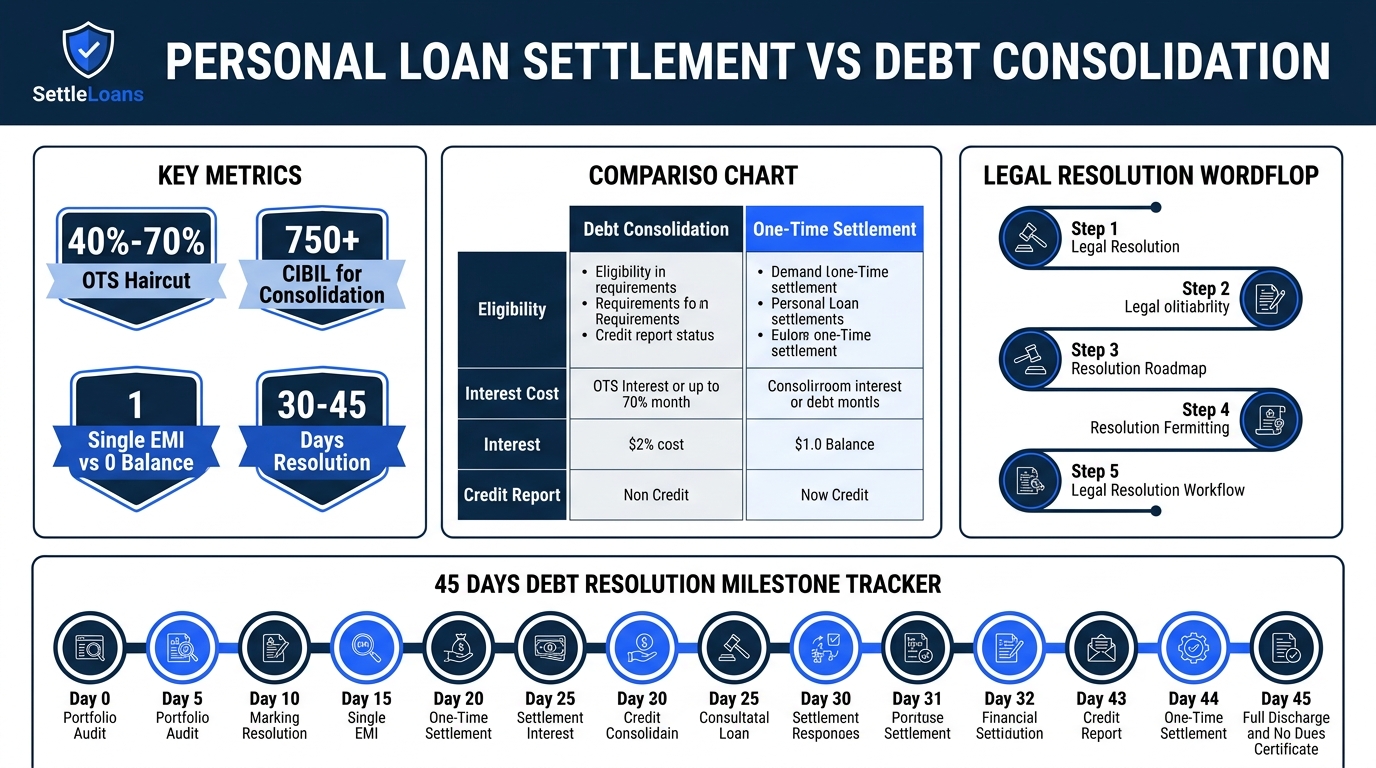
5. The Consolidation Trap vs Strategic Debt Settlement
A critical behavioral finance trap that destroys thousands of Indian middle-class households every year is the Consolidation Trap (also known as Double-Debt Overleveraging).
How the Consolidation Trap Works
A borrower takes a ₹10 Lakh consolidation loan to clear credit cards and smaller personal loans. Because the old credit card lines now show zero balances, the borrower feels a false sense of financial liquidity. When an unexpected emergency strikes, the borrower begins swiping the credit cards again while still burdened with the ₹25,000 monthly consolidation EMI.
How Strategic Debt Settlement Solves the Root Problem
Personal loan settlement permanently severs the cycle of borrowing. Under an OTS agreement, credit lines are canceled, the lender waives 40% to 70% of the dues, and the debt is extinguished permanently with an official ₹0 No Dues Certificate. The borrower enters a clean-slate financial environment with zero recurring monthly EMI liabilities.
6. RBI Regulatory Framework & Legal Protection Under Indian Law
Both debt consolidation and compromise settlements operate within the formal statutory framework established by the Reserve Bank of India. Knowing your rights ensures you cannot be coerced by unauthorized collection agents or predatory lenders.
RBI Framework for Compromise Settlements and Technical Write-offs (June 8, 2023)
Directs all regulated commercial banks, NBFCs, and urban cooperative banks to establish transparent, board-approved policies for executing One-Time Settlements (OTS) with distressed borrowers. It removes arbitrary branch discretion and legitimizes compromise settlements with principal haircuts for genuine hardship cases.
RBI Master Direction on Recovery Agents & Anti-Harassment Safeguards
Strictly bars lenders and third-party recovery agencies from using abusive language, threatening physical intimidation, calling before 8:00 AM or after 7:00 PM, calling friends, relatives, or employers, or visiting workplaces without authorization. SettleLoans advocates issue formal cease-and-desist notices to bank nodal officers to halt unlawful harassment immediately.
Legal Finality: Section 138 NI Act & Lok Adalat Decrees
When personal loan EMIs or NACH mandates bounce, banks may issue legal notices under Section 138 of the Negotiable Instruments Act or Section 25 of the PSS Act. Executing a formal OTS agreement legally compels the lender to withdraw all pending criminal complaints. Furthermore, settlements ratified in Lok Adalats hold the force of a final Civil Court decree with zero right of subsequent appeal.
7. 7-Point Framework: Consolidation vs Settlement
To determine which path is mathematically and legally optimal for your debt profile, evaluate your situation against our 7 diagnostic stress indicators:
| Diagnostic Parameter | Choose Debt Consolidation If: | Choose Loan Settlement (OTS) If: |
|---|---|---|
| 1. Current CIBIL Score | 750 or higher with zero missed EMIs | Below 680, or already showing 30+ DPD |
| 2. Fixed Obligation Ratio (FOIR) | Under 50% of monthly take-home salary | Exceeds 60%–70% of monthly income |
| 3. Income Stability | Stable job with predictable future salary growth | Job loss, salary cut, business loss, or medical shock |
| 4. Monthly Cash Flow | Sufficient surplus to afford single revised EMI | Deficit every month; borrowing to pay existing EMIs |
| 5. Total Debt-to-Annual Income | Total debt is less than 1.5x annual income | Total debt exceeds 2.5x to 3x annual income |
| 6. Future Major Borrowing Need | Planning a home mortgage in next 12–24 months | No major borrowing planned; focus is solvency |
| 7. Primary Financial Priority | Preserve credit rating and streamline payments | Stop legal harassment & eliminate debt liability |
8. Action Blueprints: Executing Either Strategy Safely
Regardless of which pathway matches your diagnostic evaluation, proper legal and administrative execution is critical to avoid costly mistakes.
Consolidation Execution Blueprint
- 1Audit Total Liabilities: Calculate exact outstanding principal, foreclosure charges, and weighted interest rates across all loans.
- 2Shop for Low-Cost Facility: Compare personal loan balance transfers, top-up home loans, or gold loan options to secure minimum interest rates.
- 3Direct Disbursal to Creditors: Instruct the new lender to disburse funds directly to old loan accounts to prevent fund leakage.
- 4Collect Closure Letters: Obtain formal closure certificates from each previous lender and close old credit card accounts.
Legal Settlement (OTS) Blueprint
- 1Legal Hardship Representation: SettleLoans advocates draft and serve formal hardship notices under RBI Fair Practices Code.
- 2Anti-Harassment Shield: Issue cease-and-desist notices to bank nodal officers to stop unauthorized agent calls and visits.
- 3Negotiate 40%–70% Haircuts: Multi-round institutional negotiations with bank Stressed Asset Resolution Branches (SARB).
- 4Official Bank Sanction & ₹0 NDC: Deposit settlement funds directly into your loan account and receive official No Dues Certificates.

Settle Loan is India's trusted debt relief and loan settlement platform. We help borrowers overcome financial distress by negotiating with banks and NBFCs to legally settle personal loans and credit card debts. With our transparent, performance-based approach, you can achieve debt freedom and regain your financial peace of mind.
COMPUTER
9. Frequently Asked Questions: Loan Settlement vs Debt Consolidation
The fundamental distinction lies in full contractual repayment versus debt forgiveness. In Debt Consolidation, you take a single new loan (or balance transfer facility) to pay off all your existing personal loans and credit cards in full. You roll multiple high-interest EMIs into one consolidated monthly installment, repaying 100% of the principal plus interest over an extended tenure. In a Personal Loan Settlement (One-Time Settlement or OTS), you negotiate with lenders through legal advocates to permanently waive 40% to 70% of your total outstanding dues in exchange for a discounted lump-sum compromise, extinguishing the liability completely.
Loan settlement saves significantly more total capital. Under an OTS settlement, 40% to 70% of your accumulated debt is permanently written off by the bank, saving you lakhs of rupees in direct cash outgo. Conversely, debt consolidation does not reduce your borrowed principal by a single rupee. While consolidation may lower your monthly EMI burden and nominal interest rate, paying interest over a new 3 to 5-year tenure actually increases your total lifetime interest outgo.
Major Indian scheduled commercial banks and prime NBFCs (such as HDFC Bank, ICICI Bank, SBI, Axis Bank, and Bajaj Finserv) mandate a minimum CIBIL score of 750 or higher, clean repayment records with zero overdue days (0 DPD), and a Fixed Obligation to Income Ratio (FOIR) strictly below 50%. If you have already missed payments or your score has dropped below 680, institutional underwriting algorithms will reject your consolidation application. In such delinquent scenarios, debt settlement represents the only viable legal remedy.
Debt consolidation initially causes a minor 5 to 15-point drop due to hard credit inquiries, but quickly boosts your CIBIL score above 780 as existing credit cards and high-interest loans are reported as "Closed - Regular" and your credit utilization ratio (CUR) drops below 30%. Loan settlement causes an immediate drop of 75 to 150 points and marks the account as "Settled" with a ₹0 balance. However, by adopting a disciplined secured credit card protocol, your score can be rebuilt back above 750 within 18 to 24 months.
No. Once any of your credit cards or personal loans cross 30+ to 90+ Days Past Due (DPD) or enter Non-Performing Asset (NPA) classification, all formal Tier-1 and Tier-2 lenders in India automatically reject unsecured consolidation loan requests due to severe credit risk flags. At that stage, seeking a new loan is impossible, and negotiating a legal One-Time Settlement (OTS) under RBI guidelines becomes your primary financial option.
The Consolidation Trap is a dangerous financial spiral that occurs when an overleveraged borrower secures a large consolidation loan to clear existing credit lines but fails to address their underlying cash flow deficit. Relieved by temporary EMI reductions, the borrower begins swiping cleared credit cards again while servicing the new massive consolidation EMI. Within 6 to 12 months, the borrower ends up with double the original debt load, triggering catastrophic insolvency.
Yes. Professional debt settlement platforms like SettleLoans represent borrowers with multi-lender exposures across nationalized banks, private banks, NBFCs, and fintech lending apps simultaneously. Our empaneled legal advocates serve formal representation notices, establish legal anti-harassment shields under RBI guidelines, negotiate maximum statutory haircuts (40%–70%), verify authentic OTS sanction letters, and secure ₹0 No Dues Certificates (NDC) across your entire debt portfolio.
Yes. Once your financial situation stabilizes post-settlement, you can approach the original lending institution, pay the previously waived haircut amount (the discount amount), and obtain a Comprehensive Final No Dues Certificate. Upon submitting this certificate, the lender is legally required under CICRA regulations to update your credit record with TransUnion CIBIL, Experian, CRIF High Mark, and Equifax from "Settled" to "Closed - Fully Paid".
Under the RBI Master Direction on Recovery Agents and Fair Practices Code, recovery agents are strictly barred from using abusive language, making threatening phone calls, contacting your employer or relatives, visiting your residence outside 8:00 AM to 7:00 PM, or harassing you in any form. Furthermore, executing a formal One-Time Settlement (OTS) legally compels lenders to withdraw all pending legal notices under Section 138 of the Negotiable Instruments Act or Section 25 of the Payment and Settlement Systems Act upon receipt of settlement proceeds.
Choose Debt Consolidation if: 1) Your CIBIL score is 750+ with zero missed EMIs; 2) Your debt-to-income ratio (FOIR) is under 50%; 3) You can secure an interest rate significantly lower than your current weighted average rate; and 4) You plan to apply for a major mortgage or business loan within the next 1 to 2 years. Choose Personal Loan Settlement if: 1) Your total EMI commitments exceed 60%–70% of your take-home pay; 2) You have experienced severe, permanent income loss or medical crisis; 3) You are already delinquent or in default; and 4) You need immediate, permanent debt elimination.
Statutory References & Official Regulatory Sources
- Reserve Bank of India (RBI): Framework for Compromise Settlements and Technical Write-offs (RBI/2023-24/40 DOR.STR.REC.20/21.04.048/2023-24).
- Reserve Bank of India (RBI): Master Direction on Recovery Agents and Fair Practices Code for Regulated Entities (RBI/2022-23/108).
- Credit Information Companies (Regulation) Act, 2005 (CICRA): Statutory reporting rules for TransUnion CIBIL, Experian, CRIF High Mark, and Equifax.
- Negotiable Instruments Act, 1881: Section 138 statutory defense and legal quashing through compromise settlement.
- Legal Services Authorities Act, 1987: Finality and civil court enforceability of Lok Adalat compromise awards.