1. The ₹5 Lakh Trap: Borrower Profile, Minimum Amount Due
In March 2024, Siddharth Menon, a 32-year-old marketing manager based in Pune, was confronted with an acute domestic emergency when his father required immediate, uncovered cardiac surgery. Lacking immediate liquidity, Siddharth utilized his ICICI Bank Rubyx Credit Card, which carried an approved credit limit of ₹2,50,000, incurring cumulative medical charges of ₹1,80,000. Under ordinary circumstances, Siddharth intended to pay off the entire balance across four consecutive salary cycles.
However, in May 2024, his employer announced corporate salary cuts alongside delayed variable compensation. Unable to service the full ₹1,80,000 statement balance, Siddharth fell into the classic retail banking trap: paying only the monthly Minimum Amount Due (MAD), typically set at 5% of the outstanding balance. For fourteen consecutive months, Siddharth faithfully paid approximately ₹8,500 to ₹10,000 every billing cycle, remitting over ₹1,25,000 in cash to ICICI Bank.
To his utter shock, by July 2025, his total statement balance had not decreased; instead, it had metastasized from ₹1,80,000 to ₹5,00,000. Due to annualized financing charges of 42%, monthly late payment penalties of ₹1,200 per cycle, over-limit fees, and mandatory 18% Goods and Services Tax (GST) compounded on every finance charge, his actual payments had done nothing to reduce the core principal. When Siddharth suffered temporary unemployment in late 2025 and defaulted entirely, the account crossed 90 days past due (DPD) and was classified as a Non-Performing Asset (NPA).
Under standard credit card terms, the Minimum Amount Due is structured solely to keep the account active while maximizing interest capitalization. In an annualized 42% APR environment, paying only MAD guarantees that 90% to 95% of each payment services finance charges and taxes, leaving the underlying principal entirely intact while compounding accelerates exponentially.
2. The Mathematics of Ruin: 42% APR, Monthly Capitalization & 18% GST Cascades
To appreciate how a modest ₹1.8 Lakh principal inflated into a crippling ₹5 Lakh institutional claim, one must examine the specific compounding mathematics embedded in Indian retail credit card contracts. Unlike standard personal loans that calculate simple reducing balance interest, credit card agreements utilize daily or monthly compound interest models under annualized percentage rates ranging from 42% to 45% (3.50% to 3.75% per month).
When a cardholder revolves a balance or misses a due date, the interest-free grace period (20 to 50 days) is instantly revoked retroactively for all transactions from the exact date of purchase. Finance charges are calculated using the formula:
Where unserviced interest and penal charges are capitalized directly into the principal at the end of each billing cycle, generating interest-on-interest compounded with an additional 18% statutory GST surcharge.
The escalation of Siddharth's ledger over eighteen months illustrates this aggressive financial multiplication:
| Timeline Milestone | Principal Base | Compounded Interest (42% APR) | Penalties, GST & Total Claim |
|---|---|---|---|
| Month 1 (Initial Swipe) | ₹1,80,000 | ₹0 (Grace Period) | ₹1,80,000 |
| Month 6 (MAD Servicing) | ₹1,76,000 | ₹44,100 | ₹2,32,400 |
| Month 12 (Revolving Peak) | ₹1,74,000 | ₹1,18,600 | ₹3,45,200 |
| Month 18 (NPA Default Claim) | ₹1,80,000 | ₹2,15,000 | ₹5,00,000 |
Consequently, out of the ₹5,00,000 claimed by ICICI Bank, a staggering ₹3,20,000 (64% of the total claim) consisted entirely of accumulated interest, late fees, and tax surcharges. Recognizing this distortion is the foundational cornerstone of our debt settlement negotiation strategy.
Check Your Loan Settlement Options
Answer 2 quick questions to evaluate your settlement eligibility.
1. What type of loan do you want to settle?
3. Behind ICICI Bank's Retail Book: NPA Provisioning & Balance Sheet Dynamics
To achieve an authentic 70% debt settlement discount, one must look beyond the collection agent's aggressive rhetoric and understand ICICI Bank's institutional accounting pressures under the Reserve Bank of India (Prudential Norms on Income Recognition, Asset Classification and Provisioning) Directions.
Unlike housing loans or secured vehicle loans, credit card debt is 100% unsecured. ICICI Bank possesses zero underlying mortgaged collateral or hypothecated property to seize or auction under the SARFAESI Act, 2002. Once an unsecured credit card account remains delinquent beyond 90 days, the bank is legally compelled by the RBI to classify it as a Non-Performing Asset (NPA) and lock up substantial capital from its operating profits to provision against potential default:
| Classification Category | Days Past Due (DPD) | Accounting Status | Mandatory RBI Provision |
|---|---|---|---|
| SMA-0 to SMA-2 | 1 – 89 Days | Standard / Stressed | 0.40% – 5.00% General Provision |
| NPA Substandard | 90 – 365 Days | Substandard Unsecured | 25.00% Specific Provision |
| NPA Doubtful (D1/D2) | 12 – 36 Months | Doubtful Unsecured | 100.00% Provisioning |
| Technical Write-Off (AUCA) | 24+ Months | Written-off Pool | 100.00% Fully Expensed |
As Siddharth's default crossed 150 days, ICICI Bank had already stopped recognizing uncollected finance charges as real income under RBI income recognition rules and was forced to allocate regulatory capital against the asset. For ICICI's Stressed Assets Resolution Branch (SARB), recovering ₹1.5 Lakhs of clean, liquid cash represents an immediate balance-sheet gain and an instant release of locked provisioning back into operating profitability.
4. The Hardship Resolution Dossier & Net Present Value (NPV) Valuation Model
Commercial banks do not approve substantial debt haircuts on arbitrary appeals. Under ICICI Bank's Board-approved Compromise Settlement Policy, discounts are sanctioned solely when empirical evidence demonstrates genuine insolvency rather than willful default.
SettleLoans conducted a thorough forensic review of Siddharth's financial standing and constructed an airtight Hardship Resolution Dossier comprising five verifiable evidential pillars:
First, certified hospital billing records, surgical invoices, and diagnostic summaries confirming the involuntary medical emergency that triggered the initial debt. Second, official corporate separation letters and 12-month bank account statements establishing the sudden cessation of regular salary credits. Third, an audited household cash-flow statement detailing basic subsistence expenses for dependents. Fourth, comprehensive credit bureau reports confirming that Siddharth had not availed fresh credit facilities elsewhere during the default phase. Fifth, an affidavit of non-ownership of unencumbered liquid investments or real estate properties.
With this evidentiary backing, SettleLoans modeled the recovery economics using ICICI Bank's internal Net Present Value (NPV) Recovery Benchmark:
Pursuing civil litigation against an individual with zero attachable assets yields an estimated recovery NPV under ₹1.1 Lakhs after accounting for 3–5 years of court friction, advocate retainers, and execution hurdles.
Our legal team demonstrated to the ICICI Zonal Credit Committee that an immediate, guaranteed One-Time Settlement of ₹1,50,000 provided superior financial value to the bank compared to years of costly, uncertain court proceedings.
6. Cease-and-Desist Defense: Neutralizing Collection Harassment & Legal Notices
Prior to seeking legal counsel, Siddharth faced unrelenting coercion from third-party recovery agencies outsourced by ICICI Bank. Tele-callers placed up to thirty threatening calls daily, contacted his aged parents, and threatened workplace confrontations. In addition, ICICI Bank's legal panel issued a statutory demand notice under Section 25 of the Payment and Settlement Systems Act, 2007 (PSSA) alleging quasi-criminal liability for an electronic mandate dishonour, alongside a notice under Section 138 of the Negotiable Instruments Act, 1881.
SettleLoans immediately enacted a dual-pronged legal protection protocol:
First, our legal team served an exhaustive Cease-and-Desist Notice upon ICICI Bank's Principal Nodal Officer (PNO) and Chief Risk Officer, citing specific infractions under the RBI Master Direction on Recovery Agents and Fair Practices Code (2022). The notice catalogued unpermitted calling hours, threats of physical confrontation, and unauthorized third-party disclosure of financial data. Within 48 hours of service, all third-party collection calls ceased completely, and the file was transferred to ICICI's internal legal conciliation cell.
Second, our advocates drafted and filed a formal legal reply to the Section 25 PSSA and Section 138 NI Act notices within the statutory 15-day timeline. The response highlighted the absence of fraudulent intent, documented involuntary medical distress, and formally expressed the borrower's readiness to execute a structured compromise settlement under RBI directives.
7. The Settlement Table: Negotiating the ₹1.5 Lakhs (70% Haircut) with ICICI SARB
Negotiating an effective credit card settlement requires direct interaction with authorized institutional officers. Third-party collection agents and branch personnel lack the delegated financial authority under ICICI Bank's Delegation of Financial Powers (DoFP) matrix to waive core principal or compound finance charges.
SettleLoans submitted the formal OTS application directly to the Stressed Assets Resolution Branch (SARB) and the Zonal Credit Committee at ICICI Bank. The negotiation proceeded across three structured conciliation rounds:
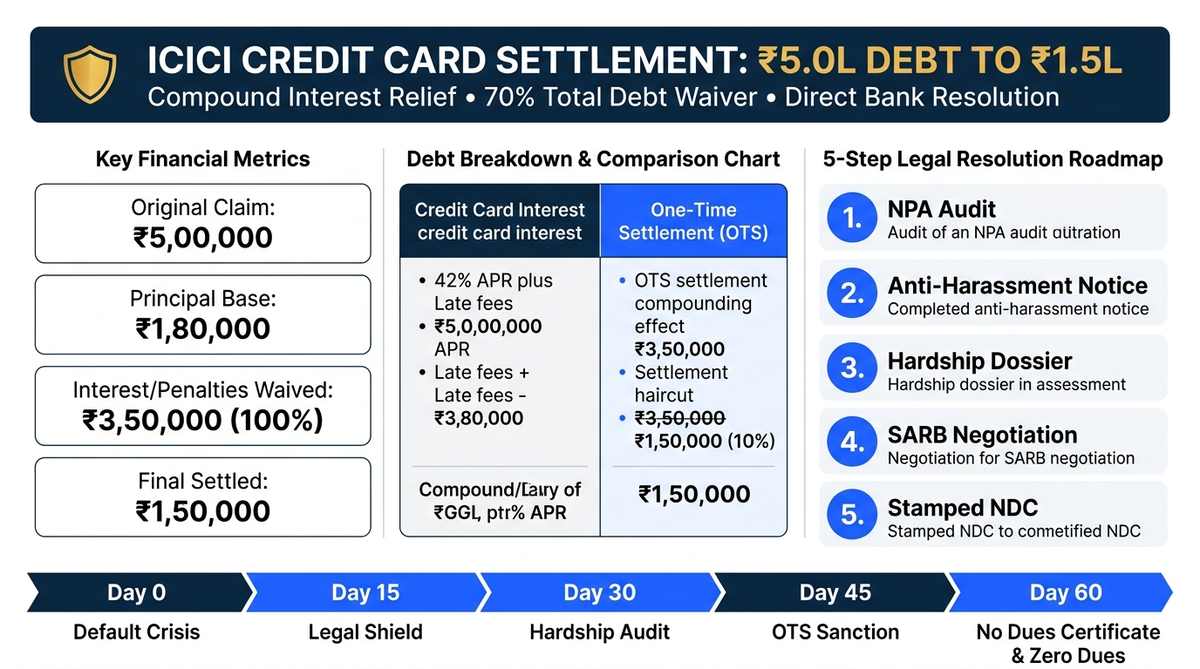
In Round 1, ICICI SARB presented an initial demand of ₹3,85,000, proposing a partial waiver of late charges while preserving the majority of accrued interest. In Round 2, SettleLoans presented a granular forensic audit isolating the original ₹1,80,000 principal, backed by medical records and a definitive offer of ₹1,35,000 mobilized through family assistance. In Round 3, following risk committee evaluation of the NPV model, ICICI Bank issued a final compromise sanction of ₹1,50,000, granting an overall 70.0% total debt waiver.
| Financial Ledger Component | Claimed Bank Dues | Approved Settlement Amount | Total Waiver / Haircut |
|---|---|---|---|
| Core Principal Balance | ₹1,80,000 | ₹1,50,000 | ₹30,000 (16.7% Haircut) |
| Compounded Finance Charges (42% APR) | ₹2,15,000 | ₹0 | ₹2,15,000 (100% Waived) |
| Late Payment & Over-limit Penalties | ₹58,000 | ₹0 | ₹58,000 (100% Waived) |
| 18% GST Surcharges & Legal Charges | ₹47,000 | ₹0 | ₹47,000 (100% Waived) |
| Total Outstanding Debt Claim | ₹5,00,000 | ₹1,50,000 Payable | ₹3,50,000 Total Relief (70.0%) |
8. Sanction Letter Forensics: 5 Mandatory Verification Checkpoints
Before remitting any settlement funds, SettleLoans conducted a stringent forensic audit of the compromise letter issued by ICICI Bank. Making unverified payments based on verbal representations by collection agencies is the single largest cause of settlement disputes in India.
Our legal team verified five non-negotiable institutional checkpoints:
First, the document was issued on official ICICI Bank Limited letterhead featuring corporate identification details, regional branch seal, and an authorized Assistant General Manager (AGM) signature and employee code. Second, the letter explicitly specified Siddharth's 16-digit credit card account number and declared ₹1,50,000 as the full, final, and absolute settlement of all claims. Third, it contained a clear debt extinguishment clause confirming that upon receipt of ₹1,50,000, all residual balances of ₹3,50,000 would be 100% written off. Fourth, the letter committed ICICI Bank to withdraw all pending legal notices under Section 25 PSSA and Section 138 NI Act within 30 days. Fifth, it established a 15-day payment window with zero deferred penalty clauses.
Payment was executed via direct NEFT transfer directly into Siddharth's specific ICICI Credit Card Account number, ensuring complete auditability and eliminating intermediary risk.
9. The ₹0 No Dues Certificate & 24-Month CIBIL Score Reconstruction
Under RBI Circular RBI/2023-24/60 (Release of Movable/Immovable Property Documents and Issue of No Dues Certificate on Repayment/Settlement of Personal Loans), commercial banks must issue a formal No Dues Certificate (NDC) and update credit bureau records within 30 calendar days of settlement receipt.
On Day 21 following the NEFT remittance, ICICI Bank issued the official stamped No Dues Certificate, confirming that the credit card account was permanently closed with a total outstanding balance of ₹0.00.
As required by credit reporting standards, ICICI Bank updated TransUnion CIBIL, Experian, and Equifax with a 'Settled' status and a ₹0 overdue balance. Siddharth's CIBIL score, which had fallen to 572 during default, stabilized at 620 upon closure.
SettleLoans structured a tailored 24-month credit rehabilitation blueprint for Siddharth:
First, opening a secured credit card backed by a ₹40,000 fixed deposit, strictly keeping monthly utilization under 20%. Second, setting automated payments for monthly utilities and mobile bills to maintain a 100% on-time track record. Third, refraining from fresh unsecured credit inquiries during the mandatory 12-month cooling window. Within 18 months, Siddharth successfully elevated his CIBIL score to 764, fully restoring his financial standing.
10. Comparative Resolution Matrix: Direct OTS vs. Restructuring vs. MAD Servicing
When confronting credit card debt distress, borrowers must evaluate the mathematical and legal realities of available resolution pathways in India:
| Resolution Pathway | Total Cash Outflow | Waiver / Haircut Scope | Legal Closure | Time to Debt Freedom |
|---|---|---|---|---|
| Direct SARB One-Time Settlement (OTS) | ₹1,50,000 (Lump Sum) | 70% Total Waiver | Permanent ₹0 NDC | 30 – 45 Days |
| Card EMI Restructuring / Conversion | ₹2,80,000 – ₹3,20,000 | 0% Principal Waiver | Active EMI Obligation | 24 – 36 Months |
| Paying Minimum Amount Due (MAD) | ₹6,00,000+ (Endless) | 0% (Compounding Loss) | No Closure (Debt Spiral) | 15 – 25 Years |
| Contested Court Litigation | Unpredictable + Legal Fees | Subject to Judicial Decree | Subject to Appeals | 3 – 5 Years |
As proven in Siddharth's case study, executing an authentic One-Time Settlement directly with ICICI Bank's Stressed Assets Resolution Branch breaks the compound interest death spiral and achieves complete financial freedom at a fraction of the claimed liability.

Settle Loan is India's trusted debt relief and loan settlement platform. We help borrowers overcome financial distress by negotiating with banks and NBFCs to legally settle personal loans and credit card debts. With our transparent, performance-based approach, you can achieve debt freedom and regain your financial peace of mind.
COMPUTER
Everything You Need to Know About ICICI Card Settlements
Clear, authoritative legal answers regarding ICICI Bank credit card settlements, compound interest waivers, recovery defense, and credit rehabilitation.
The borrower's ₹5,00,000 claimed ledger balance consisted of an original core principal of ₹1,80,000 and ₹3,20,000 in accumulated compound interest (42% APR), late payment fees, and 18% GST charges. SettleLoans compiled a comprehensive hardship dossier proving involuntary financial distress, performed a forensic ledger audit to isolate unearned penal interest, and negotiated directly with ICICI Bank's Stressed Assets Resolution Branch (SARB) to secure an official One-Time Settlement (OTS) of ₹1,50,000—representing a 70% total debt waiver.
Credit cards carry the highest interest rates in Indian retail banking, typically 3.5% to 3.75% per month (42% to 45% annual percentage rate or APR). When a borrower pays only the Minimum Amount Due (MAD) or misses payments, finance charges compound monthly, late payment fees (up to ₹1,200 per cycle) are levied, and an 18% Goods and Services Tax (GST) is added to all interest and charges. Over 18 to 24 months, these charges easily exceed 150% to 200% of the original principal amount.
No. The Minimum Amount Due on credit cards is typically calculated as 5% of the outstanding balance plus taxes and fees. Almost the entire MAD goes toward servicing monthly finance charges, late fees, and GST, with negligible reduction of the underlying principal. Paying only MAD keeps the borrower trapped in a multi-decade repayment cycle while the total debt continues to compound.
ICICI Bank's Credit Committee evaluates credit card settlement proposals using a Net Present Value (NPV) recovery formula. Because credit card debt is 100% unsecured with zero underlying collateral, once an account enters NPA status (90+ DPD) and undergoes regulatory provisioning, the bank compares immediate lump-sum cash recovery against the high legal costs and multi-year delays of pursuing civil court recovery.
No. Unsecured credit card default is strictly a civil breach of contract under the Indian Contract Act, 1872. The police cannot register an FIR, issue arrest warrants, or detain a borrower for genuine financial inability to pay credit card dues. However, if automated NACH/e-mandates bounce, the bank may send statutory legal notices under Section 25 of the Payment and Settlement Systems Act, 2007, or Section 138 of the Negotiable Instruments Act, 1881, which can be resolved through formal legal representation.
Under the RBI Master Directions on Recovery Agents (2022) and the Fair Practices Code, recovery agents are legally prohibited from calling before 08:00 AM or after 07:00 PM, contacting relatives, friends, or employers, using abusive language, or intimidating borrowers. Borrowers can issue a formal legal cease-and-desist notice to ICICI Bank's Principal Nodal Officer (PNO) and file a complaint on the RBI Integrated Ombudsman portal (cms.rbi.org.in).
Borrowers must ensure: (1) The letter is on official ICICI Bank letterhead with an authorized officer's signature, designation, and employee ID; (2) It explicitly mentions the credit card account number and the exact negotiated settlement figure as full and final discharge; (3) It includes a clause confirming 100% waiver of residual balance, interest, and penalties; (4) It commits to issuing a No Dues Certificate (NDC) and withdrawing any legal notices; (5) Payment is remitted directly into the official ICICI credit card account number.
Following settlement, ICICI Bank updates credit bureaus with a 'Settled' remark and an outstanding balance of ₹0. While the score experiences an initial drop of 75 to 120 points, the compounding default accumulation stops permanently. Borrowers can rebuild their CIBIL score back to 750+ within 18 to 24 months by using a secured fixed-deposit credit card, keeping credit utilization below 30%, and maintaining a flawless repayment track record.
Under RBI Circular RBI/2023-24/60, all regulated commercial banks including ICICI Bank must issue the formal No Dues Certificate (NDC) / Loan Closure Certificate and update credit bureau records within 30 calendar days of receiving full settlement funds. Lenders failing to comply within this statutory timeframe are liable to pay compensation of ₹5,000 per day of delay to the borrower.
Official Statutory Authorities & Regulatory Frameworks
- Reserve Bank of India (RBI): Master Direction on Credit Card and Debit Card Issuance and Conduct Directions
- RBI Master Direction: Guidelines on Fair Practices Code and Outsourcing of Financial Services / Recovery Agents
- ICICI Bank Limited: Grievance Redressal Policy & Principal Nodal Officer (PNO) Escalation Matrix
- Reserve Bank - Integrated Ombudsman Scheme, 2021: Dispute Redressal Portal for Unfair Recovery & Card Billing Disputes
- National Legal Services Authority (NALSA): Legal Services Authorities Act, 1987 — National Lok Adalat Settlement Mechanism