1. The Illusion of Written Off Loans in India
One of the most catastrophic and widespread financial misconceptions among Indian borrowers is the belief that when a bank marks an overdue loan or credit card as "Written Off," the outstanding debt has been forgiven, canceled, or erased by the government. Borrowers who download their credit reports from TransUnion CIBIL, Experian, or CRIF High Mark frequently observe a zero current balance alongside a stark "Written Off" remark, leading them to falsely conclude that their financial nightmare is over and no further payments are required.
The harsh legal and banking reality is precisely the opposite. A loan write-off is purely an internal accounting adjustment executed unilaterally by commercial banks and Non-Banking Financial Companies (NBFCs) to clean their published balance sheets. It does not discharge, forgive, or extinguish a single rupee of the borrower's contractual liability. Under Indian contract law, the lender retains complete legal ownership of the debt, maintains full enforcement rights to initiate recovery proceedings, and will aggressively deploy internal collection divisions, third-party recovery agencies, or specialized Asset Reconstruction Companies (ARCs) to recover the entire unpaid balance with compounded penalties.
A loan write-off is an accounting maneuver designed to benefit the lending institution under tax laws. Only a formal Loan Waive-Off or a legally executed One-Time Settlement (OTS) with a verified ₹0 No Dues Certificate extinguishes borrower liability under the Indian Contract Act, 1872.
2. Banking Accounting Mechanics: Technical Write-Offs vs. Actual Write-Offs
To understand why banks write off non-performing loans, one must examine the regulatory framework established by the Reserve Bank of India. Under the RBI Master Circular on Prudential Norms on Income Recognition, Asset Classification and Provisioning pertaining to Advances (IRACP), when a borrower fails to pay interest or principal installments for 90 consecutive days, the loan account is categorized as a Non-Performing Asset (NPA). As delinquency ages from Sub-Standard to Doubtful and Loss categories, banks are legally mandated to set aside substantial cash reserves—termed provisioning—against potential default losses.
When bad loans accumulate, they inflate the bank's Gross Non-Performing Asset (GNPA) ratio, impairing its credit ratings, stock valuation, and ability to raise fresh capital. To restore financial health, lenders execute what the RBI defines as a "Technical Write-Off" (or prudential write-off). In this accounting procedure, the bank transfers the defaulted loan amount from its active balance sheet asset ledger to an off-balance sheet Memorandum Ledger at the Head Office level, simultaneously claiming 100% provisioning against its gross revenue.
Crucially, writing off the loan allows the bank to claim substantial corporate income tax deductions under Section 36(1)(vii) of the Income Tax Act, 1961, which permits scheduled commercial banks to deduct bad debts written off as irrecoverable against taxable profits. However, the RBI prudential guidelines explicitly state that a technical write-off is executed without prejudice to the bank's legal right of recovery. The borrower remains fully indebted, and any subsequent recovery achieved from the debtor is credited directly to the bank's profit and loss statement as non-interest recovery income.
Check Your Loan Settlement Options
Answer 2 quick questions to evaluate your settlement eligibility.
1. What type of loan do you want to settle?
3. Loan Waive-Off Defined: Absolute Legal Extinguishment of Debt
In stark contrast to a unilateral technical write-off, a **Loan Waive-Off** represents the complete, permanent, and irrevocable cancellation of a borrower's debt obligation. When a loan is waived off, the lender formally relinquishes its legal claim against the borrower, terminating the underlying loan contract under Section 63 of the Indian Contract Act, 1872, which governs the remission or dispensation of contractual performance.
In India, genuine loan waivers generally manifest in two distinct forms. The first consists of sovereign agricultural or targeted social welfare loan waiver schemes enacted by state governments or the Central Government, where public funds are allocated to compensate lending institutions for forgiving designated farmer or priority-sector loans. The second, far more common in urban retail banking, is a negotiated **One-Time Settlement (OTS) or Compromise Settlement**. Under this framework, a distressed borrower facing legitimate, verifiable financial hardship pays a mutually agreed discounted lump-sum amount, and the bank formally waives the remaining principal, accumulated interest, penal charges, and legal expenses.
Once a loan is formally waived or settled through an authorized OTS sanction letter, the borrower receives a comprehensive ₹0 No Dues Certificate (NDC). This legal instrument immunizes the individual against future recovery actions, mandates the withdrawal of pending court notices or Section 138 cheque bounce proceedings, and obligates the lender to update credit bureaus to reflect that the account is legally closed.
4. Comprehensive Comparison Matrix: Write-Off vs. Waive-Off vs. Compromise Settlement
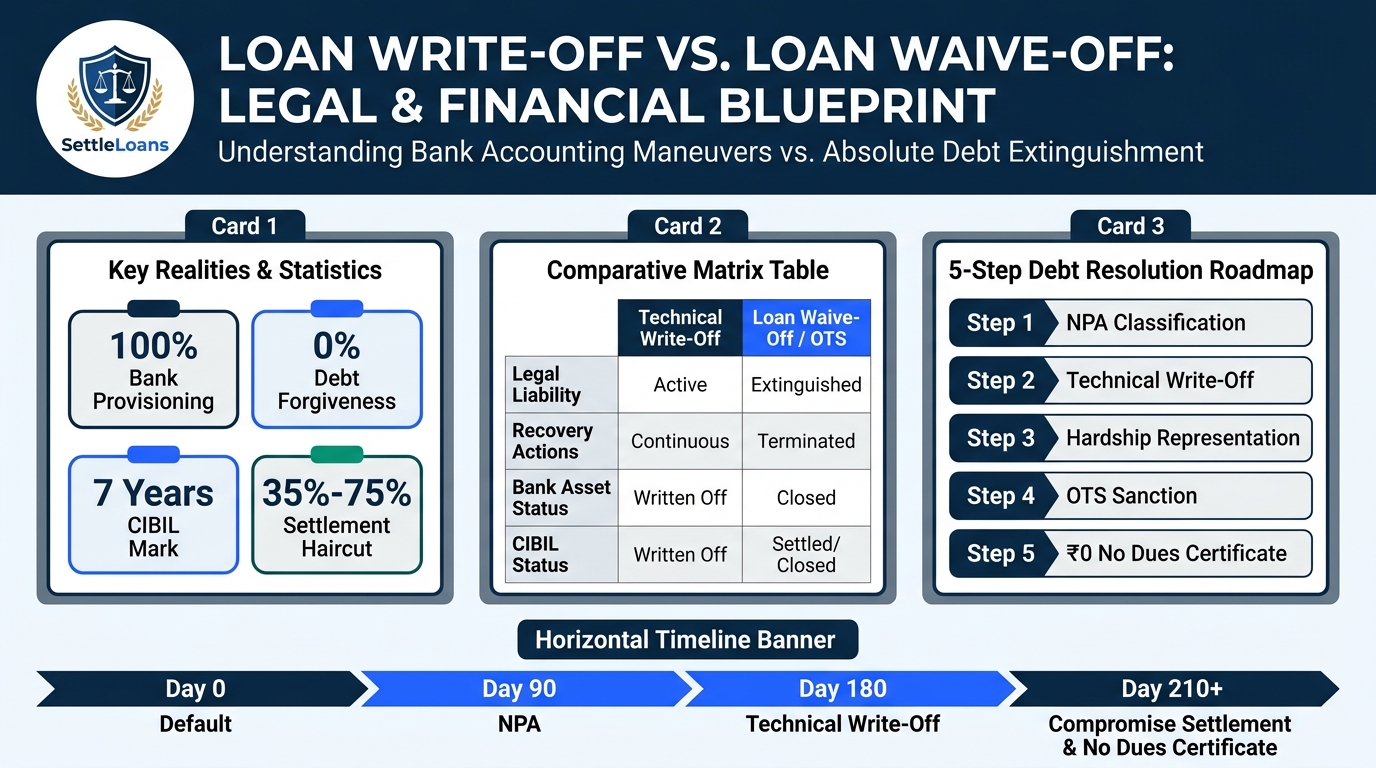
Understanding the technical and legal parameters that separate write-offs, waivers, and compromise settlements is vital for navigating debt disputes effectively. The following comparative matrix outlines the regulatory differences governing each mechanism under Indian banking jurisprudence.
| Comparative Parameter | Technical Loan Write-Off | Government / Bank Waive-Off | One-Time Settlement (OTS) |
|---|---|---|---|
| Primary Objective | Balance sheet cleaning & corporate tax deduction under Sec 36(1)(vii). | Social relief or full humanitarian cancellation of borrower liability. | Mutual compromise to recover maximum capital from distressed debtor. |
| Borrower Legal Liability | 100% Active & Legally Enforceable | 100% Extinguished & Forgiven | Fully Discharged upon agreed payment |
| Recovery Enforcement | Active recovery agents, legal notices, ARCs, and civil court suits. | Completely terminated; zero recovery permissible by law. | Permanently ceased upon issuance of ₹0 No Dues Certificate. |
| Borrower Consent | Unilateral decision by bank management without debtor knowledge. | Governed by statutory policy or government notifications. | Bilateral agreement executed via formal signed sanction letter. |
| CIBIL Bureau Status | Marked "Written Off" (Zero new loan eligibility) | Marked "Closed" or "Waived" (Clean closure) | Marked "Settled" / "Post-Settled" (Can rebuild score) |
| Closing Documentation | No document provided to borrower (remains in default). | Official debt release or government waiver certificate. | Official Bank Sanction Letter + ₹0 No Dues Certificate. |
5. Recovery Tactics & Legal Arsenal Deployed After a Loan is Written Off
Because a technical write-off does not extinguish debt obligations, banks maintain an aggressive multi-tiered recovery machinery. Once an account is transferred to the memorandum ledger, the bank's special recovery branch activates external recovery agencies, operating on contingency commissions ranging from 15% to 30% of recovered capital. These collection agents frequently utilize aggressive calling patterns, workplace visits, and social embarrassment tactics, erroneously claiming that criminal arrest warrants are imminent.
Beyond agency recovery, commercial lenders routinely assign portfolios of written-off unsecured loans to Asset Reconstruction Companies (ARCs) such as Phoenix ARC, Asset Reconstruction Company of India (ARCIL), or JM Financial under Section 5 of the SARFAESI Act, 2002. ARCs acquire non-performing debt at steep portfolio discounts (often 10% to 25% of face value) and enforce rigorous collection strategies, utilizing statutory notices and dispute summonses to compel payment.
Lenders also initiate formal legal proceedings against delinquent borrowers. For personal loans backed by electronic NACH mandates or security cheques, banks frequently issue statutory demand notices under Section 138 of the Negotiable Instruments Act, 1881, or Section 25 of the Payment and Settlement Systems Act, 2007. Lenders may also refer written-off files to National Lok Adalats or file summary civil recovery suits under Order XXXVII of the Code of Civil Procedure, 1908, to obtain enforceable recovery decrees before the 3-year statutory limitation period expires.
6. Net Present Value (NPV) & Bank Settlement Economics: Why Written-Off Debts Offer Deep Haircuts
While a written-off status exposes borrowers to ongoing recovery pressure, it paradoxically creates the strongest financial leverage for negotiating substantial settlement discounts. The financial reasoning governing bank recovery committees is grounded in Net Present Value (NPV) recovery modeling.
When evaluating an account that has been 100% provisioned and written off for 12 to 36 months, bank risk committees recognize that initiating prolonged civil litigation involves heavy legal fees, court administrative delays of 3 to 7 years, and significant uncertainty regarding asset recovery from an unsecured individual. Under standard financial modeling, the Net Present Value of an immediate lump-sum settlement offer today is far higher than the discounted present value of potential future litigation recoveries minus legal expenses:
Where r represents the bank's internal hurdle rate of capital and t represents the projected time lag in civil judicial execution.
Because the bank has already written off the asset on its balance sheet, any settlement payment received enters the bank's books as pure, instant non-interest income. When SettleLoans advocates present documented evidence of genuine financial hardship (such as job loss, medical catastrophe, or business insolvency), bank recovery managers are legally empowered under internal compromise policies to authorize substantial waivers—frequently between 40% and 75% of the total outstanding dues.
7. CIBIL Bureau Reality: How "Written Off" Destroys Credit vs. Compromise Settlement
Under the Credit Information Companies (Regulation) Act, 2005 (CICRA), all commercial banks and NBFCs are legally mandated to furnish accurate historical credit data monthly to authorized credit bureaus, including TransUnion CIBIL, Experian, Equifax, and CRIF High Mark. Leaving a defaulted loan in "Written Off" status produces severe long-term financial repercussions.
A "Written Off" bureau entry indicates to all automated underwriting algorithms that the borrower committed an unmitigated default and abandoned their contractual obligation. This causes an immediate credit score degradation of 150 to 200 points, triggering automated rejection across all Tier-1 lenders for home loans, auto loans, personal credit lines, and premium credit cards. Under statutory bureau data retention guidelines, a written-off default record remains prominently flagged in credit reports for a minimum of 7 years, continuously suppressing your financial credibility.
Conversely, executing a formal One-Time Settlement updates your bureau record to "Settled" or "Post (WO) Settled." While a settlement remark still reflects a compromise closure, it terminates the delinquency aging cycle, stops overdue interest reporting, and establishes that the account has been legally closed. This enables borrowers to initiate structured credit rehabilitation—such as using secured fixed-deposit credit cards—to systematically rebuild their credit score back to 750+ over 18 to 24 months. Furthermore, borrowers can later pay the waived haircut amount to convert their status to "Closed - Fully Paid."
8. Step-by-Step Strategic Roadmap: Transforming a Written-Off Debt into a Closed Account
Resolving a written-off loan requires a disciplined, legally backed procedural approach. SettleLoans empaneled advocates utilize a five-stage strategic workflow to transition defaulted accounts from toxic "Written Off" records to fully extinguished liabilities.
Forensic Debt & Credit Bureau Audit
Review official account statements, calculate the exact ratio of disbursed principal versus accumulated penal interest and late fees, and verify whether the loan is held by the original bank or has been assigned to an Asset Reconstruction Company.
Comprehensive Hardship Dossier Preparation
Compile verifiable legal evidence proving genuine financial distress, including salary termination notices, medical treatment records, income tax filings, or business closure documentation to justify statutory waiver eligibility.
Formal Advocate Representation & Mandate Negotiation
Submit formal legal representations to the bank's Zonal Stressed Assets Resolution Committee under RBI compromise guidelines, negotiating maximum penalty waivers and realistic principal haircuts.
Sanction Letter Verification & Safe Payment Execution
Perform rigorous legal verification of the bank's official settlement sanction letter, ensuring explicit mention of full and final settlement terms, before executing payment directly into the designated bank loan account.
Securing ₹0 No Dues Certificate & CIBIL Updation
Obtain the original, stamped ₹0 No Dues Certificate from the bank, followed by serving statutory notices to credit bureaus under CICRA 2005 to ensure the account status is updated from "Written Off" to "Settled / Closed."
9. Legal Defense Framework: Stopping Harassment & Enforcing RBI Rights
While commercial lenders possess the right to seek recovery of written-off debts, they are strictly bound by the Reserve Bank of India Fair Practices Code for Lenders and Guidelines on Recovery Agents. Under these statutory directives, recovery personnel are strictly prohibited from resorting to intimidation, verbal abuse, public humiliation, contacting borrowers before 8:00 AM or after 7:00 PM, or making unauthorized visits to borrower workplaces and residential premises.
If collection agents violate these statutory boundaries, borrowers possess robust legal remedies. SettleLoans legal advocates serve formal cease-and-desist notices to bank nodal officers, file administrative complaints before the RBI Integrated Banking Ombudsman, and initiate criminal complaints under relevant provisions of the Bharatiya Nyaya Sanhita (BNS) for criminal intimidation, defamation, and extortion.
Furthermore, in cases involving Section 138 cheque bounce or Section 25 NACH dishonour notices, legal representation ensures that valid statutory defenses are mounted. Courts recognize genuine financial impossibility, and formal compromise negotiations often lead to the quashing of criminal proceedings upon the execution of a lawful settlement agreement.
10. Institutional Legal Representation with SettleLoans
Navigating the complex institutional hierarchy of public and private commercial banks requires specialized legal and financial expertise. As India's premier debt settlement and borrower advocacy platform, SettleLoans bridges the gap between distressed borrowers and institutional lenders.
Our empaneled legal advocates represent borrowers holding single or multi-lender portfolios across major institutions including HDFC Bank, ICICI Bank, State Bank of India, Axis Bank, Kotak Mahindra Bank, Bajaj Finance, and leading ARCs. We handle all lender communications, neutralize unlawful third-party recovery harassment, negotiate the highest legally achievable settlement discounts, and guarantee that every client receives a verified, tamper-proof ₹0 No Dues Certificate.
By transforming unpayable written-off liabilities into structured, affordable compromise settlements, SettleLoans restores peace of mind, preserves personal dignity, and provides a clear pathway toward complete credit rehabilitation.

Settle Loan is India's trusted debt relief and loan settlement platform. We help borrowers overcome financial distress by negotiating with banks and NBFCs to legally settle personal loans and credit card debts. With our transparent, performance-based approach, you can achieve debt freedom and regain your financial peace of mind.
COMPUTER
Frequently Asked Questions
A loan write-off is an internal bank accounting entry where a non-performing loan is removed from the active asset ledger for tax optimization and balance sheet cleaning, but the borrower's legal liability remains 100% active. A loan waive-off is an absolute legal extinguishment of the debt, where the lender or government cancels the borrower's obligation entirely, issuing a complete release of liability.
Yes. A "Written Off" status in your credit report does not mean your debt is forgiven. The lender retains full legal rights under Indian contract law to pursue recovery, send legal notices, file suits in court, or assign the debt to an Asset Reconstruction Company (ARC). To end liability, you must execute a formal compromise settlement.
Banks execute technical write-offs under RBI Master Circular norms to reduce their Gross Non-Performing Asset (GNPA) ratio, release capital reserves, and claim tax deductions on bad debts under Section 36(1)(vii) of the Income Tax Act, 1961. It is a statutory balance sheet hygiene measure rather than borrower relief.
While banks maintain the legal right to demand repayment, recovery agents are strictly prohibited from harassing, threatening, calling outside 8 AM to 7 PM, or visiting workplaces under RBI Fair Practices Code. If recovery agents violate these regulations, you can serve legal notices and file formal complaints with the RBI Banking Ombudsman.
A write-off is executed unilaterally by the bank without borrower consent, leaving the full debt open for recovery. A One-Time Settlement (OTS) is a bilateral legal agreement where the bank agrees to accept a discounted lump sum (typically 35% to 75% haircut) to permanently close the account and issue an official ₹0 No Dues Certificate.
A "Written Off" entry indicates complete default and zero borrower cooperation, suppressing your credit score by 150 to 200 points and leading to immediate rejection for future loans. A "Settled" status reflects an agreed compromise closure; while it still carries a negative footprint, it stops delinquency aging and allows credit rehabilitation through secured products.
Yes. Written-off accounts often offer the highest settlement negotiation leverage because banks have already provisioned 100% of the asset. Any recovered amount is booked directly as clean profit, making recovery committees receptive to substantial discounts (often 40% to 70% of total dues) when structured by legal advocates.
When a bank assigns a written-off debt to an ARC under the SARFAESI Act, the ARC steps into the shoes of the original lender with all legal recovery rights. Borrowers must negotiate settlements directly with the ARC and ensure the ARC issues a valid No Dues Certificate and updates credit bureaus.
To convert a "Written Off" or "Post-Settled" entry to "Closed" in CIBIL, you can approach the original lender, pay the remaining waived balance, and obtain a Final No Dues Certificate. Under CICRA regulations, the bank is legally obligated to update the bureau status to "Closed - Fully Paid" within 30 days.
Statutory Regulatory Framework & Legal Authorities
- Reserve Bank of India (RBI): Master Circular on Prudential Norms on Income Recognition, Asset Classification and Provisioning (IRACP).
- Income Tax Act, 1961: Section 36(1)(vii) statutory provisions governing bad debt deductions for banking corporations.
- Credit Information Companies (Regulation) Act, 2005 (CICRA): Mandatory credit reporting, dispute redressal, and bureau history retention rules.
- SARFAESI Act, 2002: Section 5 provisions governing the acquisition and enforcement of distressed financial assets by ARCs.
- Indian Contract Act, 1872: Section 63 statutory provisions regarding remission and complete discharge of contractual obligations.