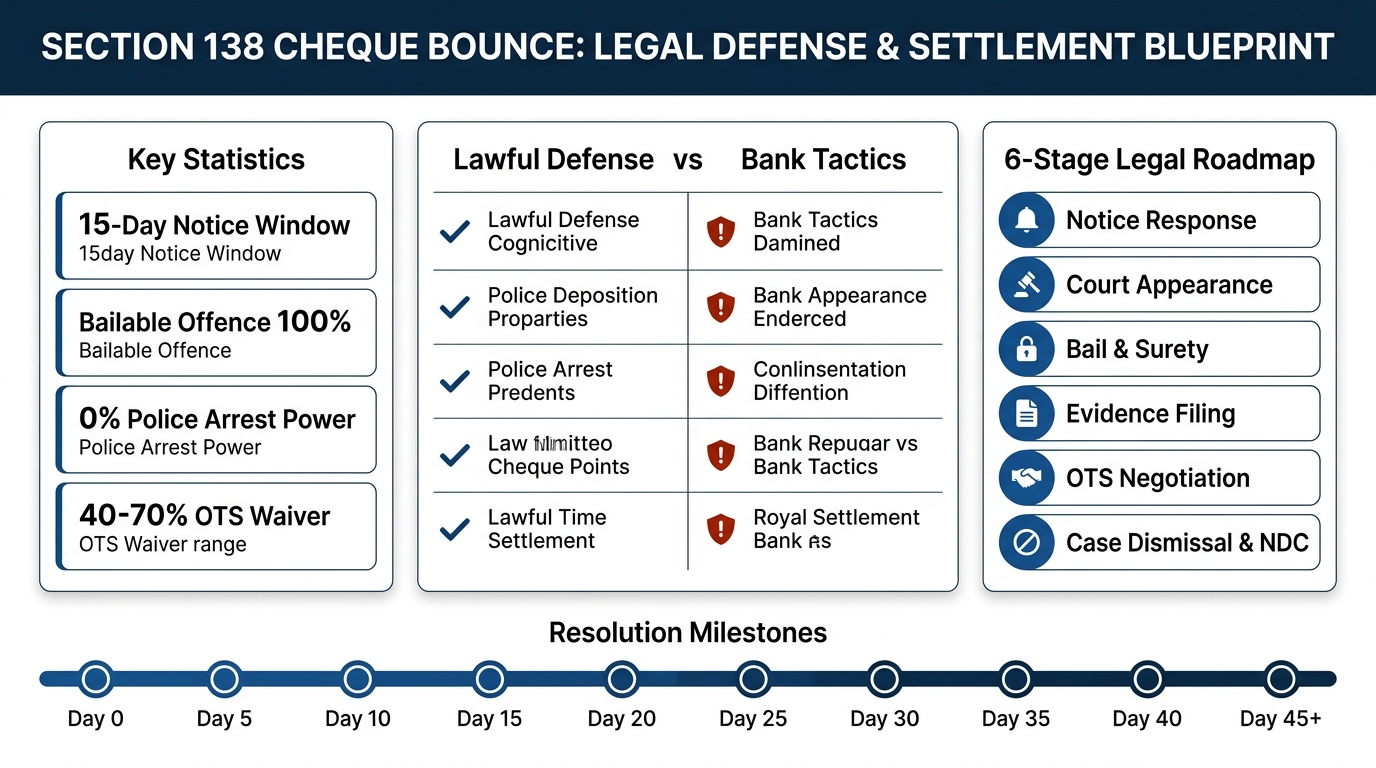
- Zero Immediate Police Arrest: Cheque bounce under Section 138 NI Act is a bailable, non-cognizable statutory offence. Police have zero authority to arrest you or register an FIR for cheque bounce.
- Strict 15-Day Statutory Cure Period: After receiving the bank's legal notice, you have 15 days to respond and cure. The bank cannot file a criminal complaint before the 15-day period expires.
- Security Cheque Supreme Court Defense: Under Dashrathbhai Patel (2022), if the bank deposited a blank security cheque without endorsing prior EMI repayments (Section 56 NI Act), the Section 138 complaint is legally invalid.
- Guaranteed Court Bail: When summons are issued, appearing through an advocate guarantees same-day bail on personal bond. Never ignore summons to avoid bailable/non-bailable warrants.
- Compounding & Full Case Dismissal: Under Section 147 NI Act, criminal proceedings are 100% compoundable upon completing a One-Time Settlement (OTS), securing total account closure and No Dues Certificate.
1. Personal Loan Cheque Bounce & Bank Pressure
When financial distress strikes—whether from sudden job loss, salary reductions, severe medical emergencies, or business downturns—defaulting on an unsecured personal loan is a distressing reality for hundreds of thousands of salaried Indians. However, the psychological trauma escalates exponentially when the lending bank or NBFC deposits an undated security cheque (PDC) that bounces, followed by alarming legal notices threatening criminal prosecution and immediate imprisonment under Section 138 of the Negotiable Instruments Act, 1881.
"Where any cheque drawn by a person on an account maintained by him with a banker for payment of any amount of money to another person from out of that account for the discharge, in whole or in part, of any debt or other liability, is returned by the bank unpaid, either because of the amount of money standing to the credit of that account is insufficient to honour the cheque... such person shall be deemed to have committed an offence."
— Section 138, Negotiable Instruments Act, 1881 (Amended 2018)
To understand how to protect yourself, it is critical to demystify why banks deploy this strategy. When you initially availed your personal loan, the lender collected between 3 to 6 blank, undated Post-Dated Cheques (PDCs) under the guise of "administrative security". In standard retail banking operations, monthly repayments are processed automatically via NACH / e-Mandate.
However, when your NACH mandate fails for consecutive months due to financial hardship, the bank's recovery division pulls out these archived security cheques, manually writes the current date, fills the entire accelerated loan outstanding (often including inflated penal interest and bounce charges), and deposits the instrument into clearing.
Why do banks do this? A personal loan default is purely a civil breach of contract. Recovering money through civil courts (such as a summary suit under Order 37 CPC) takes years. By converting a civil contractual dispute into a quasi-criminal complaint under Section 138, banks attempt to generate extreme criminal fear, coercion, and panic to force you or your family to borrow emergency funds to pay them off.
2. The 4-Stage Statutory Timeline under Section 138 NI Act
The Negotiable Instruments Act establishes an unalterable, strict statutory sequence of events. A bank cannot arbitrarily file a criminal case or demand your arrest without complying precisely with every statutory milestone. If the bank misses any statutory limitation period by even a single day, the entire complaint becomes legally defective and subject to dismissal under Section 142.
Cheque Dishonour & Return Memo
The cheque must be presented to the bank within its validity period of 3 months from the date inscribed on it. Upon dishonour, the drawee bank issues a formal "Cheque Return Memo" specifying the reason (e.g. "Funds Insufficient" or "Account Closed").
Mandatory 30-Day Legal Demand Notice
Under Section 138(b), the bank MUST issue a formal statutory demand notice in writing within 30 calendar days of receiving the cheque dishonour memo from the clearing house. If dispatched on Day 31, the entire proceeding is void ab initio.
15-Day Statutory Cure Period
Upon receipt of the legal notice, the law gives the borrower a mandatory 15-day cure window to respond or arrange settlement. No criminal offence exists during these 15 days. The bank is legally barred from filing any court complaint until Day 16.
30-Day Court Complaint Window
If payment is not made within 15 days, the statutory cause of action arises on Day 16. The bank has exactly 30 calendar days to file a private criminal complaint before the Judicial Magistrate / Metropolitan Magistrate under Section 142.
Check Your Loan Settlement Options
Answer 2 quick questions to evaluate your settlement eligibility.
1. What type of loan do you want to settle?
3. Landmark Supreme Court Judgments on Security Cheques & Presumptions
While Section 139 of the NI Act creates a legal presumption that a dishonoured cheque was issued towards a debt, this presumption is rebuttable on a "preponderance of probabilities". The Supreme Court of India has delivered several authoritative rulings curtailing banks from abusing undated security cheques for un-crystallized, inflated loan claims.
Dashrathbhai Trikambhai Patel v. Hitesh Mahendrabhai Patel (2022) 10 SCC 594
Landmark 3-Judge BenchCore Judicial Ruling: The Supreme Court held that for an offence under Section 138 to stand, the cheque must represent the exact legally enforceable debt on the date of its presentation. If the borrower has made part-payments (e.g. EMIs paid prior to default), the lender is legally required under Section 56 of the NI Act to endorse the part-payment on the instrument. If the lender deposits a cheque for the full loan amount without endorsing prior payments, dishonour of such an inflated cheque CANNOT attract Section 138 criminal liability.
Indus Airways Pvt. Ltd. v. Magnum Aviation Pvt. Ltd. (2014) 12 SCC 539
Security Cheque PrecedentCore Judicial Ruling: The Apex Court established that a post-dated cheque handed over solely as "collateral security" or advance guarantee, at a time when no crystallized debt had matured or been adjudicated, does not automatically constitute a cheque issued for a legally enforceable debt. If the contract is breached or disputed, the remedy lies in civil litigation, not mechanical criminal prosecution.
Rakesh Ranjan Shrivastava v. State of Jharkhand (2024) INSC 206
Interim Compensation ClarificationCore Judicial Ruling: Overruling previous mechanical applications of Section 143A (which allows courts to order 20% interim deposit), the Supreme Court ruled that Section 143A is directory and discretionary, not mandatory. Trial courts must evaluate the prima facie strength of the accused's defense, bona fide financial condition, and reasons before ordering any interim deposit.
4. Key Legal Defense Strategies for Personal Loan Borrowers
When faced with Section 138 legal notices or court proceedings, borrowers often feel helpless due to aggressive collection calls. However, under the law, an experienced debt defense advocate can raise powerful, evidence-backed defenses to invalidate the bank's criminal complaint:
Defense 1: Rebutting Section 139 Statutory Presumption
The accused is not required to prove their innocence "beyond reasonable doubt". Under Bir Singh v. Mukesh Kumar (2019) and Basalingappa v. Mudibasappa (2019), the borrower only needs to establish a probable defense on a "preponderance of probabilities" through cross-examination of bank officers and loan account statements to shift the burden of proof back onto the bank.
Defense 2: Violation of Section 56 (Failure to Endorse Part-Payments)
If you paid 6, 12, or 24 EMIs prior to default, the original principal loan amount no longer represents your actual balance. By depositing a blank security cheque filled for the original sanction amount or adding unverified penalties, the bank violates Section 56 of the NI Act. Under the Dashrathbhai Patel judgment, this single defect renders the complaint liable to dismissal.
Defense 3: Time-Barred Debt or Defective Statutory Notice
Under Indian law, a cheque issued for a time-barred debt (where more than 3 years have elapsed without acknowledgment under the Limitation Act, 1963) cannot be prosecuted under Section 138. Furthermore, if the bank failed to dispatch the notice within 30 days of receiving the return memo, or failed to specify the exact cheque particulars, the statutory notice is defective.
Defense 4: Lack of Locus Standi & Unauthorized Power of Attorney
Complaints filed by outsourced collection agencies or unauthorized representatives without a valid, registered Power of Attorney (POA) or specific Board Resolution under Section 141 of the NI Act fail judicial scrutiny under the Supreme Court precedent in A.C. Narayanan v. State of Maharashtra (2014).
6. Court Summons, Bailable Warrants (BW), and Bail Protocol
A major source of anxiety for borrowers is understanding what actually happens when a Section 138 complaint is filed in court. Misleading recovery agents often claim that police will arrive at night with handcuffs. In reality, Indian criminal procedure provides structured, bailable safeguards:
Stage 1: Pre-Summoning Evidence & Judicial Summons
When the bank files a complaint, the Magistrate records the complainant's verification statement (pre-summoning evidence). Upon finding prima facie compliance, the court issues a Judicial Summons ordering you to appear on a future date. A summons is NOT an arrest warrant; it is an official judicial invitation to present your defense.
Stage 2: Appearance & Instant Regular Bail as a Matter of Right
Because Section 138 is a bailable offence under the Code of Criminal Procedure (CrPC) / Bharatiya Nagarik Suraksha Sanhita (BNSS), the Magistrate MUST grant bail upon appearance. Your defense advocate files a formal bail application along with a personal bond (usually ₹10,000 to ₹25,000) and a local surety. Bail is granted immediately within minutes on the same court date.
Stage 3: What if You Missed Summons? Bailable Warrants & Recall
If summons were delivered to an old address or you failed to appear, the court may issue a Bailable Warrant (BW) or, upon repeated non-appearance, a Non-Bailable Warrant (NBW). This does not mean you go to jail. Your advocate immediately files an Application for Recall/Cancellation of Warrant under Section 70(2) CrPC along with proof of non-receipt or medical reasons, and the Magistrate recalls the warrant.
7. Official Advocate Reply to 15-Day Legal Notice (Interactive Template)
Responding to the bank's statutory demand notice within 15 days is your most powerful strategic tool. A well-drafted legal reply establishes your defense on record, places the bank on notice regarding Section 56 violations, prevents surprise ex-parte orders, and initiates structured settlement talks.
8. Section 147 Compounding & One-Time Settlement (OTS)
The ultimate objective of handling a Section 138 personal loan case is not protracted multi-year criminal litigation, but achieving complete, permanent debt closure without a criminal record. Under Section 147 of the Negotiable Instruments Act, every offence under the chapter is explicitly compoundable.
How SettleLoans Achieves Section 138 Case Dismissal via OTS
- Hardship Portfolio Presentation: Our senior financial negotiators present your documented financial distress (job loss certificates, income drop, medical expenses) to the bank's Stressed Assets Resolution Committee (SARC).
- Substantial Compromise Sanction: We negotiate a realistic One-Time Settlement (OTS) sanction letter directly on official bank letterhead, securing waivers between 40% and 70% of total claimed dues, with complete waiver of penal charges.
- Lok Adalat / Court Compounding Application: Upon payment of the agreed settlement sum, our empaneled advocates file a joint compounding application under Section 147 NI Act / Section 320 CrPC before the Magistrate or Lok Adalat Bench.
- Judicial Acquittal & No Dues Certificate: The Magistrate passes a formal judicial order compounding the offence, resulting in complete acquittal of all criminal charges, followed by the bank issuing an unconditional No Dues Certificate (NDC).
9. Comparative Legal Process Matrix
Understanding the distinct avenues used by lending institutions allows borrowers to recognize the difference between legitimate judicial procedures and unlawful third-party recovery harassment.
Table 1: Section 138 Criminal Complaint vs. Civil Summary Suit (Order 37 CPC) vs. DRT
| Legal Parameter | Section 138 NI Act (Cheque Bounce) | Order 37 CPC (Civil Summary Suit) | DRT / SARFAESI (Secured Loans) |
|---|---|---|---|
| Nature of Proceeding | Quasi-Criminal Statutory Complaint | Civil Summary Recovery Suit | Statutory Tribunal Debt Recovery |
| Governing Statute | Negotiable Instruments Act, 1881 | Code of Civil Procedure, 1908 | RDDBFI Act, 1993 / SARFAESI Act, 2002 |
| Applicability to Personal Loans | Applies if physical cheque/PDC dishonoured | Applies for liquidated contractual debts | Only applies for claims > ₹20 Lakhs |
| Bail Requirement | Bailable as a matter of right on first appearance | No bail needed (Civil matter) | No bail needed (Civil/Tribunal matter) |
| Settlement / Compounding | 100% Compoundable under Section 147 NI Act | Compromise Decree under Order 23 CPC | One-Time Settlement (OTS) Consent Terms |
Table 2: Lawful NI Act Court Procedures vs. Unlawful Recovery Agent Threats
| Action Area | Lawful Judicial Process (NI Act / CrPC) | Unlawful Collection Agent Tactic | Legal Violation / Remedy |
|---|---|---|---|
| Arrest Powers | Only Magistrate can issue warrants; police cannot arrest on notice | Threatening immediate police arrest or doorstep jail van | Criminal Intimidation (Section 503/506 IPC) |
| Notice Delivery | Written registered post/speed post to official residential address | WhatsApp fake summons with forged police seals | Forgery & Impersonation (Section 463/419 IPC) |
| Workplace Intrusion | Court summons served through registered post or court bailiff | Recovery agents visiting office or calling HR department | RBI Fair Practices Code & Trespass (Sec 441 IPC) |
| Interim Settlement | Voluntary compromise recorded before Magistrate / Lok Adalat | Extortion of spot cash under coercion without official receipt | Extortion (Section 383/384 IPC / Section 308 BNS) |

Settle Loan is India's trusted debt relief and loan settlement platform. We help borrowers overcome financial distress by negotiating with banks and NBFCs to legally settle personal loans and credit card debts. With our transparent, performance-based approach, you can achieve debt freedom and regain your financial peace of mind.
COMPUTER
Frequently Asked Questions on Section 138 Cheque Bounce
Yes, if a physical cheque (Post-Dated Cheque or security PDC) is presented and dishonoured for insufficient funds, the bank can invoke Section 138. Under the Negotiable Instruments Act, 1881, dishonour of a cheque drawn towards the discharge of a legally enforceable debt is a quasi-criminal statutory offence. However, the bank must strictly comply with mandatory statutory prerequisites: presenting the cheque within its 3-month validity, issuing a statutory demand notice within 30 days of the dishonour memo, giving a 15-day cure period, and filing the complaint before a Judicial Magistrate within 30 days thereafter.
No, absolutely not. The police cannot arrest you for a cheque bounce. Section 138 is a non-cognizable, bailable, and compoundable offence. The police have no statutory power to register an FIR, visit your residence to arrest you, or lock you up simply because a cheque bounced or because the bank issued a legal notice. Criminal proceedings can only be initiated through a private complaint filed directly before a Judicial Magistrate / Metropolitan Magistrate. You are only summoned by the court, where bail is granted as a matter of right.
The statutory sequence follows 4 strict, non-negotiable legal milestones: 1) Cheque Presentation: Within 3 months from the date on the cheque; 2) Return Memo: Dishonour memo issued by the paying bank; 3) 30-Day Legal Notice: Bank must issue a written statutory demand notice within 30 days of receiving the memo; 4) 15-Day Cure Window: The borrower has 15 calendar days from receipt of the notice to pay the amount; 5) 30-Day Filing Window: If unpaid, the cause of action arises on Day 16, and the bank must file the complaint in court within 30 days. Any failure to meet these exact timelines renders the complaint time-barred under Section 142.
While banks routinely collect blank or undated cheques as security, the Supreme Court of India in landmark rulings (Dashrathbhai Trikambhai Patel, 2022 and Indus Airways, 2014) ruled that a cheque must represent a crystallized, legally enforceable debt on the date of presentation. If the bank fills the entire loan principal plus exorbitant penalties onto a security cheque without deducting EMIs already paid (violating Section 56 NI Act), the cheque does not reflect the lawful debt, providing a rock-solid defense for dismissal.
You must immediately engage legal counsel to send a formal registered Reply to the Legal Notice before the 15-day window expires. The reply must deny that the cheque represents crystallized liability, place on record that it was an undated security instrument, highlight all part-payments made to date, challenge illegal penal interest, and express willingness to resolve the civil dispute through a structured One-Time Settlement (OTS). This sets your formal defense on judicial record before the bank approaches court.
Never ignore a judicial summons. When you receive court summons, you must engage an advocate and appear before the Magistrate on the specified date. Because Section 138 is bailable, your advocate will file an application for regular bail along with a personal bond and local surety. Bail is granted immediately on the same date. Appearing promptly prevents the Magistrate from issuing Bailable Warrants (BW) or Non-Bailable Warrants (NBW).
Section 143A of the NI Act allows trial courts to direct the accused to pay interim compensation not exceeding 20% of the cheque amount. However, the Supreme Court in Rakesh Ranjan Shrivastava v. State of Jharkhand (2024) clarified that Section 143A is directory and discretionary, not mandatory. The Magistrate cannot mechanically order 20% payment without recording reasons, assessing the strength of the borrower's prima facie defense, and evaluating financial hardship.
Yes. Under Section 147 of the NI Act, cheque bounce cases are legally compoundable at any stage of proceedings — whether during pre-summoning, trial, before Lok Adalat, or even at the appellate stage. When you negotiate a One-Time Settlement (OTS) through SettleLoans, the bank signs a formal compromise agreement, accepts the discounted lump sum, and files a joint application before the Magistrate to withdraw or compound the complaint, resulting in complete acquittal and zero criminal record.
Through professional debt settlement representation by SettleLoans, borrowers facing genuine financial distress typically secure 40% to 70% waivers on total outstanding dues. Banks agree to 100% waiver of penal interest, bounce charges, and late fees, crystallizing a manageable compromise principal payable in lump sum or structured tranches under a formal bank settlement sanction letter.
Recognize that the recovery agent is bluffing and committing an illegal act. Recovery agents have zero judicial authority. Threatening arrest or impersonating law enforcement officers constitutes Criminal Intimidation (Section 503/506 IPC / Section 351 BNS) and Extortion (Section 383/384 IPC / Section 308 BNS). Record all calls, note agent names, and immediately contact SettleLoans to issue a cease-and-desist notice to the bank's Principal Nodal Officer and file an RBI Ombudsman complaint.
Authoritative Legal & Regulatory Sources
- Supreme Court of India — Landmark Judgments on Section 138 & Security Cheque Jurisprudence
- Ministry of Law & Justice — The Negotiable Instruments Act, 1881 (Act No. 26 of 1881)
- eCourts Services — National Judicial Data Grid for Cheque Dishonour Case Status & Cause Lists
- National Legal Services Authority (NALSA) — National Lok Adalat Compounding & Settlement Guidelines
- Reserve Bank of India (RBI CMS) — Integrated Ombudsman Scheme & Fair Practices Grievance Redressal