- Zero Tolerance for Minor threats: Under Section 75 of the Juvenile Justice Act, 2015, scaring children carries up to 3 years in prison for recovery agents.
- Sanctity of the Domestic Home: In the Shanti Devi Sharma and Puttaswamy cases, the Supreme Court ruled that agents cannot disturb domestic peace or shout in residential areas.
- Strict Criminal Penal Provisions: Door banging and verbal abuse trigger FIR charges under Sections 441, 503, 506, and 509 IPC (Sections 329, 351, and 79 BNS).
- Mandatory RBI Timing and Identity Bans: Agents can only visit between 8:00 AM and 7:00 PM. They must carry DRA ID cards. They cannot discuss debt with family or minors.
- Leveraging Criminal Violations into 55% OTS: Legal notices showing child trauma push bank leaders to stop recovery visits and approve a 45% to 65% One-Time Settlement.
1. The Trauma of Domestic Debt Intimidation
Having aggressive recovery agents show up at your home is terrifying. Agents bang on doors, shout threats. And create public scenes in front of children and elderly parents. Third-party collection agencies often use these fear tactics to force quick loan payments. They rely on social panic to pressure borrowers.
This behavior causes real emotional harm to young children. Child psychologists confirm that loud shouting and door pounding trigger acute stress and night terrors. Kids fear for their family's safety. These traumatic events can harm a child's mental well-being for a long time.
Under Indian law, every citizen has a right to peace at home. A loan default is a civil matter. It does not give lenders or agents the right to enter your home or shout at your family.
Rogue agents often visit early in the morning or during dinner hours. They shout in hallways to shame families before neighbors. This conduct violates RBI Fair Practices Code rules.
Screaming at a home and scaring minors crosses legal boundaries. It is not lawful debt collection. It is a mix of criminal offenses and actionable child cruelty under Indian law.
2. Statutory Child Protection
Loan recovery is subject to strict legal rules. The Indian legal system provides strong protections for minors under child welfare laws. When agents shout or threaten violence near children, they fall under the Juvenile Justice (Care and Protection of Children) Act, 2015.
Section 75 of the JJ Act, 2015 protects children from cruelty. Anyone who causes mental cruelty, physical suffering, or emotional distress to a child faces rigorous imprisonment up to three years, a fine of one lakh rupees, or both.
The National Commission for Protection of Child Rights (NCPCR) bans child harassment during debt recovery. When a lawyer files a complaint under the JJ Act and the Commissions for Protection of Child Rights Act, 2005, local police must take immediate action.
The Child Rights Commission bans harassment of minors at home, school, or transit points during debt collection.
District CWCs have quasi-judicial powers. They can issue orders to bar recovery agents from homes with minors.
Lending banks remain legally responsible for the wrongful acts of their outsourced collection agencies.
Presenting proof of child distress to bank leaders and ombudsmen turns a debt dispute into a major regulatory violation for the lender.
Check Your Loan Settlement Options
Answer 2 quick questions to evaluate your settlement eligibility.
1. What type of loan do you want to settle?
3. Constitutional Privacy, Inviolability of Home
The Supreme Court of India protects families from residential harassment. In ICICI Bank Ltd. v. Shanti Devi Sharma (2008), the Supreme Court ruled that banks cannot use musclemen or threats to collect debt.
In Justice K.S. Puttaswamy (Retd.) v. Union of India (2017), the Supreme Court affirmed that privacy and dignity at home are fundamental rights under Article 21 of the Constitution. Shouting in hallways and banging doors violates both the Indian Penal Code (IPC) and Bharatiya Nyaya Sanhita (BNS), 2023:
Criminal Trespass & House-Trespass (Section 441, 442 & 447 IPC / Sections 329 & 331 BNS)
Entering private property without consent to intimidate or insult residents is criminal trespass under Sections 441, 442, and 447 IPC (Sections 329 and 331 BNS). Refusing to leave upon request makes it house-trespass.
Criminal Intimidation (Section 503 & 506 IPC / Section 351 BNS)
Threatening a borrower or their family with harm or public shaming is a crime under Sections 503 and 506 IPC (Section 351 BNS). It carries up to seven years in prison for severe threats.
Public Nuisance & Domestic Peace Breach (Section 268 & 290 IPC / Section 270 BNS)
Shouting loudly in apartment buildings and disturbing neighbors is a crime under Sections 268 and 290 IPC (Section 270 BNS) for breach of public peace.
Insulting Modesty of Women (Section 509 IPC / Section 79 BNS)
Using foul language or aggressive gestures toward women in the house violates Section 509 IPC (Section 79 BNS). It carries up to three years in prison.
When recovery agents break these laws, they lose all legal standing. They become offenders subject to direct police action.
4. Bank Accounting & Family Harassment Risks
To counter home harassment, you must know how collection agencies operate. Banks and NBFCs assign overdue files to third-party Direct Recovery Agencies (DRAs) after 60 to 90 days of default. These agencies work on high commission rates of 12% to 30%.
When an account crosses 90 days of non-payment, RBI rules classify it as a defaulted Asset (NPA). The bank must then set aside funds from its profits to cover potential loan losses:
| NPA status Bucket. | Overdue default Aging. | Mandatory RBI Capital Provision. | Settlement / Haircut Scope. |
|---|---|---|---|
| SMA-1 / SMA-2. | 31 – 90 Days Overdue. | 5% General Asset Provision. | Penal Interest &. Late Fee Waivers. |
| Substandard NPA. | 91 – 365 Days Overdue. | 25% Unsecured reserves. | 35% – 45% Principal Haircut. |
| Doubtful NPA 1 (D1). | 12 – 24 Months Default. | 100% Full Capital Provision. | 45% – 55% Principal Haircut. |
| Doubtful NPA 2 / Loss Asset. | 24+ Months / Written-Off. | 100% Balance Sheet Write-Off. | 55% – 65% Principal Haircut. |
Agencies lose their recovery rights once accounts enter write-off or legal action. That is why rogue agents rush to use fear tactics. When advocates document these illegal acts, the bank evaluates the loan using the Net Present Value (NPV) of Recovery formula:
Here, C_t is estimated recovery. And r is the discount rate. Deductions include court friction, lawyer fees, ombudsman fines. And locked NPA capital.
When banks face police FIRs, JJ Act notices, and RBI fines, their financial priorities change. Approving an upfront One-Time Settlement with a 45% to 65% principal waiver becomes their best economic option.
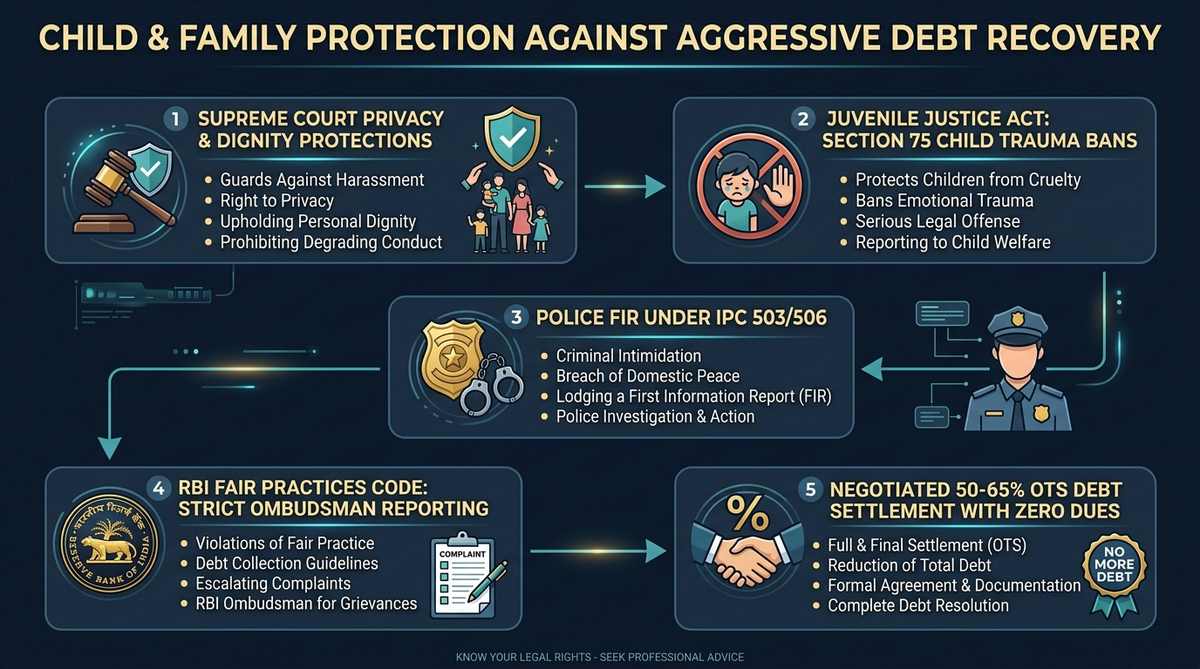
5. Child Protection Legal Defense Roadmap
The visual roadmap below shows our 5-stage legal defense process. It protects families from home visits, enforces child rights under the Juvenile Justice Act. And secures a formal loan settlement.
6. The Emergency 4-Stage Police
When agents scream outside your door, do not panic or argue. Aggressive agents see panic as weakness. Follow this clear 4-stage protocol to protect your family right away:
Stage 1: Secure the Premises & Dial Emergency Police (100 / 112)
Lock your main door. Move children and elderly parents to an inner room. Dial 100 or 112 immediately. Tell the police that unknown persons are trespassing, banging on doors. And terrorizing your family.
Stage 2: Capture Continuous Audio-Video & CCTV Evidence
Record clear video through your peephole, window, or camera. Capture the agents&apos. faces, shouting. And door banging. Ask them to show their DRA ID cards and bank letters through the grill. Do not open the door.
Stage 3: Lodge Formal Police FIR & RBI Ombudsman Complaint
Work with a lawyer to file a police complaint under Sections 441, 503, 506, and 509 IPC (Sections 329, 351, and 79 BNS) and Section 75 JJ Act. File an urgent complaint on the RBI CMS portal (cms.rbi.org.in).
Stage 4: Serve Advocate Cease-and-Desist Notice on Bank Leadership
Your lawyer sends a legal notice to the bank's MD, Nodal Officer. And agency heads. The notice cites criminal acts and child trauma, demanding an immediate stop to visits and open settlement talks.
Following this protocol stops home harassment quickly. It shifts legal pressure onto the lender and restores peace to your family.
7. Converting Home Harassment into an Affordable 45%–65%
Proof of home harassment gives you strong legal leverage. When banking lawyers present evidence of violations, lenders want to settle quickly. They prefer an out-of-court agreement over public fines and police scrutiny.
Instead of paying unfair fines and compound interest, our legal team negotiates a structured One-Time Settlement (OTS):
Submit verified proof of income loss, job disruption, or medical emergencies. This shows your default was genuine and unavoidable.
Remove all penal interest and late fees. Secure a 45% to 65% reduction on the underlying principal balance based on the loan's NPA aging.
Add a binding term in the settlement agreement. The bank must recall all agents and permanently ban home visits.
Pay the settled amount in 2 to 4 monthly installments. This lets you clear debt without draining family savings.
8. Sanction Letter Forensics, Direct Bank Remittance, RBI ₹0
You must stay alert during a debt settlement. Some rogue agents share fake letters on chat apps or take cash payments that never reach the bank. Never pay money until your lawyer reviews the official sanction letter.
- Official Bank Letterhead &. Zonal Reference: The letter must be on official bank stationery with a valid reference number and manager signature.
- Exact Borrower &. Account Identifiers: It must state your full name, PAN. And exact loan account number without error.
- Unambiguous Full closure Recital: It must state explicitly that the debt is fully settled once payment is made.
- Direct Loan Account payment: Pay only into your loan account via NEFT, RTGS, or official bank channels. Never pay cash or use personal UPI IDs.
Under RBI Circular RBI/2023-24/60, banks and NBFCs must issue a No Dues Certificate (NDC) / Loan Closure Certificate and update credit bureaus to zero balance within 30 calendar days of final payment. Lenders that miss this deadline must pay ₹5,000 per day to the borrower.
CIBIL Bureau Reporting Trajectory & Credit Rehabilitation
After settlement, the bank marks your credit report as "Settled" or "Post-Write-off Settled" with a current balance of ₹0. Your score may drop by 70 to 120 points initially. However, it stops further fines and ends collection calls. Using a secured card and making on-time payments will restore your credit score above 750 in 18 to 24 months.
9. Family Harassment Legal Defense Matrix
Reviewing your legal options helps you pick the right way to protect your home and settle your debt safely:
| Resolution Channel. | Legal Basis &. Limitations. | Family &. Child Protection. | Typical Resolution Time. | Final Legal Effect. |
|---|---|---|---|---|
| Residential Collection Actions. | Illegal pressure violating RBI Fair Practices Code. | Zero Protection (causes child trauma and distress). | Indefinite / Recurring. | Exposes lender to police action and RBI fines. |
| Emergency Police FIR &. JJ Act. | Sections 441, 503, 506 IPC &. Sec 75 Juvenile Justice Act. | Immediate Police Restraint &. Criminal trial. | 24 – 48 Hours. | Stops home visits instantly. detains rogue recovery agents. |
| RBI Banking Ombudsman. | RBI Integrated Ombudsman Scheme 2021 (Deficiency in Service). | Orders immediate stop to illegal visits. | 30 – 45 Days. | Regulatory order forcing bank compliance &. legal damages. |
| Advocate-Led 55% OTS. | Consensual settlement Agreement. | 100% Home Ceasefire &. Permanent Debt Freedom. | 15 – 30 Days. | Absolute debt closure with official ₹0 NDC. |
10. SettleLoans Child
Protecting your family from aggressive debt collectors requires experienced banking defense lawyers. Our advocates know how to enforce the Juvenile Justice Act and Supreme Court rulings. SettleLoans helps distressed borrowers across India. We issue legal notices to bank leaders, file police complaints. And handle RBI Ombudsman cases. We negotiate directly with bank zonal heads to secure 45% to 65% principal waivers and official No Dues Certificates.

Settle Loan is India's trusted debt relief and loan settlement platform. We help borrowers overcome financial distress by negotiating with banks and NBFCs to legally settle personal loans and credit card debts. With our transparent, performance-based approach, you can achieve debt freedom and regain your financial peace of mind.
COMPUTER
11. FAQs: Recovery Agents Shouting at Home
Direct answers to common questions on home recovery visits, child rights under the Juvenile Justice Act. And legal debt settlement in India.
Can a recovery agent shout at my home or bang on my door in front of my children?
No. Shouting, banging doors, or using bad language at your home is illegal. These acts violate the RBI Fair Practices Code. They also violate privacy rights under Article 21. Causing mental trauma to kids violates Section 75 of the Juvenile Justice Act. It is also a crime under Sections 441, 503, 506, and 268 of the IPC (Sections 329, 351, and 270 BNS).
What child protection laws apply if recovery agents cause psychological trauma to minors?
Section 75 of the Juvenile Justice Act, 2015 protects minors. Anyone who causes mental cruelty or emotional distress to a child faces up to three years in prison. Creating scary scenes at a child's home or school is a serious offense. You can report it to local police, Child Welfare Committees (CWCs). And the NCPCR.
What immediate steps should I take if recovery agents are screaming outside my home right now?
Call 100 or 112 right away for police help. Report criminal trespass and harassment. Record video and audio through your door or window. Capture their faces and abusive words. Ask for their DRA ID cards and bank letters through the door grill. Do not open the door. Contact a debt lawyer to file an urgent complaint.
Can recovery agents question, intimidate, or talk to my children or elderly parents?
No. Under RBI Master Directions, recovery agents cannot talk to third parties, minors, or elderly parents. They cannot share debt details with family or neighbours. Talking to or scaring children violates banking rules and child protection laws.
What criminal charges can be filed against aggressive recovery agents?
You can file a Police FIR under Section 441/447 IPC (Criminal Trespass) and Section 503/506 IPC (Criminal threats). You can also use Section 268/290 IPC (Public Nuisance), Section 509 IPC (Words outraging modesty of women), Section 383/384 IPC (Extortion), and Section 75 JJ Act. These correspond to Sections 329, 351, 270, 79, and 308 of the BNS, 2023.
What are the permitted visiting hours for loan recovery agents under RBI rules?
Under RBI rules, recovery agents may visit only between 8:00 AM and 7:00 PM on working days. Visiting before 8:00 AM or after 7:00 PM is strictly banned. Visits on holidays without prior consent are also prohibited. You can report breaches to the RBI Banking Ombudsman.
How does documenting home harassment help in negotiating a One-Time Settlement (OTS)?
When a lawyer shares clear video and audio evidence with the bank's Nodal Officer, the bank faces serious fines. The bank also risks police action. To avoid fines and public backlash, bank leaders usually withdraw the agency. They then approve a 45% to 65% OTS waiver.
Can the police arrest recovery agents for shouting and intimidating families at home?
Yes. If your complaint includes video proof of trespass, threats, or abuse toward women and children, police can act. Officers can detain the agents on the spot. They can register an FIR and summon the agency managers and bank officials.
What must be verified in an official One-Time Settlement sanction letter?
An authentic OTS letter must be on official bank letterhead with a reference number. It must show your full name, PAN. And loan account number. It must state the exact settlement amount and payment schedule. It must also confirm that all remaining dues are closed once you pay.
What is the mandatory RBI timeline for issuing a No Dues Certificate following settlement?
Under RBI Circular RBI/2023-24/60, lenders must issue a No Dues Certificate (NDC) within 30 days of final payment. They must also update credit bureaus to a zero balance. Lenders that miss this 30-day deadline must pay the borrower ₹5,000 per day of delay.