- No Third-Party Disclosures: RBI rules ban banks from contacting neighbours, guards. or landlords about your loans.
- Privity of Contract: Landlords and neighbours are legal strangers to your loan. Banks cannot harm your tenancy.
- Right to Privacy: Under the Supreme Court Puttaswamy ruling, privacy is protected under Article 21.
- Criminal Slander & Trespass: Agents face criminal charges under Section 356 BNS, Section 329 BNS. and Section 351 BNS.
- Settlement Scope: A legal notice stops home visits fast. It leads to an official 45% to 65% One-Time Settlement.
1. The Crisis of Social Shaming
Loan disputes should never reach your doorstep. Yet many harsh collection agencies cross the line. Agents shout in apartment hallways. They knock on doors nearby. They ask guards about personal matters. They also call landlords with false threats.
These harsh tactics aim to cause social shame and fear. Collection agents know that families worry about losing their homes. By spreading loan gossip in a building, agents try to force quick payments. They want you to take costly loans or use retirement savings to pay.
Under the Indian Contract Act, 1872, a loan binds only the lender and debtor. Neighbours, society committees. And landlords are legal strangers to the debt. Banks have no right to share debt data with them.
Under the Transfer of Property Act, 1882, rent laws protect tenants. You cannot be evicted for an unsecured loan default. Personal loans create no lien on rented homes.
When agents humiliate you before neighbours, debt recovery becomes illegal abuse. Indian law provides strong legal shields. You can stop home collection visits for good.
2. Privacy & Anti-Defamation Protections
Indian law and Reserve Bank of India rules protect debtors. bank lenders cannot use public shaming, third-party calls. or home threats. A clear legal shield protects you from abusive tactics.
In Justice K.S. Puttaswamy (Retd.) v. Union of India (2017), the Supreme Court declared privacy a basic right under Article 21. This protects personal dignity and loan data. In ICICI Bank v. Shanti Devi Sharma (2008), the court ruled that banks cannot use musclemen or force that disrupts peace.
The RBI Fair Practices Code orders lenders to avoid threats. Agents cannot share loan details with family, neighbours. or third parties.
Under RBI rules on outsourcing, agents can visit only between 8:00 AM and 7:00 PM. Visits outside these hours break rules.
Under Sections 43A and 72A of the IT Act and data protection laws, leaking money data to third parties is illegal.
When agents contact your landlord or speak with neighbours, the bank breaks regulatory rules. Banks remain liable for agency actions. Advocates use these violations to demand action before the Banking Ombudsman and courts.
Check Your Loan Settlement Options
Answer 2 quick questions to evaluate your settlement eligibility.
1. What type of loan do you want to settle?
3. Criminal Defamation, Society Trespass
Sharing loan defaults with neighbours, security guards. or landlords is a crime. It is also a civil wrong. Spreading private money data to shame someone is criminal slander and threats under Indian law.
Debtors facing home abuse can use strong legal protections under the Bharatiya Nyaya Sanhita (BNS), 2023. And the Indian Penal Code (IPC).
Criminal Defamation (Section 356 BNS 2023 / Section 499 & 500 IPC)
Publishing statements to hurt someone's reputation is criminal slander. Telling neighbours or landlords about debt to harm social standing brings up to two years in jail, a fine. or both.
Criminal Trespass (Section 329 BNS 2023 / Section 441 & 447 IPC)
Entering apartment buildings without consent. or staying to insult residents, is criminal trespass punishable by jail.
Criminal Intimidation & Extortion (Section 351 & 308 BNS / Sections 503, 506 & 384 IPC)
Threatening a debtor with eviction or social shame to force payment is criminal threats and extortion under Indian law.
RWA Society Bye-Laws & Civil Injunctions (Order 39 CPC)
Resident Welfare Associations can bar rogue recovery agents under society bye-laws. Advocates can also obtain civil court injunctions under Order 39 Rules 1 & 2 CPC to block visits.
When legal counsel issues formal notices citing these criminal sections and privacy rulings, lenders back down. They realize that home visits expose them to severe legal fines.
4. Bank Provisioning & Social Shaming Risks
To stop recovery abuse, debtors should understand bank incentives. Banks rarely send branch staff to homes. When a loan is 60 to 90 days overdue, banks hire Direct Recovery Agencies (DRAs). These agents work on commission.
Under RBI rules. When an account is past due for 90 days, it becomes a defaulted Asset (NPA). The bank must lock up capital in reserve funds.
| default status. | Overdue Aging Timeline. | Mandatory RBI Capital Provision. | Settlement / Haircut Scope. |
|---|---|---|---|
| SMA-1 / SMA-2. | 31 to 90 days overdue. | 5% general capital reserve. | Waiver of late fees and penal interest. |
| Substandard NPA. | 91 to 365 days overdue. | 25% unsecured reserves reserve. | 35% to 45% principal reduction. |
| Doubtful NPA 1. | 12 to 24 months in default. | 100% unsecured reserves reserve. | 45% to 55% principal reduction. |
| Doubtful NPA 2 / Loss Asset. | Over 24 months overdue. | 100% full balance sheet write-off. | 55% to 65% principal reduction. |
Third-party agents earn commissions only if they recover cash quickly. This drives rogue agents to use social shaming. When an advocate steps in, bank committees evaluate the file using the Net Present Value (NPV) of Recovery model.
Here C_t is the expected cash recovery. And r is the discount rate. Deductions include court costs, lawyer fees, Ombudsman fines. And funds locked in NPA reserves.
Notices documenting slander, trespass. and RBI violations show the bank its legal risks. Fighting complaints costs more than settling the loan. Accepting a 40% to 55% settlement payment through an official One-Time Settlement becomes the bank's best money choice.
5. Neighbour Harassment Defense Roadmap
The roadmap below shows how banking defense advocates stop neighbour abuse, enforce privacy rights. And secure an official debt settlement.
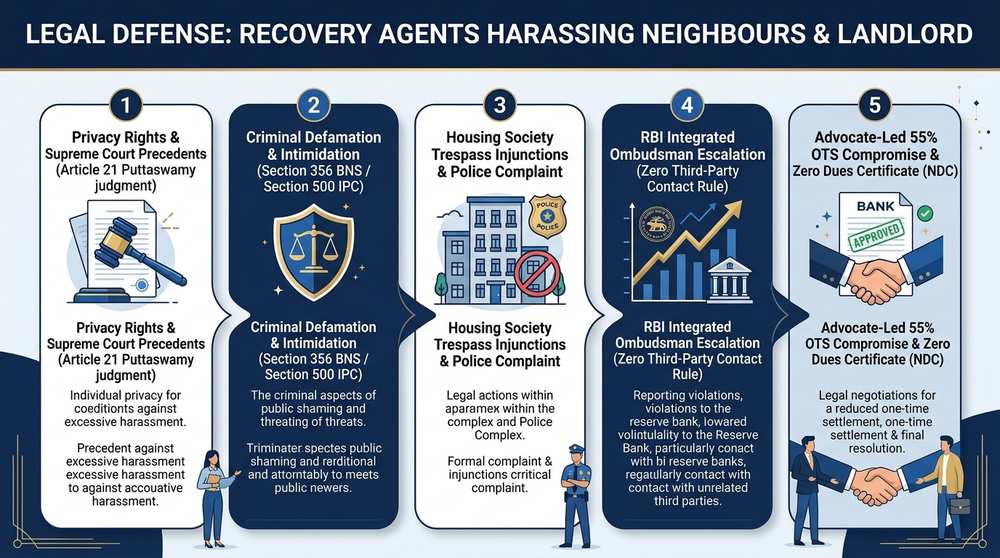
6. The Emergency 4-Stage Advocate Protocol to Halt Harassment
When an agent contacts your landlord or neighbours, arguing at the door will not help. Rogue collectors see panic as leverage. Banking defense advocates use a 4-stage legal plan to stop abuse.
Stage 1: Evidence Preservation & Landlord Legal Reassurance
Collect all evidence at once. Save CCTV clips, hallway audio, security logs. And phone chats. Give your landlord a legal letter explaining Privity of Contract to show the debt cannot touch the property.
Stage 2: Serving Advocate Legal Notice for Defamation & Trespass
Your advocate serves a legal notice on the bank Nodal Officer and agency heads. The notice cites Section 356 BNS, Section 329 BNS, Puttaswamy. and RBI rules to halt visits within 48 hours.
Stage 3: RWA Society Security Gate Ban & RBI Ombudsman Filing
Send a formal letter to your RWA requesting security guards to block agency staff. File an urgent complaint on the RBI CMS portal (cms.rbi.org.in) for fair practice violations.
Stage 4: Strategic Transition to Structured Debt Settlement
With abuse stopped and the bank under scrutiny, advocates step in. We transfer the account for a discounted One-Time Settlement.
This legal process stops lender pressure, restores peace in your building. And helps you recover financially.
7. Converting Residential Harassment into an Affordable OTS
Home abuse shows that the bank faces pressure from rising NPA reserves. They use social shaming because they lack legal options to seize your assets. Documenting these violations turns an unfair situation into strong leverage for an official One-Time Settlement (OTS).
Instead of paying heavy fines, our legal advocates settle fair settlement terms directly with bank committees.
Submit verified proof of genuine money hardship. Share medical records, job loss letters. or business drops to show the default was unintentional.
Demand total removal of late fees, penal interest. And legal costs. Seek a 45% to 65% reduction on principal based on loan aging.
Include a clear clause requiring the bank to recall recovery files. Demand an end to all contact with neighbours and landlords.
Divide the negotiated settlement sum across 2 to 4 monthly installments. This lets you clear the debt comfortably.
8. Sanction Letter Forensics & NDC for Harassed Borrowers
Debtors facing harsh collection agencies must stay alert during settlement. Collectors sometimes share fake letters on WhatsApp or ask for cash. Never transfer money until an advocate reviews and confirms the sanction letter.
- Official Letterhead: The letter must be on bank letterhead with a reference number and signature of an authorized manager.
- Account Details: It must state your full legal name, PAN. And exact loan account number.
- Full Debt Closure: It must state that paying the agreed sum clears all balances and legal claims.
- Direct Bank Payment: Payments must go directly to your loan account via NEFT/RTGS, never to an agent or personal account.
Under RBI Circular RBI/2023-24/60, all banks and NBFCs must deliver an official No Dues Certificate (NDC) within 30 calendar days. They must also update credit bureaus to zero. Unjustified delays incur a penalty of ₹5,000 per day paid to the debtor.
CIBIL Bureau Reporting Trajectory & Credit Score Rehabilitation
After settlement, the bank marks your credit bureau record as "Settled" with a balance of ₹0. While this causes a temporary score dip, it stops default fines and ends abuse. Use a secured credit card. Keep card usage under 30%. This rebuilds credit scores above 750 within 18 to 24 months.
9. Neighbour Defamation Legal Defense Matrix
Review available legal options to protect your dignity, tenancy. And money future:
| Solution Channel. | Legal Basis & Limitations. | Home Protection Scope. | Typical Solution Time. | Final Legal Effect. |
|---|---|---|---|---|
| Home abuse Tactics. | Illegal force violating privacy rules. | Zero protection with high risk of social shaming. | Indefinite or recurring. | Exposes lender to criminal slander and fines. |
| Civil Court Injunction (Order 39 CPC). | Civil court injunction against abuse. | Blocks entry into society and third-party contact. | 1 to 3 months. | Court restraining order with contempt fines. |
| RBI Banking Ombudsman. | RBI Integrated Ombudsman Scheme 2021. | Orders an immediate stop to third-party contact. | 30 to 45 days. | Regulatory order forcing bank compliance. |
| Advocate-Led 55% OTS. | Consensual settlement agreement. | Full home ceasefire and permanent debt relief. | 15 to 30 days. | Full debt closure with official ₹0 NDC. |
10. SettleLoans Legal Defense for Privacy Violations
Stopping illegal home collection requires expert banking advocates. We enforce RBI Master Directions and Supreme Court privacy rulings. SettleLoans provides complete legal defense. We send emergency notices to bank leadership. We file RBI Ombudsman complaints. We reassure landlords and settle 45% to 65% settlement waivers with official No Dues Certificates.

Settle Loan is India's trusted debt relief and loan settlement platform. We help borrowers overcome financial distress by negotiating with banks and NBFCs to legally settle personal loans and credit card debts. With our transparent, performance-based approach, you can achieve debt freedom and regain your financial peace of mind.
COMPUTER
11. FAQs: Recovery Agents Harassing Neighbours & Landlords
Verified legal answers on home debt collection, neighbour disclosures. And loan settlements in India.
Can a bank recovery agent legally talk to my neighbours or landlord about my loan?
No. Under RBI rules and Privity of Contract, banks cannot share debt details with third parties. Talking to neighbours or landlords breaks privacy laws. It is also criminal slander under Section 356 BNS and Section 500 IPC.
What should I do if a recovery agent creates a scene in my apartment corridor or society?
Record phone video and audio right away. Get CCTV footage from society guards. File a trespass complaint with your RWA. Have a lawyer send a legal notice to the bank Nodal Officer.
Can my landlord evict me because a bank recovery agent visited or called them?
No. A landlord cannot evict you. bank recovery calls. Under tenancy laws and the Transfer of Property Act, eviction needs valid legal grounds. A lawyer can send a letter to reassure your landlord.
Can recovery agents enter a gated housing society without resident authorization?
No. Gated housing societies are private property managed by RWA rules. Agents cannot force entry past security gates. Entering without permission is criminal trespass under Section 329 BNS.
Which police sections apply when recovery agents intimidate neighbours or landlords?
You can file police complaints under Section 329 BNS for trespass. Use Section 356 BNS for slander. Use Section 351 BNS for criminal threats. and Section 308 BNS for extortion.
What are the permitted hours for recovery agents to visit a residential address?
Under RBI rules, agents can visit only between 8:00 AM and 7:00 PM. Any visit before 8:00 AM or after 7:00 PM violates rules. It invites RBI Ombudsman fines.
How does neighbour and landlord harassment create leverage for a loan settlement?
When a lawyer records RBI violations, trespass. And slander, banks face big regulatory fines. To avoid fines and public complaints, banks often approve a 45% to 65% One-Time Settlement.
What documents must a recovery agent carry when visiting a borrower's home?
Every recovery agent must carry an official bank ID card. They must show an IIBF DRA certificate. They also need a bank visit authorization letter. Without these, they are illegal trespassers.
What is the mandatory RBI deadline for issuing a No Dues Certificate after settlement?
Under RBI Circular RBI/2023-24/60, banks must issue an NDC within 30 days of full payment. Any delay costs the bank ₹5,000 per day in penalty paid to the debtor.
Can a housing society RWA ban recovery agents from entering the complex?
Yes. Resident Welfare Associations (RWAs) can ban recovery agents under society bye-laws. If agents make noise or harass residents, RWAs can block them at the gate.