- Statutory Definition of Unfair Contract: Section 2(46) of CPA 2019 outlaws one-sided terms. It bans heavy fines. It bars sudden loan recalls. It stops secret rate hikes.
- Adhesion Contracts Are Not Inviolable: Standard loan forms cannot force unfair terms on you. The Supreme Court protects borrowers with low bargaining power.
- Strict RBI Penal Interest Prohibition: The RBI Fair Lending rules ban penal interest. Banks cannot add default fees to your principal debt.
- Judicial Power to Declare Terms Null &. Void: Consumer Courts can strike down bad terms under Sections 39, 47, and 58. They can order refunds and grant damages.
- Leverage into 50%–70% OTS Waivers: Challenging unfair terms stops compounding fees. It pushes lenders to grant a 50% to 70% OTS debt waiver.
1. Demystifying Standard Form Adhesion Contracts
Borrowers often receive standard loan forms. These are adhesion contracts. Banks draft them for their own safety. Borrowers cannot change individual terms.
Borrowers need fast loans. They face large banks with unequal power. On loan apps, users tap 'I Agree&apos. to long terms. Most do not see hidden rate hikes or extra fee clauses.
Indian law protects you from bad loan terms. CPA 2019 gives you strong legal tools. You can challenge, void. And strike out unfair terms.
The Legal Reality of Adhesion Contracts in Banking
A standard contract is void if it hurts consumers with zero power. Courts can strike out bad terms while keeping your settlement valid.
2. Statutory Laws Against Unfair Loan Terms
Before 2019, borrowers used Section 23 of the Indian Contract Act, 1872. This led to slow civil trials. The Consumer Protection Act, 2019 (CPA 2019) fixed this via Section 2(46). This section defines an 'unfair contract&apos. in clear words.
Under Section 2(46), an unfair term changes consumer rights. The law bans six key types of terms:
| Statutory Sub-Clause. | Prohibited Contractual Practice. | Manifestation in Bank Loan Contracts. |
|---|---|---|
| Section 2(46)(i). | Demanding excessive security deposits for performance. | Demanding big cash margins or fixed deposit liens far beyond loan risk. |
| Section 2(46)(ii). | Imposing disproportionate fines for contract breach. | Compounding penal fees, high late charges (24%–36% p.a.). And repeated bounce costs. |
| Section 2(46)(iii). | Refusing early repayment or imposing unreasonable conditions. | Levying illegal foreclosure fees on floating rate retail loans against RBI rules. |
| Section 2(46)(iv). | Permitting one-sided termination without reasonable cause. | Recalling a loan or freezing credit lines without a default or formal notice. |
| Section 2(46)(v). | Permitting one-sided assignment to consumer's detriment. | Selling overdue loans to recovery agents without prior notice. |
| Section 2(46)(vi). | Imposing unreasonable charges, duties, or conditions. | Hiking interest spreads without notice and enforcing biased arbitration clauses. |
The Supreme Court protects borrowers from one-sided terms. In Central Inland Water Transport Corporation Ltd. v. Brojo Nath Ganguly (1986) 3 SCC 156, the Court held that unfair terms signed under unequal power are void.
This was reaffirmed in Pioneer Urban Land and Infrastructure Ltd. v. Govindan Raghavan (2019) 5 SCC 725. The Apex Court held that one-sided terms are unfair trade practices. Borrowers are not bound by bad terms.
Check Your Loan Settlement Options
Answer 2 quick questions to evaluate your settlement eligibility.
1. What type of loan do you want to settle?
3. Anatomy of Oppressive Banking Clauses
Personal loans, credit cards. And business credit lines often contain bad terms. Lenders rely on four main types of abusive clauses:
Compounding Penal Interest & Fee Pyramids
Clauses letting banks charge 24%–36% penal fees. Adding fines to principal violates Section 2(46)(ii) and RBI Master Directions.
Unilateral Benchmark Escalation & Reset Covenants
Clauses letting banks raise loan spreads without notice. Under Section 2(46)(vi), borrowers must get a fair exit choice.
Unilateral Sole Arbitrator Appointment Clauses
Clauses letting banks pick a sole arbitrator in distant cities. The Supreme Court in Perkins Eastman and TRF Limited held these clauses invalid.
Unilateral Acceleration & Third-Party Disclosure
Clauses letting banks recall a loan for minor issues. Sharing borrower data with recovery agents also breaches privacy norms.
In April 2024, the RBI issued clear rules to all banks and NBFCs. Lenders cannot treat penal fees as interest rates. They cannot compound default fees. Enforcing old penalty clauses breaches both CPA 2019 and RBI rules.
4. Bank NPA Accounting & NPV Dynamics
Banks follow RBI rules on loan defaults. They apply the RBI Prudential Norms on IRACP. These rules give borrowers leverage in loan settlement talks.
Loans past 90 days become NPAs. Banks must set aside cash reserves for bad debts:
| Classification Stage. | default Duration. | Mandatory RBI Capital Provision. | Legal Vulnerability &. Settlement Stance. |
|---|---|---|---|
| SMA-1 / SMA-2. | 31 to 90 Days Overdue. | 5% General Capital Provisioning. | Penalty waiver requests. restructuring available. |
| Substandard NPA. | 91 to 365 Days Overdue. | 25% Unsecured Provisioning Allocation. | Bank waives 100% penal interest. 35% OTS ready. |
| Doubtful NPA 1 (D1). | 1 to 2 Years Delinquent. | 100% Unsecured Capital Provisioning. | High urgency. 45%–60% principal discount. |
| Doubtful 2 / Loss Asset. | 2+ Years / Written-Off. | 100% Balance Sheet Write-Off. | Maximum flexibility. 60%–75% full debt haircut. |
When you challenge unfair loan terms under Section 2(46), banks check their recovery costs. They face court delays, fee cuts. And high legal bills:
C_t is future cash. r is capital cost. Deductions cover court fee cuts and lost fines.
Fighting loan contracts in consumer court brings public risk. Courts often strike out bad fees. Thus, banks prefer deep OTS discounts for fast cash closure.
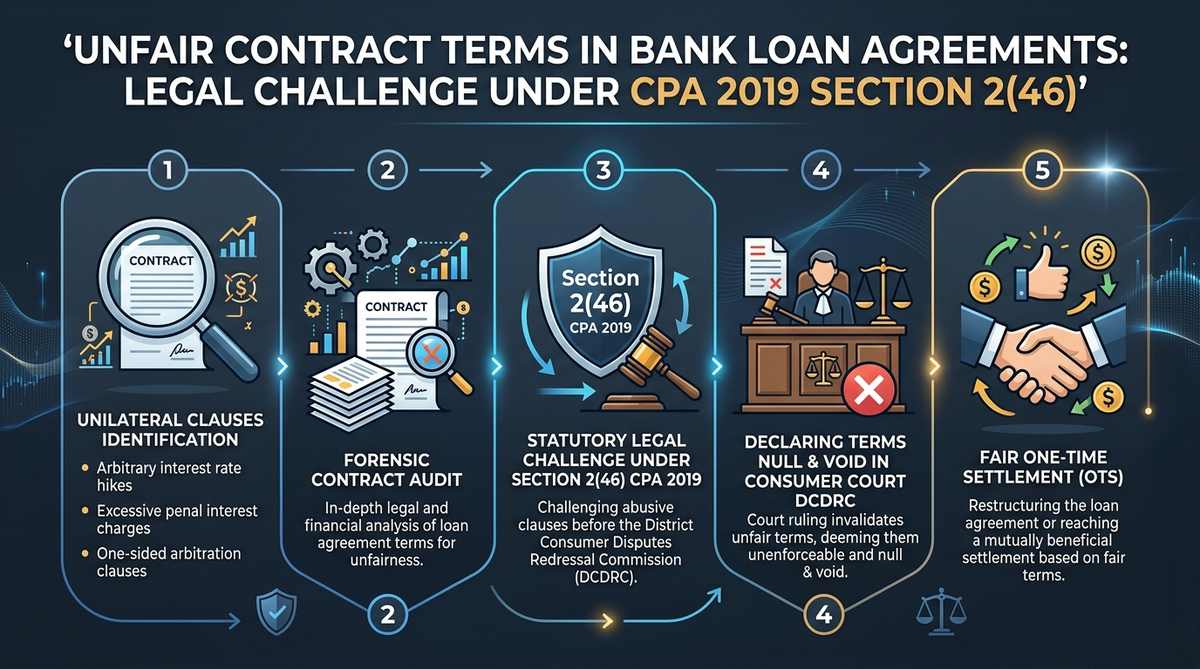
5. Statutory Contractual Challenge
This 5-stage roadmap shows how to challenge unfair terms. You can audit clauses, file under CPA Section 2(46). And secure an OTS.
6. Forensic Sanction Letter
Audit your loan papers before filing a case:
RBI rules mandate a Key Fact Statement (KFS). It must state the APR and all fees upfront. Without a KFS, hidden fees are void.
Check if the bank raised interest rates without notice. Look for rate hikes without benchmark changes.
Check if late fees were added to principal debt. This violates RBI rules and CPA Section 2(46)(ii).
Check if clauses force arbitration in far cities. Under Section 34 of CPA 2019, you can file cases locally.
7. Judicial Invalidation
The Consumer Protection Act, 2019 gives courts power to void unfair terms. State and National Commissions act under Section 47(1)(a)(ii) and Section 58(1)(a)(ii).
District Consumer Commissions (DCDRC) give swift relief under Section 39(1):
Direction to Remove Deficiencies & Abusive Clauses
Under Section 39(1)(b), courts strike out unfair terms. They fix your loan balance.
Restitution & Complete Refund of Unauthorized Levies
Under Section 39(1)(c), courts order refunds of all illegal fees and extra interest.
Monetary Compensation for Mental Agony & Distress
Under Section 39(1)(d), courts award payout for mental agony from harsh debt collection.
Cease-and-Desist Orders Against Unfair Trade Practices
Under Section 39(1)(g), courts stop banks from using unfair recovery tactics.
8. Strategic Leverage
Challenging bad contract terms gives you strong leverage. Normal recovery agents demand full payments with heavy fees.
When your lawyer sends a notice under CPA Section 2(46), your file moves to the bank Stressed Assets team. Lenders want to avoid court losses:
The Dual-Track Strategic Resolution Framework
The bank issues an OTS sanction letter. Pay the agreed sum to get a ₹0 No Dues Certificate (NDC). The bank then updates CIBIL, Experian, CRIF High Mark, and Equifax.
9. Contractual Dispute Redressal Comparative Matrix
Borrowers facing unfair terms have several legal paths. The table below compares forums, timelines, costs. And settlement leverage:
| Redressal Forum / Channel. | Governing Statutory Act. | Power to Invalidate Clauses. | Resolution Timeline. | Settlement Leverage. |
|---|---|---|---|---|
| Consumer Court (DCDRC / SCDRC). | Section 2(46), 39, 47 Consumer Protection Act 2019. | Full power to declare unfair terms null &. void. | 6 to 18 Months. | Very High (Legal risk prompts 50%–70% OTS). |
| RBI Integrated Ombudsman. | Reserve Bank Integrated Ombudsman Scheme, 2021. | Orders refund of illegal fees and charges. | 3 to 6 Months. | High (Direct regulatory pressure on bank officers). |
| Civil Court Declaratory Suit. | Section 34 Specific Relief Act &. Sec 23 Contract Act. | Can declare terms void through full trial. | 3 to 7 Years. | Moderate (Long court timelines delay settlements). |
| Commercial Arbitration Defense. | Arbitration &. Conciliation Act, 1996 (Sec 11/14/34). | Can challenge biased sole arbitrator appointments. | 12 to 24 Months. | Moderate (Higher advocate and tribunal costs). |
| Advocate-Led Direct OTS Compromise. | Hardship Representation &. Statutory Legal Notice. | Uses unfair terms as leverage for major discounts. | 30 to 60 Days. | Maximum (Quickest route to full debt relief and ₹0 NDC). |
10. SettleLoans Contractual Defense
Facing unfair bank loan terms needs expert legal help. At SettleLoans, our banking lawyers protect borrowers across India.
We audit loan contracts and issue legal notices. We file consumer cases and negotiate 50% to 70% OTS waivers. We help you clear your debt with ease.

Settle Loan is India's trusted debt relief and loan settlement platform. We help borrowers overcome financial distress by negotiating with banks and NBFCs to legally settle personal loans and credit card debts. With our transparent, performance-based approach, you can achieve debt freedom and regain your financial peace of mind.
COMPUTER