- Statutory Debt Assignment under SARFAESI: Under Section 5 of the SARFAESI Act, 2002, the bank legally sells and assigns all contractual rights and security interests to the ARC, freeing the originating bank from the debt.
- Steep 15%–25% Acquisition Cost Basis: ARCs purchase pools of non-performing loans from banks at deep discounts (paying 15 to 25 paise per rupee), giving them immense financial flexibility to grant massive settlement waivers.
- 70% to 80% Principal Haircut Opportunity: Because the ARC only needs to recover slightly above its discounted purchase price to realize strong internal rates of return, borrowers can secure unprecedented 70%–80% compromise settlements.
- Strict Security Receipts (SR) Redemption Windows: ARCs operate under strict 5-to-8 year RBI resolution timelines to redeem Security Receipts, creating powerful institutional urgency to accept cash settlements.
- Total Debt Extinguishment & ₹0 CIBIL Update: A formal One-Time Settlement executed directly with the ARC permanently discharges the borrower, releases all liens, and updates credit bureau balances to ₹0.
1. Demystifying Debt Assignment: What Happens When a Bank
Discovering that your commercial bank or Non-Banking Financial Company (NBFC) has sold or assigned your delinquent loan to an Asset Reconstruction Company (ARC) often triggers severe anxiety. Borrowers across India—whether managing defaulted personal loans, business credit facilities, home loans, or credit cards with major institutions such as State Bank of India, HDFC Bank, ICICI Bank, Axis Bank, Kotak Mahindra Bank, or Punjab National Bank—frequently receive sudden notices from unfamiliar entities like Phoenix ARC, ARCIL (Asset Reconstruction Company India Ltd), Edelweiss ARC, CFM ARC, Prudent ARC, Omkara ARC, UV ARCL, or Invent ARC.
The common initial reaction is panic: borrowers fear they have been transferred to unregulated private recovery syndicates or that their financial liability has multiplied overnight. In reality, a bank selling your loan to an ARC represents a formal institutional transaction known as Debt Assignment or Distressed Asset Acquisition. Far from being a catastrophic legal trap, the transfer of your debt to an ARC frequently opens the single greatest window of opportunity to settle your outstanding liabilities at an extraordinary 70% to 80% discount.
When a commercial bank classifies an advance as a Non-Performing Asset (NPA) that remains unrecovered past 180 to 365 days, the loan becomes an expensive balance sheet liability. Under Reserve Bank of India (RBI) prudential norms, the originating bank is forced to lock away valuable capital in mandatory 100% loss provisions. To scrub their books clean of gross NPAs, improve regulatory capital adequacy ratios, and recover immediate liquidity, banks package these non-performing advances into distressed debt portfolios and auction them off to specialized Asset Reconstruction Companies.
Once the assignment agreement is formally executed, the originating bank permanently exits the relationship. The original loan account is marked as sold or assigned in banking records, and the ARC steps into the shoes of the lender as your sole legal creditor. Understanding the commercial mechanics, regulatory rules, and accounting economics governing ARCs transforms a perceived legal crisis into an unparalleled financial settlement advantage.
2. Statutory & Regulatory Framework: SARFAESI Section 5, Debt Novation & Legal Assignment
The assignment of non-performing bank debt in India is strictly codified under federal statutes and RBI prudential directions. A bank cannot arbitrarily transfer loan contracts without adhering to precise statutory mechanisms established under the Securitisation and Reconstruction of Financial Assets and Enforcement of Security Interest (SARFAESI) Act, 2002, the Indian Contract Act, 1872, and the Transfer of Property Act, 1882.
The core statutory engine enabling distressed debt transfers is Section 5 of the SARFAESI Act, 2002 (Acquisition of rights or interest in financial assets by asset reconstruction company). The critical legal pillars governing this statutory transfer include:
Any registered ARC may acquire financial assets of any bank or financial institution by issuing debentures, bonds, or cash consideration, or by entering into an agreement for the transfer of such assets with all underlying terms, covenants, and securities.
Upon acquisition, all contracts, deeds, bonds, agreements, and security interests (mortgages, hypothecations, personal guarantees) vest automatically in the ARC. The ARC steps directly into the shoes of the originating bank as the deemed lender.
The transferring bank or the acquiring ARC must issue a formal written Intimation of Debt Assignment to the borrower. The notice must specify the total assigned principal, date of transfer, and verified repayment escrow details.
Debt assignment constitutes the transfer of an actionable claim. Under Indian contract law, the assignment passes all rights and remedies to the assignee, but does NOT impose additional liabilities or higher interest penalties beyond original contract terms.
In a series of authoritative rulings, including decisions by the Supreme Court of India and various High Courts, the judiciary has made it abundantly clear that an ARC acquires only the exact rights possessed by the assignor bank at the date of default. An ARC has zero legal authority to artificially inflate ledger balances by adding arbitrary management charges, unverified collection surcharges, or retroactive compounded penal interest that violates the original sanction agreement or the RBI Master Directions on Fair Practices Code.
Check Your Loan Settlement Options
Answer 2 quick questions to evaluate your settlement eligibility.
1. What type of loan do you want to settle?
3. The ARC Business Model: Discounted Portfolio Purchases (15%–25% Acquisition Cost) & Security Receipts (SRs)
To master the art of negotiating with an Asset Reconstruction Company, a borrower must understand how ARCs make money and how their balance sheets operate. ARCs are not conventional banking institutions that generate revenue from net interest margins on retail deposits. Rather, ARCs are specialized distressed debt funds whose sole objective is to buy non-performing loan pools at rock-bottom prices and resolve them within a defined statutory timeframe to generate high Internal Rates of Return (IRR).
When a commercial bank conducts an NPA portfolio sale, the bidding process reflects the deep distress of the underlying assets. Historically, under the classic 15:85 structure, the ARC paid 15% upfront cash to the bank and issued 85% in Security Receipts (SRs) backed by the acquired distressed assets. Under updated RBI Master Directions on Transfer of Loan Exposures, banks increasingly mandate 100% upfront cash bidding or higher cash proportions for unsecured and retail pools.
Because commercial banks have already written off or heavily provisioned these bad debts on their balance sheets, portfolios are auctioned at massive institutional discounts. For unsecured loans, business overdrafts, and credit card books, ARCs routinely purchase debt pools for 15% to 25% of the total book value (equivalent to paying 15 to 25 paise per rupee of face value). Even for secured residential and commercial mortgage portfolios, acquisition prices typically hover between 35% and 50% of the gross outstanding claim.
Furthermore, ARCs operate under strict regulatory pressure. Under RBI Master Directions on Asset Reconstruction Companies, Security Receipts issued to investors and selling banks carry a statutory resolution horizon—typically capped at 5 years, extendable to a maximum of 8 years with board approval. As the resolution clock ticks toward year 3, 4, and 5, the Net Asset Value (NAV) of the Security Receipts must be downgraded if recovery is stalled, impairing the ARC's management fees and financial standing. This dynamic creates an urgent institutional imperative for the ARC to settle accounts for immediate liquidity.
4. ARC Balance Sheet Economics, Recovery Pressures & The Net Present Value (NPV) Equation
Understanding the mathematical valuation models utilized by ARC resolution committees is the key to unlocking deep 70% to 80% principal haircut settlements. When evaluating a settlement proposal submitted by an advocate on behalf of a distressed borrower, the ARC does not compare the settlement offer to the original loan sanction amount; instead, the ARC benchmarks the offer against its actual acquisition cost basis and the Net Present Value (NPV) of pursuing coercive recovery.
Consider the real-world acquisition and recovery economics governing an assigned distressed asset:
| Distressed Asset Metric | Bank Loan Origin | ARC Acquisition Level | Target OTS Settlement |
|---|---|---|---|
| Unsecured Business Loan / OD | ₹25.0 Lakhs Face Claim | ₹4.5 Lakhs (18% Purchase Price) | ₹6.5 Lakhs (74% Principal Haircut) |
| Personal Loan / Credit Card Pool | ₹10.0 Lakhs Total Ledger | ₹1.5 Lakhs (15% Purchase Price) | ₹2.5 Lakhs (75% Principal Haircut) |
| Secured MSME Mortgage Loan | ₹50.0 Lakhs Demand Notice | ₹17.5 Lakhs (35% Purchase Price) | ₹22.0 Lakhs (56% Total Haircut) |
| Corporate Working Capital Term Loan | ₹1.0 Crore Outstanding | ₹22.0 Lakhs (22% Purchase Price) | ₹30.0 Lakhs (70% Principal Haircut) |
When an ARC purchases a ₹25 Lakh loan for ₹4.5 Lakhs, accepting an immediate One-Time Settlement of ₹6.5 Lakhs yields an absolute cash profit of ₹2.0 Lakhs (a 44.4% return on invested capital) within months of acquisition. To evaluate whether to accept this cash settlement today or proceed with multi-year litigation before Debt Recovery Tribunals (DRT) or Civil Courts, the ARC's investment committee applies the Stressed Asset NPV Recovery Valuation Formula:
Where C_t represents estimated net cash realized from future recovery, r is the ARC's hurdle rate of return (typically 18%–22%), and deductions account for 3 to 6 years of DRT/SARFAESI litigation friction, advocate fees, receiver costs, auction discounts, and rating downgrades on outstanding Security Receipts.
Because litigation across Indian civil courts and DRTs takes an average of 4 to 7 years to execute and incurs heavy legal expenditures, the discounted Net Present Value of future coercive recovery is frequently far lower than an immediate, advocate-negotiated cash settlement. When presented with a structured, verified financial hardship proposal, ARC credit committees eagerly sanction deep principal waivers to lock in immediate balance sheet liquidity.
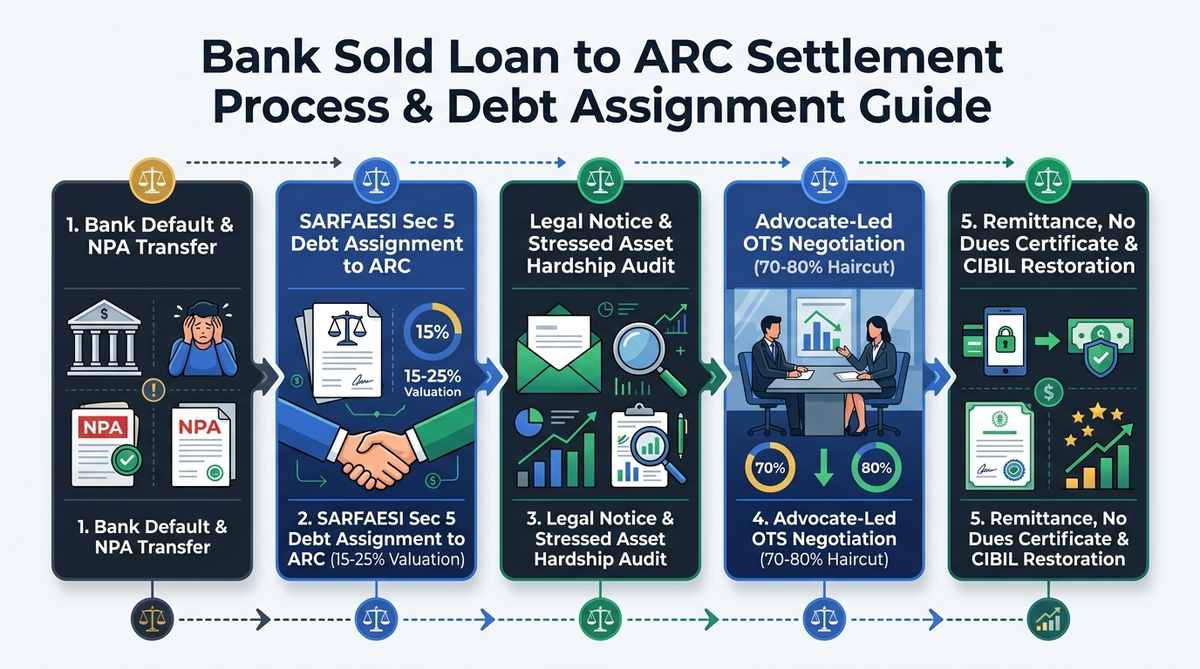
5. Bank Sold Loan to ARC Settlement Visual Roadmap
The visual roadmap below illustrates the structured 5-stage institutional journey from bank NPA classification and SARFAESI Section 5 debt assignment to forensic hardship auditing, advocate-led zonal negotiations, formal ARC OTS sanction issuance, and final RBI No Dues Certificate delivery with credit bureau restoration.
6. Strategic Legal Defense: How Advocates Leverage the ARC Cost Basis to Secure 70%–80% Haircuts
Attempting to negotiate directly with an Asset Reconstruction Company without specialized legal counsel is fraught with peril. While ARCs possess enormous pricing flexibility, their front-line recovery executives and contracted recovery agencies are incentivized through aggressive recovery targets. They frequently employ intimidation tactics, threaten immediate property attachment, and quote inflated figures to extract maximum capital from unrepresented borrowers.
Experienced debt resolution advocates dismantle these aggressive tactics by implementing a methodical 4-phase institutional legal defense:
Phase 1: Notice of Legal Representation & Cease-and-Desist Injunction
Advocates issue a formal Notice of Representation to the ARC's Principal Officer and Legal Recovery Head. This statutory notice invokes the RBI Master Directions on ARC Fair Practices Code, halts all unauthorized recovery agency telephone harassment, forbids intrusive home or workplace visits, and establishes that all further communications must occur exclusively through registered legal counsel.
Phase 2: Forensic Assignment Audit & Legal Vulnerability Check
Our banking lawyers demand and scrutinize the underlying Assignment Agreement, Deed of Assignment, and Schedule of Assets. We examine whether state stamp duty was fully discharged on the assignment instrument under local Stamp Acts, check registration compliance under Section 17 of the Registration Act, 1908, verify whether mandatory Section 5(1A) notices were validly served, and challenge inflated compound interest debits.
Phase 3: Financial Hardship Dossier Submission to ARC Resolution Committees
Bypassing collection agents, advocates engage directly with the ARC's Stressed Asset Resolution Committee located at their corporate headquarters (predominantly in Mumbai, Delhi, or Bangalore). We submit an unassailable financial hardship dossier—comprising audited business profit and loss declines, GST turnover drop proofs, medical disability records, or debt insolvency affidavits—substantiating a permanent incapacity to service the original debt.
Phase 4: Structuring the 70%–80% Haircut Settlement & Lok Adalat Consent
Armed with the ARC's low acquisition cost benchmark, advocates structure a formal compromise settlement offering 20% to 30% of the ledger balance (a 70% to 80% haircut). Where pending litigation exists before DRTs or Civil Courts, we execute a formal Joint Memorandum of Compromise and obtain a consent decree before the National Lok Adalat, ensuring ironclad judicial finality with zero future legal recourse.
By shifting the negotiation battleground from high-pressure recovery calls to executive credit committee boardrooms, borrowers achieve decisive debt relief while remaining completely insulated from legal exposure.
7. Forensic Checklist for Watertight ARC Settlement Letters: Ensuring Absolute Legal Finality
A critical vulnerability in the ARC debt settlement process involves the authenticity and legal phrasing of the One-Time Settlement Sanction Letter. Because ARCs frequently outsource recovery operations to third-party agencies, rogue recovery agents sometimes issue fraudulent, unofficial "settlement approval emails" or verbal assurances to extract partial token payments. Depositing funds without an authentic, legally binding ARC sanction letter leaves your loan open, allowing the ARC to appropriate the money as a simple token credit while continuing recovery actions for the remaining balance.
Before remitting a single rupee, our legal team subjects every ARC settlement letter to five mandatory forensic validation checkpoints:
The sanction letter must be issued on official corporate ARC letterhead, featuring registered CIN numbers, corporate office addresses, unique alphanumeric proposal tracking codes, and verifiable signatures of authorized Vice Presidents or Assistant General Managers.
The document must explicitly cite both the original bank loan account number and the ARC internal trust reference account (e.g., "Phoenix Trust FY22-Scheme A"), confirming the complete legal chain of custody for the assigned advance.
The terms must state unambiguously that upon receipt of the agreed compromised settlement sum, all remaining principal, accrued interest, penal levies, legal costs, and future claims stand fully, irrevocably, and perpetually extinguished.
The sanction letter must legally bind the ARC to withdraw all pending Section 138 NI Act cheque bounce complaints, DRT original applications, Section 13(2)/13(4) SARFAESI actions, and release all property title deeds or personal guarantees within 30 days.
Never remit settlement funds to an individual recovery agent's personal bank account, a collection agency QR code, or an unverified intermediary escrow. Settlement remittances must be deposited exclusively via RTGS/NEFT directly into the designated ARC corporate bank account or via an Account Payee Demand Draft drawn in favor of "[Name of ARC] - Trust Account / Scheme [Reference]".
8. Settlement Remittance, Debt Extinguishment, RBI No Dues Certificate & CIBIL Bureau Clean-Up
Remitting the agreed settlement amount to the Asset Reconstruction Company marks the financial fulfillment of the compromise. However, the legal resolution process is truly complete only when the ARC delivers a formal No Dues Certificate (NDC) and updates credit bureau registries to reflect zero outstanding liability.
Under RBI Master Directions and Circular RBI/2023-24/60 (Responsible Lending Conduct – Release of Movable/Immovable Property Documents and Issuance of NDC), all regulated entities, including ARCs, are statutorily bound by mandatory post-settlement timelines:
The ARC is legally required to deliver an official No Dues Certificate (NDC) / Loan Closure Certificate, return all original registered title deeds or security instruments, and update credit information companies (CIBIL, Experian, Equifax, CRIF High Mark) within 30 calendar days of receiving full settlement funds. Any failure or unjustified delay renders the entity liable to pay statutory compensation of ₹5,000 per day of delay directly to the borrower.
Navigating Credit Bureau Reporting & Credit Score Rehabilitation
Understanding how credit information companies reflect an ARC settlement is essential for strategic long-term financial recovery:
- Bureau Account Status Tag: The ARC updates the credit bureau record from "Active / Default / 90+ DPD" to "Settled" or "Post-Assignment Settled", with the current balance strictly recorded as ₹0.
- Termination of Compounding Default Remarks: The "Settled" status permanently stops monthly negative DPD updates and legally prevents any further sale or assignment of the debt to secondary recovery agencies.
- Commercial & Retail Credit Rebuilding: While the "Settled" remark creates a temporary credit score dip, the borrower can rapidly rebuild credit by obtaining a secured credit card backed by a fixed deposit, maintaining credit utilization under 30%, and ensuring flawless on-time utility payments.
- 750+ CIBIL Score Restoration Horizon: By following structured credit rehabilitation protocols, borrowers consistently rebuild their credit score to 750+ within 18 to 24 months, fully restoring institutional borrowing eligibility across Indian commercial banks.
9. Bank vs. ARC Debt Settlement Comparative Strategy Matrix
Comparing the key institutional differences between settling directly with an originating commercial bank versus settling with an Asset Reconstruction Company highlights why an ARC assignment creates superior settlement outcomes:
| Resolution Parameter | Settling with Originating Bank | Settling with Asset Reconstruction Company (ARC) |
|---|---|---|
| Creditor Cost Basis | 100% of original disbursed principal | 15% – 25% of book value (acquired at deep discount) |
| Achievable Principal Haircut | 35% – 55% Principal Waiver (strict internal limits) | 70% – 80% Principal Haircut (massive commercial headroom) |
| Decision-Making Hierarchy | Rigid branch-to-zonal bureaucracy; vigilance scrutiny | Autonomous Stressed Asset Resolution Committees; rapid approvals |
| Institutional Urgency | Low urgency once 100% provisioned on balance sheet | High urgency due to 5–8 year Security Receipts (SR) redemption window |
| Tranche Payment Flexibility | Strict 30–60 day lump sum demand | Flexible 2 to 4 tranche payment schedules across 60–120 days |
| Legal Finality & NDC | Bank-stamped OTS letter & No Dues Certificate | ARC-stamped OTS sanction, DRT consent decree & ₹0 NDC |
10. SettleLoans Legal Defense & ARC Resolution Advisory
Resolving a bad loan that has been assigned to an Asset Reconstruction Company requires seasoned debt defense advocates who understand SARFAESI jurisprudence, distressed debt valuation models, and ARC credit committee operations. SettleLoans represents business owners and individual borrowers across India: issuing formal representation notices, halting third-party recovery agency harassment, conducting forensic audits of assignment deeds, and negotiating directly with ARC senior executives in Mumbai and regional headquarters to secure the deepest lawful 70% to 80% principal haircut settlements backed by official, legally binding No Dues Certificates.

Settle Loan is India's trusted debt relief and loan settlement platform. We help borrowers overcome financial distress by negotiating with banks and NBFCs to legally settle personal loans and credit card debts. With our transparent, performance-based approach, you can achieve debt freedom and regain your financial peace of mind.
COMPUTER
11. Frequently Asked Questions: Bank Sold Loan to ARC Settlement
Direct, legally verified answers to essential questions regarding loans sold to Asset Reconstruction Companies, SARFAESI Section 5 debt assignments, and borrower settlement rights in India.
What does it mean when a bank sells or assigns my loan to an ARC?
When a bank sells your loan to an Asset Reconstruction Company (ARC), it executes a legal assignment of debt under Section 5 of the SARFAESI Act, 2002. The originating bank permanently removes the Non-Performing Asset (NPA) from its balance sheet, transfers all underlying contractual rights, security interests, and recovery powers to the ARC, and registers the ARC as the new legal creditor. The borrower is no longer indebted to the original bank, but owes the debt directly to the ARC.
Why do Asset Reconstruction Companies purchase bad loans at steep discounts?
ARCs are specialized financial institutions regulated by the RBI that acquire distressed loan portfolios in bulk auctions. Because commercial banks want to clean up their balance sheets and release 100% regulatory capital provisioning on bad debts, ARCs purchase these portfolios at steep discounts—typically paying only 15% to 25% of the total outstanding loan book value. This low acquisition cost basis gives ARCs immense financial headroom to negotiate deep debt compromises while remaining profitable.
Why can borrowers negotiate larger haircuts (70%–80%) with ARCs compared to original banks?
Original banks face strict internal audit guidelines, vigilance scrutiny, and accounting constraints that make deep principal haircuts difficult to approve. In contrast, an ARC that purchased your ₹10 Lakh bad loan for ₹2 Lakhs can accept a settlement of ₹2.5 Lakhs to ₹3 Lakhs (a 70%–75% haircut on the original balance) and still generate an attractive profit margin. Furthermore, ARCs face strict RBI statutory time limits (usually 5 to 8 years) to resolve Security Receipts (SRs), creating powerful institutional urgency to settle.
Does an ARC have the legal authority to seize mortgaged property under SARFAESI?
Yes. Under Section 5(2) and Section 5(3) of the SARFAESI Act, upon execution of the assignment deed, all legal rights, hypothecations, and registered mortgages held by the original bank vest automatically in the ARC. For secured loans, the ARC can legally issue Section 13(2) sixty-day demand notices, Section 13(4) possession notices, and conduct public property auctions. However, for clean unsecured personal loans or credit cards, ARCs have zero SARFAESI seizure powers and must rely strictly on civil litigation or debt settlement.
What is the legal requirement for a bank to notify the borrower before assigning debt to an ARC?
Under Section 5(1A) of the SARFAESI Act and RBI Master Directions on Transfer of Loan Exposures, the assigning bank or the acquiring ARC must issue a formal written Intimation of Debt Assignment to the borrower. This notice must specify the date of transfer, the identity of the ARC, the assigned account balance, and the designated repayment accounts. Until such statutory intimation is served, the borrower cannot be penalized for communicating with or remitting payments to the originating bank.
How does advocate representation protect borrowers during ARC settlement negotiations?
Advocates serve a formal Notice of Representation that immediately halts aggressive third-party collection agency calls and field visits under the RBI Fair Practices Code. Legal counsel then conducts a forensic review of the assignment deed to identify stamp duty or registration flaws, benchmarks the ARC's estimated purchase cost basis, compiles a verified financial hardship dossier, and negotiates directly with ARC resolution committees in Mumbai or regional hubs to secure legally binding, maximum-haircut One-Time Settlements.
What critical clauses must be verified in an ARC Settlement Sanction Letter before paying?
An ARC settlement sanction letter must be issued on official ARC stationery, signed by an authorized signatory, and clearly cite the original bank loan account number, the ARC internal reference number, the exact agreed settlement amount, and specific tranche dates. Crucially, it must contain a comprehensive debt extinguishment clause confirming that upon payment, all remaining claims are irrevocably waived, all pending legal proceedings (DRT, Section 138 NI Act, SARFAESI) will be withdrawn within 30 days, and an official No Dues Certificate will be issued.
How does an ARC settlement affect credit bureau reporting across CIBIL, Experian, and CRIF?
Following settlement remittance, the ARC is mandated by RBI regulations and the Credit Information Companies (Regulation) Act, 2005 to update all four credit bureaus (CIBIL, Experian, Equifax, CRIF High Mark) within 30 days. The account status is updated to 'Settled' or 'Post-Assignment Settled' with the outstanding balance reduced to ₹0. This halts all continuous negative monthly default reporting, allowing the borrower to rehabilitate their credit score back to 750+ over an 18 to 24 month period.
Can an ARC file a criminal FIR or have a borrower arrested for loan default?
No. Under Indian civil jurisprudence and landmark Supreme Court rulings, pure financial loan default is strictly a civil dispute and not a criminal offense. ARCs cannot file criminal FIRs or cause police arrests for genuine default. Criminal proceedings can only arise if the borrower issued cheques or NACH auto-debit mandates that bounced under Section 138 of the Negotiable Instruments Act or Section 25 of the PSS Act, or if there was proven criminal fraud or submission of forged collateral documents.