- Strict 10-Day Statutory Limitation: Under Order XXXVII Rule 2(3) CPC, you have strictly 10 calendar days to file a formal Memorandum of Appearance upon receiving the initial court summons.
- No Automatic Right to Defend: Unlike ordinary civil suits where a written statement is filed as of right, an Order 37 suit requires filing an application for "Leave to Defend" under Rule 3(5) supported by a comprehensive affidavit.
- Unconditional Leave via Triable Issues: Under the Supreme Court benchmark in Hubtown (2017), establishing plausible defenses—such as illegal penal compounding or incorrect ledger debits—entitles the borrower to unconditional leave to contest.
- Leveraging Section 89 CPC for OTS: Grant of Leave to Defend strips the bank of summary relief and subjects it to a 3–5 year civil trial, driving credit committees to agree to a 45%–65% One-Time Settlement (OTS).
- Formal Disposal via Order 23 Rule 3: Concluded settlements are formalized via a joint compromise application before the Civil Court, resulting in full suit withdrawal and issuance of an official RBI ₹0 No Dues Certificate.
1. 10-Day Civil Litigation Emergency: Order 37 CPC Suits
When a borrower defaults on an unsecured personal loan, business line of credit, or credit card facility with an outstanding claim below the ₹20 Lakh threshold of the Debt Recovery Tribunal (DRT), commercial banks and Non-Banking Financial Companies (NBFCs) frequently bypass standard civil litigation. Instead, institutional lenders—including State Bank of India, HDFC Bank, ICICI Bank, Axis Bank, and Kotak Mahindra Bank—initiate fast-track recovery proceedings by filing a Summary Suit under Order XXXVII (Order 37) of the Code of Civil Procedure, 1908 (CPC) in the City Civil Court, District Court, or High Court exercising original civil jurisdiction.
An Order 37 summary suit represents one of the most aggressive, procedurally expedited legal weapons available in Indian civil jurisprudence. In an ordinary civil suit governed by Order VI and Order VIII of the CPC, the defendant is served with a standard summons and enjoys an automatic statutory right to file a Written Statement within 30 to 90 days, followed by extensive framing of issues, witness cross-examination, and protracted arguments spanning several years.
By contrast, Order 37 is designed specifically to prevent defendants from using procedural delays against liquidated commercial debts. Under this summary regime, the borrower has zero automatic right to defend the suit. The court operates under a statutory presumption that the bank's documented claim—founded on a written loan agreement, promissory note, or dishonored negotiable instrument—is legally valid and due.
The immediate consequence of receiving an Order 37 summons is an unyielding, non-extendable statutory limitation clock: the borrower is granted strictly 10 calendar days from the date of physical or registered service to enter an appearance in court through an advocate. Failure to act within these 10 days results in an immediate judicial forfeiture of your defense, empowering the judge to pass an instant ex-parte decree against you for the entire claimed sum with compounding interest and legal costs.
2. Statutory Architecture: Order XXXVII Rules 1–3 & The Landmark Supreme Court Hubtown Precedent
To mount an impenetrable legal defense against a summary recovery suit, a borrower must understand the bifurcated, two-tier procedural structure codified under Order XXXVII of the Civil Procedure Code:
Under Order XXXVII Rule 2(2) CPC, the bank serves a specific summons in Form No. 4 of Appendix B. The defendant must file a formal Memorandum of Appearance within 10 days under Rule 3(1), providing an address for service. The bank is then formally notified of the defendant's appearance.
Under Order XXXVII Rule 3(4) CPC, the bank serves a 'Summons for Judgment' in Form No. 4A supported by an affidavit verifying the debt. The borrower has strictly 10 days from this service to file an application under Rule 3(5) seeking 'Leave to Defend' supported by a detailed counter-affidavit.
Summary suits are filed in Senior Civil Judge Courts (claims up to ₹3–20 Lakhs depending on state amendments), City Civil Courts, or High Courts with Original Civil Jurisdiction (such as Delhi High Court for claims exceeding ₹2 Crore, or Bombay High Court for claims exceeding ₹1 Crore).
Under the Limitation Act, 1963, a summary suit for money recovery must be instituted within strictly 3 years from the date the loan was recalled or the date of the last acknowledged payment/revival letter under Section 18 of the Limitation Act.
The judicial cornerstone governing the grant of Leave to Defend was authoritatively laid down by the Supreme Court of India in the landmark judgment IDBI Trusteeship Services Ltd. v. Hubtown Ltd. (2017) 1 SCC 568, which updated the historic principles of Mechelec Engineers (1976). The Supreme Court established a definitive five-point test:
- Substantial Defense: If the defendant raises a substantial defense showing reasonable grounds, the defendant is entitled to unconditional leave to defend.
- Triable Issues with Fair Bona Fide Defense: If the defendant raises triable issues showing a fair or bona fide defense, the court shall grant unconditional leave to defend.
- Doubtful Defense / Plausible Contention: If the defendant discloses a defense that appears plausible but doubtful, the court may grant conditional leave, directing a deposit of a specified sum or security into court.
- Illusory, Sham, or Moonshine Defense: If the defense is established to be frivolous, sham, or moonshine, leave to defend shall be refused, and the plaintiff is entitled to an immediate decree.
- Admitted Part-Liability: If the defendant admits part of the debt, leave to defend cannot be granted unless the admitted sum is first deposited in court.
Check Your Loan Settlement Options
Answer 2 quick questions to evaluate your settlement eligibility.
1. What type of loan do you want to settle?
3. The Hazard of Inaction: Automatic Ex-Parte Decrees, Asset Execution & Salary Attachments
Ignoring an Order 37 summons or procrastinating past the 10-day limitation window under the mistaken impression that civil suits drag on for decades is the single most catastrophic error a borrower can make. Under Order XXXVII Rule 2(3) CPC, the statute explicitly commands that upon failure to enter appearance, "the allegations in the plaint shall be deemed to be admitted and the plaintiff shall be entitled to a decree for any sum not exceeding the sum mentioned in the summons."
Once an ex-parte summary decree is sealed by the Civil Court, the bank promptly initiates coercive enforcement under Order XXI (Execution of Decrees and Orders) of the CPC:
- Warrants of Attachment on Movable & Immovable Assets: Under Order XXI Rule 54 CPC, the executing court issues orders attaching the judgment debtor's residential properties, commercial units, machinery, and vehicles for public court auction.
- Garnishee Orders & Salary Attachment: Under Order XXI Rule 46 and Rule 48 CPC, the court serves Garnishee Orders on the borrower's employer or other commercial banking accounts, mandating automatic deduction of salary or frozen account balances directly to the bank.
- Pre-Decree & Post-Decree Compounding Interest: The court decree formalizes interest at 18% to 24% per annum from the date of default until realization, dramatically inflating the debt liability.
- Civil Imprisonment in Extreme Execution Default: While rare and subject to means inquiry under Section 51 and Order XXI Rule 37 CPC, persistent, fraudulent concealment of assets to frustrate decree execution can warrant civil detention.
If an ex-parte decree was already passed because you were never served with the summons or were hospitalized with proof of medical incapacity, an application under Order XXXVII Rule 4 CPC must be filed immediately to set aside the decree under "special circumstances." However, the judicial bar for establishing special circumstances is exceptionally high. Timely appearance within the 10-day window is infinitely safer.
4. Bank Balance Sheet Accounting, NPA Provisioning & The Net Present Value (NPV) Equation
Why do commercial banks file summary suits instead of waiting for out-of-court collections, and how do advocates leverage bank balance sheet rules to negotiate massive 45% to 65% settlement discounts? The answer lies in the Reserve Bank of India's Prudential Norms on Income Recognition, Asset Classification and Provisioning (IRACP).
Once a loan remains delinquent beyond 90 days, it is classified as a Non-Performing Asset (NPA). For clean, unsecured advances, the mandatory capital provisioning burden on the bank increases exponentially across aging categories:
| NPA Classification Category | Delinquency Aging Period | RBI Mandatory Capital Provision | Target OTS Haircut Scope |
|---|---|---|---|
| Special Mention Account (SMA-1/2) | 31 – 90 Days Overdue | 5% General Provisioning | 0% – 15% (Penal Waivers Only) |
| Sub-Standard Asset (Unsecured) | 91 – 365 Days Default | 25% Core Capital Provision | 30% – 45% Principal Haircut |
| Doubtful Asset 1 (D1) | 12 – 24 Months Default | 100% Full Provision on Unsecured Advance | 45% – 55% Principal Haircut |
| Doubtful Asset 2 / Loss Asset | 24+ Months / Full Write-Off | 100% Balance Sheet Write-Off | 55% – 65% Principal Haircut |
When a borrower successfully obtains Leave to Defend, the summary suit is converted into an ordinary civil suit. This strips the bank of quick recovery and locks the loan in contested litigation for 3 to 5 years. During this period, the bank must maintain 100% capital provisions while incurring advocate fees, court fees, and operational overheads. To avoid this balance sheet drag, the bank's Stressed Asset Management Group (SAMG) applies the Net Present Value (NPV) Valuation Formula:
Where C_t represents estimated recoverable cash flows over time, r is the bank's cost of capital discount rate, and deductions account for 3 to 5 years of City Civil Court friction, advocate retainers, execution friction, and 100% idle capital locked in NPA provisions.
When experienced advocates present an immediate cash One-Time Settlement (OTS) backed by a verified hardship dossier, the mathematical NPV of receiving 45% of the principal today is vastly superior to the discounted value of chasing an unsecured borrower through 4 years of civil appeals.
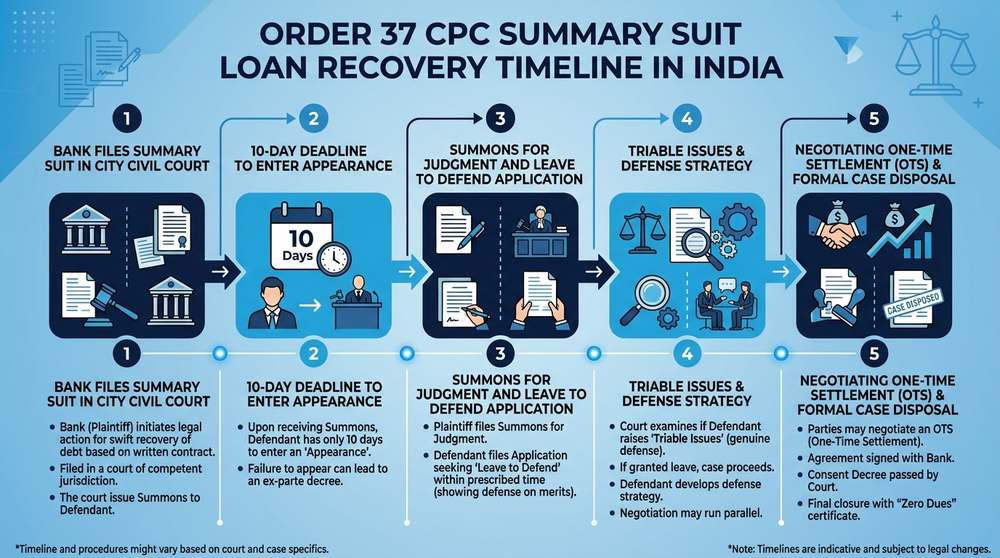
5. Order 37 CPC Summary Suit Defense & Settlement Visual Roadmap
The visual roadmap below outlines the 5-stage institutional progression from the initial Form No. 4 court summons to entering an appearance within 10 days, formulating triable issues in the Leave to Defend affidavit, navigating court-annexed mediation under Section 89 CPC, and formalizing a binding compromise decree with full debt extinguishment.
6. Advocate-Led Strategic Defense: Formulating Triable Issues & Drafting Watertight Leave to Defend
The battle in an Order 37 summary suit is won or lost entirely on the quality of the Leave to Defend counter-affidavit. A generic reply claiming financial hardship or personal misfortune is classified by courts as a "moonshine defense" and rejected immediately. To secure unconditional leave under the Hubtown doctrine, our litigation team formulates concrete, legally substantiated triable issues:
Triable Issue 1: Illegal Penal Interest Compounding & RBI Fair Lending Breaches
Under the RBI Master Circular on Fair Practices Code and RBI Directives on Fair Lending Conduct (effective 2024), lenders are strictly prohibited from compounding penal interest or capitalizing penalties into the principal debt. We audit the bank's statement of account and prove that significant portions of the claimed sum represent unauthorized compounding penal debits, rendering the debt unliquidated.
Triable Issue 2: Inadmissibility of Electronic Evidence & Section 65B Violations
Summary suits rely on computer-generated loan account statements. Under Section 65B of the Indian Evidence Act, 1872 (and Section 63 of Bharatiya Sakshya Adhiniyam, 2023) along with the Bankers' Books Evidence Act, 1891, electronic records are legally inadmissible without a contemporaneous certificate signed by the principal officer. Failure to attach this statutory certificate destroys summary entitlement.
Triable Issue 3: Limitation Bar Under Articles 19 & 21 of the Limitation Act, 1963
Banks often institute summary suits after sitting on non-performing accounts for over 3 years. We demonstrate that the suit was filed beyond the prescribed 3-year limitation window, and that purported 'balance confirmation letters' or automated NACH debit attempts do not constitute valid acknowledgments of liability under Section 18 of the Limitation Act.
Triable Issue 4: Lack of Territorial or Pecuniary Jurisdiction
Many banks file summary suits in centralized metro courts where their processing hubs reside, despite the loan contract being executed and the borrower residing in another state. We challenge territorial jurisdiction under Section 20 CPC and pecuniary jurisdiction, demanding return of the plaint under Order VII Rule 10 CPC.
By presenting these unassailable legal discrepancies in the Leave to Defend affidavit, the court recognizes that the bank's claim involves contested questions of law and accounting fact that cannot be decided summarily, compelling the judge to grant leave to defend.
7. Converting Summary Suits to One-Time Settlements: Section 89 CPC & Sanction Forensics
Once Leave to Defend is granted, the balance of power shifts decisively in favor of the borrower. The bank can no longer secure a summary judgment within weeks; it must now face years of contested civil trial. At this exact juncture, our advocates activate Section 89 of the Code of Civil Procedure (Settlement of disputes outside the Court) to transition the litigation into a structured One-Time Settlement (OTS).
We represent the borrower before the court-annexed Mediation Center, the National Lok Adalat, or directly engage the bank's Zonal Stressed Assets Resolution Branch (SARB). Before remitting any settlement amount, our legal counsel subjects the bank's OTS Sanction Letter to five mandatory forensic checkpoints:
The sanction letter must be issued on official bank stationery, carrying an authenticated reference number and the verifiable signature of an authorized Scale-IV/V Zonal Manager with delegated financial power.
The document must explicitly cite the pending Summary Suit Number, Court Name, Loan Account Number, and state that the compromise sum resolves the exact litigation pending before the court.
The sanction must unequivocally state that upon remittance of the agreed settlement sum, all remaining principal, penal charges, memo interest, and legal costs stand irrevocably extinguished.
The terms must legally obligate the bank's panel advocate to appear before the Civil Court on the next scheduled hearing date to formally record satisfaction and withdraw the summary suit.
Never remit settlement funds to an individual advocate's personal bank account or a recovery agency UPI handle. All settlement payments must be deposited directly into your designated loan account via RTGS/NEFT or by an Account Payee Demand Draft drawn in favor of "[Bank Name] A/C [Your Loan Account Number]".
8. Settlement Remittance, Order 23 Rule 3 Compromise Decree & RBI ₹0 NDC Mandate
Remitting the negotiated settlement funds completes the financial transaction, but absolute legal finality requires closing the judicial record in the Civil Court and updating credit bureaus.
Under Order XXIII Rule 3 (Compromise of Suit) of the CPC, when a suit is adjusted wholly by a lawful agreement or compromise in writing and signed by the parties, the court records the compromise and passes a Consent Decree / Order of Disposal:
Under RBI directives on Responsible Lending Conduct, commercial banks and NBFCs are statutorily mandated to deliver a formal No Dues Certificate (NDC) / Loan Closure Letter, return all post-dated security cheques, and update all credit information companies (CIBIL, Experian, Equifax, CRIF High Mark) within 30 calendar days of receiving full settlement remittance. Unjustified delay makes the lender liable to pay compensation of ₹5,000 per day of delay directly to the borrower.
Credit Bureau Status & Post-Litigation Credit Rebuilding
Following the compromise disposal of the summary suit, the bank updates the credit bureau record:
- Bureau Status Tag: The account status changes from "Suit Filed / Active Default / 90+ DPD" to "Settled" or "Post-Write-Off Settled" with current outstanding balance updated to ₹0.
- Elimination of Legal Default Flags: Formal withdrawal of the civil suit removes active litigation risks that obstruct new corporate directorships, commercial partnerships, or travel visas.
- Systematic Credit Score Rehabilitation: By subscribing to a secured credit card backed by a fixed deposit, maintaining credit utilization below 25%, and maintaining immaculate on-time payments, borrowers rebuild their CIBIL score above 750 within 18 to 24 months.
9. Order 37 Summary Suit Defense vs Alternate Resolution Matrix
Evaluating the legal pathways available upon receiving an Order 37 summary recovery summons allows borrowers to make an informed, risk-adjusted decision:
| Strategy / Response Pathway | Procedural Mechanism | Principal Haircut Potential | Resolution Timeline | Legal & Asset Risk |
|---|---|---|---|---|
| Advocate-Led Leave to Defend + OTS | 10-day appearance; triable issues in affidavit; Section 89 OTS | 45% – 65% Principal Waiver | 30 – 60 Days | Lowest risk; absolute legal closure with ₹0 No Dues Certificate |
| National Lok Adalat Settlement | Joint referral under Legal Services Authorities Act, 1987 | 40% – 60% Principal Waiver | Single Session | Non-appealable Consent Decree; 100% refund of court fees |
| Contested Full Civil Trial | Written Statement, witness cross-examination, final arguments | 0% – 15% (Subject to trial decree) | 3 – 5 Years | Heavy advocate fees, compounding interest decrees, operational strain |
| Ignoring Summons / Non-Appearance | Ex-parte decree passed under Order XXXVII Rule 2(3) CPC | 0% (100% Principal + 18% p.a. Interest) | Immediate (15–30 Days) | Maximum risk; immediate asset attachment, salary seizure, execution warrants |
10. SettleLoans Legal Defense & Summary Suit Representation
Facing an Order 37 summary recovery suit requires immediate, specialized civil litigation counsel. SettleLoans represents borrowers across India: drafting and filing formal Memorandums of Appearance within the strict 10-day statutory window, formulating comprehensive Leave to Defend affidavits establishing triable issues under the Supreme Court Hubtown framework, and negotiating directly with bank Zonal Stressed Asset committees to secure binding 45%–65% One-Time Settlements backed by Order 23 Rule 3 compromise decrees and official No Dues Certificates.

Settle Loan is India's trusted debt relief and loan settlement platform. We help borrowers overcome financial distress by negotiating with banks and NBFCs to legally settle personal loans and credit card debts. With our transparent, performance-based approach, you can achieve debt freedom and regain your financial peace of mind.
COMPUTER
11. Frequently Asked Questions: Order 37 CPC Summary Suit Defense
Direct, legally verified answers to critical questions regarding Order XXXVII summary suits, 10-day court appearance rules, Leave to Defend affidavits, and loan settlement in India.
What is an Order 37 CPC Summary Suit for bank loan recovery?
An Order 37 (Order XXXVII) Summary Suit under the Code of Civil Procedure, 1908, is a specialized fast-track civil legal remedy utilized by commercial banks and NBFCs to recover liquidated contractual debts, dishonored negotiable instruments, and written loan agreements. Unlike a standard civil suit where a defendant has an automatic right to contest by filing a written statement within 30 to 90 days, an Order 37 suit strips the borrower of an automatic right to defend unless the court explicitly grants 'Leave to Defend'.
What is the exact timeline to respond to an Order 37 CPC summons?
The borrower has strictly 10 calendar days from the date of receiving the Form No. 4 summons to file a formal 'Memorandum of Appearance' in the court. Subsequently, when the bank serves a 'Summons for Judgment' (Form No. 4A), the borrower has strictly another 10 calendar days to file an affidavit seeking 'Leave to Defend'.
What happens if a borrower fails to enter appearance within 10 days?
Under Order XXXVII Rule 2(3) CPC, if the borrower fails to enter an appearance within 10 days of receiving summons, the factual allegations in the bank's plaint are deemed admitted by operation of law. The court will immediately pass an ex-parte money decree in favor of the bank for the full claimed amount along with pre-suit and post-decree interest.
What is 'Leave to Defend' and on what grounds is it granted?
Leave to Defend is a formal application and affidavit filed by the defendant under Order XXXVII Rule 3(5) CPC requesting judicial permission to contest the bank's claims. Under the Supreme Court ruling in IDBI Trusteeship Services Ltd. v. Hubtown Ltd. (2017), the court grants unconditional leave if the borrower raises genuine 'triable issues' or a substantial legal defense, such as incorrect ledger accounting, illegal penal compounding, lack of territorial jurisdiction, or debt barred by limitation.
Can an Order 37 CPC summary suit be converted into a One-Time Settlement (OTS)?
Yes. Once an appearance is entered and a strong Leave to Defend affidavit is placed on record, the bank faces the reality of the suit converting into an ordinary long-drawn civil suit taking 3 to 5 years. Advocates leverage this legal friction under Section 89 of the CPC to initiate compromise negotiations, referral to National Lok Adalat or court mediation, securing 45% to 65% principal waivers and formal withdrawal of the suit.
Can an Order 37 CPC civil suit lead to immediate arrest or jail time?
No. An Order 37 summary suit is purely a civil litigation for recovery of a money debt. It does not carry criminal penalties, arrest warrants, or imprisonment. Only in the post-decree execution stage, if a judgment debtor willfully conceals assets or violates specific court injunctions under Order XXI Rule 37 CPC, can civil detention be considered under extreme and rare statutory circumstances.
What are the common triable issues raised against bank recovery claims?
Common triable issues include: (1) Capitalization of penal charges contrary to RBI Master Directions on Fair Lending Conduct, (2) Failure to produce Section 65B Indian Evidence Act / BSA certificates for electronic loan statements, (3) The suit being barred by the 3-year limitation period under the Limitation Act 1963, (4) Incomplete credit for payments made by the borrower, and (5) The claim being unliquidated or relying on unilateral, contested debit memos.
How does the court formally dispose of the summary suit after an OTS payment?
Upon full remittance of the negotiated settlement sum, the parties file a joint compromise application under Order XXIII Rule 3 CPC along with the bank's official OTS sanction letter. The Civil Court records the settlement and either dismisses the suit as withdrawn or passes a Consent Decree recording full debt satisfaction, followed by the delivery of a zero-balance No Dues Certificate.