- Statutory ₹20 Lakh Threshold: Under the Recovery of Debts and Bankruptcy (RDB) Act, 1993, banks and financial institutions can only approach the DRT for claims aggregating ₹20 Lakhs or higher.
- Dangers of Ex-Parte Default: Failing to enter appearance within 30 days of receiving a DRT summons leads to ex-parte Recovery Certificates, granting Recovery Officers sweeping powers to attach accounts and assets.
- Interim Stay via Securitisation Applications: Parallel SARFAESI auction actions under Section 13(4) can be stayed by filing a Securitisation Application (SA) under Section 17 challenging procedural illegalities.
- NPV Recovery Calculations: Bank Stressed Asset Management Groups regularly compromise 35% to 60% of outstanding debt because prolonged DRT trials tie up expensive capital reserves under mandatory RBI provisioning norms.
- Judicially Binding Consent Orders: An advocate-negotiated One Time Settlement (OTS) endorsed by the Presiding Officer permanently extinguishes lender claims and guarantees delivery of title deeds with zero remaining liability.
1. Demystifying the Debt Recovery Tribunal (DRT)
When a high-value loan account crosses 90 days of continuous non-payment and slips into Non-Performing Asset (NPA) classification, commercial lenders in India deploy specialized statutory machinery to recover their exposure. For exposure values exceeding ₹20 Lakhs, the primary legal forum used by public sector banks, private scheduled banks, and housing finance companies is the Debt Recovery Tribunal (DRT).
Established under the Recovery of Debts and Bankruptcy Act, 1993 (RDB Act), the DRT functions as a quasi-judicial body designed to circumvent the extensive procedural delays inherent in traditional civil court recovery suits. Headed by a Presiding Officer holding the status of a District Judge, the tribunal possesses exclusive jurisdiction over banking recovery claims above the statutory threshold. Civil courts are expressly barred under Section 18 of the RDB Act from entertaining any suit or case in respect of matters falling within the DRT's statutory purview.
While receipt of a formal DRT summons often triggers intense distress for corporate directors, commercial borrowers, and person guarantors, the institutional reality of the tribunal presents a powerful strategic window. Because the DRT operates under summary judicial procedures, the active intervention of an experienced banking defense advocate can transform an aggressive recovery lawsuit into an institutional forum for a structured, court-sanctioned One Time Settlement (OTS).
2. Legal Grounding: Section 19 DRT Claims & SARFAESI Dynamics
Understanding the legal architecture governing high-ticket debt recovery requires analyzing the dual statutory tracks frequently deployed simultaneously by Indian banking institutions:
Under Section 19 of the RDB Act, the lender files an exhaustive claim outlining loan sanction letters, hypothecation deeds, guarantee covenants, and statement of accounts. The bank requests the Presiding Officer to issue a formal Recovery Certificate for the total claimed amount plus ongoing penal compounding.
For secured advances, banks simultaneously invoke the Securitisation and Reconstruction of Financial Assets and Enforcement of Security Interest Act, 2002 (SARFAESI Act). Lenders issue Section 13(2) demand notices and Section 13(4) possession notices to take symbolic or physical control of mortgaged assets.
Any borrower aggrieved by wrongful SARFAESI enforcement measures can challenge the bank by filing a Securitisation Application under Section 17 before the DRT within 45 days. This provides an indispensable defensive shield to obtain interim stay orders against proposed auctions.
Orders passed by the DRT Presiding Officer can be appealed before the Debt Recovery Appellate Tribunal (DRAT) under Section 20 RDB Act or Section 18 SARFAESI. Debt defense advocates routinely petition to reduce statutory pre-deposit requirements based on showed hardship.
Although the RDB Act aims for summary disposal within 180 days, real-world tribunal pendency across major benches (such as Delhi, Mumbai, Chennai, Kolkata, Bengaluru, and Ahmedabad) routinely spans 24 to 48 months. This procedural friction imposes heavy operational burdens on banks, establishing large leverage for borrowers seeking an amicable, discounted settlement.
Check Your Loan Settlement Options
Answer 2 quick questions to evaluate your settlement eligibility.
1. What type of loan do you want to settle?
3. The Threat of Judicial Inaction
The most catastrophic mistake a borrower or guarantor can make upon receiving a DRT summons is to ignore the notice or delay engaging specialized counsel. Unlike civil suits where procedural delays may temporarily stall matters, failing to enter appearance in the DRT triggers swift adverse statutory consequences under the RDB Act.
Defendants must file a Written Statement (WS) within 30 days (extendable to 45 days). If a defendant fails to do so, the Presiding Officer can proceed ex-parte under Section 19(5) and issue a Recovery Certificate (RC):
- Issuance of Final Recovery Certificate: The DRT accepts the bank's inflated account statements without cross-examination, converting the disputed claim into a conclusive judicial decree carrying exorbitant penal interest rates of 18%–24% per annum.
- Transmission to the Recovery Officer: Under Section 25 and Section 28 of the RDB Act, the Recovery Certificate is transferred to the Recovery Officer, an executive authority armed with summary coercive powers.
- Attachment of Bank Accounts & Receivables: The Recovery Officer issues garnishee orders attaching the borrower's operational bank accounts, customer receivables, and financial securities without prior public notice.
- Distress Sale of Movable and Immovable Assets: Uncontested certificates empower the Recovery Officer to conduct immediate public e-auctions of mortgaged properties as well as unencumbered personal assets belonging to principal borrowers and personal guarantors.
Under Section 25(b) of the RDB Act, if a debtor conceals assets or refuses compliance with a Recovery Certificate, the Recovery Officer holds statutory powers. The officer can order civil detention. Timely advocate representation before the tribunal is therefore critical to halt coercive enforcement.
4. Bank NPA Accounting, Provisioning & NPV Equation
Securing a large 35% to 60% principal waiver in a high-ticket DRT litigation is not a matter of pleading for institutional sympathy; it is an exercise in financial modeling aligned with RBI prudential norms. Commercial banks are governed by strict capital adequacy standards under the Reserve Bank of India (Prudential Framework for Resolution of Stressed Assets) Directions.
As a delinquent loan languishes in DRT litigation, the lending institution is mandated to lock away escalating percentages of its core operating capital in non-productive provisioning reserves:
| NPA Classification Bucket | DRT Litigation Duration | Mandatory RBI Capital Provision | Expected OTS Haircut Range |
|---|---|---|---|
| Sub-Standard Asset | 12 – 18 Months | 15% Secured / 25% Unsecured | 15% – 30% Total Waiver |
| Doubtful 1 (D1) | 18 – 30 Months | 25% Secured / 100% Unsecured | 30% – 45% Principal Haircut |
| Doubtful 2 (D2) | 30 – 48 Months | 40% Secured / 100% Unsecured | 45% – 55% Principal Haircut |
| Doubtful 3 & Loss Asset | 48+ Months / Written-Off | 100% Complete Capital Write-Off | 55% – 65% Principal Haircut |
When a borrower mounts a robust legal defense, the bank's Zonal Stressed Asset Management Committee conducts a rigorous financial assessment known as the Net Present Value (NPV) Recovery Benchmark:
Where C_t represents expected recovery cash flows, r is the bank's internal discount rate, and deductions reflect 3–5 years of tribunal friction, advocate retainers, court fees, asset depreciation. also, the opportunity cost of regulatory capital trapped in mandatory provisions.
Prosecuting a contested DRT matter to final execution requires years of judicial effort and large expenses. so, bank credit committees frequently find that an immediate lump-sum settlement of 40% to 55% delivers higher net recovery than waiting for uncertain future auction proceeds.
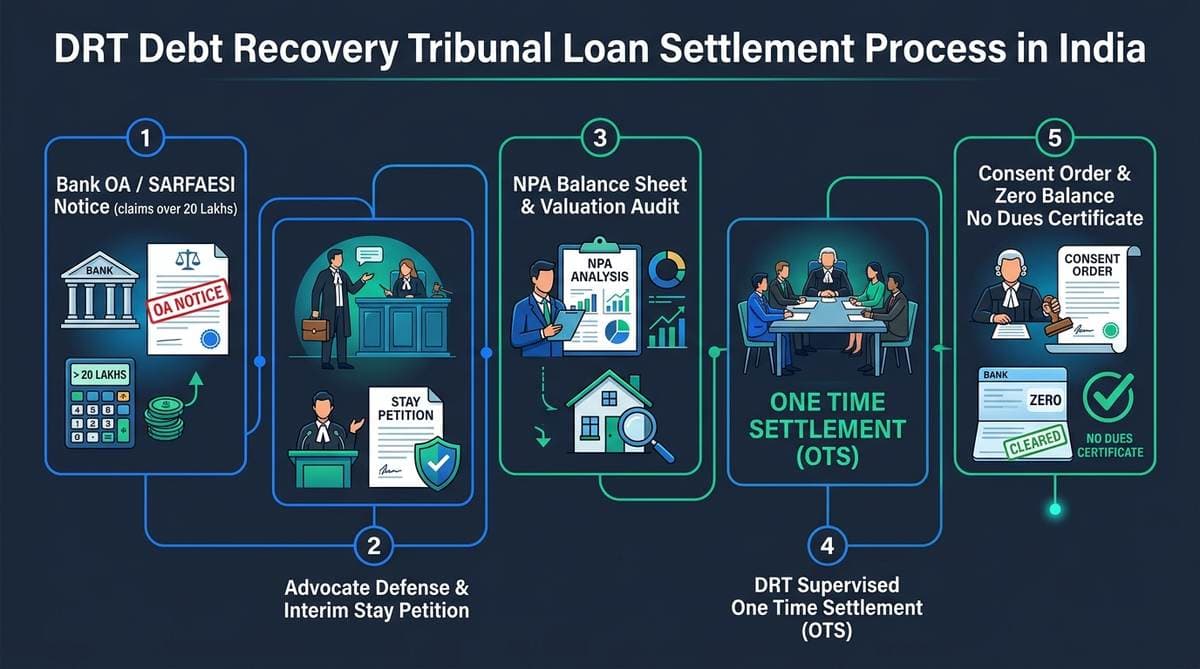
5. DRT Loan Settlement Process & Legal Defense Visual Roadmap
The visual roadmap below illustrates the 5-stage trajectory. It guides you from receiving an Original Application or SARFAESI summons to advocate defense, ledger forensics, Zonal Committee talks, and executing a DRT Consent Order with full No Dues Certification.
6. Defense Strategy: Contesting DRT Original Applications (OA)
Transforming a high-stakes DRT recovery case into a negotiated compromise requires methodical litigation defense. Rather than approaching the bank in a position of legal vulnerability, our debt defense advocates apply a 4-phase strategic counter-offensive:
Phase 1: Entering Appearance & Filing Written Statement (WS)
Within 30 days of receiving the DRT summons, our legal counsel enters a formal Vakalatnama and files a comprehensive Written Statement under Section 19(5) of the RDB Act. We dispute unverified debit entries, challenge ambiguous penal compounding, and contest the validity of security creation documents.
Phase 2: Filing Securitisation Application (SA) with Interim Stay Petitions
If the bank has started parallel physical possession or auction cases under SARFAESI Section 13(4), we file an urgent Securitisation Application under Section 17 alongside an Interlocutory Application (IA) for an interim stay. We highlight statutory procedural lapses—such as failure to serve 30-day auction notices or improper reserve price valuation—to restrain distress property sales.
Phase 3: Forensic Account Ledger Audit & Counterclaim Assertion
Our financial experts conduct a granular audit of the bank's statement of accounts under the Bankers' Books Evidence Act, 1891. We expose excessive interest capitalization, penal rate hikes violating RBI circulars, and uncredited margin money deposits, establishing a formal Counterclaim or Set-Off under Section 19(8).
Phase 4: Bypassing Branch Officials & Engaging the Stressed Asset Resolution Branch
With litigation properly managed in tribunal hearings, our advocates bypass aggressive branch recovery officers. We present a structured settlement proposal directly to the General Manager and Zonal Committee of the Stressed Asset Resolution Branch (SARB).
This comprehensive legal defense eliminates the threat of summary ex-parte decrees and compels the financial institution to treat the borrower as an equal negotiating counterpart.
7. DRT-Supervised OTS & Consent Order Forensics
When resolving high-ticket non-performing loans exceeding ₹20 Lakhs, informal verbal promises or unilateral branch confirmation emails carry severe legal risks. Unscrupulous recovery managers have been known to accept partial payments as regular installments without closing the underlying DRT litigation, leaving the borrower exposed to future recovery certificates.
A legally watertight DRT loan settlement must satisfy four mandatory institutional forensic checkpoints:
The OTS sanction must be issued by the competent Zonal Credit Committee on official bank letterhead. The document must recite the specific OA/SA suit number, agreed compromised amount, and exact tranche payment deadlines.
The joint compromise terms must be formally filed before the Presiding Officer of the DRT. The tribunal passes a judicially binding Consent Order or Compromise Decree under the RDB Act, permanently disposing of the bank's Original Application.
The consent order must explicitly mandate the unconditional return of original property title deeds, share certificates, and personal guarantee discharge letters within a defined 30-day window following final remittance.
If an interim Recovery Certificate had been issued, the consent order must instruct the Recovery Officer to formally recall the RC, withdraw all garnishee notices, and vacate property attachment orders from revenue land records.
All settlement payments must be remitted directly into the designated loan collection pool account via Real Time Gross Settlement (RTGS) or Banker's Cheque. Missing a single scheduled tranche deadline without prior judicial extension can cause the settlement to lapse, reviving the bank's original full claim.
8. Loan Remittance, RBI ₹0 NDC Mandate & CIBIL Repair
Following the execution of the DRT Consent Order and completion of the agreed settlement remittance, the final imperative is securing unassailable closure records and managing credit score recovery. Under RBI Circular RBI/2023-24/60 (Responsible Lending Conduct – Release of Movable/Immovable Property Documents and Issuance of NDC), all regulated lending institutions must adhere to strict post-settlement timelines.
Banks are legally obligated to return all original movable and immovable property title deeds and issue an official No Dues Certificate (NDC) within 30 calendar days of receiving full settlement remittance. Failure to release documents within this period obligates the bank to compensate the borrower at a statutory rate of ₹5,000 per day of delay.
Credit Information Bureau (CIBIL) Trajectory & Score recovery
Borrowers must understand the precise mechanism of credit bureau reporting after resolving high-value litigation:
- Bureau Status Reporting: The lending institution reports the account to credit bureaus (CIBIL, Experian, Equifax, CRIF) with the official status remark "Settled" or "Post-Write-off Settled", reflecting a current outstanding balance of ₹0.
- Cessation of Delinquency Compounding: While a settled remark triggers a temporary credit score drop, it permanently ends compounding default records (90+ DPD) and eliminates legal litigation flags.
- 12-Month Institutional Cooling Period: Under RBI guidelines, commercial lenders observe a 12-month cooling window before considering fresh unsecured commercial credit lines for settled corporate or person entities.
- Restoring 750+ Credit Scores: By leveraging secured fixed-deposit credit instruments, maintaining strict credit use under 25%, and recording flawless payment histories, settled borrowers reliably rebuild their CIBIL score above 750 within 18 to 24 months.
9. Dispute Resolution Matrix: DRT vs SARFAESI vs Civil Suit
Evaluating the strategic parameters across major Indian debt recovery forums illustrates why a DRT-supervised One Time Settlement offers the most advantageous balance of legal finality, risk mitigation, and debt reduction:
| Resolution Forum | Statutory Governing Act | Typical Haircut Potential | Resolution Timeline | Key Legal Risk & Borrower Defense |
|---|---|---|---|---|
| DRT Section 19 OA | RDB Act, 1993 | 35% – 60% Principal Waiver | 18 – 36 Months | Risk of ex-parte Recovery Certificate; defended via WS & ledger audit |
| SARFAESI Section 13/17 | SARFAESI Act, 2002 | 30% – 50% Compromise OTS | 6 – 12 Months | Risk of physical auction; defended via Section 17 SA stay petitions |
| Civil Court Recovery Suit | Code of Civil Procedure, 1908 | 15% – 30% Waiver | 4 – 7 Years | Protracted trial; heavy court fees; defended via Leave to Defend |
| NCLT Corporate Insolvency | Insolvency & Bankruptcy Code, 2016 | 50% – 85% Resolution Plan | 12 – 24 Months | Loss of corporate management control; Section 12A withdrawal settlement |
10. SettleLoans High-Ticket DRT Legal Defense
Navigating a high-stakes DRT claim requires seasoned legal advocates. Counsel must possess deep mastery of banking law, the RDB Act, SARFAESI procedures, and RBI directives. SettleLoans provides comprehensive defense across India. We enter immediate tribunal appearances, file Written Statements, and obtain stay orders against asset auctions. also, we negotiate directly with bank Zonal Committees to deliver massive principal haircuts backed by binding Consent Orders and official No Dues Certificates.

Settle Loan is India's trusted debt relief and loan settlement platform. We help borrowers overcome financial distress by negotiating with banks and NBFCs to legally settle personal loans and credit card debts. With our transparent, performance-based approach, you can achieve debt freedom and regain your financial peace of mind.
COMPUTER
11. Frequently Asked Questions: DRT Loan Settlement Process in India
Direct, legally verified answers to essential questions regarding Debt Recovery Tribunal summons, Original Application defenses, stay petitions, and One Time Settlements in India.
What is the Debt Recovery Tribunal (DRT) and what is its pecuniary jurisdiction?
The Debt Recovery Tribunal (DRT) is a specialized quasi-judicial tribunal established under the Recovery of Debts and Bankruptcy Act, 1993 (RDB Act). The central government has set the minimum pecuniary threshold at ₹20 Lakhs. Commercial banks, public sector lenders, and registered financial institutions can approach the DRT to institute recovery cases for non-performing debts of ₹20 Lakhs and above.
What is an Original Application (OA) filed by a bank in the DRT?
An Original Application (OA) is the formal statutory claim filed by a bank or financial institution under Section 19 of the RDB Act before the Presiding Officer of the DRT. It sets out the borrower's default history, outstanding principal, accrued penal interest, and requests the tribunal to issue a Recovery Certificate (RC) against the borrower and guarantors.
Can a borrower settle a loan after the bank files an OA in the DRT?
Yes. A significant percentage of high-value DRT cases culminate in a negotiated One Time Settlement (OTS). Once advocates challenge inflated interest claims and present financial hardship, banks frequently prefer a DRT-supervised compromise settlement rather than enduring 3 to 5 years of contested litigation and capital provisioning.
What happens if a borrower ignores a summons from the DRT?
Ignoring a DRT summons is extremely perilous. If the borrower fails to appear within 30 days, the Presiding Officer will declare the defendant ex-parte, accept the bank's claims without contest, and issue an ex-parte Recovery Certificate. The Recovery Officer can then attach bank accounts, garnish receivables, seize properties, or even issue civil detention orders.
How does an advocate secure an interim stay against SARFAESI actions in the DRT?
When a bank starts physical possession or auction measures under Section 13(4) of the SARFAESI Act alongside an OA, borrowers can file a Securitisation Application (SA) under Section 17 before the DRT. Advocates file an urgent Interlocutory Application (IA) for an interim stay, showing procedural defects in the bank's statutory notices, undervaluation of assets, or proposing a bona fide OTS repayment schedule.
What is a Consent Order or Compromise Decree in the DRT?
A Consent Order is an official order passed by the Presiding Officer of the DRT when the borrower and the bank jointly submit agreed compromise terms. It incorporates the sanctioned OTS amount, payment timelines, release of title deeds, and provides that upon full remittance, the Original Application stands disposed of as fully settled.
How much haircut or discount is realistic in a DRT loan settlement?
The settlement discount in DRT matters typically ranges between 35% and 60% of the total outstanding ledger claim. The final figure depends on collateral realisability, NPA vintage (Doubtful 1 vs Doubtful 2), forced sale valuation of secured assets, and the borrower's showed liquidity constraints.
Can an unrepresented borrower negotiate directly with bank zonal committees?
While legally permissible, unrepresented borrowers face severe disadvantages. Bank recovery desks leverage the threat of immediate Recovery Certificates to demand unreasonable lump sums. Seasoned DRT advocates conduct forensic ledger audits, challenge usurious interest, and negotiate directly with Zonal Credit Committees with strong legal leverage.
What is the statutory timeline for the bank to issue a No Dues Certificate after DRT settlement?
Under RBI Circular RBI/2023-24/60, all scheduled commercial banks and NBFCs must deliver the original property title documents and issue a formal No Dues Certificate (NDC) within 30 calendar days of receiving the final settlement tranche. Any unjustified delay mandates the bank to pay ₹5,000 per day in statutory relief.
How does a DRT settlement affect my CIBIL score and future credit eligibility?
The bank updates the account status in credit bureaus (CIBIL, Experian, Equifax) as 'Settled' with an outstanding balance of ₹0. While this prevents ongoing default escalation, fresh unsecured loans require a 12-month cooling period. Borrowers can restore their credit score above 750 within 18 to 24 months through disciplined secured credit management.