- Zero Direct Cash Authorization: RBI Master Directions ban field agents from taking cash without instant, server-validated digital receipts.
- High Misappropriation Risk: Cash handed to field agents goes to third-party firms, not the bank Core Banking System (CBS). The loan stays unpaid.
- Manual Paper Receipts Are Void: Banks reject carbon-copy paper slips and rubber stamps during internal audits and court trials.
- Use Direct Bank Channels Only: Pay settlement amounts only through RTGS, NEFT, net banking, or bank branch CMS challans.
- Mandatory 30-Day No Dues Certificate: Under RBI Circular RBI/2023-24/60, banks must issue an NDC and set your bureau balance to ₹0 within 30 days.
1. Anatomy of Field Collection
Commercial banks and NBFCs often assign overdue loans to third-party recovery agencies. These include SBI, HDFC Bank, ICICI Bank, Axis Bank, Kotak Mahindra Bank, and Bajaj Finance. Field agents visit homes and demand immediate cash. They claim cash is the only way to avoid police action or court warrants. They also promise instant settlement discounts.
Why do field agents push so hard for cash? Collection agencies earn commissions between 8% and 25% on recovered amounts. When an agent takes cash, the money goes into the agency float. It does not enter the regulated Core Banking System (CBS) of the bank.
This cash float leads to serious fraud. Rogue agents promise fake spot discounts. They say a small cash payment will close the loan forever. The agent gives a fake handwritten slip, pockets the cash. And never deposits it. Weeks later, the bank sends legal notices for the full balance. The borrower loses money and the debt remains unpaid.
2. RBI Master Directions on Cash Collections
The Reserve Bank of India sets strict rules to protect borrowers from coercion and fraud. Under the RBI Master Direction on Fair Practices Code for Lenders (DOR.ORG.REC.65/21.04.158/2022-23) and circulars on Outsourcing of Financial Services, the central bank limits how recovery agents can collect money.
Key statutory rules from the Reserve Bank of India include:
Every recovery transaction must create an instant digital receipt. The bank must also send an automated SMS and email alert from its core server to your phone.
Every visiting agent must carry a bank identity card. They must hold an official Bank Authorization Letter and valid IIBF DRA certification.
Agents can only visit between 8:00 AM and 7:00 PM. They cannot threaten arrest, seize property, or make fake verbal settlement promises.
The Supreme Court of India and RBI hold banks fully liable for illegal acts, fraud. And threats by their recovery agents.
No bank or agency can force you to pay in cash. Borrowers have a legal right to pay all dues, EMIs. And settlements through traceable bank channels. Funds must go directly to the bank loan account.
Check Your Loan Settlement Options
Answer 2 quick questions to evaluate your settlement eligibility.
1. What type of loan do you want to settle?
3. The Mechanics of Cash Misappropriation
Paying cash to a field agent is risky. Third-party agencies are not linked directly to the bank database. Banks run on Core Banking Solutions like Finacle, BaNCS, or Flexcube. Accounts update only when funds arrive via NEFT, RTGS, NACH, IMPS, or branch CMS counters.
When you pay cash to a field agent, major problems occur:
1. Outright Theft & Agent Absconding (Section 406 & 420 IPC / BNS)
Collection agencies face high staff turnover. Rogue agents collect cash across an area, issue fake slips. And quit. The bank never gets the money. And the borrower remains in default.
2. Agency Float Retention & Delayed Ledger Credit
Agencies often hold collected cash in private accounts for weeks. They do this to earn interest or hit monthly targets. Meanwhile, the bank adds penal interest and late fees to your loan.
3. Misallocation Toward Penalties Instead of Principal Debt
Without a formal OTS letter, the bank system credits cash against overdue fines and legal charges first. The principal balance stays unpaid, leaving your debt alive.
Manual slips do not update credit bureaus. Rating agencies continue to show default flags like 90+ DPD or Substandard Asset. This severely damages your CIBIL score.
4. Bank Balance Sheet Economics, Recovery Quotas
Borrowers should know how banks handle overdue debt. Under Reserve Bank of India (RBI) Prudential Norms on Income Recognition, Asset Classification and Provisioning (IRACP), loans unpaid for 90 days become Non-Performing Assets (NPAs).
Banks must set aside 15% to 100% of the loan amount in capital reserves. Court cases, arbitration, and Section 138 cheque bounce trials take years and cost money. Thus, bank Stressed Asset Committees approve One-Time Settlements to recover funds quickly.
| Delinquent Facility Type. | Gross Outstanding Balance. | Typical Field Agency Commission. | Institutional OTS Settlement Range. |
|---|---|---|---|
| Unsecured Personal Loan. | ₹3.0 Lakhs – ₹12.0 Lakhs. | 12% – 20% on collected cash. | ₹1.2 Lakhs – ₹4.8 Lakhs (50%–65% Haircut). |
| Credit Card Unpaid Balance. | ₹1.5 Lakhs – ₹6.0 Lakhs. | 15% – 25% on collected cash. | ₹50,000 – ₹2.1 Lakhs (60%–70% Haircut). |
| Business Loan / SME Credit. | ₹15.0 Lakhs – ₹75.0 Lakhs. | 8% – 15% on collected cash. | ₹6.0 Lakhs – ₹30.0 Lakhs (50%–60% Haircut). |
| Fintech Instant Digital Loan. | ₹25,000 – ₹2.0 Lakhs. | 18% – 25% on collected cash. | ₹10,000 – ₹80,000 (50%–65% Haircut). |
When an advocate starts debt settlement talks for a borrower, the bank credit committee uses the Net Present Value (NPV) Recovery Valuation Benchmark:
In this equation, Direct_Electronic_Remittance means guaranteed cash paid straight to the bank treasury. Deductions include court costs, legal retainers, frozen capital reserves. And agency leakage over 3 to 5 years.
This math shows why banks prefer direct digital settlements over agency cash collections. By skipping third-party middlemen, borrowers can get 40% to 70% waivers directly from bank officers.
5. Safe Payment & Resolution Process Roadmap
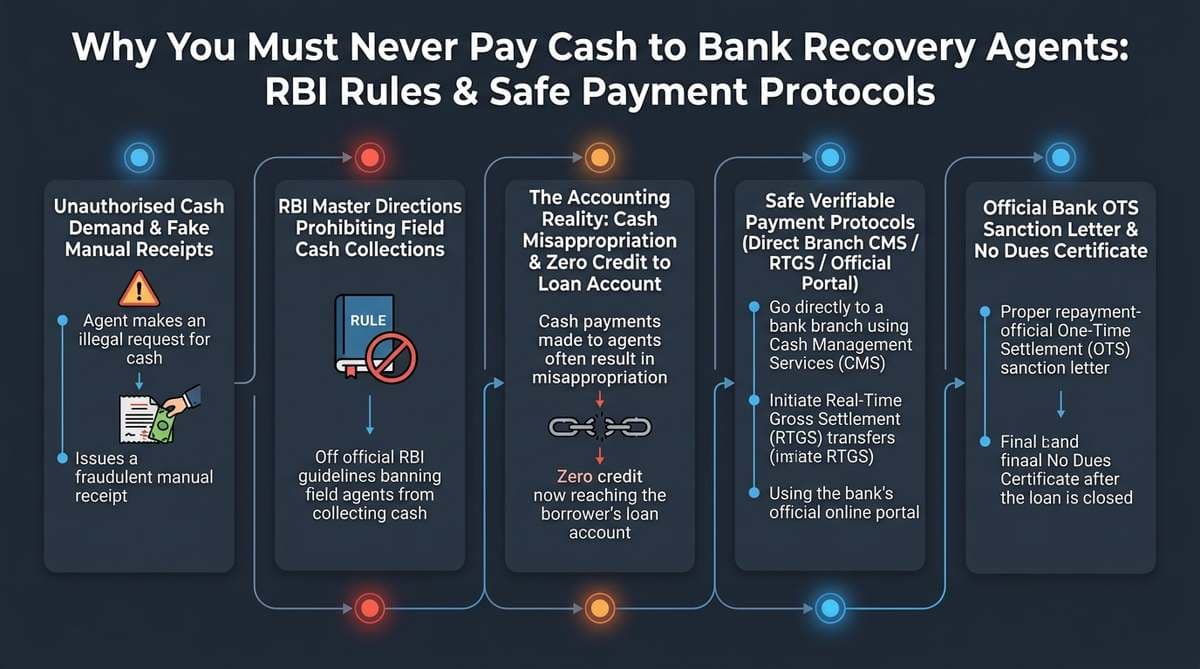
The guide below shows two paths. One is the risky route of paying cash to field agents. The other is the safe, legal path of an advocate-led bank settlement under RBI rules.
6. Forensic Verification
A common loan scam involves fake settlement letters. Rogue agencies make fake bank letters on forged stationery to pocket cash. Always verify settlement papers before paying any money.
Check these clear warning signs to spot fake settlement documents:
Warning Sign 1: Handwritten Slips, Generic Receipts or Third-Party Agency Branding
If the slip or letter shows an agency name (like "Apex Recovery") instead of the bank (like "HDFC Bank Ltd."), it is invalid. Genuine settlements use the lending bank name only.
Warning Sign 2: Absence of Verifiable Bank Dispatch Reference Numbers
Genuine OTS letters carry a unique system reference number (such as `HDFC/RECOVERY/OTS/2026/XXXXX`). Any branch manager can verify it on the bank intranet. Fake letters use generic dates.
Warning Sign 3: Payment Directed to Individual UPI IDs or Third-Party Accounts
Scam agents often ask you to scan personal QR codes on Google Pay, PhonePe, or Paytm. Genuine payments go only to your loan account number or bank collection account.
Warning Sign 4: Omission of Explicit Criminal Complaint Withdrawal Terms
If the bank filed Section 138 NI Act or Section 25 PSSA cases, the OTS letter must state that the bank will withdraw all court complaints upon payment.
Never pay money or hand over cash until an advocate verifies the OTS letter directly with the bank Zonal Legal Manager or Stressed Asset Branch.
7. Safe Institutional Payment Protocols
Once you receive an approved OTS letter, pay through secure bank channels. This ensures full legal debt discharge. Use these three approved methods:
Visit a bank branch in person. Ask for a CMS deposit slip. Fill in your 16-digit loan account number and the OTS code from your letter. The teller will give a stamped slip with a Machine Validation Number.
Send an RTGS or NEFT from your bank account to the lender virtual collection account. Put your loan account number as the beneficiary. You get a unique UTR number as legal proof.
Log in to the official bank website or app. Go to the loan repayment section. Check that the settlement amount matches your letter, then pay through net banking.
These three methods create a clear digital audit trail on RBI payment rails. They protect you from fraud and prove your payment beyond doubt.
8. Post-Payment Closure
Paying the settlement amount settles the financial debt. However, you must complete two vital legal steps to protect your credit record:
1. Enforcing Delivery of the Official No Dues Certificate (NDC) Within 30 Days
Under RBI Master Circular RBI/2023-24/60 (Responsible Lending Conduct), all commercial banks and NBFCs must issue an official No Dues Certificate (NDC) / Loan Closure Certificate. They must also return all original cheques and property deeds within 30 calendar days of receiving settlement funds. If the bank fails to deliver the NDC within 30 days, they must pay statutory payout of ₹5,000 per day of delay.
2. Credit Bureau Rectification to ₹0 Outstanding Balance Across CIBIL, Experian, CRIF
Under the Credit Information Companies (Regulation) Act, 2005, the bank is legally required to update all four credit bureaus (TransUnion CIBIL, Experian, Equifax, CRIF High Mark) within 30 days. The loan account status must be modified from "Default / Active Suit Filed / Written Off". to "Settled", with the outstanding ledger balance reduced to strictly ₹0.
A "Settled". status shows the loan closed for a lower amount. It stops negative monthly DPD marks and halts debt recovery calls. You can get a secured credit card against a fixed deposit (FD), keep usage below 20%. And pay on time. This rebuilds your CIBIL score to 750+ within 18 to 24 months.
9. Cash Payment vs Direct Bank Remittance Matrix
Comparing cash payments against advocate-led bank settlements shows why you should never hand over cash:
| Operational Parameter. | Paying Cash to Field Recovery Agent. | Advocate-Supervised Institutional Settlement. |
|---|---|---|
| Regulatory Legitimacy. | Banned under RBI Master Directions. | 100% Compliant with RBI Fair Practices Code. |
| Payment Verification. | Handwritten paper slip (Legally Void). | Bank UTR Number or CBS Teller Slip. |
| Misappropriation Risk. | High (Agent theft and delayed deposits). | Zero (Funds go directly to bank treasury). |
| Settlement Authorization. | Verbal promises or fake agency slips. | Official Bank-Stamped OTS Sanction Letter. |
| Legal Case Quashing. | Court cases and warrants stay active. | Full withdrawal of Section 138 &. Section 25 cases. |
| Closure records. | No official bank closure document. | Official RBI-Mandated No Dues Certificate (NDC). |
| Credit Bureau Impact. | Persistent default flags. CIBIL damage. | Updated to "Settled". with ₹0 Balance. |
10. SettleLoans Anti-Harassment
If recovery agents demand cash, issue threats, or visit your home, you do not have to fight alone. SettleLoans gives you full legal defense. We send legal notices to stop rogue agencies, report extortion to bank nodal officers, audit settlement letters. And negotiate 40% to 70% One-Time Settlements. We also secure your official No Dues Certificate and ensure ₹0 CIBIL updates.

Settle Loan is India's trusted debt relief and loan settlement platform. We help borrowers overcome financial distress by negotiating with banks and NBFCs to legally settle personal loans and credit card debts. With our transparent, performance-based approach, you can achieve debt freedom and regain your financial peace of mind.
COMPUTER
11. FAQs: Paying Recovery Agents & Safe Debt Settlement
Clear, legally verified answers to essential questions regarding recovery agent cash demands, RBI guidelines, fake settlement receipts. And safe digital payment protocols in India.
Can you legally pay cash to loan recovery agents in India?
No. You should never pay cash. Under RBI Master Directions and Fair Practices Code, banks and NBFCs cannot let field agents collect untracked cash. If an agency collects cash in rare cases, they must give an instant digital receipt. The bank must send instant SMS and email alerts. Never hand over loose cash or take handwritten paper slips.
Why does cash paid to a recovery agent never credit the loan account?
Collection agencies work on third-party commissions. When you pay cash to a field agent, the money sits in the agency private hands. It does not enter the Core Banking System (CBS). Rogue agents often pocket the cash or delay deposits for months. Because no money enters your loan account, the bank treats you as a defaulter. Penal interest and late fees keep rising.
What should I do if a recovery agent refuses digital payment and insists on cash?
If an agent demands cash and refuses digital modes like NEFT, RTGS, or CMS challans, suspect fraud immediately. Refuse to pay. Demand their Bank Authorization Letter and IIBF DRA Certificate. Record their demands on audio or video. Report the agent to the bank Principal Nodal Officer and file a police complaint for extortion.
Are handwritten paper receipts issued by recovery agents legally valid?
No. Handwritten slips carry zero legal weight in bank audits or court trials. Even slips with rubber stamps or logos are invalid. Banks routinely reject handwritten receipts from third-party vendor agents. Only electronic receipts with a bank UTR number and server timestamp prove debt discharge.
How can I safely pay for a loan settlement without risking fraud?
Follow three clear steps to settle safely. First, get an official One-Time Settlement (OTS) sanction letter on bank letterhead with a verified reference number. Second, pay only through direct bank channels like RTGS, NEFT, net banking, or a branch CMS challan. Third, collect an official No Dues Certificate (NDC) directly from the bank.
What are the RBI guidelines regarding recovery agent conduct and cash handling?
Under RBI Circular DOR.ORG.REC.65/21.04.158/2022-23, banks and NBFCs are fully liable for agent actions. Agents cannot intimidate borrowers. They can only contact you between 8:00 AM and 7:00 PM. They cannot make false promises or collect cash without instant digital receipts. Violations can lead to heavy fines and cancelled agency licenses.
What should I do if I already paid cash to an agent and the bank claims non-receipt?
If you paid cash and the bank still shows a default, act fast. Send a written complaint to the bank Principal Nodal Officer. Attach your manual slips, chats. And agent details. If the bank does not resolve it in 30 days, escalate to the RBI Integrated Ombudsman. You can also file a police complaint under Section 406 and Section 420 IPC / BNS for cheating.
How does safe digital settlement protect my CIBIL score?
You pay directly to the bank under an authorized OTS letter. The bank credit team then updates all four bureaus: TransUnion CIBIL, Experian, Equifax, and CRIF High Mark. Under RBI rules, they must mark the status as 'Settled' with a ₹0 balance within 30 days. This stops default flags and lets you rebuild your credit score.