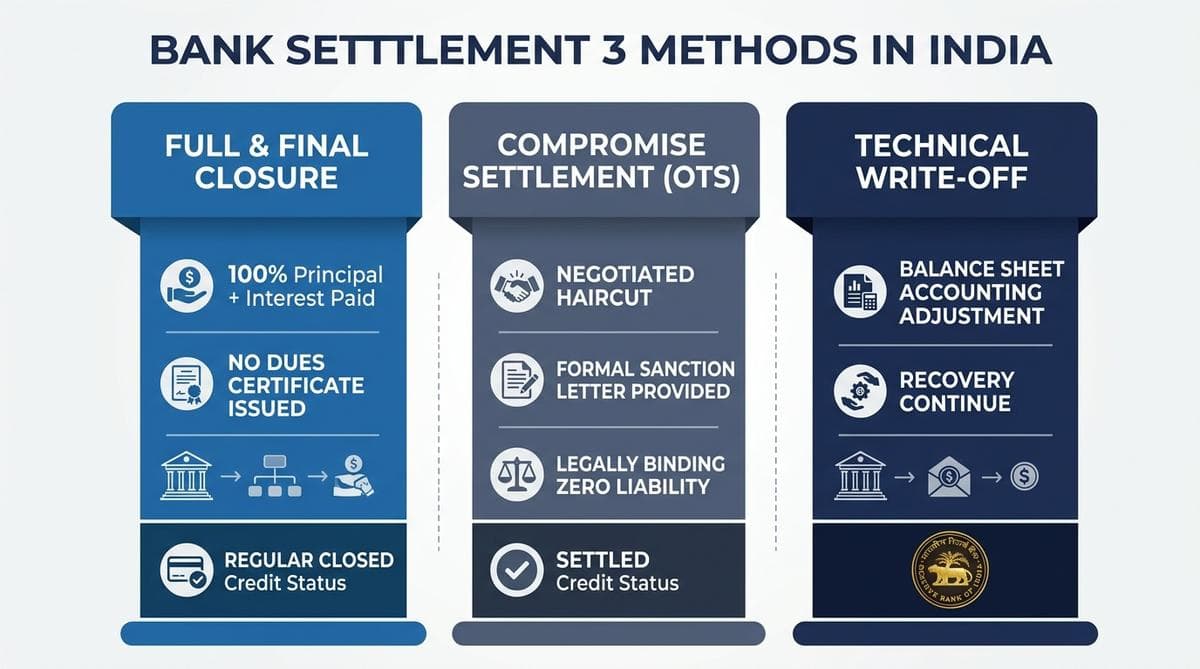
- Full Closure vs. Compromise Settlement: Full closure involves paying 100% of the loan with zero haircut, resulting in a spotless "Closed" status. A compromise settlement (OTS) grants a negotiated financial haircut (typically 40% to 75% relief) and reports as "Settled" with a ₹0 balance.
- The Credit Write-Off Fallacy: A technical or prudential write-off is an internal bank accounting measure to remove bad debts from active balance sheets. It does NOT forgive borrower liability, and recovery actions continue until a formal settlement is signed.
- Section 63 Statutory Remission: Under Section 63 of the Indian Contract Act, 1872, once a lender formally remits a portion of the debt via an authorized settlement letter and accepts payment, they are legally barred from claiming the waived balance.
- RBI Compromise Settlement Framework: Regulated by the RBI Master Direction of June 8, 2023, banks must follow transparent Board-approved policies for OTS approvals, mandatory No Dues Certificate issuance, and credit bureau reporting within 30 days.
- Total Debt Extinguishment via NDC: An official, bank-stamped No Dues Certificate (NDC) is the ultimate proof of ₹0 legal liability, protecting the borrower permanently from future collection calls, asset attachments, or assigned recovery agencies.
1. Demystifying Full Closure, Compromise Settlement (OTS)
In Indian banking and retail credit terminology, borrowers frequently encounter three distinct phrases when dealing with overdue credit facilities: Full and Final Loan Closure, Compromise Settlement (One-Time Settlement or OTS), and Credit Write-Off. Although these terms are often casually interchanged by collection executives, call center representatives, and stressed borrowers, they represent fundamentally different legal, accounting, and credit realities under Reserve Bank of India (RBI) regulations and the Indian Contract Act, 1872.
Failing to grasp these technical distinctions creates catastrophic financial traps. Thousands of distressed borrowers mistakenly assume that when a bank employee informs them their non-performing personal loan or credit card balance has been "written off," their debt has been forgiven. Months later, they find themselves served with Section 138 Negotiable Instruments Act criminal summons, civil recovery suits under Order 37 of the Code of Civil Procedure (CPC), or relentless demands from third-party Asset Reconstruction Companies (ARCs) that purchased the debt portfolio.
To establish strategic control over personal finances, a borrower must understand that an operational Full Closure reflects 100% contractual fulfillment, a Compromise Settlement represents a mutually agreed legal discharge at a discounted sum, and a Write-Off is merely an internal accounting mechanism that preserves 100% of the creditor's legal recovery rights.
100% principal, interest, and charges paid. No haircut. Clean "Closed" CIBIL status. Complete release of collateral.
Negotiated lump-sum payment (30%–60% of total dues). Formal waiver of shortfall. Legally binding ₹0 liability & NDC.
Internal ledger adjustment by bank. Debt remains 100% legally collectible. Ongoing recovery pressure and legal action.
2. Statutory Banking Framework & RBI Master Directions on Stressed Assets
The architecture governing loan compromises in India is anchored in strict statutory frameworks established by the Reserve Bank of India and codified under Indian contract jurisprudence. On June 8, 2023, the Reserve Bank of India issued its landmark Master Direction – Framework for Compromise Settlements and Technical Write-offs (RBI/2023-24/40 DOR.STR.REC.20/21.04.048/2023-24), providing comprehensive regulatory legitimacy to compromise settlements across all Commercial Banks, Non-Banking Financial Companies (NBFCs), Primary (Urban) Co-operative Banks, and All-India Financial Institutions.
Under this RBI mandate, every regulated lending entity must possess a comprehensive, Board-approved policy that lays down explicit delegation of powers for approving compromise settlements. The framework mandates that banks cannot arbitrarily deny compromise avenues to distressed borrowers who have experienced genuine economic distress, medical emergencies, business insolvencies, or structural job losses.
Crucially, the statutory framework harmonizes with the Indian Contract Act, 1872. Section 62 of the Act establishes the doctrine of contract novation, allowing parties to substitute a new agreement for an existing one. Furthermore, Section 63 explicitly empowers a promisee (the bank) to dispense with or remit, wholly or in part, the performance of the contractual promise made by the promisor (the borrower). When a bank formally sanctions a compromise settlement and accepts a reduced sum in full discharge of the debt, Section 63 operates as an absolute statutory bar against any future claim or litigation for the remaining balance.
Key Statutory Highlights of RBI June 8, 2023 Master Direction
- Mandatory Board Governance: Compromise settlements must follow transparent, objective criteria rather than arbitrary discretion by individual branch managers.
- Mandatory Time-Bound NDC Issuance: Upon receipt of the agreed compromise payment, lenders must promptly issue an unconditional No Dues Certificate and release all original security documents within 30 days.
- Cooling-Off Period Framework: Borrowers executing a compromise settlement are subject to a minimum cooling-off period (at least 12 months) before regulated lenders can consider fresh credit exposures.
Check Your Loan Settlement Options
Answer 2 quick questions to evaluate your settlement eligibility.
1. What type of loan do you want to settle?
3. Bank Accounting Mechanics: NPA Provisioning, Write-Offs & Balance Sheet Cleansing
To understand why banks agree to sacrifice large sums in compromise settlements, one must examine the internal balance sheet mechanics of commercial lending institutions. When an EMI remains unpaid for 90 consecutive days, the loan is classified as a Non-Performing Asset (NPA) under RBI prudential norms. Once an account enters NPA classification, the bank is strictly prohibited from recognizing interest income on that asset and must begin locking away its own capital in the form of Mandatory Loan Loss Provisions.
As a defaulted loan ages through various NPA categories—Sub-Standard (15% provisioning), Doubtful-1 (25% to 40% provisioning), Doubtful-2 (40% to 100% provisioning), Doubtful-3 (100% provisioning), and Loss Asset (100% write-off requirement)—the lending institution experiences immense balance sheet pressure. Capital that could otherwise be deployed into profitable, high-yielding advances remains sterile and locked in regulatory reserves.
When a bank executes a Technical Write-Off (also referred to as a Prudential Write-Off), it removes the bad loan from its active balance sheet ledger and transfers it to an off-balance sheet "Memorandum Account" or "Advance Under Collection Account (AUCA)". This reduces the bank's reported Gross NPA ratio and yields tax deductions under Section 36(1)(vii) of the Income Tax Act, 1961. However, the legal obligation of the borrower remains 100% active. The bank continues active recovery operations through internal collection wings, external recovery agencies, or legal courts.
4. Financial Mathematics: NPV Recovery Equations & Bank Haircut Thresholds
A compromise settlement is never granted as an act of corporate benevolence; it is the calculated result of a rigorous mathematical valuation. When a borrower submits a formal compromise proposal through legal counsel, the bank's Stressed Asset Settlement Committee or Special Recovery Committee evaluates the offer against the Net Present Value (NPV) of Estimated Future Recoveries.
If the bank rejects an immediate compromise settlement, it must pursue protracted recovery through the Debt Recovery Tribunal (DRT), Civil Courts, or Lok Adalat. This legal pathway entails heavy litigation expenses, advocate retainers, court fee disbursements, process service expenses, and significant time value erosion over a 3 to 7 year litigation lifecycle. Furthermore, the bank incurs continuous opportunity costs by maintaining 100% capital provisioning against the defaulted asset.
Where C_t represents estimated future cash recoveries in year t, r is the bank's internal discount rate or hurdle rate (typically 12% to 15%), and statutory deductions account for 3–5 years of court friction, advocate fees, execution expenses, and capital locked in regulatory NPA reserves.
When an advocate presents a well-structured financial hardship dossier proving that the borrower lacks attachable unencumbered assets, the bank's mathematical model reveals that receiving a guaranteed lump-sum settlement of 35% to 50% today yields a superior Net Present Value compared to chasing an uncertain 100% through 5 years of contested court proceedings.
5. Structural Comparison: Visual Roadmap of Banking Resolution Paths
The visual roadmap below illustrates the operational workflows, legal ramifications, and credit bureau outputs associated with the three distinct debt resolution paths in India: Full & Final Closure, Compromise Settlement (OTS), and Technical Write-Off.
6. Legal Distinctions: Full Closure vs. Compromise Settlement vs. Write-Off Liability
The legal enforceability of creditor claims differs radically across these three financial states. Understanding the legal protections inherent in each pathway ensures that borrowers do not leave themselves vulnerable to renewed collection demands or secondary debt assignment actions.
AFull and Final Loan Closure (100% Repayment)
Under a regular full closure, the borrower satisfies all primary contractual obligations under the original loan agreement. The bank issues an unconditional No Dues Certificate (NDC) or NOC, cancels all registered hypothecations or mortgages within 30 days pursuant to the RBI directive of September 13, 2023, returns all original property documents or vehicle title deeds, and updates credit bureaus (CIBIL, Experian, Equifax, CRIF) to reflect an unblemished "Closed" status.
BCompromise Settlement / OTS (Accord & Satisfaction)
Under a compromise settlement, the parties enter into a binding accord and satisfaction. The lender formally agrees to accept a discounted cash consideration in exchange for releasing the borrower from all further liabilities. Once the agreed compromise amount is credited to the bank's designated loan account, the original debt is legally extinguished. The bank must unconditionally withdraw all pending legal notices, arbitration claims, SARFAESI proceedings, and criminal complaints under Section 138 of the NI Act or Section 25 of the PSS Act.
CCredit Write-Off (Zero Legal Discharge)
A credit write-off does not alter the borrower's legal status in the slightest. The borrower remains fully liable for the entire outstanding principal, contractual interest, and penal charges. Banks often sell written-off debt portfolios to Asset Reconstruction Companies (ARCs) under Section 5 of the SARFAESI Act, 2002. If a borrower does not formally resolve a written-off loan through an OTS, they face ongoing enforcement actions and perpetual credit bureau impairment.
7. Forensic Checklist for Watertight Compromise Settlement Letters
One of the most dangerous hazards in debt resolution is falling victim to unauthorized, fraudulent, or defective settlement arrangements. Unscrupulous recovery agents frequently issue fabricated settlement letters or demand cash payments into third-party accounts, falsely promising that the loan will be closed. To ensure complete legal immunity, every compromise settlement must undergo rigorous forensic verification against the following statutory checklist before any funds are disbursed:
The 7-Point Compromise Sanction Letter Forensic Audit
8. Post-Resolution Execution: Securing ₹0 NDC & CIBIL Score Rehabilitation
Remitting the agreed settlement payment is not the final step in resolving defaulted debt. The post-settlement execution phase is critical to guarantee that the compromise agreement is accurately recorded in statutory credit repositories and banking archives.
Following the full receipt of settlement tranches, the lender is legally required under the Credit Information Companies (Regulation) Act, 2005 (CICRA) and RBI Master Directions to update all four authorized credit bureaus—TransUnion CIBIL, Experian, Equifax, and CRIF High Mark—within 30 days. The account status will transition from "Default / Written Off" to "Settled" (or "Post-Settlement Closed") with the current balance and amount overdue updated strictly to ₹0.
While a "Settled" credit remark indicates that the lender absorbed a financial haircut, bringing the balance to ₹0 halts the destructive month-on-month default reporting that continually drags credit scores downward. Once the account reflects zero liability, borrowers can implement structured credit rehabilitation strategies—such as utilizing fixed-deposit-backed credit cards and maintaining flawless payment histories—to restore credit scores back to 750+ within 18 to 24 months.
9. Comprehensive Comparative Matrix: 3 Resolution Mechanisms Compared
The comparative table below outlines the core parameters, financial impacts, legal protections, and credit bureau consequences of Full Closure, Compromise Settlement (OTS), and Technical Write-Off:
| Comparative Parameter | Full & Final Closure | Compromise Settlement (OTS) | Technical Write-Off |
|---|---|---|---|
| Total Amount Paid | 100% Principal + Accrued Interest | 30%–60% of Total Outstanding (Negotiated) | ₹0 (Unpaid Default State) |
| Financial Haircut Received | 0% (No Waiver) | 40%–70% Principal/Interest Waiver | None (Debt remains legally active) |
| Legal Debt Discharge | Complete Contractual Discharge | Complete Legal Discharge via Remission (ICA Sec 63) | Zero Discharge; Borrower remains 100% liable |
| No Dues Certificate (NDC) | Issued (Unconditional Closure) | Issued (Unconditional Settlement NDC) | Never Issued |
| Credit Bureau Status | "Closed" (Positive Status) | "Settled" with ₹0 Balance | "Written Off" / Active Default |
| CIBIL Score Impact | Maintained / Enhanced (750+) | Initial drop; Recoverable to 750+ in 18–24 mo | Severe perpetual damage (Below 600) |
| Legal Recovery Action | Permanently Terminated | Withdrawn pursuant to Settlement Covenants | Active; DRT, Sec 138, and ARC assignment |
| Release of Collateral/Papers | Released within 30 days (RBI Rule) | Released upon full OTS receipt | Retained by bank / Assigned to ARC |
10. SettleLoans Legal Advisory: Securing Legally Binding Debt Extinguishment
Navigating the complex institutional machinery of commercial banks, NBFCs, and Asset Reconstruction Companies requires specialized legal expertise and seasoned financial negotiation acumen. At SettleLoans, our senior debt defense advocates and banking specialists represent stressed borrowers across India to achieve decisive, legally binding compromise settlements.
From serving formal Notices of Representation to halt collection agency harassment under the RBI Fair Practices Code, to compiling verified financial hardship dossiers and negotiating directly with Zonal Settlement Committees, SettleLoans ensures you receive the maximum legitimate haircut while safeguarding your legal rights and securing an unconditional No Dues Certificate.

Settle Loan is India's trusted debt relief and loan settlement platform. We help borrowers overcome financial distress by negotiating with banks and NBFCs to legally settle personal loans and credit card debts. With our transparent, performance-based approach, you can achieve debt freedom and regain your financial peace of mind.
COMPUTER
11. Frequently Asked Questions
What is the core technical difference between full and final loan closure and a compromise settlement?
Full and final loan closure occurs when a borrower pays 100% of the contractual principal, accrued interest, and valid charges, resulting in a clean 'Closed' status on credit bureau records. In contrast, a compromise settlement (One-Time Settlement or OTS) is a legally negotiated arrangement where the lender accepts a reduced lump sum (a financial haircut) to extinguish the total debt, which is reported to credit bureaus as 'Settled' with a ₹0 balance.
Does a bank credit write-off mean the borrower is legally relieved of the loan debt?
No. A credit write-off (or technical/prudential write-off) is strictly an internal balance sheet accounting maneuver executed by banks to clean up gross Non-Performing Assets (NPAs) and optimize tax liabilities. It does NOT extinguish borrower liability. The bank or its assigned recovery agents retain 100% legal rights to file civil suits, issue DRT summons, or enforce recovery until a formal compromise settlement or full repayment takes place.
What statutory protections govern compromise settlements under RBI Master Directions?
Under the RBI Master Direction on Compromise Settlements and Technical Write-offs dated June 8, 2023, all regulated entities (commercial banks, NBFCs, and cooperative banks) must maintain Board-approved policies for debt compromises. The framework mandates objective evaluation of borrower distress, transparent sanction processes, mandatory issuance of No Dues Certificates upon full settlement receipt, and cooling-off periods for future credit access.
How does the Indian Contract Act, 1872 protect a borrower who completes a compromise settlement?
Under Section 63 of the Indian Contract Act, 1872, a creditor has the full legal power to dispense with or remit, wholly or in part, the performance of the contractual promise made to them. Once the lender formally accepts the reduced compromise amount via a signed sanction letter and issues a No Dues Certificate, the doctrine of accord and satisfaction applies, legally barring the lender from initiating future recovery claims for the waived balance.
What is the exact Net Present Value (NPV) recovery formula banks use to evaluate compromise proposals?
Banks compare the immediate cash offered in an OTS against the Net Present Value of anticipated legal recoveries: NPV_Recovery = ∑ [ C_t / (1 + r)^t ] - Litigation Costs - Provisioning Burden. If the upfront settlement offer exceeds the discounted recovery value expected over 3 to 5 years of legal proceedings in DRT or civil court, the bank's internal committee is financially incentivized to approve the compromise.
What essential clauses must be verified in a compromise settlement sanction letter?
A valid compromise sanction letter must be printed on official bank letterhead, signed by an authorized branch or zonal executive, specify exact loan account numbers, detail the agreed settlement sum and tranche payment deadlines, explicitly state that all remaining claims are permanently waived, guarantee the withdrawal of all civil, Section 138, and SARFAESI actions, and commit to issuing a formal No Dues Certificate within 30 days.
How does a compromise settlement impact my CIBIL score compared to a full closure?
A full closure keeps or enhances your CIBIL score with an unblemished 'Closed' remark. A compromise settlement updates the account status to 'Settled' with an outstanding balance of ₹0. While this temporarily dampens the credit score by 50 to 100 points, it completely stops ongoing monthly negative default reporting, enabling structured credit rebuilding back to 750+ within 18 to 24 months through secured credit products.
Can a bank reopen a settled loan account or demand the waived amount years later?
No, provided the compromise settlement was executed with a genuine sanction letter from an authorized banking official, payments were deposited into the bank's designated loan account before the deadline, and an unconditional No Dues Certificate was obtained. Under the doctrine of promissory estoppel and contract remission, the bank cannot legally reopen the account or demand the waived shortfall.
Can a borrower later convert a 'Settled' CIBIL status to 'Closed' by paying the remaining haircut?
Yes. If a borrower achieves improved financial liquidity in the future and wishes to eliminate the 'Settled' remark, they can approach the lender, request a calculation of the previously waived shortfall balance, remit that amount, and obtain an updated No Dues Certificate. The lender will then submit an updated report to credit bureaus marking the account as 'Closed'.