- Privity of Contract Non-Liability: Under Section 2(h) of the Indian Contract Act, parents owe nothing. They have no duty unless they signed as a loan guarantor.
- Section 329 BNS Criminal Trespass: Agents who enter without consent commit criminal trespass. Refusing to leave is a crime punishable by jail time.
- Supreme Court Privacy Precedents: The Puttaswamy and Prakash Kaur rulings protect home privacy under Article 21. Banks cannot use force at home.
- Senior Citizens Act Safeguards: The 2007 Act allows local tribunals to fine banks that cause mental pain to aging parents.
- Advocate Cease-and-Desist Shield: A legal notice forces banks to stop home visits. It moves talks toward an official OTS settlement.
1. The Old Address Exploitation Crisis
Many professionals move to new cities or abroad for work. Old family home addresses often remain on bank loan files. If an unpaid personal loan passes 90 days past due, the bank marks it as a defaulted Asset (NPA). This follows Reserve Bank of India (RBI) rules.
Third-party collection agencies earn high commissions of 15% to 25%. Instead of finding the borrower's new home, agents often visit aging parents. They use fear and social shame. They falsely threaten police action to force parents to pay using their retirement savings.
Family ties do not create loan liability. Under Indian civil law, an adult child is a separate legal person. Aging parents have zero financial duty for debts they did not sign.
2. Privity of Contract & Absolute Non-Liability
Under Section 2(h) of the Indian Contract Act, 1872, loan terms bind only the signers. This rule is called Privity of Contract. An unsecured personal loan or credit card debt exists solely between the bank and the individual adult borrower.
Indian law treats every adult as an independent person. Parents cannot be forced to pay an adult child's debt. They are liable only if they signed as a co-borrower or loan guarantor under Section 126 of the Act.
In standard unsecured loans, parents are complete strangers to the contract. Demands for parental gold or savings are illegal. Even in an Order 37 CPC summary suit, court orders apply only to the borrower's assets. Parental pensions and properties remain fully protected under Section 60 CPC.
Check Your Loan Settlement Options
Answer 2 quick questions to evaluate your settlement eligibility.
1. What type of loan do you want to settle?
3. Criminal Trespass Laws
Recovery agents have no judicial or legal powers. They carry no search warrants. They have no more right to enter a home than any ordinary stranger.
Section 329 of the Bharatiya Nyaya Sanhita, 2023 (BNS) replaced Sections 441 and 442 IPC. Under this law, entering private property to threaten or annoy someone is criminal house-trespass. Once parents say the borrower moved away and ask agents to leave, staying on the property is a criminal offense.
Pushing past safety grills or shouting in hallways breaks Section 351(2) BNS for criminal threats. It also violates Section 308 BNS for extortion and Section 79 BNS for disturbing domestic peace. Elderly parents can dial 112 to call the police for immediate help and an FIR.
4. Supreme Court Privacy Shield, Judicial Precedents
In Justice K.S. Puttaswamy v. Union of India (2017), a nine-judge bench made privacy a fundamental right under Article 21. The ruling protects private homes from commercial harassment.
This rule builds on ICICI Bank Ltd. v. Prakash Kaur (2007). In that case, the Supreme Court banned banks from using musclemen for debt collection. The court ordered that debt recovery must follow lawful civil steps without shaming family members.
Under Sections 21 to 23 of the Maintenance and Welfare of Parents and Senior Citizens Act, 2007, tribunals can penalize lenders that cause mental pain to seniors. Harassing elderly parents makes banks liable for damages in court.
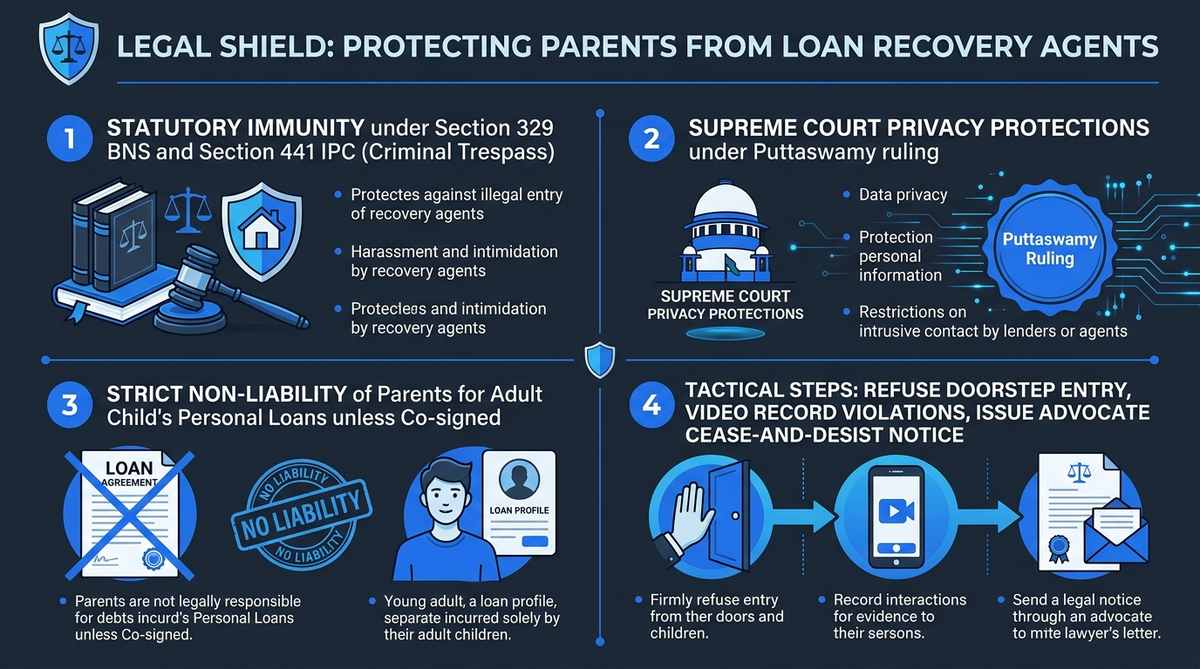
Figure 1: Legal protections shielding elderly parents from recovery agent visits under Section 329 BNS, Supreme Court privacy rulings. And the Indian Contract Act.
6. Tactical Doorstep Protocol for Aging Parents
To stay safe, elderly parents should keep main doors and safety grills locked. Homeowners do not have to speak with third-party agents at their door.
Under RBI rules, agents must show three key documents: a bank ID card, an IIBF Debt Recovery Agent (DRA) certificate. And a formal bank visit letter. Without these papers, the agent is an illegal intruder.
Parents can say clearly: "The borrower moved away and does not live here. We are not borrowers or guarantors. You cannot enter. Please leave now. Send all notices to our legal counsel.". Recording phone video creates legal proof under Sections 61 and 63 of the Bharatiya Sakshya Adhiniyam, 2023 (BSA) for police reports and RBI complaints.
7. Bank NPA Mechanics & the NPV Valuation Model
When an unsecured loan is unpaid for over 90 days, it becomes a Substandard Asset. Under RBI rules, the bank must set aside 15% to 100% of the loan amount from its profits. To reduce these losses, banks hire agencies on 15% to 25% commissions. This drives agents to visit family homes aggressively.
Bank committees evaluate bad loans using financial math. They compare quick settlements against long court cases using Net Present Value (NPV):
Here, C_t is expected recovery cash flow. And r is the discount rate. Litigation costs and NPA provisions reduce net bank value over time.
When advocates cite Section 329 BNS and file regulatory notices, banks realize that visiting parents yields zero cash. harassment also exposes them to RBI fines. Banks often agree to a One-Time Settlement (OTS), waiving 40% to 65% of the debt to close the account.
8. Serving a Formal Advocate Cease-and-Desist Notice
Verbal requests to agents rarely work because agency staff changes often. Protecting your parents permanently needs a two-part legal strategy.
First, serve an official Address Update Notice to the bank's Principal Nodal Officer via Speed Post. This provides your new address. The bank can no longer claim agents were searching for you. Any future visit to your parents becomes willful criminal trespass.
Second, send an Advocate Cease-and-Desist Notice citing Puttaswamy, the Senior Citizens Act, and RBI rules. This notice orders the bank to stop agent visits and speak only with your lawyer. In over 98% of cases, this stops doorstep harassment within 48 to 72 hours.
9. Comparative Legal Enforcement Matrix
Knowing the difference between private recovery agents and court officials helps protect your family. The matrix below shows legal limits for each recovery channel in India:
| Enforcement Channel. | legal Authority. | Right to Enter Parental Home. | Legal Liability of Aging Parents. | allowed Countermeasures. |
|---|---|---|---|---|
| Third-Party Recovery Agents. | Private agency contract. Zero court power. | Zero. Entry without consent is criminal trespass. | Zero. Parents protected by Privity of Contract. | Police report under Sec 329 BNS / 351 BNS, Advocate Notice, RBI Ombudsman. |
| Civil Court Bailiff (Order XXI CPC). | Warrant issued by a Civil Court. | Only with court warrant for named property. | Zero. Court cannot take parent assets for child debt. | File objection under Order XXI Rule 58 CPC to prove parent ownership. |
| SARFAESI Authorized Officer. | SARFAESI Act, 2002 (Secured loans only). | Zero for personal loans. Only for mortgaged property with DM order. | Zero unless parents gave property deeds as security. | File Section 17 appeal before the Debts Recovery Tribunal (DRT). |
| Lok Adalat Notice / settlement. | Legal Services Authorities Act, 1987. | None. No home visits. Attendance is voluntary. | Zero. No penalty for not attending. | Advocate helps agree on a fair One-Time Settlement. |
| Section 138 NI Act (Cheque Bounce). | Judicial Magistrate First Class Court. | Zero. Notice comes by post or police only. | Zero. Only the cheque signer faces trial. | Bail, court defense. And adding under Section 147 NI Act via OTS. |
10. SettleLoans Legal Relief in Protecting Parents
No elderly parent in India should live in fear of recovery agents banging on doors for an adult child's personal loan. At SettleLoans, our senior banking lawyers and loan negotiators defend borrowers and their families across India.
When you hire us, SettleLoans sends formal Vakalatnama notices, Address Update Mandates, and Cease-and-Desist notices to bank nodal desks. This stops doorstep visits to your parents right away. Our team then negotiates directly with bank committees to secure an official One-Time Settlement (OTS) with a 40% to 65% waiver and a bank-stamped No Dues Certificate (NDC).

Settle Loan is India's trusted debt relief and loan settlement platform. We help borrowers overcome financial distress by negotiating with banks and NBFCs to legally settle personal loans and credit card debts. With our transparent, performance-based approach, you can achieve debt freedom and regain your financial peace of mind.
COMPUTER
11. FAQs: Recovery Agents & Parental Legal Rights
Clear answers about recovery agent limits, Section 329 BNS trespass laws, Supreme Court privacy rulings. And debt settlement in India.
Can recovery agents legally visit my parents' house if I no longer live there?
No. Under RBI rules, agents cannot visit old family homes after you update your address. Visiting parents without cause is third-party harassment. It also counts as criminal house-trespass under Section 329 of the Bharatiya Nyaya Sanhita, 2023.
Are elderly parents legally responsible for repaying their adult child's personal loan or credit card debt?
No. Under Section 2(h) of the Indian Contract Act, 1872, loan contracts bind only the borrower. Parents have zero liability. They are not responsible unless they signed as a co-borrower or guarantor under Section 126 of the Act.
What should aging parents do immediately when a recovery agent arrives at their doorstep?
Keep all doors and safety grills locked. Ask for the agent's Bank ID card, IIBF DRA certificate, and bank visit letter. State clearly that the borrower moved away. Do not let them enter. Record a video on your phone and tell them to leave.
Can a bank or recovery agent seize household furniture, appliances, or gold from parents' house?
No. Recovery agents have zero power to seize property. Only a civil court bailiff with an Order XXI CPC warrant can attach assets. Also, Section 60 CPC protects basic household items. The bank cannot touch parental assets for your debt.
Which criminal sections apply if recovery agents harass elderly parents or refuse to leave?
Refusing to leave private property is criminal trespass under Section 329 BNS (Section 441/442 IPC). Threatening family members violates Section 351 BNS for criminal intimidation. Forcing money payments by fear is extortion under Section 308 BNS.
What did the Supreme Court of India rule regarding recovery agents and family privacy?
In ICICI Bank v. Prakash Kaur (2007), the Supreme Court banned musclemen for debt collection. In the Puttaswamy (2017) ruling, the court held that home privacy is a fundamental right under Article 21. Banks cannot harass innocent family members at home.
How does a formal legal notice from an advocate stop recovery agents from visiting parents?
A legal cease-and-desist notice gives the bank your new address. It cites Section 329 BNS trespass laws. It demands all future talks go through your legal counsel. Banks recall field agents quickly to avoid police cases and RBI Ombudsman fines.
Can a lending bank freeze parents' bank accounts or deduct money for their child's loan default?
No. A banker's lien under Section 171 of the Indian Contract Act applies only to the debtor's own accounts. Freezing a parent's pension or savings account is illegal. The bank must reverse such actions and may face RBI penalties.