- Cognizable Criminal Offense: Blocking doors or cars is a crime. It is Wrongful Confinement under Section 127 BNS (Section 340 IPC). It also counts as Wrongful Restraint under Section 126 BNS (Section 339 IPC).
- Key Snatching is Illegal: Taking car or bike keys by force is a crime. It is Extortion under Section 308 BNS. It is Robbery under Section 309 BNS. It carries strict jail terms.
- Constitutional Liberty Shield: Article 21 protects your personal freedom and dignity. Article 19(1)(d) protects your right to move freely anywhere in India. Private recovery agents cannot block your way.
- Direct Lender Liability: Banks and NBFCs remain responsible for their recovery agents. RBI Master Directions hold lenders accountable for third-party threats and physical abuse.
- Legal Counsel Stops Field Visits: Serving a Cease-and-Desist notice through an advocate halts home visits. It pushes the bank to negotiate an official 40% to 65% OTS settlement.
1. The Physical Restraint & Muscle Tactics Reality
Defaulting on a loan or credit card creates deep financial stress. In many Indian cities, borrowers face illegal recovery pressure. Recovery agents often use physical force. They stand in front of entrance doors. They block society gates. Some agents park bikes behind a borrower's car to stop them from driving out. Others block borrowers on their way to work.
In worse cases, agents snatch car or bike keys by force. They reach through open car windows. Agents wrongly think these strong-arm tactics are legal recovery steps. In reality, trapping people causes severe mental distress. It harms dignity and endangers personal safety.
Under Indian law, an unsecured loan default is a civil contract matter under the Indian Contract Act, 1872. It is not a crime. It gives no right to block your body or stop your travel. When an agent blocks an exit or takes keys, they commit a criminal crime.
Lenders have lawful civil remedies for defaults. They can file civil summary suits under Order 37 of the Code of Civil Procedure, 1908. They can use the Arbitration and Conciliation Act, 1996. They can pursue cheque bounce cases. They cannot use street muscle. Confinement tactics expose both agents and banks to criminal charges and heavy regulatory fines.
2. Penal Law Breakdown
Indian criminal law protects citizens from unlawful physical control. No private person can block or trap another citizen. The transition from the Indian Penal Code, 1860 (IPC) to the Bharatiya Nyaya Sanhita, 2023 (BNS) reinforces these rights. Clear legal protections protect personal freedom.
Two primary offenses apply when agents block movement. These are Wrongful Restraint and Wrongful Confinement:
Statutory Penal Sections Applicable to Recovery Muscle Tactics
Section 126 BNS (Corresponding to Section 339 &. 341 IPC): Wrongful Restraint
Wrongful restraint occurs when someone stops you from moving in a direction you have a right to go. An agent standing in your doorway commits this crime. Blocking a corridor or walkway is also punishable. It carries jail time of up to one month, a fine, or both.
Section 127 BNS (Corresponding to Section 340 &. 342 IPC): Wrongful Confinement
Wrongful confinement happens when someone traps you within a set boundary. Surrounding a home or locking an exit gate forms illegal confinement. Parking vehicles to block a driveway or garage is also illegal. This offense carries imprisonment up to one year, fines, or both.
Section 308 &. 309 BNS (Corresponding to Section 383, 384 &. 390 IPC): Extortion &. Robbery
Snatching car or bike keys by force is a serious crime. Grabbing phones to prevent recording is also illegal. Demanding cash under physical threats counts as extortion and robbery. These crimes carry severe jail terms of up to ten years.
Section 351 BNS (Corresponding to Section 503 &. 506 IPC): Criminal Intimidation
Threatening harm to your body, name, or property is a crime. Criminal intimidation carries up to two years of jail. If threats involve death or severe harm, jail terms increase up to seven years.
Section 189 BNS (Corresponding to Section 141 &. 143 IPC): Unlawful Assembly
When two or more recovery agents gather to intimidate or trespass, they form an unlawful assembly. Every member of that group shares criminal guilt under penal law.
Penal statutes operate separately from loan contracts. Even with unpaid debts, agents cannot break criminal law. When an agent blocks your path or takes property, the police must act. Under the Bharatiya Nagarik Suraksha Sanhita, 2023 (BNSS), police must register complaints and start formal action.
Check Your Loan Settlement Options
Answer 2 quick questions to evaluate your settlement eligibility.
1. What type of loan do you want to settle?
3. Constitutional Protections
The Indian Constitution protects your right to move freely. Article 19(1)(d) gives all citizens the right to travel across India without illegal barriers. Article 21 ensures that no person loses personal liberty except by lawful procedure. Private recovery agents cannot block your movement.
In Maneka Gandhi v. Union of India (1978) 1 SCC 248, the Supreme Court gave wide meaning to personal liberty. It includes the full right to physical movement and freedom from restraint. Any private firm using musclemen to block citizens violates fundamental constitutional rights.
The Supreme Court has condemned physical recovery tactics in key rulings. In ICICI Bank Ltd. v. Prakash Kaur &. Ors. (2007) 2 SCC 711, the apex court stopped banks from using musclemen to stop vehicles on public roads. The court ruled that banks must follow the rule of law. They cannot use physical force or threats to collect debts.
In Justice K.S. Puttaswamy (Retd.) v. Union of India (2017) 10 SCC 1, the Supreme Court protected bodily privacy under Article 21. Agents standing outside a residence or blocking a driveway violate your constitutional liberty. These acts are civil wrongs and punishable criminal offenses.
4. RBI Master Directions & Code of Conduct
The Reserve Bank of India sets strict rules for debt recovery. These rules draw power from Section 35A of the Banking Regulation Act, 1949 and the RBI Act, 1934. All commercial banks and NBFCs must follow these directives.
The RBI Master Directions on Outsourcing and the Fair Practices Code (FPC) strictly ban physical threats, confinement. And intimidation:
Mandatory RBI Regulatory Prohibitions for Recovery Agents
Strict Prohibition on Physical Coercion &. Restraint
Agents cannot use physical force. They cannot block gates, trap vehicles, snatch keys, or hold borrowers inside properties.
Permissible Interaction Window (8 AM – 7 PM)
Visits can only happen between 8:00 AM and 7:00 PM. Visiting outside these hours violates RBI rules directly.
Mandatory DRA Certification &. Identification
Every visiting agent must hold valid DRA certification from IIBF. Agents must show bank authorization letters and photo ID cards.
Total Ban on Public Shaming &. Corridor Scenes
Agents cannot shout in hallways. They cannot speak with society guards or shame borrowers before neighbors and coworkers.
The RBI enforces direct lender liability. Banks cannot blame third-party agencies. If an agent blocks your gate or snatches keys, the principal bank faces fines before the RBI Integrated Ombudsman and Consumer Commissions. The Ombudsman can award payout up to ₹20 Lakhs for actual losses. The Ombudsman can also award up to ₹1 Lakh for mental agony and harassment.
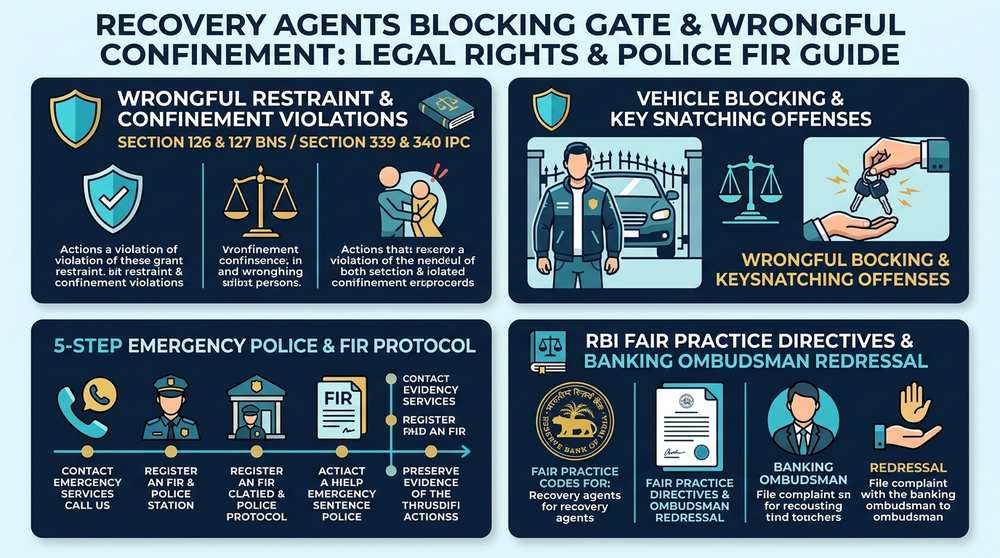
6. Tactical Emergency Protocol
If agents block your door or vehicle, stay calm. Follow this structured legal protocol. Taking clear steps creates strong evidence, stops intimidation. And triggers police action:
Step 1: Start Continuous Video Recording Immediately
Turn on video recording on your phone. Record the physical blockage, the agents&apos. faces. And their vehicle numbers. State clearly on camera: "I want to leave my home. But you are physically blocking me.".
Step 2: Dial Emergency Helpline 112 / 100
Call 112 right away. Tell the operator: "Unknown persons are blocking my gate, trapping my car. And threatening me.". Request immediate police dispatch for wrongful confinement.
Step 3: Alert Building Security &. Preserve CCTV Footage
Notify your building guards or society committee. Ask security to log the trespassers. Request them to preserve CCTV footage of the gate or parking blockage as proof.
Step 4: File a Formal Written Police Complaint (FIR)
Submit a written complaint to the police station under Section 173 BNSS. Cite Section 126 BNS (Wrongful Restraint), Section 127 BNS (Wrongful Confinement), Section 308 BNS (Extortion), and Section 351 BNS (Criminal Intimidation). Name the agents and the bank.
Step 5: Judicial Escalation under Section 223 BNSS (Sec 200 CrPC)
If local police do not register an FIR, escalate to the SP under Section 175(3) BNSS. Your lawyer can also file a private criminal complaint before the Judicial Magistrate under Section 223 BNSS.
Filing an official criminal complaint shifts leverage to you. Bank legal teams take criminal complaints seriously. To avoid regulatory fines and court scrutiny, banks recall field agencies and agree to an institutional OTS settlement.
7. Bank NPA Accounting Economics
Recovery agents use force because banks are pressured by unpaid loans. An unpaid loan becomes a Non-Performing Asset (NPA) after 90 days.
When a loan turns to an NPA, banks stop earning interest. They must also lock away their own cash as a safety cushion:
- Substandard NPA: Banks must set aside 15% of the loan value.
- Doubtful NPA: Banks must set aside 100% of the loan value.
- Loss Assets: The bank writes off the entire loan as a loss.
Civil court cases take 3 to 5 years. They have high fees and lawyer costs. Also, the law protects your basic household items from seizure. Banks use a Net Present Value (NPV) formula to see if a settlement makes sense:
This formula balances expected cash back against the cost of fighting a long court battle.
Long court fights reduce bank profits. Banks prefer a One-Time Settlement (OTS). A 40% to 65% waiver brings fast cash back to the bank. It is cheaper than fighting for years. Rogue street tactics are done by commission agents, not by the bank's legal team.
8. Structured OTS Settlement Protocols
Never pay cash to recovery agents. They often keep the money as personal fees. Your loan balance stays high. And the harassment continues.
Follow this 3-step plan to end the debt and stop the harassment:
1. Legal Notice
Your lawyer notifies the bank of all illegal threats. All communication must now go through your advocate.
2. OTS Sanction
We negotiate with bank managers to get a signed settlement letter. It confirms your waiver and payment terms.
3. Official NDC
You pay the bank directly. They issue a formal No Dues Certificate, clearing your debt status.
Once paid, the bank updates your status to "Settled" with credit bureaus. This ends your liability and lets you fix your credit score.
9. Enforcement Powers vs Illegal Restraint Matrix
This table shows who has legal power and who does not.
| Recovery Source. | Legal Authority. | Can Block Paths? | Permissible Actions. | Your Remedy. |
|---|---|---|---|---|
| Recovery Agents. | None. | No. | Only visits between 8 AM - 7 PM. | Police Complaint & Lawyer Notice. |
| Court Bailiff. | Court Warrant. | Only with warrant. | Must show ID & follow rules. | File legal defense in court. |
| SARFAESI Officer. | Secured Assets Only. | No. | Must send 60-day notice first. | Apply to Debt Recovery Tribunal. |
| Police. | Crime only. | No. | Cannot collect debts. | Police Complaints Authority. |
| Lok Adalat. | Mediation. | No. | Mutual talk only. | Court-approved settlement. |
10. SettleLoans Wrongful Confinement Legal Defense
No one should be threatened or trapped by collection agents. SettleLoans provides a shield against this harassment. We enforce your rights under Article 21 and Section 127 BNS. We send legal notices to stop field agents immediately. We move your case to formal settlement discussions. Our team helps you get 40% to 65% waivers and your official No Dues Certificate.

Settle Loan is India's trusted debt relief and loan settlement platform. We help borrowers overcome financial distress by negotiating with banks and NBFCs to legally settle personal loans and credit card debts. With our transparent, performance-based approach, you can achieve debt freedom and regain your financial peace of mind.
COMPUTER
11. FAQs: Recovery Muscle Tactics & Legal Remedies
Clear legal answers on gate blocking, key snatching, police complaints. And debt settlement rights.
Is it illegal for a recovery agent to physically block my doorway or gate?
Yes. It is illegal and a cognizable crime. Blocking a doorway stops your movement. This acts as Wrongful Restraint under Section 126 BNS (Section 339 IPC). It also counts as Wrongful Confinement under Section 127 BNS (Section 340 IPC). Recovery agents have zero legal right to block you.
What should I do if a collection agent blocks my car or bike from leaving parking?
Start video recording on your phone right away. Record the agent's face and vehicle number plate. Film the blockage clearly. State aloud that they are blocking your movement. Dial 112 to call the police for criminal restraint. Stay calm and avoid physical fights.
Can recovery agents snatch or confiscate my vehicle or house keys by force?
No. Snatching keys by force is illegal. It is theft under Section 303 BNS (Section 379 IPC). It is extortion under Section 308 BNS (Section 383 IPC). If agents use threats, it becomes robbery under Section 309 BNS (Section 390 IPC). Robbery is a serious non-bailable crime.
What criminal sections apply to recovery agents using physical muscle tactics?
Several key penal laws apply. These include Section 126 BNS for Wrongful Restraint. Section 127 BNS applies for Wrongful Confinement. Section 351 BNS covers Criminal Intimidation. Section 308 BNS covers Extortion. Section 189 BNS applies if multiple agents gather. Section 329 BNS covers Criminal Trespass on your property.
How do I file a police FIR against recovery agents for wrongful confinement?
Submit a written complaint to the police station under Section 173 BNSS. Note the date, time, lender name, and agent details. Attach your video evidence. If the police refuse to register an FIR, write to the SP under Section 175(3) BNSS. You can also file a complaint with the Magistrate under Section 223 BNSS.
Are banks and NBFCs legally responsible for the criminal acts of their outsourced agents?
Yes. Banks and NBFCs remain legally responsible. RBI Master Directions on Outsourcing enforce strict rules. The Supreme Court affirmed this in ICICI Bank v. Prakash Kaur. Lenders face direct penalties for threats or confinement committed by recovery agents.
Can a bank repossess a vehicle on the road without judicial process or court orders?
No. The Supreme Court bans musclemen from seizing vehicles on roads. Lenders must follow legal due process. For secured car loans, they must send formal pre-seizure notices. They must give a cure period. Any repossession requires lawful inventory procedures.
How does appointing a debt settlement advocate stop physical harassment?
A debt settlement advocate files a formal Vakalatnama. The lawyer sends a Cease-and-Desist notice to bank nodal officers. Under the RBI Fair Practices Code, lenders must stop home visits once you hire legal counsel. All talks move through your lawyer for a fair OTS settlement.