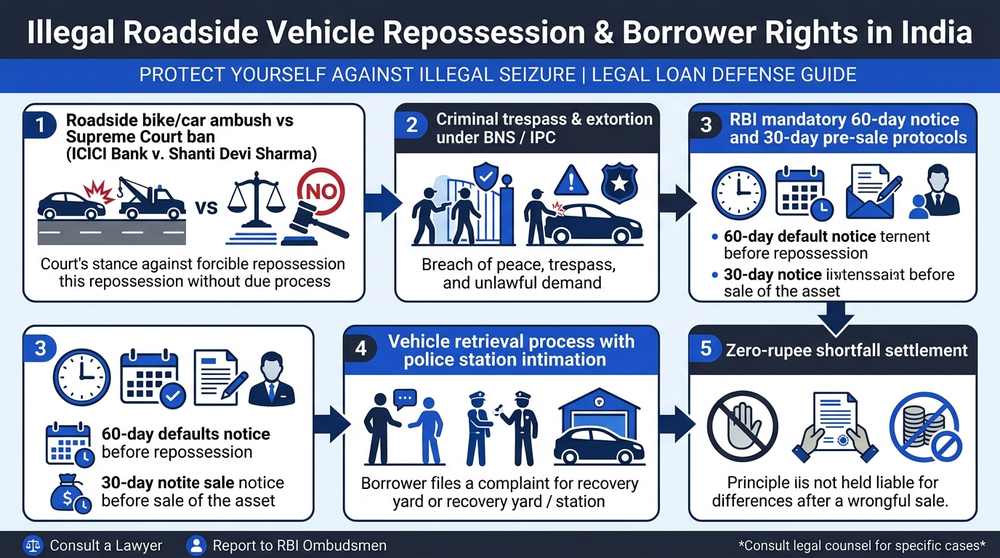
- Supreme Court Ban on Road Seizures: In ICICI Bank v. Shanti Devi Sharma and Prakash Kaur, the Supreme Court banned musclemen for vehicle recovery.
- Criminal Charges for Snatching: Seizing a vehicle on the road is extortion (Sec 308 BNS) and robbery (Sec 310 BNS). Both agents and bank officers face police action.
- Mandatory Notice Rules: Under RBI rules and Section 176 of the Contract Act, lenders must serve 60-day default and 30-day pre-sale notices.
- Fast Police &. Legal Action: Calling 112, checking DRA cards, avoiding surrender sheets. And filing a Zero FIR helps recover your vehicle quickly.
- Zero-Rupee Shortfall Settlements: Procedural errors and illegal seizure counterclaims allow advocates to settle remaining loan balances to ₹0 with an official NDC.
1. Vehicle Snatching & Highway Ambush Rules
Across India, many bike and car owners face roadside ambushes by recovery agents. When a borrower misses two or three monthly EMIs due to job loss or medical costs, agents corner them at traffic lights or toll booths. Third-party agents snatch keys, threaten drivers. And tow vehicles away without any court warrant or legal notice.
Banks and NBFCs rely on the public's lack of legal knowledge. Borrowers often believe hypothecation gives lenders the right to seize vehicles anywhere. This is completely false. Hypothecation is only a financial security charge. It does not grant ownership or police powers to financiers.
Skipping legal court processes to use untrained agents turns loan recovery into a criminal offense. Drivers are left stranded on highways and face public humiliation. Knowing your rights helps you get your vehicle back and stop illegal debt claims.
2. Supreme Court Jurisprudence
The Supreme Court of India has ruled clearly that banks cannot take the law into their own hands. The apex court banned musclemen for debt collection. Seizing vehicles by force breaks Article 21 rights of personal liberty and human dignity.
The Supreme Court held banks strictly liable for agent harassment. The court ruled that using musclemen to seize vehicles breaks the rule of law. Bank leaders can be held personally liable.
The Supreme Court banned musclemen from seizing vehicles on roads. Debt collection must follow the law. Banks must use civil courts rather than strong-arm tactics.
A three-judge bench held that loan clauses allowing repossession do not permit force. Taking vehicles without court orders or notice is unlawful and a banking failure.
The Supreme Court confirmed that repossession requires fair notice. Borrowers must get time to pay dues, followed by a pre-sale notice with fair market valuation.
High Courts across India have ruled that snatching keys on public roads is criminal robbery and extortion. Contract clauses that permit force are void under Section 23 of the Indian Contract Act.
Check Your Loan Settlement Options
Answer 2 quick questions to evaluate your settlement eligibility.
1. What type of loan do you want to settle?
3. Statutory Notice Protocols
The Reserve Bank of India (RBI) sets strict recovery rules in its Fair Practices Code and Circular RBI/2022-23/108. Every bank and NBFC must follow these steps before taking action against hypothecated assets. Lenders often skip these rules, giving borrowers strong legal grounds to fight back.
Under RBI rules, a legal vehicle repossession requires four clear legal stages:
Mandatory 60-Day Loan Default & Recall Notice
Lenders must give a written notice with a 60-day cure period. The notice must show the exact overdue amount, separating base principal from penal interest and late fees.
Pre-Repossession Notice & Advance Police Station Intimation
The lender must serve a pre-repossession notice before taking the vehicle. The bank must also inform the local police station in writing. Agents must carry bank IDs and IIBF DRA certificates.
Immediate Post-Repossession Inventory & Condition Protocol
After taking the vehicle, the lender must draft an inventory list with witnesses. It must record fuel level, vehicle condition. And personal items. A copy must go to the borrower immediately.
30-Day Pre-Sale Notice & Statutory Right of Redemption
Under Section 176 of the Indian Contract Act, 1872, the lender must give 30 days notice before auctioning the asset. The borrower has the right to redeem the vehicle by clearing overdue EMIs.
4. Criminal & Civil Liabilities
When agents use force to take vehicles on public roads, they face criminal charges under the Bharatiya Nyaya Sanhita (BNS), 2023. And the Indian Penal Code (IPC). Financiers have no legal immunity from criminal trial.
Threatening a borrower to get vehicle keys is criminal extortion. On a public road, force makes this highway robbery under Section 310 BNS / Section 392 IPC, carrying up to 10 to 14 years in jail.
Taking a vehicle without the owner's free consent is theft under Section 303 BNS. Removing cars parked on streets without a valid court warrant is an unlawful criminal act.
Blocking vehicle movement, snatching keys, or shouting threats is wrongful restraint and threats. Bank executives who hire these agencies can be charged under Section 61 BNS / Section 120B IPC.
5. Vehicle Seizure & Retrieval Roadmap
Understanding the steps of an illegal road seizure helps you stop harassment and reclaim your vehicle:
6. Emergency Step-by-Step Protocol
If recovery agents stop your vehicle on the road, follow these steps to stay safe and recover your property:
Step 1: Dial 112 Immediately & Report Vehicle Snatching
Stay inside your locked vehicle. Call police emergency at 112 right away. Report that unknown persons are blocking your vehicle and trying to snatch your keys. This creates an official police record.
Step 2: Demand Official Credentials & Video Record the Interaction
Record a video on your smartphone. Ask agents to show their bank ID card, IIBF DRA certificate. And bank authorization letter. Write down the license numbers of their vehicles.
Step 3: Strictly Refuse to Sign Blank "Voluntary Surrender" Forms
Agents often push a pre-printed surrender paper. Never sign any document under pressure. Signing gives the bank a false defense that you gave up the vehicle voluntarily.
Step 4: Lodge a Formal Police Complaint / Zero FIR
Go to the nearest police station immediately. File a complaint for extortion, theft. And threats under Sections 308, 303, and 351 BNS. Ask police to recover the vehicle under Section 497 BNSS / Section 451 CrPC.
Step 5: Engage Legal Advocates to Serve Notices & Approach Ombudsman
Have banking advocates send a legal notice to the bank Nodal Officer citing Supreme Court rulings. Also file a complaint with the RBI Banking Ombudsman for asset return and payout.
7. Bank NPA Accounting, NPV Recovery Formula
After an illegal seizure, lenders often sell the vehicle at a cheap auction price. They then demand a large shortfall balance. Understanding bank NPA accounting helps explain why banks frequently waive these balances during legal talks.
Once the vehicle is sold, the loan becomes an unsecured bad asset. Under RBI rules, banks must set aside 100% reserves from their profits. Suing for the shortfall in civil courts takes 3 to 5 years and costs heavy legal fees with low odds of recovery.
Where C_t is expected shortfall cash flow. And r is the discount rate. Court costs and 100% bad loan provisions reduce the net recovery value for the bank.
When faced with police complaints and Supreme Court Shanti Devi Sharma citations, the bank's Net Present Value turns negative. Bank settlement committees agree to a ₹0 full-and-final shortfall settlement to close the file cleanly.
8. Settlement Sanction Letter Forensics, RBI ₹0 NDC Mandate
Never pay cash to recovery agents or accept verbal settlement offers. Every vehicle loan settlement must be in writing. Get a signed One-Time Settlement (OTS) Sanction Letter on official bank letterhead.
Mandatory Clauses in a Vehicle Loan Shortfall Settlement Letter
- Account Details: Clear listing of loan number, vehicle registration number, chassis number. And engine number.
- Full Debt Closure: Clear clause stating the agreed payment or ₹0 waiver clears all principal, shortfall fees. And legal charges.
- Withdrawal of Cases: Commitment to drop all Section 138 NI Act, Section 25 PSSA, arbitration. And civil court cases in 30 days.
- Form 35 &. NOC: Agreement to issue RTO Form 35 and an NOC to remove the bank lien from your vehicle registration.
Under RBI Circular RBI/2023-24/60, lenders must issue a No Dues Certificate (NDC) and return original documents within 30 days. Delays cost lenders ₹5,000 per day in payout. Once settled, the bank updates credit bureaus (CIBIL, Experian, Equifax, CRIF High Mark) to show a ₹0 outstanding balance.
9. Vehicle Repossession Pathways vs Remedies Matrix
Review how different repossession methods compare under Indian law:
| Resolution Pathway. | Legal Authority / Basis. | Borrower Risk. | Timeline. | Final Legal Result. |
|---|---|---|---|---|
| Illegal Roadside Musclemen Seizure. | Zero legal basis. violates Shanti Devi Sharma &. BNS. | High (Asset lost plus heavy shortfall debt demanded). | 6 – 18 Months. | High risk of continued harassment and arbitration. |
| Coerced "Voluntary Surrender" | Signed under pressure without debt waiver. | High (Lender sells car at distress price and sues for balance). | 3 – 9 Months. | No legal protection. lender keeps pursuing shortfall. |
| Court Receiver Repossession (Section 9). | Judicial order by District Court or High Court. | Moderate (Court supervision with formal notice). | 6 – 12 Months. | Lawful court process with right to file objections. |
| Advocate-Led ₹0 Shortfall OTS. | Procedural violations leveraged for full waiver. | Zero (Residual shortfall debt 100% waived). | 30 – 60 Days. | Complete legal closure. binding NDC and ₹0 CIBIL balance. |
10. SettleLoans Legal Defense & Vehicle Seizure Advisory
Facing aggressive recovery agents and roadside vehicle seizures requires experienced banking advocates. SettleLoans defends vehicle loan borrowers across India. We send criminal counter-notices, help police recover seized vehicles, challenge biased arbitration under Section 12(5) of the Arbitration Act. And negotiate complete ₹0 shortfall waivers with official No Dues Certificates.

Settle Loan is India's trusted debt relief and loan settlement platform. We help borrowers overcome financial distress by negotiating with banks and NBFCs to legally settle personal loans and credit card debts. With our transparent, performance-based approach, you can achieve debt freedom and regain your financial peace of mind.
COMPUTER
11. FAQs: Illegal Vehicle Seizure & Recovery Agent Rules
Verified legal answers on vehicle repossession rules, Supreme Court rulings. And police assistance in India.
Is it legal for bank recovery agents to intercept and seize my vehicle on the road in India?
No. The Supreme Court banned roadside vehicle seizures in Prakash Kaur (2007) and Shanti Devi Sharma (2008). Banks cannot use agents to stop or take vehicles on public roads. Taking a vehicle by force without a court order is illegal under Article 21 and counts as extortion.
What criminal offenses do recovery agents commit when they snatch a bike or car by force?
Roadside seizures involve severe crimes under the Bharatiya Nyaya Sanhita (BNS) and IPC. These include extortion (Section 308 BNS / Sec 383 IPC), theft (Section 303 BNS / Sec 378 IPC), robbery (Section 310 BNS / Sec 390 IPC), wrongful restraint (Section 126 BNS). And criminal threats (Section 351 BNS).
What immediate steps should I take if recovery agents surround me on the street?
First, stay calm and dial police at 112. Second, ask agents for their bank ID, IIBF DRA certificate. And bank letter. Third, record a video of the scene on your phone. Fourth, do not give up your keys or sign any surrender papers.
Can the police help me retrieve my vehicle if it was forcibly towed to a private yard?
Yes. File an immediate written complaint or Zero FIR at the nearest police station for vehicle snatching and extortion. Banks must inform local police before any legal repossession. The police can order the lender to return the vehicle.
What mandatory notices must a bank serve before repossessing a hypothecated vehicle?
Under RBI rules and contract law, lenders must send four notices. These include a 60-day default notice, a pre-repossession notice, an immediate inventory list. And a 30-day pre-sale auction notice under Section 176 of the Contract Act.
What is a 'Forced Voluntary Surrender Form' and why should I never sign it?
Agents often force scared borrowers to sign a surrender paper. They use it in court to claim you gave up the car willingly. Signing this paper takes away your legal rights. It also lets the bank sue you for a large shortfall debt.
What is a vehicle loan shortfall balance and how can advocates settle it to ₹0?
A shortfall balance is the unpaid loan gap left after an auction sale. By proving the road seizure was illegal and lacked mandatory notices, advocates file strong counterclaims. This forces the bank to waive the remaining balance to ₹0.
Can I claim compensation from the bank for mental harassment and loss of vehicle use?
Yes. Under the Consumer Protection Act, 2019, consumer courts often award ₹1 Lakh to ₹10 Lakhs in damages against banks for illegal repossession. You can also file a complaint with the RBI Banking Ombudsman.
Can a lender freeze my salary account or seize my home for an unpaid auto loan shortfall?
No. Once a vehicle is sold, the leftover debt becomes an unsecured loan. A lender cannot freeze your accounts or take your home without winning a civil court suit under Order 37 CPC.
How long does a bank have to issue a No Dues Certificate after loan settlement?
Under RBI Circular RBI/2023-24/60, banks must issue a No Dues Certificate and return original papers within 30 days of settlement. If they delay, the bank must pay you ₹5,000 for each day of delay.