- Zero Criminal Jurisdiction: Pure financial default on unsecured personal loans, credit cards, or instant apps is an exclusively civil breach of contract under the Indian Contract Act, 1872. Police cannot arrest you for debt.
- Impersonation is a Serious Crime: Collection agents posing as police inspectors or issuing fake WhatsApp "Crime Branch arrest warrants" commit punishable offenses under Section 170, 419, and 384 IPC (Sections 204, 319, and 308 BNS).
- FIR & Summons Verification: Real police summons require formal physical service under Section 41A CrPC (Section 35 BNSS). Fake FIR numbers sent over WhatsApp can be instantly verified on State CCTNS portals.
- Turning the Tables via Legal Complaint: Filing a cyber extortion complaint and RBI Ombudsman escalation forces lenders to disassociate from rogue agencies and negotiate a structured 45% to 65% One-Time Settlement (OTS).
- Mandatory ₹0 NDC Delivery: Following settlement fulfillment, RBI directives require lenders to deliver an official No Dues Certificate within 30 days under a ₹5,000 per day delay penalty.
1. Police Calls for Loan Defaults: Stopping Extortion
Few experiences trigger more intense psychological panic than answering a phone call to hear an aggressive voice claim: "I am Sub-Inspector Sharma calling from the Cyber Crime Cell / Crime Branch Police Station. A non-bailable cheating warrant has been issued against you by the bank. If you do not deposit ₹85,000 within two hours, a police team will arrive at your workplace to place you under arrest."
Within minutes, the panicked borrower receives forged PDF documents via WhatsApp adorned with state police emblems, fake FIR numbers, forged magistrate signatures, and urgent QR codes demanding immediate payment. For salaried professionals, small business owners, and families managing sudden job loss or medical crises, this calculated psychological warfare destroys peace of mind and induces sheer terror.
The objective truth must be stated clearly: in over 99.8% of cases, the person on the other end of the line is not a police officer, investigator, or government official. They are commission-driven tele-callers employed by third-party recovery agencies or digital lending platforms. Operating out of informal call centers, these rogue agents deploy Caller ID spoofing apps, background police siren sound effects, and forged legal notices to bypass your rational defenses and extort payments through calculated intimidation.
2. Statutory Legal Protections: Civil Debt Default vs. Criminal Liability & Supreme Court Precedents
Under the Indian legal framework, non-payment of an unsecured personal loan, credit card balance, or digital fintech loan is strictly a civil dispute arising from breach of contract under the Indian Contract Act, 1872. Commercial defaults do not fall within the scope of criminal jurisprudence unless explicit fraudulent inducement was committed at the time of borrowing.
The Supreme Court of India and various High Courts have consistently reprimanded commercial banks and police departments for attempting to weaponize the criminal justice system to recover commercial debts:
The Supreme Court held that banks and financial institutions cannot employ musclemen or recovery agents who resort to intimidation, harassment, or unlawful force. The Court mandated that banks are vicariously liable for criminal acts committed by their recovery agents.
The Supreme Court established the definitive legal distinction between mere breach of contract and criminal cheating under Section 420 IPC. To sustain a criminal charge, fraudulent intention must exist at the very inception of the transaction.
For offenses carrying imprisonment under 7 years, automatic arrest is strictly prohibited. Investigating officers must issue formal physical notices under Section 41A CrPC (Section 35 BNSS), and arbitrary arrests by police are treated as contempt of court.
Police officers are bound by state police manuals and the Police Act. Investigating commercial civil transactions without a formal magistrate reference under Section 156(3) CrPC is illegal and exposes police personnel to disciplinary inquiry and suspension.
If you applied for a loan using genuine identity documents (PAN, Aadhaar, bank statements) and made initial EMI repayments before suffering unexpected financial hardship (job termination, business failure, medical catastrophe), you have committed zero criminal offenses. Lenders have the legal right to pursue civil recovery through civil courts, summary suits, or Lok Adalat, but zero legal right to initiate police arrest or harassment.
Check Your Loan Settlement Options
Answer 2 quick questions to evaluate your settlement eligibility.
1. What type of loan do you want to settle?
3. Anatomy of Fake Police Summons, WhatsApp Notices & Digital Forgery
Rogue recovery agencies use standardized digital templates designed to mimic official law enforcement and judicial summonses. Understanding the common structural hallmarks of these fraudulent documents allows you to immediately debunk them:
Red Flag 1: Forged Emblems & Incoherent Legal Jargon
Fake notices frequently copy low-resolution state police logos, national emblems, or Ministry of Home Affairs crests. They combine contradictory legal phrases such as "Section 420 Non-Bailable Arrest Warrant issued by Cyber Crime Branch under Banking Ombudsman Act". Police departments cannot issue court arrest warrants, and the Banking Ombudsman has zero criminal jurisdiction.
Red Flag 2: WhatsApp Delivery Without Speed Post or Registered Mail
Legitimate judicial summonses and statutory police notices under Section 41A CrPC must be formally served in physical writing by an assigned process server or sent via registered Speed Post with an official acknowledgment card. Real police officers never send informal PDF attachments via disposable prepaid mobile numbers on WhatsApp.
Red Flag 3: Urgent Settlement Demands via UPI or Private QR Codes
If the caller or message demands that you transfer funds immediately to a personal UPI ID, a third-party gateway, or a virtual account to "quash the arrest warrant", you are experiencing pure criminal extortion. Police officers and courts never accept commercial loan settlements over UPI.
Red Flag 4: Territorial Jurisdiction Absurdities
A borrower residing in Bengaluru will receive a threat call from an alleged "Rohini Crime Branch Police Station in Delhi" or "Khar Police Station in Mumbai". Under Section 177 CrPC, criminal inquiries can only be initiated within the local jurisdiction where the alleged cause of action arose. A distant police station cannot initiate proceedings for an unsecured loan taken locally.
4. Bank Balance Sheet Accounting, NPA Provisioning & The Net Present Value (NPV) Equation
Why do banks and digital lending NBFCs hire aggressive collection agencies in the first place? To understand the root cause, one must examine banking prudential norms governed by Reserve Bank of India Master Directions. Indian financial institutions operate under strict statutory capital provisioning rules. When a borrower misses three consecutive monthly installments (90 days overdue), the asset is classified as a Non-Performing Asset (NPA).
The progressive provisioning requirements mandate banks to lock up substantial liquidity:
| Delinquency Stage | Overdue Days (DPD) | RBI Mandatory Capital Provision | Typical Settlement Haircut Potential |
|---|---|---|---|
| Special Mention Account (SMA-1) | 31 – 60 Days | Standard Provision (0.4% – 5%) | 0% (Fee / Late Charge Waivers Only) |
| SMA-2 / Pre-NPA | 61 – 90 Days | 5% General Reserve Locked | 10% – 20% Penalty Waivers |
| Substandard Asset (NPA) | 91 – 365 Days | 25% Unsecured Capital Provision | 35% – 45% Principal Haircut |
| Doubtful Asset (D1 / D2) | 1 – 3 Years Overdue | 100% Full Balance Sheet Provision | 50% – 60% Principal Haircut |
| Loss Asset / Written-Off | 3+ Years Overdue | 100% Fully Written Off Reserve | 60% – 75% Total Ledger Haircut |
When a loan enters NPA status, holding the bad debt damages the bank's Return on Equity (ROE) and Capital Adequacy Ratio (CAR). When evaluating whether to sustain endless third-party collection efforts or accept an advocate-negotiated compromise settlement, the bank's Credit and Risk Management Committee calculates the Net Present Value (NPV) of Recovery:
Where C_t represents estimated recoverable cash flows over time, r is the lender's cost of capital discount rate, and deductions account for 3–5 years of judicial court friction, advocate retainers, regulatory risk exposure, and balance sheet capital locked in zero-yielding NPA provisioning.
Because pursuing civil court litigation or arbitration requires years of court friction and substantial legal expenditure, recovering 35% to 50% in immediate, structured settlement cash yields a significantly higher Net Present Value than engaging in prolonged legal disputes.
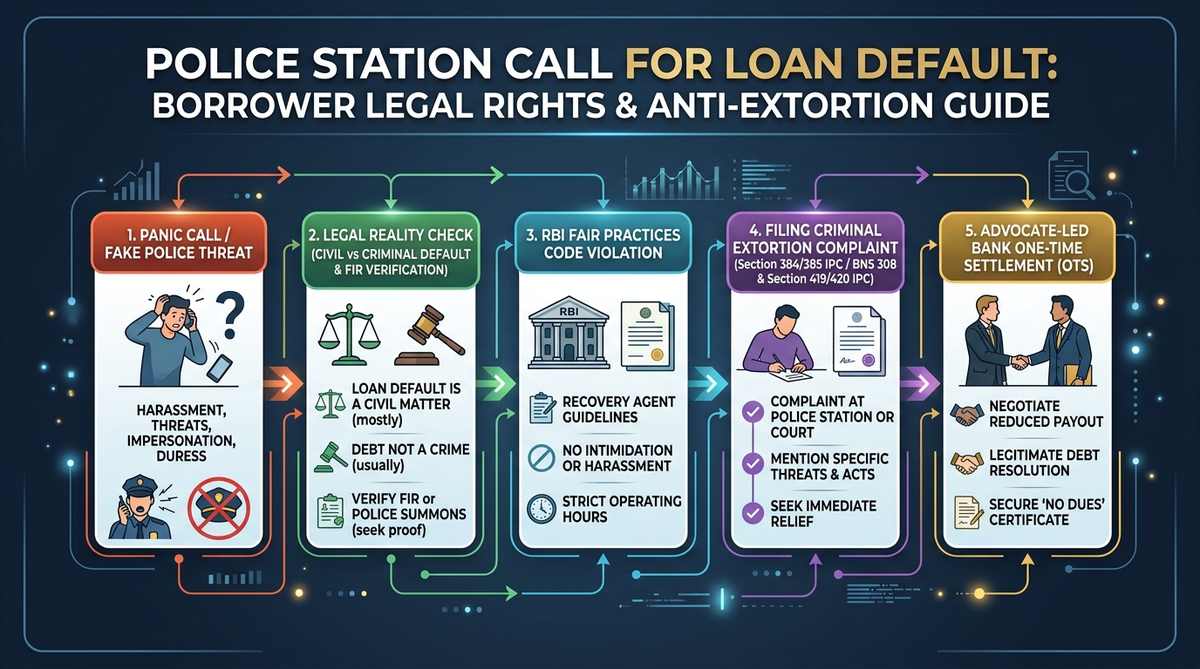
5. Police Intimidation Defense & Debt Resolution Visual Roadmap
The visual roadmap below details the complete 5-stage institutional progression from receiving an unlawful intimidation call to conducting legal reality checks, filing criminal extortion complaints under Indian penal law, and executing a binding One-Time Settlement (OTS) with full zero-balance No Dues Certificate discharge.
6. How to Verify Real FIR Status, Station Jurisdiction & Expose Impersonators
When confronted with a caller claiming to be a police officer, execute the following forensic verification protocol to dismantle the scam in real time:
1Demand Full Police Credentials & Station Landline
Ask the caller for their full name, rank/designation, Police General Diary (GD) number, posting station, and official government landline number. Impersonators will evade these specific questions, turn abusive, or abruptly disconnect the call.
2Cross-Verify on State Police CCTNS Portals
Under the nationwide Crime and Criminal Tracking Network & Systems (CCTNS), all genuine First Information Reports (FIRs) are uploaded digitally within 24 to 48 hours. You can search your State Police public citizen portal (e.g., Delhi Police e-FIR, Maharashtra Police CCTNS, UP Police Citizen Portal) using your district and name. If no record appears, the FIR number provided is a fabricated string.
3Demand a Formal Section 41A CrPC Written Notice
State clearly on the call: "Under Section 41A of the Code of Criminal Procedure, please issue a formal written notice signed by the Station House Officer (SHO) and dispatch it to my registered postal address. I will appear with my legal counsel." No collection agency can produce a lawful 41A notice for commercial loan defaults.
4Record All Calls & Capture Digital Evidence
Preserve call logs, audio recordings, WhatsApp messages, profile screenshots, and digital PDFs. This empirical evidence forms the basis for criminal extortion complaints and regulatory penalties against the lending bank.
7. Filing Criminal Extortion Complaints (IPC / BNS) & RBI Ombudsman Actions
When a recovery agent impersonates a police officer or threatens arrest, they cross the boundary from aggressive civil collection into active criminal offenses. Borrowers hold the legal power to initiate criminal and regulatory proceedings against both the individual agent and the lending institution under the following statutory provisions:
Section 170 IPC / Section 204 BNS: Whoever pretends to hold any particular office as a public servant and does or attempts to do any act under colour of such office is punishable with imprisonment up to two years.
Section 419 IPC / Section 319 BNS: Whoever cheats by pretending to be some other person or public authority is punishable with imprisonment of either description for a term which may extend to three years and fine.
Sections 384 & 385 IPC / Section 308 BNS: Intentionally putting any person in fear of injury or wrongful arrest in order to dishonestly induce them to deliver money constitutes criminal extortion, carrying rigorous imprisonment up to three years.
Section 66D Information Technology Act, 2000: Cheating by personation using computer resources or digital communication networks is punishable with imprisonment up to three years and a fine of ₹1 Lakh.
Under the Reserve Bank of India (RBI) Fair Practices Code for Lenders and Master Directions on Outsourcing of Financial Services, banks are strictly prohibited from resorting to intimidation, verbal abuse, or misleading representations. By lodging a complaint on the RBI Complaint Management System (CMS portal at cms.rbi.org.in) with audio recordings, the borrower can trigger regulatory audits against the bank, leading to the immediate termination of the rogue recovery agency and significant compensation.
8. Loan Remittance Protocols, RBI No Dues Certificate (NDC) Mandate & CIBIL Bureau Restoration
Once advocate representation halts police impersonation threats and transitions the dispute into legitimate One-Time Settlement (OTS) negotiations, executing the settlement cleanly is essential to prevent future disputes.
Five Golden Rules for Safe Settlement Remittance
- Official Bank Letterhead Sanction: Never pay a single rupee based on verbal assurances or WhatsApp texts. Insist on a formal One-Time Settlement (OTS) approval letter generated on bank letterhead with unique reference numbers and authorized signatures.
- Direct Loan Account Remittance: Deposit all funds directly into your specific loan account number via RTGS, NEFT, or an Account Payee Cheque drawn in favor of "[Bank Name] A/C [Your Loan Number]". Never transfer funds to agency accounts or personal UPI handles.
- Unconditional Debt Extinguishment: Ensure the settlement letter explicitly states that payment of the agreed sum constitutes full and final settlement, with all residual principal, penal interest, and legal claims permanently waived.
- RBI 30-Day Mandatory NDC Rule: Under RBI Circular RBI/2023-24/60, regulated commercial banks and NBFCs must issue a zero-balance No Dues Certificate (NDC) within 30 calendar days of settlement completion. Any delay entitles the borrower to statutory compensation of ₹5,000 per day of delay.
- CIBIL Bureau Rehabilitation: Following settlement, the bank reports the account status to credit bureaus (CIBIL, Experian, Equifax, CRIF) as "Settled" with an outstanding balance of ₹0. By opening a secured fixed-deposit credit card and maintaining on-time utility payments, borrowers systematically rebuild their credit score back to 750+ within 18 to 24 months.
9. Harassment Response & Dispute Resolution Comparative Matrix
A comparative evaluation of borrower response strategies highlights why legal advocate defense delivers superior protection compared to unrepresented panic:
| Action / Approach | Legal Validity & Authority | Financial Impact | Harassment Trajectory | Ultimate Outcome |
|---|---|---|---|---|
| Paying Under Police Threat | Zero legal protection; extortion | 100% full debt + inflated late fees paid | Escalates; agents demand further extortion payments | Debt remains active; no official closure letter |
| Arguing or Ignoring Calls | Civil default remains unaddressed | Default interest accumulates to 24%–36% per annum | Harassment expands to family, friends, and workplace | Risk of ex-parte civil decree or arbitration award |
| Filing Police / Cyber Complaint | Statutory rights under IPC/BNS & IT Act | Immediate halt of illegal collection fees | Instant cessation of calls; criminal scrutiny on agency | Shields borrower; creates leverage for negotiation |
| Advocate-Led Section OTS | Formal RBI & Banking Ombudsman protocol | 45% – 65% Principal Haircut & full waiver | 100% eliminated; all communications handled by counsel | Official bank-stamped ₹0 NDC & full legal discharge |
10. SettleLoans Legal Defense & Anti-Harassment Debt Advisory
You do not have to endure fear, criminal intimidation, or sleepless nights over an unpaid loan. SettleLoans represents distressed borrowers across India, providing an impenetrable shield against unlawful recovery harassment. Our dedicated banking litigation advocates issue statutory cease-and-desist notices, draft formal criminal complaints against impersonators, handle all communications with lenders, and negotiate structured One-Time Settlements (OTS) yielding 45% to 65% principal haircuts backed by official, bank-stamped No Dues Certificates.

Settle Loan is India's trusted debt relief and loan settlement platform. We help borrowers overcome financial distress by negotiating with banks and NBFCs to legally settle personal loans and credit card debts. With our transparent, performance-based approach, you can achieve debt freedom and regain your financial peace of mind.
COMPUTER
11. Frequently Asked Questions: Police Station Calls for Loan Default
Verified legal answers regarding recovery agent police impersonation, fake Crime Branch notices, and borrower legal protections in India.
Can a police officer call or arrest me for defaulting on an unsecured personal loan or credit card?
No. Defaulting on an unsecured personal loan or credit card in India is strictly a civil dispute arising from breach of contract under the Indian Contract Act, 1872. The Supreme Court has repeatedly held that police authorities have zero statutory jurisdiction to register FIRs, summon borrowers, or act as debt collectors for private financial institutions. Pure commercial loan defaults do not constitute a cognizable criminal offense.
Why do recovery agents pretend to call from a police station or Crime Branch?
Third-party collection agencies rely on psychological intimidation, fear of social stigma, and public ignorance of the law. By impersonating police officers, using fake police station background noise, or sending fabricated 'Crime Branch arrest warnings' via WhatsApp, rogue tele-callers attempt to induce extreme panic so that distressed borrowers borrow from informal lenders or surrender funds immediately.
What criminal offenses does a recovery agent commit by impersonating a police officer?
Impersonating a police officer and issuing threats of arrest constitute severe criminal offenses under Indian law. These include Personating a Public Servant (Section 170 IPC / Section 204 BNS), Cheating by Personation (Section 419 IPC / Section 319 BNS), Criminal Extortion (Sections 384 and 385 IPC / Section 308 BNS), Criminal Intimidation (Section 506 IPC / Section 351 BNS), and Digital Forgery / Impersonation under Section 66D of the Information Technology Act, 2000.
How can I verify whether a police call, WhatsApp notice, or FIR is genuine or fake?
First, demand the caller's full name, Police General Diary (GD) number, designation, and official station landline number. Never call back on numbers provided in unsolicited messages. Second, visit your State Police CCTNS online portal (such as Delhi Police, UP CCTNS, or Maharashtra Cyber) to verify whether any genuine FIR exists under your name or vehicle/PAN details. Legitimate police summons are served in person as physical notices under Section 41A of the CrPC (or Section 35 of the BNSS) with official station seals, never as informal threatening PDF templates on WhatsApp.
What should I do immediately when receiving a fake police threat call for an overdue loan?
Remain calm and avoid arguing aggressively. Record the entire telephone conversation using an automatic call recorder. Save screenshots of all WhatsApp messages, caller profile photos, and forged documents. State clearly: 'Loan default is a civil matter. Provide your GD number and send a formal summons under Section 41A CrPC to my registered address. I am recording this call for submission to the Cyber Cell and the RBI Banking Ombudsman.' Then contact a specialized debt defense advocate.
Can a bank or recovery agent file a cheating case under Section 420 IPC for simple loan default?
To establish cheating under Section 420 IPC (or Section 318 BNS), the lender must prove fraudulent intention right from the inception of the loan (e.g., submitting forged PAN/salary slips). If you made initial EMI payments or defaulted due to genuine financial distress (job loss, business closure, medical crisis), the Supreme Court has ruled that default is purely civil and criminal cheating charges cannot be maintained.
Where can I file a formal criminal complaint against a recovery agency for extortion and impersonation?
You can file a formal complaint with: (1) Your local police station or Cyber Crime Police Station for extortion and impersonation; (2) The National Cyber Crime Reporting Portal (cybercrime.gov.in); (3) The Principal Nodal Officer of the lending bank; and (4) The Reserve Bank of India Integrated Ombudsman (CMS portal at cms.rbi.org.in), which can penalize the lending institution and ban the outsourced recovery agency.
What are the RBI Fair Practices Code guidelines regarding recovery agent conduct?
Under RBI Circulars on Recovery Agents and Fair Practices Code, banks and NBFCs are strictly prohibited from: (1) Calling borrowers before 8:00 AM or after 7:00 PM; (2) Using threatening, abusive, or intimidating language; (3) Contacting relatives, colleagues, or neighbors; (4) Making misleading representations such as posing as police officers or court officials; and (5) Visiting borrower premises without pre-notified authorization and valid bank identity cards.
How does legal advocate representation stop fake police harassment and lead to an OTS?
When specialized advocates issue legal anti-harassment notices and initiate regulatory escalation, the bank's internal Stressed Asset Resolution Group intervenes immediately. Lenders terminate rogue agency assignments to avoid heavy RBI regulatory fines and criminal litigation. The dispute shifts to senior bank legal officers, opening the door for an amicable One-Time Settlement (OTS) with 45% to 65% principal haircuts.
What is the penalty if a bank fails to provide a No Dues Certificate after loan settlement?
Under RBI Circular RBI/2023-24/60, lenders are legally required to issue an official No Dues Certificate and update all four credit bureaus (CIBIL, Experian, Equifax, CRIF) to reflect a zero balance within 30 days of receiving the final agreed settlement payment. Any unjustified delay mandates the bank to pay statutory compensation of ₹5,000 per day of delay directly to the borrower.