- Trade Cycle Debt Relief: Textile traders, diamond processors, and MSME owners in Surat can legally settle unsecured business loans, personal credit lines, and dropline OD facilities when market liquidity contracts.
- Zero SARFAESI Exposure: Unsecured commercial and personal credit facilities carry zero mortgage backing, making them completely immune from SARFAESI property attachments or factory seizures without a court decree.
- 45% to 65% Principal Waivers: Driven by 100% unsecured NPA provisioning mandates under RBI IRACP prudential directions, bank zonal committees routinely approve significant compromise discounts.
- Local Court Notice Defense: Formal legal representation effectively counters Section 138 NI Act cheque bounce notices, Section 25 PSSA summons, and Order 37 summary suits in Surat District and Sessions Court (Athwalines).
- Mandatory 30-Day RBI NDC Release: Under RBI Circular RBI/2023-24/60, lenders must issue an official No Dues Certificate within 30 days of settlement payment, backed by a ₹5,000 per day statutory delay penalty.
1. Surat Trade Cycles, MSME Liquidity Unsecured Loan
Surat stands as India's undisputed commercial powerhouse for man-made synthetic textiles and diamond cutting and polishing. From the bustling wholesale corridors of the Ring Road Textile Market, Millennium Market, and Surat Textile Market (STM) to the traditional diamond bourses in Mahidharpura, Varachha, and the modern Surat Diamond Bourse (SDB) at Khajod, the city operates on an interconnected web of high-volume, credit-driven commerce. Industrial estates in Sachin GIDC, Pandesara, Katargam, and Olpad house thousands of power loom weaving units, yarn texturizing plants, processing mills, and diamond manufacturing workshops.
However, Surat's distinctive commercial velocity also exposes businesses and entrepreneurs to severe macroeconomic vulnerabilities. The local trading ecosystem relies heavily on unsecured financial instruments: unsecured MSME business loans, dropline overdraft (OD) facilities, cash credit limits, fintech merchant advance lines, and multi-lender personal loans. When international diamond export demand softens due to shifting consumer trends or geopolitical frictions, or when domestic textile wholesale demand fluctuates due to synthetic yarn price shocks and delayed payment cycles from outstation buyers, cash flows dry up overnight.
In a typical Surat business default scenario, a trader or manufacturer who previously serviced multiple credit lines seamlessly suddenly experiences a working capital bottleneck. Incoming trade receivables that normally take 60 days to realize extend to 150 or 180 days. Meanwhile, commercial banks and non-banking financial companies (NBFCs) continue auto-debiting monthly EMIs and interest charges. When operational accounts fall short, auto-debits bounce, triggering punitive NACH rejection charges, late fees, and compounding penal interest.
Similarly, salaried professionals working in Surat's burgeoning technology, petrochemical, and logistics corridors in Hazira, Vesu, and Adajan face personal financial distress from unexpected medical emergencies, family commitments, or job transitions. When borrowers attempt to juggle multiple unsecured loan EMIs with high credit card revolving balances, compounding interest quickly overwhelms regular monthly income. In both commercial and personal spheres, attempting to bridge liquidity gaps with expensive short-term loans only accelerates insolvency, making structured, advocate-led debt settlement the only sustainable legal solution.
2. Statutory Framework: RBI IRACP Master Directions, SARFAESI Limits & Surat Judicial Jurisdictions
A successful loan settlement in Surat is founded upon a deep understanding of Indian banking jurisprudence, Reserve Bank of India regulatory directives, and the specific jurisdiction of local courts across Surat district. Commercial lenders frequently attempt to intimidate distressed borrowers by threatening immediate asset seizure, police complaints, or factory lockouts. However, Indian law provides well-defined statutory firewalls that protect honest borrowers facing bona fide economic hardship.
Under the RBI Master Direction on Prudential Norms on Income Recognition, Asset Classification and Provisioning pertaining to Advances (IRACP), lenders are governed by strict institutional classifications when managing overdue credit facilities:
Under RBI IRACP guidelines, a loan account is categorized as Special Mention Account (SMA-0, SMA-1, SMA-2) during the initial 90 days of overdue status before formal Non-Performing Asset (NPA) classification. Once an account turns NPA, banks must derecognize unrealized interest from revenue and initiate balance sheet provisioning.
Under Section 13(2) of the SARFAESI Act, 2002, extra-judicial property attachment applies strictly to secured debts backed by registered mortgage or hypothecated tangible collateral. Unsecured personal loans, clean business loans, and dropline credit lines are completely exempt from SARFAESI action.
Legal claims below ₹20 Lakhs fall within the jurisdiction of the Surat District and Sessions Court in Athwalines and local Civil Courts. Claims of ₹20 Lakhs and above are subject to the Debt Recovery Tribunal (DRT-1 and DRT-2 Ahmedabad), which exercises jurisdiction over commercial banking disputes in South Gujarat.
Under RBI Directives on Fair Lending Conduct (effective 2024), banks are barred from compounding penal interest or capitalizing default penalties into the loan principal. Default levies must be charged solely as reasonable administrative penal charges, creating strong grounds for full waiver during OTS negotiations.
The Supreme Court of India and the Gujarat High Court have repeatedly affirmed that commercial banks and NBFCs cannot utilize extra-judicial coercion, third-party musclemen, or public humiliation to recover unsecured loans. Lenders seeking recovery must adhere strictly to lawful civil adjudication or mutual compromise conciliation.
Check Your Loan Settlement Options
Answer 2 quick questions to evaluate your settlement eligibility.
1. What type of loan do you want to settle?
3. Escalation Risks: Cheque Bounce (NI Act 138), NACH Rejections, Banker Liens & Recovery Pressures
When a borrower in Surat defaults on an unsecured loan without professional legal representation, lenders deploy a multi-pronged escalation strategy designed to induce panic. Commercial banks and private NBFCs maintain aggressive debt recovery desks that leverage both statutory criminal notices and aggressive field recovery agents to force immediate repayments.
Distressed borrowers face five primary legal and operational escalation risks:
- Section 138 Negotiable Instruments Act Notices: If undated security cheques issued at the time of loan disbursal are presented and dishonoured for insufficient funds, lenders issue a statutory 15-day demand notice prior to filing criminal complaints before the Chief Judicial Magistrate (CJM) Court in Surat.
- Section 25 Payment and Settlement Systems Act (PSSA): When automated NACH e-mandates bounce, NBFCs increasingly file criminal complaints under Section 25 of the PSSA, 2007, which carries penal provisions identical to cheque bounce proceedings.
- Order 37 Summary Suits in Surat Civil Courts: For unsecured debts below ₹20 Lakhs, lenders file summary suits under Order 37 of the Code of Civil Procedure (CPC) in Surat District Court, seeking swift commercial decrees unless leave to defend is obtained.
- Unlawful Banker Lien Account Freezes: Invoking Section 171 of the Indian Contract Act, banks attempt to place debit blocks on operational current accounts or savings accounts across other branches, freezing business working capital.
- Workplace & Market Harassment: Third-party recovery agents frequently visit trading shops in Ring Road markets or diamond offices in Mahidharpura, violating RBI Fair Practices codes and damaging commercial reputations.
Surat traders often make ad-hoc token payments of ₹25,000 to ₹1,00,000 under intense pressure from recovery agents who promise verbal moratoriums. This is a severe strategic misstep. In a delinquent loan account, uncoordinated token deposits are immediately appropriated toward overdue penal interest and memo charges without reducing the core principal ledger. Settlement negotiations must be formalized before paying any settlement funds.
4. Bank Balance Sheet Accounting, NPA Provisioning & The Net Present Value (NPV) Equation
Securing a favorable 45% to 65% One-Time Settlement requires understanding the financial incentives that govern bank credit committees. Major commercial banks—including State Bank of India, Bank of Baroda, HDFC Bank, ICICI Bank, Axis Bank, Kotak Mahindra Bank, and leading NBFCs—operate under strict institutional balance sheet rules prescribed by the Reserve Bank of India.
When an unsecured loan remains irregular past 90 days, the bank is legally required to allocate capital reserves against the advance:
| Asset Classification Stage | Overdue Aging Timeline | Mandatory RBI Capital Provision | Feasible OTS Haircut Range |
|---|---|---|---|
| SMA-0 to SMA-2 | 1 – 90 Days Overdue | 0.40% – 5.0% Standard Advance Provision | 0% – 15% (Penal Charges Waiver Only) |
| Substandard (Unsecured Loan) | 91 – 365 Days Default | 25% Core Capital Provision | 30% – 45% Principal Haircut |
| Doubtful 1 (D1 Asset) | 12 – 24 Months Default | 100% Full Provision on Unsecured Portion | 45% – 55% Principal Haircut |
| Doubtful 2 / Loss Asset | 24+ Months / Written-Off | 100% Full Balance Sheet Write-Off | 55% – 65% Principal Haircut |
Because clean unsecured personal and business loans carry no collateral backing, commercial banks must provide an aggressive 100% capital reserve once the loan transitions into the Doubtful category. Every month an unsecured NPA remains unresolved, it ties up valuable Tier-1 regulatory capital. When evaluating whether to initiate protracted civil litigation in Surat courts or sanction an immediate compromise OTS, the bank's Stressed Asset Management Group (SAMG) applies the mathematical Net Present Value (NPV) Valuation Formula:
Where C_t represents estimated recoverable cash flows over time, r is the bank's cost of capital discount rate, and deductions account for 3 to 5 years of Surat court friction, advocate fees, execution challenges on unsecured debtors, and capital locked in 100% idle NPA provisioning.
When experienced debt settlement advocates present an upfront compromise payment supported by a verified trade hardship dossier, the bank's internal financial algorithms prove that recovering 40% to 55% of the principal ledger today yields a substantially higher Net Present Value than pursuing years of uncertain litigation against an unsecured borrower.
5. Surat Loan Settlement Visual Roadmap
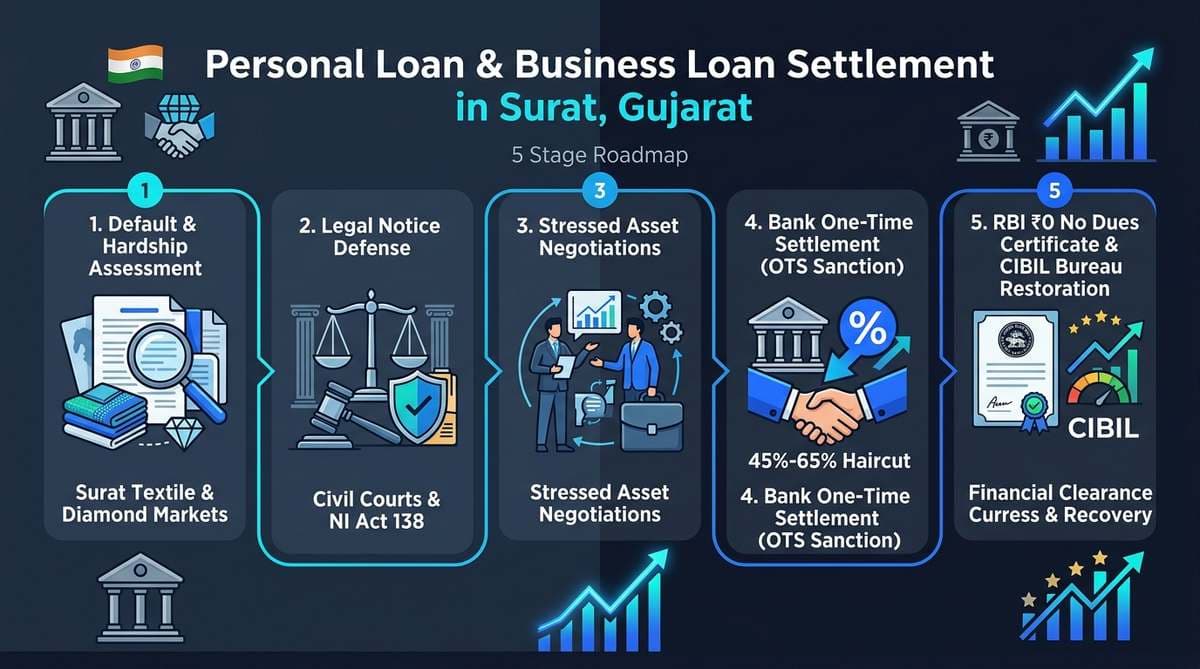
The visual roadmap below details the structured 5-stage institutional progression for loan settlement in Surat: from initial default assessment in textile and diamond trade sectors to formal legal notice defense, zonal stressed asset negotiations, OTS sanction letter verification, and final RBI No Dues Certificate issuance with credit bureau restoration.
6. Advocate-Led Defense & Negotiating 45%–65% OTS Waivers: The Surat Strategic Protocol
Attempting to negotiate a loan settlement individually often results in frustration. Local branch managers in Surat lack the discretionary authority to write off significant loan principal, while outsourced collection agencies operate on recovery commissions and intentionally prolong pressure tactics.
Professional debt resolution advocates execute a structured 4-phase institutional protocol that bypasses branch-level bottlenecks and engages senior bank decision-makers directly:
Phase 1: Legal Representation & Anti-Harassment Notice
Advocates issue a formal Notice of Appearance and Cease-and-Desist representation to the bank's Regional Stressed Asset desk and recovery wing. Citing the RBI Fair Practices Code, this notice prohibits unauthorized agent visits to commercial markets (Ring Road, Mahidharpura) or residential homes, transferring all communications exclusively to legal counsel.
Phase 2: Forensic Ledger Audit & Penal Charge Dissection
Our legal and financial team conducts a forensic audit of the loan ledger from disbursal date. We extract the true net principal, strip out compounding penal interest, annual maintenance fees, late renewal debits, and uncharged memo interest, establishing an objective baseline for compromise negotiations.
Phase 3: Hardship Dossier Submission to Stressed Asset Desks
We bypass branch staff to submit an unassailable financial hardship dossier to the bank's Stressed Assets Resolution Branch (SARB) in Ahmedabad or Surat. The dossier includes audited balance sheets showing business turnover declines, GST return contraction, buyer default notices, or medical proofs demonstrating genuine inability to repay in full.
Phase 4: Lok Adalat Conciliation & Structured Compromise
Advocates structure an aggressive OTS settlement proposing 35% to 55% of verified principal, payable as a lump sum or in 2 to 4 monthly installments. When appropriate, we refer the matter to the National Lok Adalat at Surat District Court (Athwalines), securing a formal decree that completely shields the borrower from future claims.
By shifting the negotiation from informal tele-calling harassment to structured legal advocacy before bank credit committees, borrowers in Surat secure deep financial relief while ensuring complete statutory protection.
7. Forensic Checklist for Watertight Bank Sanction Letters: Safeguarding Complete Legal Finality
A critical phase in the loan settlement process is the forensic verification of the One-Time Settlement (OTS) Sanction Letter. Unscrupulous recovery agents frequently issue fake "settlement discount emails" or forged approval letters on WhatsApp to collect partial funds. Paying money against an unauthorized document leaves the loan active, compounding penal interest, and vulnerable to future litigation.
Before remitting a single rupee, our legal advocates verify the sanction letter against five mandatory forensic checkpoints:
The sanction letter must be issued on official bank letterhead with registered regional/zonal office details, proposal reference numbers, and digital or physical signatures of authorized Scale-IV/V bank officers.
The document must explicitly cite your exact 16-digit loan account number, customer ID (CIF), business entity name, PAN, and confirm the permanent cancellation and closure of the credit limit.
The terms must state without ambiguity that upon payment of the agreed settlement sum, all remaining principal, interest, penal charges, and legal expenses stand irrevocably waived with zero future recourse.
The letter must mandate the immediate withdrawal of any pending Section 138 NI Act cases, Section 25 PSSA complaints, or civil suits in Surat courts, alongside the release of all banker lien freezes on linked accounts.
Never remit settlement funds into an individual agent's bank account, collection agency QR code, or personal escrow. Settlement payments must be deposited directly into your designated bank loan account via RTGS/NEFT or an Account Payee Demand Draft drawn in favor of "[Bank Name] A/C [Your Loan Account Number]".
8. Remittance Protocols, RBI ₹0 No Dues Certificate Mandate & CIBIL Restoration
Remitting the agreed compromise amount represents a decisive milestone, but debt resolution is complete only when the lender legally closes the account and credit bureau records reflect zero outstanding liability.
Under RBI Circular RBI/2023-24/60 (Responsible Lending Conduct – Release of Movable/Immovable Property Documents and Issuance of NDC), all commercial banks, urban cooperative banks, and NBFCs must comply with strict statutory timelines:
The lending institution is statutorily required to deliver an official No Dues Certificate (NDC) / Loan Closure Letter, return all unencumbered original documents or security cheques, and update all credit information companies (CIBIL, Experian, Equifax, CRIF High Mark) within 30 calendar days of receiving full settlement remittance. Any unjustified delay makes the lender liable to pay statutory compensation of ₹5,000 per day of delay directly to the borrower.
Understanding Credit Bureau Reporting & Score Rehabilitation
Understanding how a settlement is reflected across credit bureaus is crucial for long-term commercial and personal financial planning:
- Account Status Update: Credit bureau records update from "Active / Default / 90+ DPD" to "Settled" or "Post-Write-off Settled", with current outstanding balance shown as ₹0.
- Termination of Daily Default Accrual: The "Settled" tag permanently freezes monthly negative payment remarks and prevents the bank from selling unrecovered balances to asset reconstruction companies (ARCs).
- Institutional Cooling Period: Regulated commercial lenders typically observe a 12-month cooling window before evaluating fresh unsecured credit applications from settled borrowers.
- Credit Rebuilding Protocol: By subscribing to a secured credit card backed by a fixed deposit, keeping credit utilization below 30%, and ensuring prompt utility and trade payments, borrowers restore their CIBIL score above 750 within 18 to 24 months.
9. Comparative Strategy Matrix: OTS vs Restructuring vs Lok Adalat vs Civil Litigation
Evaluating the primary institutional pathways available to resolve delinquent unsecured personal and business loans in Surat enables borrowers and MSME owners to choose the most prudent strategy:
| Resolution Pathway | Legal Mechanism & Forum | Principal Haircut Scope | Resolution Timeline | Financial & Legal Risk Profile |
|---|---|---|---|---|
| Advocate-Led One-Time Settlement (OTS) | Zonal Stressed Asset desk negotiations; structured legal compromise | 45% – 65% Principal Waiver | 30 – 60 Days | Lowest risk; absolute legal closure with ₹0 No Dues Certificate |
| National Lok Adalat Settlement | Statutory conciliation at Surat District Court (Athwalines) | 40% – 60% Principal Waiver | Single Hearing Session | Non-appealable civil court decree equivalent; 100% court fee refund |
| Loan Restructuring / Term Loan Conversion | Conversion into 3–5 year structured EMI loan | 0% (Full Principal + Interest Repayable) | 60 – 90 Days | High recurring cash-flow burden; default reignites severe recovery litigation |
| Contested Surat Civil / DRT Litigation | Adjudication in Surat District Court or DRT Ahmedabad | 0% – 20% (Subject to trial decree) | 3 – 5 Years | High advocate retainers, court fees, compounding interest decrees, bank liens |
10. SettleLoans Legal Defense & Surat Debt Advisory
Resolving delinquent personal loans, business credit facilities, and overdrafts in Surat demands seasoned legal advocates who understand commercial banking operations, RBI prudential norms, and local trade dynamics. SettleLoans represents textile merchants, diamond traders, MSME business owners, and salaried professionals across Surat: issuing formal representation notices, halting unlawful recovery agent harassment, defending against Section 138 NI Act notices in Surat courts, conducting forensic ledger audits, and negotiating directly with bank zonal authorities to secure the deepest lawful principal haircuts backed by official, bank-stamped No Dues Certificates.

Settle Loan is India's trusted debt relief and loan settlement platform. We help borrowers overcome financial distress by negotiating with banks and NBFCs to legally settle personal loans and credit card debts. With our transparent, performance-based approach, you can achieve debt freedom and regain your financial peace of mind.
COMPUTER
11. Frequently Asked Questions: Loan Settlement Services in Surat
Direct, legally verified answers to essential questions regarding personal loan settlement, business credit compromise, and borrower protections in Surat, Gujarat.
Can textile traders and diamond merchants in Surat settle unsecured business and personal loans?
Yes. Traders, diamond brokers, MSME entrepreneurs, and salaried borrowers in Surat can legally settle unsecured personal loans, business lines of credit, and overdrafts through a formal One-Time Settlement (OTS). Once an account turns Non-Performing past 90 days, commercial banks and NBFCs must allocate capital provisions under RBI IRACP rules. Stressed asset desks routinely approve 45% to 65% principal waivers when presented with verified trade cash-flow hardship evidence.
Can banks in Surat seize commercial shops, looms, or polishing machinery for unsecured loan defaults?
No. Under Section 13(2) of the SARFAESI Act, 2002, coercive asset attachment without court intervention applies exclusively to secured loans backed by registered mortgages or hypothecated tangible collateral. Unsecured personal loans, clean business loans, and collateral-free OD limits are completely exempt from SARFAESI. Lenders cannot seize textile looms, diamond tools, commercial offices, or residential premises without a formal civil court decree.
What should a Surat borrower do upon receiving a Section 138 NI Act or Section 25 PSSA notice?
A statutory notice for bounced cheques (Section 138 Negotiable Instruments Act) or failed NACH auto-debits (Section 25 Payment and Settlement Systems Act) requires immediate legal action within the 15-day statutory response window. Specialized debt defense advocates draft a comprehensive legal reply establishing lack of mens rea, highlighting compounding penal disputes, and transferring the matter toward an amicable OTS before trial summons are issued in Surat District Courts.
How does Lok Adalat in Surat assist in loan settlement?
The District Legal Services Authority (DLSA) in Surat conducts regular National and State Lok Adalats at the District and Sessions Court in Athwalines. Lok Adalat provides a statutory conciliation forum where bank zonal officers and borrower advocates negotiate mutually agreeable compromise settlements. Settlements concluded before Lok Adalat carry the status of a final, non-appealable civil court decree with 100% refund of any court fees.
Can banks freeze unrelated current or savings accounts in Surat branches?
Banks often attempt to place debit blocks by asserting a general banker lien under Section 171 of the Indian Contract Act, 1872. However, this right cannot be exercised arbitrarily over third-party partnership funds, separate corporate entities, or salary accounts without prior formal notice. Advocates can challenge and overturn unauthorized freezes by filing statutory petitions under the RBI Fair Practices Code and Banking Ombudsman directives.
What percentage of loan waiver can borrowers in Surat negotiate through an OTS?
In unsecured personal and business loan settlements, borrowers in Surat typically achieve a 100% waiver of accumulated penal interest, overdue charges, and memo fees, alongside a 45% to 65% haircut on the core ledger principal. The exact compromise depends on account aging (SMA-2, Substandard, or Doubtful D1/D2 asset status) and the strength of the financial hardship dossier.
What documents are required to establish genuine trade hardship in Surat?
To substantiate financial distress, Surat borrowers submit trade ledger extracts, GST return filings demonstrating turnover contraction, audited Profit & Loss accounts, records of cancelled export orders or delayed trade receivables from wholesale markets, unpaid buyer dishonour notices, or personal medical documentation proving severe economic impairment.
What is the mandatory timeline for banks to issue a No Dues Certificate (NDC) post-settlement?
Under RBI Circular RBI/2023-24/60, all regulated commercial banks and NBFCs must deliver a formal No Dues Certificate (NDC) / Loan Closure Letter and update credit bureau records within 30 calendar days of receiving the full settlement amount. Lenders failing to adhere to this timeline are liable to pay statutory compensation of ₹5,000 per day of delay directly to the borrower.
How does loan settlement affect CIBIL scores and how can Surat entrepreneurs rebuild credit?
Post-settlement, the credit bureau status changes from active default (90+ DPD) to 'Settled' with an outstanding balance of ₹0. While an initial credit score dip occurs, it permanently stops compounding negative payment defaults. By obtaining a secured credit card against a modest fixed deposit and maintaining disciplined on-time payments, entrepreneurs restore their CIBIL score above 750 within 18 to 24 months.