1. SME Venture Collapse: Borrower Profile, Cash Flow Shock
In October 2023, Rajesh Singhal, a 41-year-old entrepreneur operating a proprietary textile and apparel trading enterprise in Surat, secured an unsecured collateral-free business loan of ₹15,00,000 from Axis Bank Limited. Designed to fund peak-season inventory procurement and working capital expansion, the commercial facility was disbursed over a 36-month repayment tenure at an annualized interest rate of 16.50%, generating a substantial monthly equated installment (EMI) of ₹53,120. Rajesh executed the facility agreement as sole proprietor while signing an irrevocable personal guarantee agreement in his individual capacity.
For eighteen consecutive months, the enterprise serviced its repayment obligations without a single dishonour. However, in late 2025, two major domestic retail chains that accounted for over 65% of the firm's trade receivables defaulted on payments and subsequently filed for insolvency. Simultaneously, steep volatility in raw fabric costs wiped out operating profit margins. Within ninety days, Rajesh's working capital cycle broke down completely, causing commercial revenues to plunge by over 80%.
Having exhausted his personal emergency liquidity servicing vendor liabilities and operational payroll, Rajesh defaulted on the May 2026 Axis Bank EMI. Within three consecutive billing cycles of non-payment, the loan account was formally classified as a Non-Performing Asset (NPA) under Reserve Bank of India prudential norms. Compounded default interest, late payment penalties, and bounce charges rapidly inflated the claimed outstanding ledger balance to ₹17,24,000.
Small and Medium Enterprises (MSMEs) facing sudden commercial failure often confront dual vulnerabilities: corporate liquidity exhaustion and aggressive recovery enforcement directed against personal guarantors. Understanding the legal distinction between mortgaged security and unsecured personal guarantees is essential to prevent coercive asset surrender.
2. Commercial vs. Retail Debt: How Axis Bank Treats Unsecured Business Loans
Commercial debt negotiation operates under fundamentally distinct legal, accounting, and institutional dynamics compared to retail consumer loans. When an individual defaults on a consumer credit card or personal loan, the bank evaluates the delinquency against household income and salary slip loss. By contrast, an unsecured business loan default involves commercial risk assessment, enterprise solvency audits, GST reconciliation, and personal guarantee enforceability.
Crucially, because an unsecured MSME business loan carries zero hypothecated machinery, pledged plant equipment, or mortgaged real estate, Axis Bank possesses no statutory authority to invoke the Securitisation and Reconstruction of Financial Assets and Enforcement of Security Interest (SARFAESI) Act, 2002. Under Section 13(2) and Section 13(4) of SARFAESI, summary physical possession without prior court intervention is strictly restricted to secured creditors holding registered equitable mortgages.
To resolve unsecured commercial NPA exposures, Axis Bank routes distressed accounts to its specialized Stressed Assets Resolution Branch (SARB) and Commercial Credit Committees. These specialized recovery wings operate under Board-approved compromise settlement policies aligned with the Reserve Bank of India Framework for Compromise Settlements and Technical Write-offs (2023), empowering credit authorities to write off substantial principal balances when enterprise insolvency is incontrovertibly established.
Check Your Loan Settlement Options
Answer 2 quick questions to evaluate your settlement eligibility.
1. What type of loan do you want to settle?
3. Behind the Bank Ledger: Axis Bank NPA Provisioning & MSME Accounting
Under the RBI Master Directions on Prudential Norms on Income Recognition, Asset Classification and Provisioning, commercial scheduled banks must set aside substantial capital provisions from their operating profits against stressed assets. The lack of collateral in unsecured business loans makes them extraordinarily costly for Axis Bank to hold on its active balance sheet.
As delinquency ages past specific regulatory thresholds, mandatory provisioning coverage ratios increase exponentially:
| Delinquency Bucket | Days Past Due (DPD) | Asset Classification | Mandatory RBI Provision |
|---|---|---|---|
| SMA-0 to SMA-2 | 1 – 89 Days | Standard (Stressed MSME) | 0.40% – 5.00% General Provision |
| NPA Substandard | 90 – 365 Days | Substandard (Unsecured MSME) | 25.00% Specific Provision |
| NPA Doubtful (D1) | 12 – 24 Months | Doubtful Asset Grade 1 | 100.00% of Unsecured Balance |
| Loss / Technical Write-off | 24+ Months | Loss Asset (AUCA Ledger) | 100.00% Fully Written Off |
When Rajesh's loan entered deep default, Axis Bank faced the immediate regulatory imperative of freezing further income recognition while provisioning hundreds of thousands of rupees against its capital reserve. By securing a structured ₹5.5 Lakh cash settlement upfront, Axis Bank was able to immediately release ₹3.75+ Lakhs of regulatory provisioning straight back into quarterly earnings, creating powerful commercial motivation for the bank to execute a compromise settlement.
4. Personal Guarantor Protection: Shielding Residential & Personal Assets from Seizure
The most severe anxiety confronting defaulting business founders involves the enforcement of personal guarantees. When third-party recovery agencies initially contacted Rajesh, they issued unlawful verbal threats claiming that Axis Bank would immediately attach his family's residential apartment, freeze his spouse's independent bank accounts, and auction household belongings within forty-eight hours.
SettleLoans immediately dismantled these coercive tactics through statutory legal clarification. Under Section 128 of the Indian Contract Act, 1872, the liability of a personal guarantor is indeed co-extensive with that of the principal borrowing entity. However, co-extensive liability does not confer summary attachment powers upon the creditor.
To attach personal immovable property for an unsecured business loan default, Axis Bank is legally compelled to institute a formal civil recovery suit before a competent Civil Court or Commercial Court. Under Order 38 Rule 5 of the Code of Civil Procedure, 1908 (Attachment Before Judgment), a court will only grant interim attachment if the lender produces incontrovertible documentary proof that the defendant is actively attempting to dispose of assets with fraudulent intent to defeat creditors.
Furthermore, obtaining a final civil court recovery decree in Indian commercial courts typically requires between three to six years of contested litigation, followed by multi-year execution proceedings under Order 21 CPC. Recognizing that Rajesh possessed zero attachable commercial real estate, SettleLoans established that the bank's threat of asset seizure was legally unviable, shifting the negotiation posture entirely in favor of an amicable One-Time Settlement.
Section 128 Indian Contract Act: Establishes co-extensive surety liability, but enforces no summary attachment without court adjudication.
Order 38 Rule 5 CPC: Prohibits attachment before judgment unless malicious asset dissipation is proven with strict evidential thresholds.
SARFAESI Inapplicability: Absolute statutory bar against summary physical possession on all unsecured MSME commercial loans.
6. Forensic Hardship Dossier & Commercial NPV Recovery Valuation Formula
Securing a massive commercial debt waiver from Axis Bank requires overcoming stringent anti-willful-default audits. Under Master Circular guidelines, the bank must satisfy itself that funds were not siphoned into personal shell entities and that business failure was genuine.
SettleLoans engineered an exhaustive Commercial Hardship Resolution Dossier comprising five forensic pillars:
First, audited profit and loss statements and balance sheets for the preceding two fiscal years reflecting operating losses, inventory obsolescence write-offs, and bad debt impairments. Second, GST portal filing records showing Nil GSTR-3B filings and surrender of commercial tax registrations. Third, certified 12-month bank statements across all corporate and individual accounts evidencing zero regular trade turnover. Fourth, formal lease surrender deeds and commercial utility disconnection certificates proving permanent physical closure of the operating premises. Fifth, an unencumbered asset disclosure affidavit confirming zero secondary real estate or financial investments.
Alongside this hardship substantiation, SettleLoans presented Axis Bank's Commercial Risk Committee with a mathematical valuation comparing immediate OTS cash versus long-term civil court recovery using the standard banking Net Present Value (NPV) Recovery Formula:
Where CashFlow_t represents speculative future realization from civil court execution decrees, discounted across a 5-year timeline against Axis Bank's Weighted Average Cost of Capital (WACC), deducting substantial advocate fees, court registry charges, and balance-sheet capital provisioning drag.
Our mathematical model demonstrated that pursuing civil litigation against a shuttered enterprise would yield an effective net present value of under ₹3.8 Lakhs over a 5-year horizon. An immediate cash settlement of ₹5.5 Lakhs delivered substantially higher recovery efficiency to Axis Bank.
7. The Settlement Table: Negotiating the 63.3% Haircut with Axis Bank SARB
Negotiating an enterprise compromise settlement with Axis Bank requires bypassing local branch sales personnel who lack write-off mandates under Axis Bank's Delegation of Financial Powers (DoFP) hierarchy. SettleLoans engaged directly with the Stressed Assets Resolution Branch (SARB) and the Regional Stressed Assets Credit Committee at Axis Bank's Zonal Headquarters.
The negotiations progressed through three structured, evidence-backed rounds:
In Round 1, Axis Bank SARB issued an initial counter-demand of ₹12,00,000, agreeing to waive accrued penal charges but insisting upon recovering 80% of the core principal. SettleLoans countered in Round 2 by submitting certified tax affidavits confirming complete business cessation and presenting an upfront settlement corpus arranged exclusively through third-party family assistance.
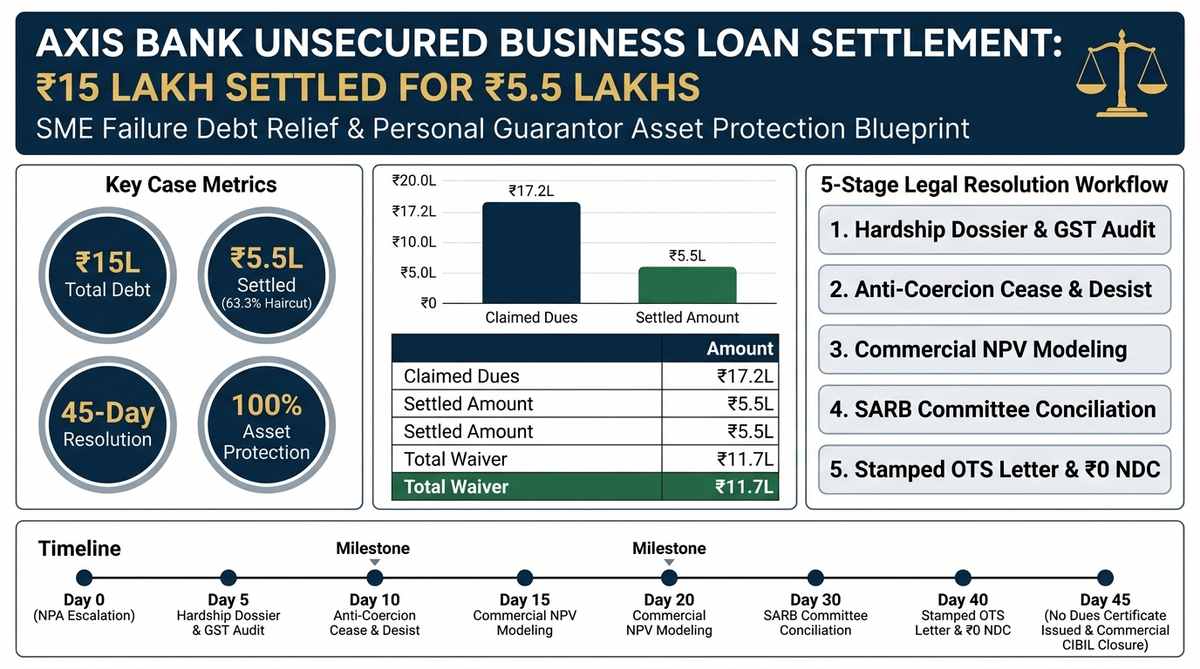
In Round 3, following risk committee validation of the NPV valuation model, Axis Bank sanctioned an official compromise settlement of ₹5,50,000. This represented a 63.3% haircut on core principal and an aggregate financial waiver of ₹11,74,000 across principal, regular interest, and compounding penalties.
| Financial Ledger Component | Claimed Bank Dues | Approved Settlement Amount | Total Waiver / Haircut |
|---|---|---|---|
| Core Principal Outstanding | ₹15,00,000 | ₹5,50,000 | ₹9,50,000 (63.3% Haircut) |
| Accrued Regular Interest | ₹1,12,000 | ₹0 | ₹1,12,000 (100% Waived) |
| Penal Interest & Overdue Levies | ₹74,000 | ₹0 | ₹74,000 (100% Waived) |
| NACH Bounce Penalties & Legal Costs | ₹38,000 | ₹0 | ₹38,000 (100% Waived) |
| Total Outstanding Claim | ₹17,24,000 | ₹5,50,000 Payable | ₹11,74,000 Total Relief (68.1%) |
8. Sanction Letter Forensics: 5 Essential Clauses & Secure Payment Execution
Prior to releasing any financial settlement funds, SettleLoans conducted a meticulous forensic audit of the formal sanction letter issued by Axis Bank. Many unguided borrowers fall victim to fraudulent collection communications or invalid letters issued by external recovery agencies without legal delegation.
Our legal team audited and validated five mandatory institutional clauses in Rajesh's settlement sanction:
First, the document was issued on official Axis Bank Limited corporate letterhead containing the Corporate Identity Number (CIN: L65110GJ1993PLC020769), branch seal, and the authorized signature and employee code of a Vice President (Commercial Asset Resolution). Second, the letter explicitly recorded ₹5,50,000 as the full, final, and absolute settlement of all claims arising under the commercial loan account number. Third, it incorporated an explicit clause confirming 100% debt extinguishment and write-off of the balance principal and accrued interest. Fourth, the sanction explicitly discharged and released Rajesh Singhal from his obligations as personal guarantor. Fifth, it formally committed Axis Bank to withdraw all pending notices under Section 138 of the Negotiable Instruments Act and Section 25 of the Payment and Settlement Systems Act within thirty days.
Following legal clearance, the payment of ₹5,50,000 was executed via Real Time Gross Settlement (RTGS) directly into the designated Axis Bank Loan Account Number, ensuring direct institutional receipt without intermediary exposure.
9. The ₹0 No Dues Certificate & Commercial CIBIL Score Reconstruction
Under RBI Circular RBI/2023-24/60, regulated commercial banking institutions are mandated to issue a formal No Dues Certificate (NDC) and transmit updated credit records to Credit Information Companies within thirty calendar days of full settlement realization.
On Day 28 following the RTGS remittance, Axis Bank issued the official stamped digital No Dues Certificate, certifying that the loan facility stood permanently closed with zero outstanding dues.
In compliance with credit reporting guidelines, Axis Bank updated TransUnion CIBIL Commercial, Experian Commercial, and the promoter's individual credit profile with the status 'Settled' and an outstanding balance of ₹0. While Rajesh's personal credit score initially adjusted downward during the default period, the formal closure eliminated active default accumulation and removed legal exposure.
SettleLoans provided Rajesh with a structured 24-month credit rehabilitation roadmap: establishing a secured fixed-deposit credit card with a ₹75,000 limit, maintaining credit utilization under 20%, ensuring flawless repayment of utility and vendor accounts, and adhering to the mandatory 12-month cooling period before seeking fresh commercial borrowing. Within twenty months, Rajesh successfully rebuilt his individual CIBIL score to 762, positioning him to launch a new enterprise on solid financial footing.
10. Comparative Resolution Matrix: Commercial OTS vs. IBC/NCLT vs. DRT Litigation
Distressed enterprise owners must evaluate the comparative advantages of commercial One-Time Settlements against alternative institutional debt resolution avenues available under Indian banking jurisprudence:
| Resolution Mechanism | Resolution Timeline | Haircut / Waiver Scope | Guarantor Protection | Operational Continuity |
|---|---|---|---|---|
| Direct SARB One-Time Settlement (OTS) | 30 – 60 Days | 50% – 70% Principal Haircut | Complete Release in Sanction Letter | Immediate Closure (Zero Litigation) |
| MSME Pre-Pack Insolvency (IBC Section 240A) | 90 – 180 Days | 30% – 60% Haircut | Subject to NCLT Resolution Plan | High Legal Compliance & IP Costs |
| Civil Court / DRT Recovery Litigation | 3 – 6 Years | 0% – Nominal (Court Decided) | Active Litigation & Attachment Risk | Severe Disruption & High Legal Fees |
| Commercial Restructuring / Extension | 30 – 60 Days | 0% Haircut (Accumulated Interest) | Guarantee Remains Actively Bound | High Recurring Debt Servicing Drag |
As demonstrated in this verified case study, negotiating an authentic One-Time Settlement directly with Axis Bank SARB provides the fastest, most economical, and legally conclusive resolution, extinguishing debt obligations while fully shielding personal assets.

Settle Loan is India's trusted debt relief and loan settlement platform. We help borrowers overcome financial distress by negotiating with banks and NBFCs to legally settle personal loans and credit card debts. With our transparent, performance-based approach, you can achieve debt freedom and regain your financial peace of mind.
COMPUTER
Commercial Debt Settlement & Guarantor Protection FAQs
Authoritative legal insights regarding Axis Bank unsecured business loan settlements, MSME debt haircuts, personal guarantor rights, and credit score reconstruction.
No. For unsecured business loans, no mortgage or legal charge is created on your residential or commercial real estate. Axis Bank cannot invoke summary possession powers under the SARFAESI Act, 2002. While signing a personal guarantee makes the promoter personally liable, the bank can only attempt asset attachment by filing a protracted civil recovery suit or Section 138/PSSA legal proceedings and obtaining a court decree, which typically takes 3 to 6 years in Indian civil courts.
The business owner suffered insurmountable commercial collapse following supply chain insolvency and loss of key buyer contracts. SettleLoans assembled a forensic hardship dossier including audited balance sheets showing zero revenue, GST surrender receipts, and bank account statements showing liquidity exhaustion. By presenting an empirical Net Present Value (NPV) recovery analysis directly to the Axis Bank Stressed Assets Resolution Branch (SARB), we secured a 63.3% principal haircut (₹5.5 Lakhs) and 100% waiver of penal interest and legal charges.
Commercial debt negotiations involve enterprise-level balance sheet forensics, business failure substantiation, GST reconciliation, and personal guarantee dynamics. Unlike consumer retail loans where settlement is evaluated on individual salary loss, commercial loan settlement with Axis Bank SARB centers on proving total enterprise insolvency, absence of diverted funds or willful default, and demonstrating that an immediate lump-sum settlement yields higher net recovery than multi-year civil litigation.
Under Section 128 of the Indian Contract Act, 1872, the liability of a surety (guarantor) is co-extensive with that of the principal debtor. When a business entity defaults, the bank can demand payment from the personal guarantor. However, co-extensive liability does not grant the bank power to seize personal assets without due legal process. In an unsecured facility, the lender must obtain a final civil court decree or execute a formal compromise settlement under RBI guidelines to extinguish the guarantee.
To secure approval from Axis Bank's Commercial Credit Committee, the business must provide: (1) Audited balance sheets and profit & loss statements for the last 2 years showing operational losses; (2) GST cancellation certificate or Nil GST returns (GSTR-3B / GSTR-1); (3) Certified 12-month bank statements of both the entity and personal guarantor showing zero cash flow; (4) Proof of commercial lease termination or shop closure; (5) Written affidavits confirming lack of secondary commercial assets or undisclosed investments.
Business loan default due to commercial failure is purely a civil contractual dispute. Police cannot register an FIR, issue summons, or arrest an entrepreneur for business bankruptcy. However, if repayment cheques bounce or electronic NACH/e-mandates fail, Axis Bank may issue statutory demand notices under Section 138 of the Negotiable Instruments Act, 1881, or Section 25 of the Payment and Settlement Systems Act, 2007, which are quasi-criminal and require formal legal representation.
Axis Bank utilizes an internal Net Present Value (NPV) recovery benchmark under its Board-approved Compromise Policy. The Stressed Assets Committee compares the immediate lump-sum cash offered against the discounted present value of potential future legal recoveries minus 3–5 years of court litigation expenses, advocate retainers, asset depreciation, and regulatory provisioning capital locked against the NPA.
Before depositing funds, borrowers must verify: (1) The letter is on official Axis Bank letterhead with a verified branch seal and authorized signatory employee ID; (2) Exact settlement amount (e.g., ₹5,50,000) explicitly stated as full and final discharge; (3) Complete debt extinguishment and waiver of all balance principal, penal interest, and legal costs; (4) Explicit release and discharge of the personal guarantor; (5) Commitment to withdraw all pending Section 138/PSSA legal notices and issue a ₹0 No Dues Certificate within 30 days.
Following settlement, Axis Bank reports the commercial account to CIBIL Commercial and personal credit bureaus as 'Settled' with an outstanding balance of ₹0. While this leads to an initial drop in the promoter's individual CIBIL score, the accumulation of active default entries ceases. By utilizing secured credit instruments and maintaining clean banking records, founders can systematically rebuild their CIBIL score back above 750 within 18 to 24 months.
Official Statutory Authorities & Regulatory Frameworks
- Reserve Bank of India (RBI): Framework for Compromise Settlements and Technical Write-offs & MSME Stressed Asset Directives
- RBI Master Direction: Fair Practices Code for Lenders & Conduct of Recovery Agents
- Axis Bank Limited: Grievance Redressal Policy & Commercial Asset Resolution Escalation Matrix
- Reserve Bank - Integrated Ombudsman Scheme, 2021: Dispute Resolution Portal for Unfair Recovery & Settlement Non-Compliance
- Insolvency and Bankruptcy Board of India (IBBI): MSME Special Resolution Provisions under Section 240A of the IBC, 2016