- Halting Compounding Debt: Defaulting on an overdraft facility triggers daily compounding penal interest and account freezing; a structured OTS permanently caps and closes the compounding ledger.
- Zero SARFAESI Exposure for Clean ODs: Unsecured business overdrafts and personal lines of credit without registered mortgages are exempt from SARFAESI property attachments under Indian banking law.
- 45% to 65% Principal Compromise: Driven by 100% unsecured NPA provisioning mandates under RBI IRACP rules, bank stressed asset committees routinely approve substantial principal haircuts.
- Restricting Banker Lien Overreach: Indiscriminate debit freezes on unrelated bank accounts can be legally challenged and released under Section 171 of the Indian Contract Act.
- Mandatory RBI ₹0 NDC Delivery: Lenders must issue an official No Dues Certificate within 30 days of settlement remittance under penalty of ₹5,000 per day of delay.
1. Demystifying Bank Overdraft Facilities & The Irregularity Trap
Bank Overdraft (OD) facilities and Dropline Overdraft lines are common yet hazardous credit structures in India. They are widely used by MSMEs, self-employed professionals, and salaried individuals. Unlike term loans amortized through predictable EMIs, an overdraft facility functions as a flexible revolving credit window linked to an operational current or savings account.
Under standard commercial banking agreements executed with major lenders—including State Bank of India, HDFC Bank, ICICI Bank, Axis Bank, Kotak Mahindra Bank, and Punjab National Bank—borrowers are granted a sanctioned credit limit. Interest is calculated on a daily product basis on the actual utilized balance and debited to the account at the end of each calendar month. In a Dropline Overdraft, the sanctioned limit or drawing power does not remain static. Instead, the bank systematically reduces the authorized threshold on a monthly or quarterly basis over an agreed tenure of 3 to 10 years, simulating principal reduction without enforcing fixed EMI structures.
The danger of an overdraft emerges when business revenue slows, client receivables stall, or cash flow crises hit. In a term loan, missing an installment creates an EMI overdue entry. In an overdraft facility, if credits fall short of interest debits or exceed drawing power, the entire account enters "irregular" or "out-of-order" status.
Once an OD account becomes irregular, banks initiate automatic debit blocks, preventing further operational withdrawals. Deprived of liquidity, the borrower is unable to deposit fresh operational funds because any incoming capital is instantly swallowed by accumulated interest debits, penal charges, and processing penalties. This mechanical debt spiral rapidly converts a manageable short-term cash flow crunch into an insurmountable financial default, leaving formal debt settlement as the only viable exit strategy.
2. RBI IRACP Norms, SARFAESI Limits & Banker Lien Protections
Navigating an overdraft default requires an acute understanding of Indian banking jurisprudence, regulatory circulars issued by the Reserve Bank of India, and statutory civil safeguards. Commercial lenders frequently exploit borrower unfamiliarity with banking regulations to deploy aggressive recovery tactics. However, Indian statutory frameworks provide robust legal protections that govern delinquent overdraft credit facilities.
Under the RBI Master Direction on IRACP Prudential Norms, an overdraft account is classified as Non-Performing when it remains continuously "out of order." The regulatory parameters defining this classification are clear:
An OD account is out of order if the balance exceeds the sanctioned limit for 90 days. It is also out of order if there are zero credits for 90 days, or if credits fail to cover interest debited during that period.
Under Section 13(2) of the SARFAESI Act, 2002, coercive asset seizure powers apply solely to debts secured by registered mortgages or tangible collateral. Unsecured business ODs and personal lines of credit are completely immune from SARFAESI attachment.
Under Section 171 of the Indian Contract Act, 1872, banker lien rights are strictly bounded. A bank cannot arbitrarily exercise general lien over third-party accounts, distinct corporate entities, or salary accounts without prior notice and judicial justification.
Under RBI Directives on Fair Lending Conduct (effective April 2024), banks are strictly prohibited from levying penal interest on a compounding basis. Penalties for OD default must be charged solely as reasonable 'penal charges' without capitalization into the principal ledger.
In landmark rulings, Indian courts have established that banks cannot engage in self-help recovery. Lenders cannot seize business machinery, vehicles, or inventory for clean unsecured credit without a civil court decree or arbitral execution order. Any extra-judicial seizure violates Article 300A of the Constitution of India.
Check Your Loan Settlement Options
Answer 2 quick questions to evaluate your settlement eligibility.
1. What type of loan do you want to settle?
3. Compounding Interest, Account Freezes & Recovery Risks
When a borrower ignores an irregular overdraft account or attempts to manage the default by making sporadic, insufficient token payments, the compounding mechanics of the banking ledger create severe operational paralysis. Because overdrafts do not have fixed EMI dates, interest continues to accrue daily against the peak ledger balance.
Left unaddressed, the institutional default triggers a predictable escalation sequence across five critical risk dimensions:
- Operational Current Account Freezing: The lending bank applies a total debit freeze on the OD current account. Business transactions, vendor payouts, and payroll transfers are abruptly halted, paralyzing ongoing commercial enterprise.
- Negotiable Instruments Act (Section 138) Exposure: If post-dated security cheques or automated National Automated Clearing House (NACH) mandates bounce due to account freezing or insufficient balance, the bank may initiate criminal proceedings under Section 138 of the NI Act or Section 25 of the Payment and Settlement Systems Act.
- Cross-Account Banker Lien Exercise: The bank searches internal systems and freezes other savings accounts, fixed deposits, or sister-concern current accounts maintained within the same banking institution under a purported claim of banker lien.
- Recovery Litigation via DRT or Civil Courts: If the aggregate exposure exceeds ₹20 Lakhs, the bank initiates formal recovery proceedings before the Debt Recovery Tribunal (DRT) under the Recovery of Debts and Bankruptcy (RDB) Act, 1993, or files an Order 37 summary suit in Civil Court for claims below ₹20 Lakhs.
- Severe Commercial & Personal CIBIL Degradation: Commercial CIBIL (CMR ranking) and personal credit scores plummet by 150 to 250 points, registering 90+ Days Past Due (DPD) tags that freeze all access to institutional finance across India.
Borrowers frequently make small token deposits of ₹20,000 to ₹50,000 into a frozen OD account under pressure from recovery tele-callers. This is a critical financial error. In an irregular OD account, token payments are instantly appropriated toward uncharged memo interest and overdue late penalties without reducing the principal loan balance by a single rupee. Settlement negotiations must precede any further capital remittance.
4. Balance Sheet NPA Provisioning & NPV Recovery Formula
Securing a deep 45% to 65% principal haircut on an overdraft facility requires understanding the economic motivations of commercial bank credit committees. Indian commercial banks do not view delinquent debt through emotional lenses; their decisions are strictly governed by RBI balance sheet provisioning mandates and mathematical recovery models.
When an overdraft facility remains irregular beyond 90 days, the bank must derecognize all accrued uncollected interest from its profit and loss statement and allocate substantial capital reserves against the advance:
| NPA Classification Stage | Overdue Aging Timeline | RBI Mandatory Capital Provision | Target OTS Haircut Scope |
|---|---|---|---|
| SMA-0 / SMA-1 / SMA-2 | 1 – 90 Days Irregularity | 0.40% – 5.0% General Provision | 0% – 15% (Penal Waivers Only) |
| Substandard (Unsecured OD) | 91 – 365 Days Default | 25% Core Capital Provision | 30% – 45% Principal Haircut |
| Doubtful 1 (D1 Asset) | 12 – 24 Months Default | 100% Full Provision on Unsecured Portion | 45% – 55% Principal Haircut |
| Doubtful 2 / Loss Asset | 24+ Months / Written-Off | 100% Balance Sheet Write-Off | 55% – 65% Principal Haircut |
Because clean unsecured overdrafts require an aggressive 100% capital provisioning once classified in the Doubtful category, every month the account remains unrecovered drains bank capital. When deciding whether to litigate through DRT/Civil Courts or sanction a compromise One-Time Settlement, the bank's Stressed Asset Management Group (SAMG) applies the Net Present Value (NPV) Valuation Formula:
Here, C_t represents estimated recoveries over time, and r is the bank's cost of capital discount rate. Deductions account for 3 to 5 years of court delays and advocate retainers. They also factor in court fees, execution friction, and capital locked in NPA provisions.
When experienced debt advocates present an immediate cash settlement backed by audited hardship proof, the bank's financial model responds favorably. Recovering 40% to 55% of the principal today yields a higher Net Present Value than chasing an unsecured borrower through 4 years of contested litigation.
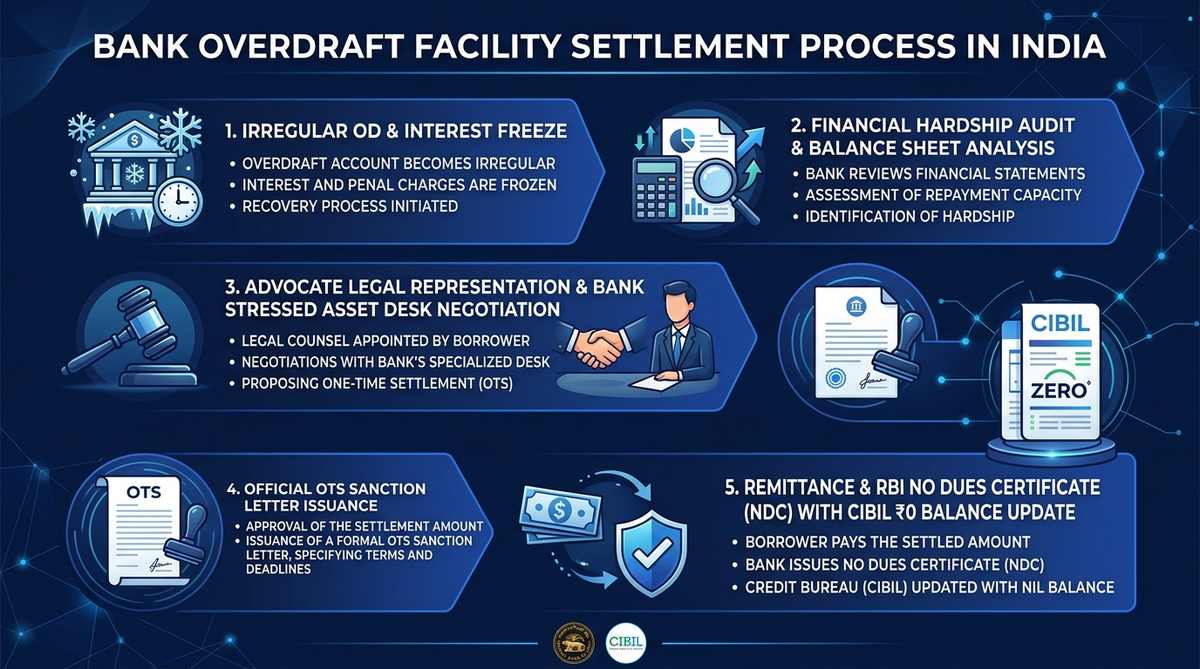
5. Bank Overdraft Facility Settlement Visual Roadmap
The visual roadmap below illustrates the structured 5-stage institutional progression. It guides you from initial OD account irregularity and interest freezing to forensic auditing, advocate-led zonal negotiations, official OTS sanction issuance, and final RBI No Dues Certificate delivery with credit bureau restoration.
6. Strategic Legal Defense & Converting Irregular OD to OTS
Attempting to negotiate an overdraft settlement independently often results in frustration. Branch managers lack the discretionary authority to sanction significant principal haircuts, while outsourced recovery agencies earn commissions based on maximum collection, intentionally keeping borrowers trapped in cycles of token payments.
Professional debt resolution advocates execute a structured 4-phase institutional strategy designed to bypass lower-level resistance and secure executive approval:
Phase 1: Legal Representation & Cease-and-Desist Defense
Advocates serve a formal Notice of Representation on the bank's Zonal Head and Legal Recovery Cell. This notice invokes the RBI Fair Practices Code, halts unlawful recovery agent harassment at your commercial premises or residence, challenges illegal banker lien freezes, and establishes a formal legal channel for all future communications.
Phase 2: Forensic Ledger Audit & Penal Charge Dissection
Our financial experts conduct a thorough audit of the overdraft statement of account from inception. We isolate the core drawn principal, dispute unauthorized commitment charges, penal compounding, and renewal inspection fees, establishing the true baseline debt figure for settlement discussions.
Phase 3: Hardship Dossier Submission to Stressed Asset Desks
We bypass local branch personnel to engage the bank's Stressed Assets Resolution Branch (SARB/SAMB) or Zonal Settlement Committee. We present an unassailable hardship dossier—including audited profit and loss statements, GST return dips, business closure affidavits, or medical proofs—substantiating a permanent diminution in debt-servicing capacity.
Phase 4: Compromise Terms Structuring & Lok Adalat Conciliation
Advocates structure an aggressive OTS proposal offering 35% to 55% of the verified principal, payable in a lump sum or structured across 2 to 4 monthly tranches. Where appropriate, we refer the compromise agreement to the National Lok Adalat, obtaining a formal decree that completely shields the borrower against future litigation.
By shifting the negotiation forum from high-pressure recovery calls to senior bank credit committees, borrowers secure substantial financial relief while maintaining complete legal protection.
7. Forensic Checklist for Watertight OD Sanction Letters
A critical phase in the overdraft settlement process is the forensic verification of the One-Time Settlement Sanction Letter. Delinquent borrowers are frequently targeted by rogue recovery agents who issue fabricated "settlement approval emails" or verbal promises to extract partial payments. Remitting funds without a genuine, bank-authorized sanction letter leaves your overdraft facility open and accumulating interest.
Before disbursing a single rupee, our legal team subjects the settlement sanction letter to five mandatory forensic validation checkpoints:
The sanction letter must be issued on official bank letterhead containing registered zonal office addresses, unique alphanumeric proposal reference codes, and verifiable digital or physical signatures of authorized Scale-IV/V bank officers.
The document must explicitly cite your exact 16-digit overdraft account number, customer identification file (CIF), business entity name, PAN, and clearly state the permanent revocation and closure of the credit limit.
The terms must state without ambiguity that upon payment of the agreed compromised sum, all remaining principal, uncharged interest, penal charges, and legal expenses stand fully and irrevocably waived.
The sanction letter must mandate the immediate lifting of all debit freezes/liens on linked accounts and require the bank to withdraw all pending legal notices, DRT claims, or Section 138 NI Act complaints upon payment.
Never remit settlement funds to an individual recovery agent's account, a collection agency UPI QR code, or an unverified escrow account. Settlement funds must be deposited directly into your designated bank overdraft loan account via RTGS/NEFT or an Account Payee Demand Draft drawn in favor of "[Bank Name] A/C [Your OD Account Number]".
8. Settlement Remittance, RBI ₹0 NDC Mandate & CIBIL Recovery
Executing the financial settlement by remitting the agreed compromised amount represents a major victory. However, the debt resolution process is complete only when the account is legally closed and credit bureau records reflect zero outstanding liability.
Under RBI Circular RBI/2023-24/60 (Responsible Lending Conduct – Release of Movable/Immovable Property Documents and Issuance of NDC), all commercial banks, urban cooperative banks, and NBFCs are statutorily bound by strict timelines:
The lending bank is statutorily required to deliver an official No Dues Certificate (NDC) / Loan Closure Letter within 30 calendar days. It must return unencumbered documents or security cheques and update credit bureaus. Any unjustified delay makes the bank liable to pay statutory compensation of ₹5,000 per day of delay directly to the borrower.
Navigating Credit Bureau Reporting & Score Rehabilitation
Understanding how an overdraft settlement is reflected across credit bureaus is crucial for future financial planning:
- Account Status Tag: In credit bureau records, the overdraft facility status is updated from "Active / Default / 90+ DPD" to "Settled" or "Post-Write-off Settled", with current outstanding balance shown as ₹0.
- Termination of Daily Penal Accrual: The "Settled" remark permanently halts the accumulation of monthly negative payment remarks and prevents the bank from ever selling the unrecovered balance to asset reconstruction companies (ARCs).
- 12-Month Institutional Cooling Window: Regulated commercial lenders enforce a standard 12-month cooling window before considering new unsecured credit applications from settled borrowers.
- Strategic Credit Rebuilding Protocol: By subscribing to a secured credit card backed by a modest fixed deposit, maintaining credit utilization below 30%, and ensuring flawless on-time utility and credit payments, borrowers consistently restore their CIBIL score above 750 within 18 to 24 months.
9. Overdraft Resolution Comparative Strategy Matrix
Evaluating the key institutional pathways available to resolve a delinquent bank overdraft facility enables borrowers and business owners to select the most financially prudent strategy:
| Resolution Pathway | Legal Mechanism & Forum | Principal Haircut Scope | Resolution Timeline | Financial & Legal Risk |
|---|---|---|---|---|
| Advocate-Led One-Time Settlement (OTS) | Zonal Stressed Asset desk negotiation; structured compromise | 45% – 65% Principal Waiver | 30 – 60 Days | Lowest risk; absolute legal closure with ₹0 No Dues Certificate |
| National Lok Adalat Settlement | Statutory conciliation under Legal Services Authorities Act | 40% – 60% Principal Waiver | Single Session | Non-appealable civil court decree equivalent; zero court fees |
| Working Capital Restructuring / WCTL | Conversion of irregular OD into 3–5 year Term Loan | 0% (Full Principal + Interest Repayable) | 60 – 90 Days | High recurring EMI burden; requires strict collateral & cash flows |
| Contested DRT / Civil Court Litigation | Adjudication under RDB Act (DRT) or Order 37 CPC (Civil Court) | 0% – 20% (Subject to trial decree) | 3 – 5 Years | Substantial legal expenses, compounding interest decrees, asset attachment risk |
10. SettleLoans Legal Defense & Overdraft Debt Advisory
Resolving a delinquent overdraft facility requires specialized legal advocates. Counsel must understand commercial banking operations, RBI directives, and stressed asset protocols. SettleLoans represents business owners and individuals across India. We issue formal notices, challenge unlawful banker liens, and conduct forensic ledger audits. Furthermore, we negotiate directly with bank zonal authorities to secure maximum lawful debt waivers backed by bank-stamped No Dues Certificates.

Settle Loan is India's trusted debt relief and loan settlement platform. We help borrowers overcome financial distress by negotiating with banks and NBFCs to legally settle personal loans and credit card debts. With our transparent, performance-based approach, you can achieve debt freedom and regain your financial peace of mind.
COMPUTER
11. Frequently Asked Questions: Bank Overdraft Facility Settlement
Direct, legally verified answers to essential questions regarding bank overdraft loan settlements, dropline facility closures, and borrower protections in India.
Can an unsecured bank overdraft (OD) facility be settled through a One-Time Settlement (OTS)?
Yes. Unsecured bank overdrafts, business credit lines, and dropline overdraft facilities can be formally settled through a One-Time Settlement (OTS). Once an OD account remains out-of-order past 90 days and is classified as a Non-Performing Asset (NPA), banks are required under RBI prudential guidelines to allocate substantial provisioning capital. To mitigate recovery costs and balance sheet drag, banks routinely approve OTS compromise settlements with 45% to 65% principal haircuts.
What makes an overdraft account 'irregular' or 'out-of-order' under RBI guidelines?
Under the RBI Master Direction on Prudential Norms on Income Recognition, Asset Classification and Provisioning (IRACP), an overdraft or cash credit facility is treated as 'out-of-order' if the outstanding balance continuously exceeds the sanctioned limit or drawing power (DP) for 90 days, or if the credits in the account are insufficient to cover the interest debited during the preceding 90-day period.
Can a bank freeze other savings or current accounts for an overdue overdraft facility?
Banks frequently attempt to freeze linked accounts by invoking the 'Right of General Lien' under Section 171 of the Indian Contract Act, 1872. However, this right is subject to strict judicial limits. Banks cannot freeze third-party partnership accounts, distinct legal entity funds, or salary accounts without prior statutory notice. Advocates can challenge unauthorized freezes under the RBI Fair Practices Code and Banking Ombudsman directives.
How does a dropline overdraft differ from a regular revolving OD in settlement negotiations?
A standard revolving OD maintains a fixed sanctioned limit where interest is charged on daily utilization, whereas a dropline overdraft systematically reduces the drawing power on a monthly or quarterly basis akin to principal amortization. In dropline defaults, borrowers often face dual stress: shrinking liquidity limits combined with compounding interest. Settlement negotiations for dropline ODs focus on the actual principal drawn rather than inflated phantom balances created by accelerated limit drops.
Can a bank initiate SARFAESI proceedings on an unsecured overdraft limit?
No. The SARFAESI Act, 2002 applies exclusively to secured loans backed by registered mortgages or hypothecated tangible collateral. If your overdraft facility is clean or unsecured (such as collateral-free business ODs or salaried personal ODs), the bank has zero authority to issue Section 13(2) demand notices or seize physical property under SARFAESI. The bank's legal recourse is limited strictly to civil suits, arbitration, or Lok Adalat conciliation.
How do banks calculate the settlement amount for a defaulted overdraft facility?
Bank settlement committees evaluate the Net Present Value (NPV) of recovery against the cost and duration of civil litigation. The benchmark starts with the ledger principal outstanding at the date of NPA classification. The bank typically waives 100% of accumulated penal interest, late renewal fees, and uncharged memo interest, and negotiates a 45% to 65% haircut on the core principal depending on the borrower's verified financial distress.
What documents are required to prove financial hardship for an OD settlement?
To substantiate a genuine inability to service an OD limit, borrowers must submit a comprehensive financial hardship dossier. This includes audited balance sheets showing business losses, GST turnover drop records, bank statements showing dried-up receivables, cancellation of client contracts, debtor default statements, or personal medical documentation demonstrating severe economic distress.
What is the timeline for receiving a No Dues Certificate (NDC) after paying the OD settlement?
Under RBI Circular RBI/2023-24/60, commercial banks and NBFCs are legally mandated to deliver a formal No Dues Certificate / Loan Closure Letter and update credit bureau records within 30 calendar days of receiving the full settlement remittance. Failure to comply makes the lender liable to pay compensation of ₹5,000 per day of delay directly to the borrower.
How does settling an overdraft facility impact the business and personal CIBIL score?
Following an OTS, the lender reports the account to credit bureaus (CIBIL, Experian, Equifax, CRIF High Mark) as 'Settled' or 'Post-Write-Off Settled' with an outstanding balance of ₹0. While this causes a temporary credit score drop, it immediately terminates the compounding 90+ DPD default status. Through systematic credit rebuilding protocols, borrowers can restore their credit score above 750 within 18 to 24 months.