- Exporter & MSME Debt Compromise: Sports goods manufacturers, leather units, and trading firms in Jalandhar can resolve distressed unsecured credit lines at 40% to 65% OTS principal waivers.
- NRI & Expat Corridor Protection: Legal notices instantly halt unlawful cross-border harassment, abusive international phone calls, and false claims regarding passport impoundment.
- Jalandhar District Court Defense: Experienced advocates enter appearance for Section 138 NI Act cheque bounce and Section 25 PSSA NACH matters, quashing coercive warrants and executing compounding orders.
- Statutory Shield under Section 60 CPC: Commercial equipment, manufacturing tools, and primary family residential homes enjoy total statutory immunity against unsecured debt attachment.
- Formal Closure & Clean Credit: Every negotiated settlement concludes with an official bank-stamped No Dues Certificate under RBI rules, transitioning credit reports to Settled with zero remaining liability.
1. The Sports Goods & Expat Corridor Debt Crisis in Jalandhar
Jalandhar serves as the manufacturing center of India sports goods sector and the heart of the Doaba expat corridor. From workshops in Basti Nau and Basti Sheikh crafting export-grade cricket gear to leather tanneries on Kapurthala Road and surgical instrument units, local enterprises rely heavily on international buyers. Extended export payment cycles, elevated shipping freight rates, and overseas market slowdowns frequently tie up essential working capital.
To sustain production and payrolls, business owners often take unsecured personal loans, business lines, and credit cards. When overseas buyer payments lag, debts compound rapidly. This financial strain extends to expat families in Jalandhar, Phagwara, and Hoshiarpur who funded family migration or foreign education expecting overseas remittances that later faced currency and job market disruptions abroad.
Defaulting on unsecured debt in Punjab is a civil contractual matter, never a criminal offense. Rolling over credit via app loans compounds the problem. Engaging an established personal loan settlement company in Jalandhar Punjab enables legal compromise under binding RBI directives.
Salaried professionals in Model Town and Civil Lines confront similar hardships after health emergencies or job transitions. When defaults happen, recovery agencies deploy pressure tactics, calls, and unauthorized visits. Understanding your statutory rights under civil law is vital to stopping harassment and achieving legal debt closure.
2. Statutory Protections & Punjab Indebtedness Laws
Borrowers across Punjab enjoy strong protections under state and central statutes. Central to regional defense is the Punjab Relief of Indebtedness Act, 1934. Codifying the Damdupat doctrine, it prohibits lenders from demanding interest exceeding original principal sums. Our advocates pair this act with the Usurious Loans Act, 1918 to remove inflated penal charges, unnotified late fees, and compounding penalties during OTS negotiations.
Additionally, RBI Master Directions on Fair Practices and Recovery Agents regulate collection methods for all banks and NBFCs, establishing actionable safeguards:
Enforceable Legal Protections Governing Borrowers in Punjab
1. Strict Time & Location Rules on Recovery Outreach
Agents may only call between 08:00 AM and 07:00 PM. Unannounced visits to factory units in Basti Nau or homes without advance written notice are barred. Contacting friends, vendors, or overseas relatives is prohibited.
2. Criminal Safeguards Under Bharatiya Nyaya Sanhita, 2023 (BNS)
Unauthorized entry into factory sheds or homes is Criminal Trespass under Section 329 BNS. Threats of physical harm or harassment constitute Criminal Intimidation under Section 351 BNS. Demanding spot cash without bank receipts constitutes Extortion under Section 308 BNS.
3. Complete Asset Immunity Under Section 60 CPC
Section 60(1) CPC exempts tools of artisans, machinery required for trade, and primary residential homes from attachment in unsecured debt decrees. Unsecured personal loans carry no mortgage rights.
4. Supreme Court Precedents Prohibiting Coercion
In ICICI Bank Ltd. v. Prakash Kaur (2007) and Sardar Trilok Singh v. Satya Deo Tripathi (1979), the Supreme Court barred recovery through intimidation or strong-arm tactics. Debt must be resolved via due legal process.
If collection agencies breach these statutes in Jalandhar, our advocates file representations with the bank Principal Nodal Officer and escalate complaints to the RBI Integrated Ombudsman.
Check Your Loan Settlement Options
Answer 2 quick questions to evaluate your settlement eligibility.
1. What type of loan do you want to settle?
3. District Courts, DRT & NRI Legal Jurisdictions in Jalandhar
When unsecured loans stay delinquent beyond 90 to 180 days, banks invoke statutory recovery mechanisms. In Jalandhar, primary adjudication occurs at the District & Sessions Courts Complex near Master Tara Singh Nagar and Ladowali Road.
For unsecured debts under ₹20 Lakhs, lenders cannot approach debt recovery tribunals. They rely on civil and magistrate courts in Jalandhar:
- Summary Suits Under Order 37 CPC: Lenders file summary recovery suits before the Civil Judge Senior Division. Our advocates file Leave to Defend applications challenging penal interest calculations and unverified statements, transferring claims into regular contested civil trials.
- Section 138 NI Act & Section 25 PSSA Summons: When cheques or NACH mandates bounce, banks file criminal complaints before Judicial Magistrates. Our legal team secures bail, quashes warrants, and uses Section 147 NI Act compoundability to settle the matter and dismiss cases upon OTS completion.
- DRT Chandigarh Jurisdiction (Debts Over ₹20 Lakhs): Claims exceeding ₹20 Lakhs go to DRT Chandigarh. Because the tribunal covers Punjab, Haryana, and Chandigarh, extensive trial timelines encourage bank recovery committees to accept negotiated out-of-court OTS settlements.
Fintech apps often initiate unilateral arbitration in cities like Mumbai or Delhi. Under Supreme Court precedents in Perkins Eastman (2020) and TRF Ltd. (2017), unilateral appointments are legally void. Our advocates file jurisdictional objections under Section 11 and 14 of the Arbitration Act, moving matters back to Punjab.
4. Bank NPA Accounting & NPV Recovery Benchmark in Jalandhar
Bank compromise settlements are driven by mathematical and capital adequacy mandates under RBI regulations. When an unsecured personal loan stays overdue past 90 days, the lender must classify the account as a Non-Performing Asset (NPA).
NPA classification triggers escalating mandatory provisioning against operating profits under RBI rules:
- Sub-Standard Asset (First 12 Months): Lenders must maintain 15% to 25% provisions on unsecured exposure.
- Doubtful Asset (12 to 36 Months): Provisioning mandates escalate to 100% of the unsecured balance.
- Loss Asset (Beyond 36 Months): The loan is fully written off against balance sheet reserves.
Civil litigation in Jalandhar takes 3 to 5 years with high legal costs and no mortgaged collateral to auction. Bank committees therefore evaluate settlement offers using Net Present Value math:
Where C_t represents estimated recoveries, r is the discount rate, and deductions account for 3–5 years of court friction and capital locked in NPA provisions.
A structured upfront OTS provides faster cash recovery, eliminates ongoing litigation costs, and releases locked provisions back to bank profits, making settlement mutually advantageous.
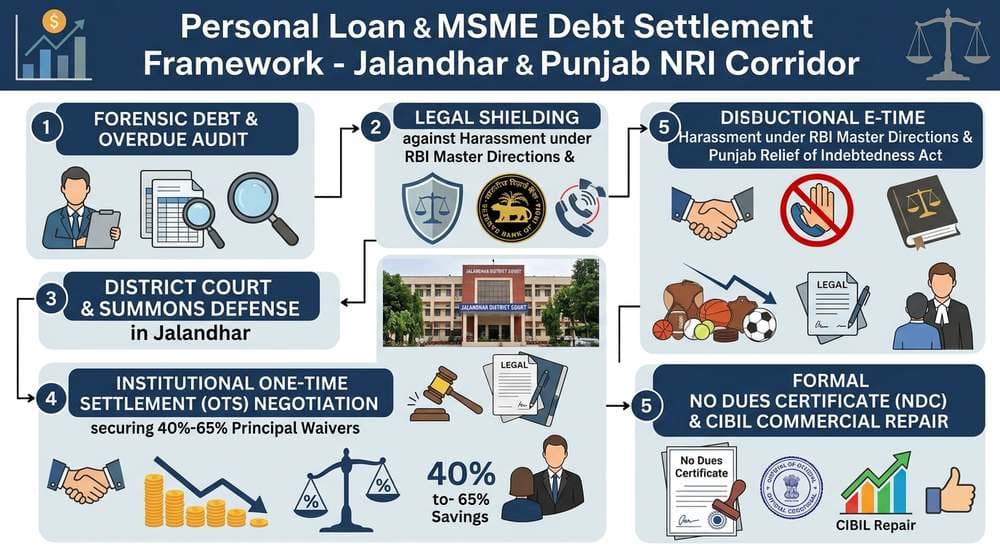
6. Tactical Settlement Protocol & Advocate Defense in Jalandhar
Negotiating directly with recovery agents often leads to lost funds credited only toward interest. SettleLoans executes a structured 5-stage legal defense protocol to secure complete debt resolution:
Stage 1: Forensic Loan Audit
We examine loan sanction agreements, statements, and penalty charges to establish the authentic principal debt.
Stage 2: Cease-and-Desist Notice
Our advocates serve legal notices to bank nodal desks, routing all collection contact through our office and halting doorstep visits.
Stage 3: Jalandhar Court Appearance
We represent you for Section 138 NI Act or Section 25 PSSA summons, secure bail, and prevent adverse judicial orders.
Stage 4: Institutional OTS Negotiation
We submit financial hardship dossiers directly to bank compromise committees to secure 40% to 65% waivers.
Stage 5: Sanction Verification & NDC
Our advocates verify bank sanction letters. You pay directly into the bank loan account and receive official No Dues Certificates.
This legal approach protects your commercial standing in Punjab, stops harassment, and ensures full legal debt discharge.
7. Sanction Letter Forensics & Bank Waivers in Jalandhar
In the debt resolution industry, the most critical safeguard is ensuring that your settlement is sanctioned through official bank channels rather than unauthorized collection intermediaries. Rogue recovery agencies frequently issue counterfeit or unauthorized settlement letters featuring forged signatures or unofficial email domains to siphon funds into third-party accounts. Paying on a fraudulent letter leaves your loan delinquent in banking databases.
Our banking lawyers conduct a thorough forensic examination of every settlement sanction document prior to authorizing any disbursement:
Statutory Checklist for Authentic Bank OTS Sanction Letters
1. Official Bank Letterhead & Digital Authentication
The document must be printed on official bank stationery featuring verified institutional contact details, corporate identification numbers (CIN), and issued from a verified bank corporate domain.
2. Complete Borrower & Account Enumeration
The letter must explicitly recite the borrower legal name, PAN, unique 16-digit loan account numbers, and exact outstanding balance prior to the application of compromise waivers.
3. Definitive Waiver & Payment Schedule
The document must explicitly detail the approved settlement sum, the exact breakdown of waived principal, penal charges, and the specific due dates for single or structured tranche installments.
4. Judicial Case Withdrawal & NDC Clause
The sanction letter must contain an unambiguous covenant obligating the lender to withdraw all pending Section 138 NI Act, Section 25 PSSA, and civil court cases, and issue an NDC within 30 days.
Payments must invariably be transacted directly to the lender designated loan account via RTGS, NEFT, or official bank demand draft. Cash handovers to recovery agents or third-party agencies are strictly prohibited under our legal protocol.
8. NDC Issuance & CIBIL Commercial Repair in Jalandhar
The ultimate legal milestone of debt resolution is the issuance of the unconditional No Dues Certificate (NDC). Under Reserve Bank of India Circular RBI/2023-24/60 on Responsible Lending Conduct, commercial banks and NBFCs are legally obligated to release all original security documents and issue a formal NDC within 30 days of receiving the full settlement amount. If a lender unreasonably delays this issuance, our advocates serve statutory default notices and escalate the matter to the Banking Ombudsman, holding the lender liable for compensatory penalties.
Following the execution of an OTS, the lending institution transmits the updated account status to credit rating bureaus, including TransUnion CIBIL, Experian, Equifax, and CRIF High Mark. The bureau records will reflect the account as "Settled" with an outstanding balance of ₹0. While a settled status initially impacts your credit score, it completely terminates ongoing delinquency reporting, halts compounding damage, and eliminates the risk of civil recovery execution.
Borrowers in Jalandhar can methodically rebuild their credit profile to 750+ over a 12 to 24 month period by following a disciplined credit rehabilitation roadmap:
- Fixed Deposit-Backed Credit Cards: Secure a credit card pledged against a modest fixed deposit at a public sector bank, maintaining credit utilization strictly below 30%.
- Impeccable Trade & Retail Amortization: Ensure all recurring utility, GST, and retail bills are cleared well prior to due dates to establish fresh positive payment history.
- Quarterly Bureau Audits & Dispute Filing: Inspect your comprehensive CIBIL report every 90 days. If a lender mistakenly retains an active "Overdue" or "Written Off" flag post-settlement, our advocates file formal bureau rectification disputes with the NDC copy.
9. Comparative Protection Matrix for Doaba Borrowers
Navigating the complex landscape of debt recovery across Jalandhar and Punjab requires an analytical understanding of how various categories of debt are treated under civil and commercial law. The following matrix illustrates the legal forums, typical lender litigation maneuvers, statutory debtor defenses, and achievable settlement parameters across major loan classes:
| Debt Category | Judicial Forum | Primary Lender Action | Debtor Statutory Shield | Typical Settlement & Timeline |
|---|---|---|---|---|
| Unsecured Personal Loans | Jalandhar Civil Courts / Lok Adalat | Order 37 summary suit or Section 138 summons | Section 60 CPC asset protection, RBI Fair Practices Code | 45% to 65% Waiver 2 to 5 Months |
| Sports & Leather MSME Loans | Jalandhar District Courts / DRT Chandigarh | Civil recovery suit or DRT Original Application | Punjab Relief of Indebtedness Act, MSME Samadhaan | 40% to 60% Waiver 3 to 6 Months |
| Cash Credit / Overdraft Shortfalls | DRT Chandigarh / District Courts | Civil recovery suit for unhedged shortfall balance | Damdupat rule, challenge to penal compounding | 35% to 55% Waiver 4 to 7 Months |
| Fintech & Digital Credit Apps | Distant Arbitration / Local JMIC Courts | Unilateral arbitration notices in other states | Supreme Court ruling in Perkins Eastman & TRF Ltd. | 50% to 70% Waiver 1 to 3 Months |
| Credit Card Outstandings | Jalandhar District Courts / Lok Adalat | Collection notices and Lok Adalat summons | Usurious Loans Act, 100% penal interest waiver | 50% to 65% Waiver 1 to 4 Months |
10. SettleLoans Legal Defense in Jalandhar
Managing severe debt while steering an export business, sustaining a manufacturing workshop, or supporting an expat family in Jalandhar requires specialized, fearless legal advocacy. SettleLoans represents borrowers with comprehensive institutional defense across Punjab. Our senior advocates stop collection harassment through statutory notices, defend Section 138 NI Act summons in Jalandhar District Courts, represent commercial entities before DRT Chandigarh, and negotiate substantial 40% to 65% One-Time Settlements directly with senior bank committees. With zero upfront recovery compromises and complete verification of every sanction document, we ensure your family, business, and financial dignity remain completely protected.

Settle Loan is India's trusted debt relief and loan settlement platform. We help borrowers overcome financial distress by negotiating with banks and NBFCs to legally settle personal loans and credit card debts. With our transparent, performance-based approach, you can achieve debt freedom and regain your financial peace of mind.
COMPUTER
11. Frequently Asked Questions: Jalandhar & Punjab
Authoritative legal guidance regarding personal loan compromise, sports goods business defaults, NRI expat protections, and local court procedures across Jalandhar and the Doaba belt.
Why should sports goods exporters and leather traders in Jalandhar choose legal debt settlement over continuous debt rolling?
Sports goods manufacturers in Basti Nau and leather processing units along Kapurthala Road frequently confront prolonged overseas payment delays from international buyers. When operational cash flows tighten, business owners often take high-interest unsecured personal and business loans to bridge export working capital shortfalls. Rolling over debt through fresh personal credit lines or fintech apps rapidly inflates liabilities due to compounding interest and punitive penal charges. A formal legal One-Time Settlement (OTS) halts this debt spiral by freezing interest accrual, shielding factory assets and residential properties under Section 60 of the Code of Civil Procedure, and negotiating an institutional compromise based strictly on audited debt servicing capacity, typically saving 40% to 65% of the outstanding balance.
How does legal advocacy protect NRI and expat families in Jalandhar, Phagwara, and Hoshiarpur from cross-border recovery intimidation?
The Doaba belt has thousands of families with non-resident relatives working across Canada, the United Kingdom, Europe, and the Middle East. Recovery agents frequently exploit this geographic dynamic by making unlawful overseas calls to expat relatives, issuing false threats regarding passport cancellation, or threatening red-corner notices for civil defaults. A dedicated debt settlement legal firm immediately stops this misconduct. By executing a formal Vakalatnama and issuing statutory cease-and-desist notices to bank nodal authorities, advocates establish that loan default is purely a civil contractual dispute. Under RBI Master Directions and Indian penal laws, lenders are prohibited from contacting non-borrower third parties, thereby safeguarding your family dignity both locally in Punjab and abroad.
Can lending institutions in Jalandhar seize factory manufacturing equipment or ancestral property for unsecured personal loan defaults?
No. Lenders cannot arbitrarily attach or auction manufacturing machinery, production tools, or ancestral residential property for unsecured personal or business loan defaults. Unsecured credit facilities carry no underlying mortgage, lien, or hypothecation over your physical assets. Furthermore, Section 60(1) of the Code of Civil Procedure expressly protects tools of artisans, machinery necessary for trade, and primary residential dwellings from attachment or execution in civil debt decrees. Any recovery agent threatening immediate property seizure or factory lockouts is acting in direct violation of law, and our legal team takes immediate action through criminal intimidation complaints under the Bharatiya Nyaya Sanhita.
What specific protections does the Punjab Relief of Indebtedness Act provide to distressed borrowers in Jalandhar?
The Punjab Relief of Indebtedness Act, 1934 serves as a powerful statutory bulwark against predatory lending practices across the state of Punjab. The statute was legislated to protect borrowers from extortionate interest rates, arbitrary collection surcharges, and exploitative recovery practices. When paired with the Reserve Bank of India Master Directions on Fair Practices and Compromise Settlements, our advocates invoke these state statutory provisions during high-level settlement negotiations to strip away compounded penal charges, uncredited interest capitalizations, and unauthorized collection fees, compelling banking committees to negotiate solely on the genuine base principal.
How do debt defense advocates manage Section 138 NI Act and Section 25 PSSA summons at Jalandhar District Courts?
When post-dated security cheques or electronic NACH mandates bounce following financial distress, banks often file criminal complaints under Section 138 of the Negotiable Instruments Act or Section 25 of the Payment and Settlement Systems Act before the Judicial Magistrates First Class at the Jalandhar District & Sessions Courts Complex. Our litigation advocates file formal appearance, furnish bail bonds to prevent coercive arrest warrants, and scrutinize the statutory demand notice for procedural defects. Because cheque bounce offenses under Section 147 of the NI Act are compoundable by law, we leverage the ongoing court proceedings to negotiate a structured OTS agreement, culminating in complete criminal dismissal upon clearance of the settlement sum.
How does a debt settlement company stop recovery agents from staging disruptive visits to business premises and residential homes?
Unlawful visits by unauthorized recovery agents to sports goods showrooms, leather manufacturing sheds, or family residences in areas like Model Town or Civil Lines violate RBI Master Directions. Upon client onboarding, our advocates issue formal legal representations to the bank chief compliance officer and collection nodal desks. Under established banking regulations, once a borrower is formally represented by an advocate, all communications regarding recovery must be routed exclusively through legal counsel. If agents persist in unauthorized visits or verbal intimidation, we initiate immediate complaints before the RBI Integrated Ombudsman and file criminal complaints under Sections 308, 329, and 351 of the Bharatiya Nyaya Sanhita for extortion, criminal trespass, and intimidation.
What waiver percentages are realistically achievable for unsecured bank loans in Jalandhar and the Doaba region?
Settlement waivers depend on the age of delinquency, asset classification under RBI NPA provisioning norms, and the verifiable extent of genuine financial hardship. For unsecured personal loans, business credit lines, and credit card balances that have aged past 90 to 180 days into Doubtful NPA categories, borrowers in Jalandhar and the Doaba region typically secure waivers ranging from 40% to 65% of the total outstanding demand. In addition, banking committees regularly approve a complete 100% waiver of accumulated penal interest, late payment penalties, and legal tracking surcharges once presented with audited financial accounts demonstrating severe liquidity contraction.
How are commercial disputes and high-value loan default claims handled between Jalandhar District Courts and DRT Chandigarh?
Judicial jurisdiction is determined strictly by the outstanding claim quantum and legal character of the debt. For unsecured recovery claims under ₹20 Lakhs, lending institutions must initiate proceedings before the Civil Courts at Jalandhar through summary suits under Order 37 CPC or ordinary recovery suits. For claims exceeding ₹20 Lakhs, banks must file Original Applications before the Debts Recovery Tribunal (DRT-1 or DRT-2) in Chandigarh. Given that DRT Chandigarh adjudicates claims across Punjab, Haryana, and Himachal Pradesh, formal trials frequently encounter extended hearing intervals. Recognizing that multi-year civil litigation incurs substantial legal expenditures without any guaranteed asset liquidation, bank recovery committees prefer entering into structured out-of-court OTS compromises.
What legal steps ensure credit bureau restoration across CIBIL, Experian, and CRIF High Mark after completing an OTS in Punjab?
Executing a financial settlement is only complete once formal regulatory closure is recorded. Following receipt of the agreed OTS amount, the lending institution is mandated under RBI Circular RBI/2023-24/60 to issue an unconditional No Dues Certificate (NDC) and closure sanction letter within 30 days. Concurrently, the lender must report the account to credit information companies such as CIBIL, Experian, and CRIF High Mark as "Settled" with zero remaining outstanding balance. Our legal team audits these bureau updates to eliminate erroneous "Written Off" or continuing delinquent overdue flags, establishing a structured roadmap for credit rehabilitation through secured trade instruments and timely retail repayments.