- Zero Automatic Overseas Bureau Linkage: An Indian loan default reported to TransUnion CIBIL or Experian India cannot automatically transfer to or damage your US, UK, Canadian, or UAE credit scores due to territorial data firewalls under CICRA 2005.
- Identifier Disconnect (PAN/Aadhaar vs SSN/Emirates ID): Credit bureaus operate exclusively on national tax and identity tokens. Indian lenders do not capture or report US Social Security Numbers, UK National Insurance numbers, Canadian SINs, or Emirates IDs.
- Immigration & Visa Clearances Are Civil-Immune: Foreign immigration agencies (USCIS, UK Home Office, IRCC Canada, UAE ICP) evaluate criminal records, not foreign civil consumer debts. Pure loan defaults do not block H-1B, PR, Green Card, or work visa renewals.
- Airport Detention & Passport Seizure Myths: Commercial banks and recovery agencies possess zero legal authority to issue airport Look Out Circulars (LOCs) or impound passports for standard retail loan or credit card defaults under the Passports Act, 1967.
- Seamless Remote Resolution via Special Power of Attorney: NRIs can execute full and final compromise settlements (typically at 50% to 75% principal haircuts) through Indian debt defense advocates without international travel.
1. Demystifying Cross-Border Credit Reporting & NRI Scores
For hundreds of thousands of Non-Resident Indians (NRIs), Overseas Citizens of India (OCIs), and expatriates residing in the United States, the United Kingdom, Canada, Australia, Singapore, and the Gulf Cooperation Council (GCC) nations such as the United Arab Emirates and Saudi Arabia, unresolved debts in India represent a source of profound emotional distress. Whether triggered by an unexpected job relocation, medical emergencies, currency fluctuations, real estate stalling, or startup ventures that folded during economic downturns, unpaid personal loans, credit card balances, education loans, and home loan facilities left behind with Indian commercial lenders—such as State Bank of India, HDFC Bank, ICICI Bank, Axis Bank, Kotak Mahindra Bank, or Bajaj Finance—frequently produce intense cross-border anxiety.
This anxiety is systematically weaponized by aggressive third-party collection agencies and unregulated tele-callers operating within India. Unscrupulous recovery operatives frequently contact overseas phone numbers, message corporate LinkedIn profiles, or harass elderly parents residing in India with dire threats: claiming that an unresolved CIBIL default will automatically demolish their US FICO score, trigger negative reporting to UK Experian or Equifax Canada, lead to immediate salary garnishment through the UAE Al Etihad Credit Bureau (AECB), or result in immediate deportation, visa cancellation, and airport arrest upon entering India.
From a rigorous statutory, regulatory, and legal standpoint, these claims are completely false. Under international private law, bilateral data privacy conventions, and domestic financial statutes, consumer credit reporting systems operate within strictly isolated national silos. An Indian loan default does not, cannot, and will not automatically transmit to or contaminate your foreign credit profile in the US, UK, Canada, UAE, or any other sovereign jurisdiction. Understanding the exact statutory frameworks, technical credit mapping architectures, and legal jurisdictional limits transforms ungrounded fear into structured financial resolution.
2. Statutory Data Sovereignty Firewalls: CICRA 2005, FCRA, GDPR & Cross-Border Credit Isolation
To understand why an Indian credit default cannot cross international borders, one must examine the governing legislative architecture. In India, consumer and commercial credit information is governed strictly by the Credit Information Companies (Regulation) Act, 2005 (CICRA) and the comprehensive circulars issued by the Reserve Bank of India (RBI).
Under Section 15 and Section 17 of CICRA 2005, the four licensed Credit Information Companies (CICs) in India—namely TransUnion CIBIL, Experian Credit Information Company of India, Equifax Credit Information Services, and CRIF High Mark—are statutorily restricted from disseminating consumer credit data to unauthorized offshore entities. The law mandates that credit data collected from Indian credit institutions (commercial banks, NBFCs, and ARCs) can only be accessed by specified credit institutions operating within the territorial jurisdiction of India for specific, authorized domestic credit assessment purposes.
Sections 15–22 of CICRA prohibit cross-border data leakage. Indian banks are legally licensed to furnish repayment history solely to RBI-registered CICs. No statutory mechanism or bilateral protocol permits Indian lenders to file negative data directly with foreign consumer credit bureaus.
Foreign consumer reporting acts—such as the US Fair Credit Reporting Act (FCRA, 15 U.S.C. § 1681), the UK Data Protection Act 2018 / UK GDPR, and the UAE Data Protection Law (Federal Decree-Law No. 45/2021)—strictly prohibit bureaus from ingesting unverified offshore consumer debt data lacking domestic identity verification.
Furthermore, credit scoring models rely entirely on standardized national identification tokens. In India, credit histories are mapped against an individual's Permanent Account Number (PAN), Aadhaar, Voter ID, and Passport Number. In contrast, foreign credit bureaus map financial histories strictly to their domestic identifiers: the 9-digit Social Security Number (SSN) or Individual Taxpayer Identification Number (ITIN) in the United States, the National Insurance (NI) Number and electoral roll in the United Kingdom, the Social Insurance Number (SIN) in Canada, and the Emirates ID in the UAE.
Because there is zero algorithmic, technical, or legal interoperability between an Indian PAN/Aadhaar database and a foreign SSN or Emirates ID repository, credit profiles remain entirely segregated. Even though international conglomerates like TransUnion and Experian operate subsidiaries in both India and overseas jurisdictions, their underlying databases operate on completely isolated corporate servers separated by strict statutory and jurisdictional firewalls.
Check Your Loan Settlement Options
Answer 2 quick questions to evaluate your settlement eligibility.
1. What type of loan do you want to settle?
3. Country-Specific Credit Bureau Mechanics: US, UK, Canada & UAE (AECB)
To eliminate lingering ambiguities, it is vital to analyze the exact consumer reporting mechanisms across the primary geographic corridors where Non-Resident Indians reside:
In the United States, credit reporting is governed strictly by the Fair Credit Reporting Act (FCRA) and overseen by the Consumer Financial Protection Bureau (CFPB). US bureaus require a furnisher to possess an active US data furnisher agreement, adhere to the Metro 2 data format, and furnish records tied to a US SSN or ITIN. Indian commercial banks do not have US furnisher agreements and cannot report to US bureaus. An Indian CIBIL default of any magnitude has precisely zero effect on your US FICO score or your eligibility for US mortgages, auto loans, or credit cards.
The UK credit reporting ecosystem is regulated under the Financial Conduct Authority (FCA) and the strict data principles of the UK GDPR and the Data Protection Act 2018. UK credit files are established through the UK electoral register, domestic bank accounts, utility bills, and National Insurance numbers. Ingesting unverified foreign claims from an Indian bank without a UK court-registered foreign judgment would violate UK data protection mandates and expose the reporting entity to severe regulatory sanctions.
Under the Personal Information Protection and Electronic Documents Act (PIPEDA) and provincial consumer reporting acts (such as Ontario's Consumer Reporting Act), Canadian bureaus map financial liabilities exclusively to domestic Canadian credit history linked to a Social Insurance Number (SIN) and Canadian addresses. Indian loan defaults are completely invisible to Canadian lenders evaluating auto financing or residential mortgages.
A frequent misconception among Gulf NRIs is that Indian banks can register defaults directly on their AECB credit report in Dubai or Abu Dhabi. The AECB operates under UAE Federal Law No. (6) of 2010 and Central Bank of the UAE regulations, sourcing credit data exclusively from UAE-licensed financial institutions, telecom operators (e&, du), and utilities tied to your UAE Emirates ID. Indian banks cannot report to AECB, nor can an Indian civil default freeze your UAE bank accounts or cancel your UAE residence visa without a formal execution judgment from a UAE federal court under bilateral reciprocity treaties—a rare and cost-prohibitive procedure for consumer loans.
4. Bank NPA Accounting Economics & The NRI NPV Recovery Equation
Why are Indian commercial banks and Asset Reconstruction Companies (ARCs) exceptionally eager to offer deep One-Time Settlement (OTS) waivers to Non-Resident Indians? The answer lies in bank balance sheet economics, Reserve Bank of India (RBI) provisioning mandates, and the mathematical reality of cross-border debt recovery.
When an NRI borrower defaults and relocates abroad, Indian banks immediately recognize the extreme structural difficulty of cross-border legal recovery. Under the RBI's Master Framework on Resolution of Stressed Assets, once an account reaches Non-Performing Asset (NPA) status (Sub-Standard past 90 days, Doubtful past 12 months, and Loss Asset past 36 months), the lending institution must lock up between 15% and 100% of the loan value in mandatory capital provisioning.
To evaluate whether to pursue an NRI borrower legally or accept a compromise settlement, bank recovery committees and ARCs utilize a Net Present Value (NPV) recovery formula. They calculate the discounted cash flow of attempting cross-border litigation versus accepting an immediate lump-sum settlement:
Where C_t represents projected net recoveries across future time periods, r is the bank's internal hurdle discount rate, and deductions account for 5–8 years of judicial friction across multiple jurisdictions, foreign advocate retainers, consular attestation expenses, and 100% non-performing asset capital provisioning locks.
Because prosecuting an offshore borrower across international jurisdictions costs millions of rupees and takes nearly a decade with uncertain recovery prospects, an Indian bank or ARC faces a deeply negative recovery calculation. When an NRI presents a structured, advocate-negotiated cash settlement offer backed by verified hardship documentation, the bank's settlement committee can instantly release 100% frozen provisions, eliminate bad debt from their audit books, and realize immediate capital recovery. This economic leverage is precisely why NRIs routinely achieve massive 50% to 75% principal haircuts on unsecured loans and credit cards.
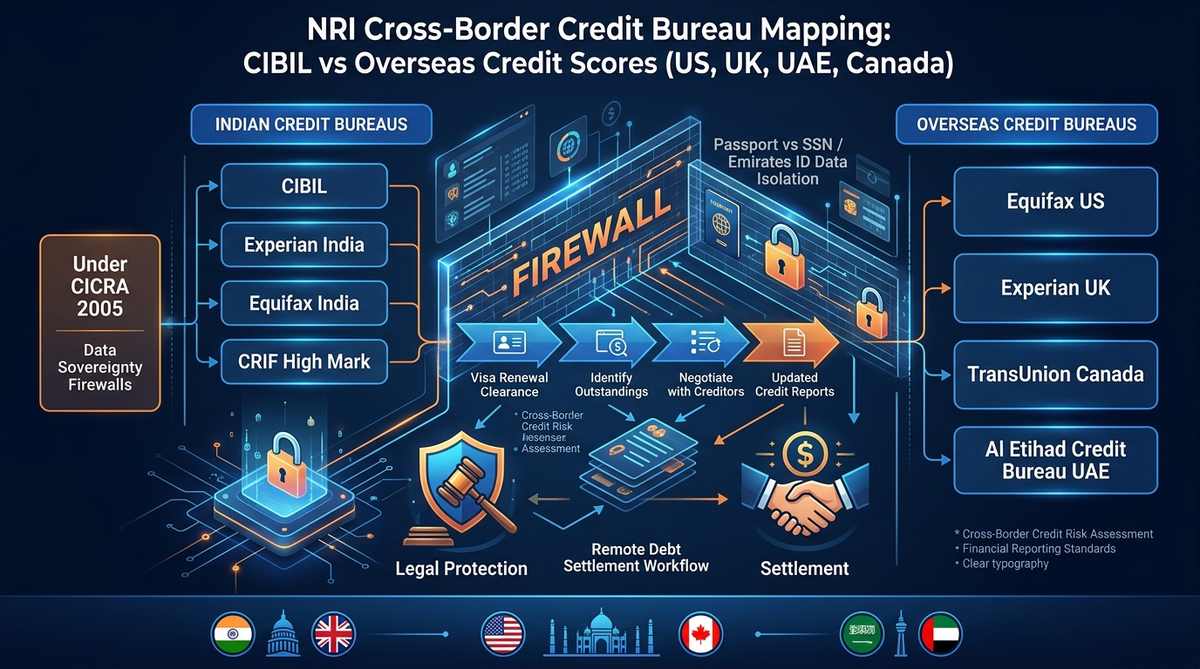
Visual Architecture Breakdown: Indian credit information companies (TransUnion CIBIL, Experian India, Equifax India, CRIF High Mark) operate behind strict data sovereignty firewalls established under Section 15 of CICRA 2005. Overseas credit bureaus (Equifax US, Experian UK, TransUnion Canada, AECB UAE) are completely segregated through sovereign identity tokens (PAN/Aadhaar vs SSN/Emirates ID), ensuring zero automated cross-border credit score contamination.
6. Immigration & Visa Realities: H-1B, Green Card, UK Skilled Worker & UAE Visas
One of the most insidious tactics utilized by aggressive collection agencies is fabricating threats regarding immigration status. Borrowers are falsely told that defaulting on an Indian bank loan will lead to an alert on their passport, revocation of their US H-1B visa, rejection of their US Permanent Residency (Green Card), cancellation of a Canadian Permanent Residency application, or refusal of a UK Skilled Worker visa extension.
To clarify this with absolute legal certainty: Foreign immigration authorities do not review, track, or evaluate foreign consumer credit defaults. Immigration agencies operate under strict statutory mandates focused on identity verification, national security, public health, financial self-sufficiency in the host country, and criminal background checks (Police Clearance Certificates or PCCs):
US Citizenship and Immigration Services (USCIS) and consular officers require disclosure of criminal convictions, moral turpitude crimes, and immigration violations. Defaulting on a commercial bank loan is a pure civil matter under Indian law and does not constitute a criminal conviction. It has zero bearing on Form DS-160 visa stamping, H-1B lottery processing, L-1 transfers, or I-485 Adjustment of Status.
UKVI assesses applicants under the "General Grounds for Refusal" (Part 9 of the Immigration Rules), which focuses on criminal sentences, deception, and unpaid NHS debts incurred inside the UK. Unresolved consumer debts with commercial banks in India are not accessible to UKVI and do not constitute grounds for visa refusal or deportation.
IRCC evaluates admissibility under the Immigration and Refugee Protection Act (IRPA) based on criminality, security, and medical conditions. A standard Indian Police Clearance Certificate (PCC) issued by the Ministry of External Affairs records only registered criminal FIRs and court convictions; civil debt disputes and CIBIL records do not appear on Indian PCCs.
UAE residence visa issuance, employment visas, and Golden Visas require a local UAE security clearance and medical fitness certificate. Indian civil loan defaults have zero connectivity with UAE immigration authorities unless a UAE federal court has issued an enforcement order—which does not happen for Indian retail consumer debts.
7. Legal Jurisdiction: Section 138 NI Act, Look Out Circulars (LOCs) & Civil Decrees
While cross-border credit reporting and immigration threats are legally toothless, borrowers must remain fully informed about genuine Indian legal procedures that lenders may initiate domestically:
If security cheques issued by the borrower bounce upon presentation, the lender may file a complaint under Section 138 of the NI Act or Section 25 of the Payment and Settlement Systems Act, 2007 (for failed NACH / e-mandates). While Section 138 is a quasi-criminal statutory offense, it is compoundable and bailable. If the borrower is abroad and fails to respond to court summons, the magistrate may issue bailable warrants. Engaging legal counsel to represent the NRI under Section 205 of the CrPC/BNSS allows advocates to seek exemption from personal appearance and settle the dispute out of court.
A prominent fear among NRIs is being detained at Indian international airports (such as Delhi, Mumbai, Bengaluru, or Hyderabad) due to a Look Out Circular (LOC). Under Ministry of Home Affairs (MHA) Office Memoranda and landmark rulings of the Delhi High Court and Bombay High Court, commercial banks cannot arbitrarily request LOCs for standard consumer debt defaults. LOCs are legally restricted to cases involving active cognizable criminal offenses, wilful economic fraudsters fleeing the country, or fraud investigations exceeding ₹50 Crores led by the CBI, SFIO, or ED. Standard personal loans, education loans, and credit card defaults do not meet the legal threshold for LOC issuance.
For claims exceeding ₹20 Lakhs, banks can initiate proceedings before the Debt Recovery Tribunal (DRT) under the Recovery of Debts and Bankruptcy Act, 1993. For smaller claims, banks may file Summary Suits under Order 37 of the Civil Procedure Code (CPC). While courts can pass ex-parte money decrees if summons go unreplied, enforcing that decree against an NRI's foreign assets requires complex cross-border execution suits under Section 44A of the CPC, which banks almost never pursue due to exorbitant legal costs.
8. Remote Settlement Protocol: Settling Indian Bank Loans from Abroad via Special Power of Attorney (SPA)
NRIs do not need to take leave from work, purchase expensive international flight tickets, or subject themselves to confrontational bank visits to resolve defaulted Indian liabilities. The entire debt settlement lifecycle can be conducted seamlessly and securely from abroad through authorized legal representation:
Consular-Attested Special Power of Attorney (SPA) or Legal Authorization
The NRI executes a limited Special Power of Attorney (SPA) or formal Letter of Legal Representation authorizing specialized debt settlement advocates to represent them before the bank, NBFC, ARC, or judicial forums. The SPA can be easily attested at the nearest Indian Embassy or Consulate abroad, or executed electronically under the Information Technology Act.
Formal Notice of Representation & Third-Party Harassment Cessation
Legal counsel serves a formal Notice of Representation on the lender's head office and nodal grievance officers under the RBI Fair Practices Code. This legally forces recovery agents to immediately cease contacting the NRI's overseas number, employer, or relatives in India.
Forensic Loan Audit & Financial Hardship Dossier Compilation
Advocates audit the loan statements to strip away illegal penal compounding, uncredited payments, and unauthorized insurance charges. A verified financial hardship dossier (documenting job disruption, medical costs, or foreign living expense inflation) is submitted directly to the bank's Zonal Stressed Asset Management Committee (SAMC).
Verification of Official Settlement Sanction Letter
Before a single rupee is remitted, legal advocates forensically verify the formal Settlement Sanction Letter issued on official bank letterhead, ensuring it contains specific tranche payment deadlines, comprehensive debt extinguishment clauses, commitment to withdraw pending Section 138/civil suits, and issuance of the No Dues Certificate (NDC).
Direct Bank Remittance, NDC Receipt & Credit Bureau Rectification
The agreed settlement amount is transferred directly from the borrower's NRE/NRO or overseas bank account into the lender's designated settlement account. Within 30 days of remittance, the bank issues the official No Dues Certificate and updates the account balance to ₹0 across TransUnion CIBIL, Experian, Equifax, and CRIF High Mark.
9. Country-by-Country Credit Bureau & Legal Jurisdictional Matrix
The comparative matrix below outlines the exact legal, technical, and regulatory realities of Indian loan defaults across the world's primary expat jurisdictions:
| Jurisdiction / Parameter | Primary Credit Bureaus | CIBIL Default Impact | Immigration / Visa Risk | Legal Enforcement Barrier | Average Settlement Haircut |
|---|---|---|---|---|---|
| United States (USA) | Equifax US, Experian US, TransUnion US | 0% (Zero Impact) | Zero Risk (Civil-Immune) | Requires US state court trial under foreign money judgment acts; prohibitive legal cost. | 55% – 75% Principal Waiver |
| United Kingdom (UK) | Experian UK, Equifax UK, TransUnion UK | 0% (Zero Impact) | Zero Risk (UKVI Immune) | Requires common law action in UK High Court; unviable for retail consumer debt. | 50% – 70% Principal Waiver |
| Canada | Equifax Canada, TransUnion Canada | 0% (Zero Impact) | Zero Risk (IRCC Immune) | Requires provincial court recognition action; costs exceed unsecured claim values. | 50% – 70% Principal Waiver |
| United Arab Emirates (UAE) | Al Etihad Credit Bureau (AECB) | 0% (Zero Impact) | Zero Risk (GDRFA/ICP) | Requires formal UAE Federal Court execution under bilateral treaty; rarely pursued for retail loans. | 60% – 80% Principal Waiver |
| Australia / New Zealand | Equifax AU, Experian AU, illion | 0% (Zero Impact) | Zero Risk (Department of Home Affairs) | Requires state supreme court registration of foreign judgment; economically unviable. | 50% – 70% Principal Waiver |
10. SettleLoans Remote Legal Defense & NRI Stressed Asset Advisory
SettleLoans is India's premier institutional debt resolution and legal advisory platform. We specialize in representing Non-Resident Indians, expatriates, and overseas professionals facing delinquent personal loans, credit card portfolios, business facilities, and mortgage disputes across Indian commercial banks and Asset Reconstruction Companies.
Our panel of seasoned DRT and civil advocates act as your dedicated legal shield in India. We eliminate all third-party collection harassment, represent your interests before bank zonal settlement committees, verify every sanction clause for absolute legal finality, and secure maximum statutory waivers—allowing you to permanently close your Indian debts with complete peace of mind while living abroad.

Settle Loan is India's trusted debt relief and loan settlement platform. We help borrowers overcome financial distress by negotiating with banks and NBFCs to legally settle personal loans and credit card debts. With our transparent, performance-based approach, you can achieve debt freedom and regain your financial peace of mind.
COMPUTER
11. Frequently Asked Questions (NRI Debt & Overseas Credit)
Authoritative legal and regulatory answers regarding cross-border credit reporting, immigration impacts, and remote debt settlement in India.
Will an Indian loan default affect my overseas credit score in the US, UK, Canada, or UAE?
No. An Indian loan or credit card default reported to TransUnion CIBIL, Experian India, Equifax India, or CRIF High Mark does not automatically transfer to or affect your foreign credit scores with overseas bureaus such as US Equifax/Experian/TransUnion, UK Experian, Equifax Canada, or UAE Al Etihad Credit Bureau (AECB). National credit bureaus operate under strict domestic data sovereignty legislation (such as India's CICRA 2005, US FCRA, UK Data Protection Act/GDPR, and UAE Central Bank regulations) and utilize separate national identification numbers (PAN/Aadhaar vs. SSN, National Insurance number, SIN, or Emirates ID), creating an absolute data firewall between jurisdictions.
Can an Indian bank report a defaulted loan directly to US credit bureaus like Experian or Equifax?
No. Indian commercial banks and NBFCs are legally licensed to furnish credit performance data exclusively to Indian Credit Information Companies (CICs) registered under Section 4 of the Credit Information Companies (Regulation) Act, 2005 (CICRA). Indian lenders have no legal standing, data reporting agreements, or technical mechanisms to report consumer loan defaults directly to foreign credit bureaus like US Equifax, Experian, or TransUnion US, nor do they possess your US Social Security Number (SSN) to match credit profiles.
Can a loan default in India impact my foreign visa renewal, Green Card, or PR application?
Pure financial default on an unsecured personal loan or credit card in India is strictly a civil contract breach and has zero impact on foreign visa renewals, US H-1B stamping, US Green Card applications, UK Skilled Worker visas, Canadian Express Entry PR, or UAE residence visas. Foreign immigration authorities evaluate criminal background checks (police clearance certificates) and public health/morality grounds, not overseas civil debt disputes. An impact can only arise if a competent criminal court in India has issued a Non-Bailable Warrant (NBW) or formal Look Out Circular (LOC) in cases of proven criminal fraud, cheating under IPC Section 420, or wilful evasion of court summons under Section 138 of the Negotiable Instruments Act.
Can Indian banks or recovery agencies legally contact me or harass my family while I am abroad?
Under the RBI Fair Practices Code and RBI Master Directions on Recovery Agents, lenders are strictly prohibited from intimidating, harassing, or threatening borrowers or their family members. Family members who are not co-borrowers or legal guarantors have zero legal liability for the borrower's debts. When an NRI appoints legal counsel via a formal Notice of Representation, all direct calls, unscheduled home visits, and contact to third parties must cease immediately by law.
Can an Indian bank file a court case or obtain a money decree against an NRI living abroad?
Yes. An Indian bank or Asset Reconstruction Company (ARC) can file a civil recovery suit (such as an Order 37 CPC summary suit) or initiate Debt Recovery Tribunal (DRT) proceedings if the debt exceeds ₹20 Lakhs. The bank can serve court summons to the borrower's registered Indian address or via electronic service (email/WhatsApp) approved by the court. However, enforcing an Indian civil money decree overseas requires initiating fresh execution proceedings in the foreign jurisdiction under foreign civil procedure laws, which is commercially unviable for unsecured retail loans.
Can an Indian bank stop an NRI at the airport or impound an Indian passport for loan default?
No bank, NBFC, or recovery agency has the legal authority to seize a passport or issue airport travel bans. Under Section 10 of the Passports Act, 1967, only the Regional Passport Officer or a criminal court can impound a passport. Look Out Circulars (LOCs) can only be requested by designated public sector bank heads in cases of wilful default and large-scale economic fraud (typically exceeding ₹50 Crores) where an FIR has been registered. Standard personal loan, credit card, or small business loan defaults do not meet the legal threshold for LOCs.
How can an NRI settle an Indian loan or credit card default without travelling to India?
An NRI can execute a clean, remote One-Time Settlement (OTS) by appointing specialized debt resolution advocates through a Special Power of Attorney (SPA) or formal Letter of Authorization. The legal team audits the loan contracts, submits verified financial hardship documentation directly to the bank's zonal or national settlement committee, negotiates a substantial principal waiver (typically 50% to 75%), validates the official Settlement Sanction Letter, coordinates remittance directly into the bank's designated settlement account, and secures the final No Dues Certificate and ₹0 CIBIL balance update.
What happens if an Indian bank assigned or sold my defaulted loan to an ARC while I am abroad?
When a bank assigns debt to an Asset Reconstruction Company (such as Phoenix ARC, ARCIL, or Edelweiss) under Section 5 of the SARFAESI Act, the ARC acquires the loan at a steep discount (typically 15%–25% of book value). This low acquisition cost basis provides NRIs with a superior opportunity to negotiate deep compromise settlements—frequently achieving 70% to 80% haircuts on the total outstanding claim—through authorized legal advocates.
What is the difference between 'Settled' and 'Closed' CIBIL status for an NRI?
'Settled' indicates that the lender accepted a partial payment under a compromise and wrote off the remaining balance, which halts continuous monthly default reporting and marks the account balance as ₹0. 'Closed' indicates that the loan was paid in full without waivers. While an NRI residing abroad may not immediately need an Indian credit profile, achieving a 'Settled' status with a ₹0 balance eliminates all civil and legal exposure, unblocks future Indian financial investments, and allows the Indian credit score to recover over 18 to 24 months.
Can an Indian bank pursue legal action against an NRI under Section 138 of the Negotiable Instruments Act?
If security cheques issued by the borrower bounce due to insufficient funds, the bank can file a complaint under Section 138 of the Negotiable Instruments Act, 1881. While Section 138 is a quasi-criminal statutory offense, it is compoundable and bailable. If the borrower is abroad and fails to appear after valid service of summons, a magistrate may issue bailable or non-bailable warrants. Appointing legal counsel to represent the NRI in court allows for rapid compounding and closure through out-of-court settlement.