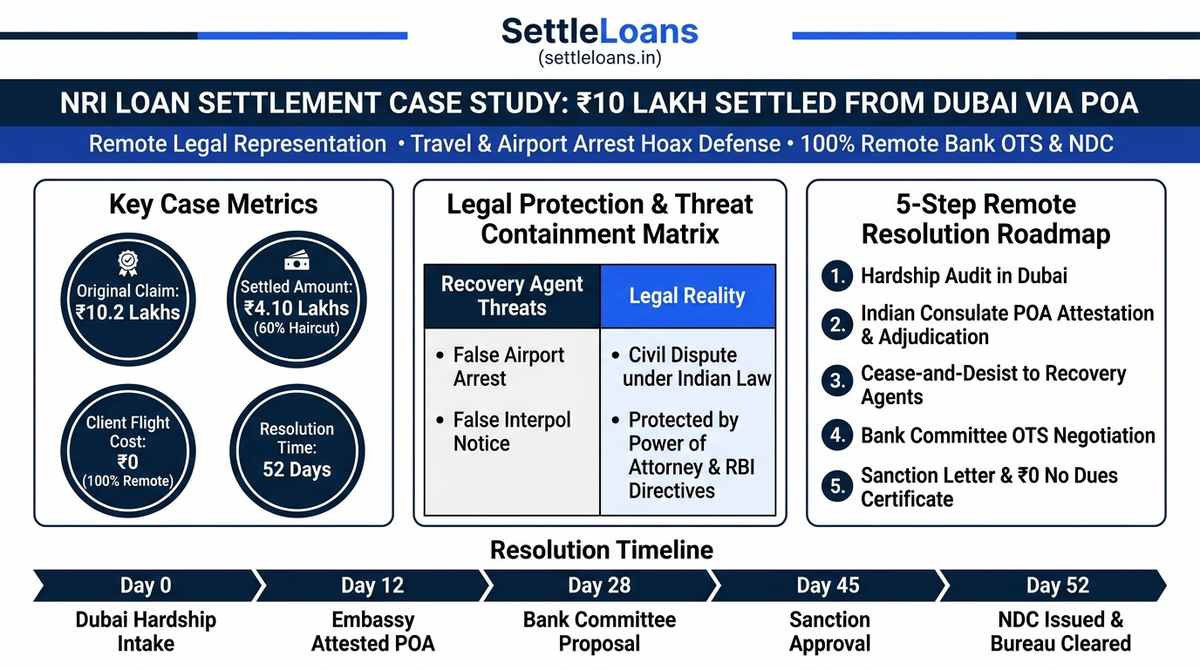
- Zero Airport Arrest or LOC Risk: Unsecured personal loan defaults are strictly civil disputes under Indian law. Immigration officers at Indian airports have zero legal authority to detain or question travelers for unpaid retail bank loans.
- 100% Remote Consular Power of Attorney: NRIs can execute a Special Power of Attorney (SPA) at the Indian Consulate in Dubai or Abu Dhabi, authorizing senior legal advocates in India to represent them before bank committees without taking flights.
- 50%–65% Stressed Asset Haircuts: Under RBI provisioning and Net Present Value (NPV) recovery rules, banks prefer a discounted lump-sum compromise over prohibitive, multi-year cross-border litigation in UAE courts.
- Immediate Protection for Indian Family: Formal legal representation notices immediately halt unlawful recovery agent phone calls and residential visits to elderly parents and relatives in India under RBI Master Directions.
- Official Stamped Sanction & ₹0 NDC: All settlements are verified on official bank letterheads before remittance, guaranteeing an irrevocable No Dues Certificate and complete credit bureau resolution within 30 days.
1. The ₹10 Lakh Crisis: Expat Relocation, Cash Flow Shock
In October 2024, Tariq Siddiqui, a 36-year-old structural design engineer residing in Hyderabad, availed an unsecured personal loan of ₹10,00,000 from a major Indian private sector bank to consolidate domestic family commitments prior to his relocation to the United Arab Emirates. The sanctioned facility carried a repayment tenure of 48 months at an annualized interest rate of 14.25%, generating a fixed equated monthly installment (EMI) of ₹27,450. For eight consecutive billing cycles, Tariq serviced his loan obligations promptly through automated National Automated Clearing House (NACH) mandates debited from his domestic resident salary account.
Following his relocation to Dubai, UAE, on an employment visa, Tariq encountered severe macroeconomic headwinds. His sponsoring contracting firm experienced severe payment bottlenecks on municipal infrastructure projects, culminating in a three-month backlog of salary disbursements, followed by a mandatory 30% contract compensation reduction. Simultaneously, the steep cost of living in Dubai—encompassing residential rent, mandatory medical insurance copays, and basic subsistence expenses in UAE Dirhams (AED)—rapidly drained his foreign emergency cash buffers, leaving him unable to remit funds to his Indian bank account.
When his Indian account balance fell below the requisite threshold, successive NACH debit instructions bounced, incurring steep statutory penalty charges and default interest. Within 90 days of continuous non-serviceability, the bank classified the facility as a Non-Performing Asset (NPA) under Reserve Bank of India prudential norms. Unchecked late fees, compounding penal interest, and legal notice levies rapidly inflated the gross ledger balance to ₹10,85,000, triggering an aggressive recovery campaign directed against both Tariq in Dubai and his elderly parents in Hyderabad.
Non-Resident Indians facing income dislocation abroad frequently find themselves targeted by aggressive recovery agencies leveraging geographic distance, unfamiliarity with cross-border civil jurisdiction, and calculated legal misinformation to induce acute panic.
2. Demystifying the Airport Arrest & Look Out Circular (LOC) Myth
As the delinquency crossed 120 days, third-party recovery agencies engaged by the lender initiated intensive telephonic harassment, contacting Tariq via international VoIP calls and sending threatening WhatsApp messages. The collection personnel claimed that a Look Out Circular (LOC) had been registered against his Indian passport, threatening that the moment his flight landed at Rajiv Gandhi International Airport in Hyderabad or Mumbai International Airport, immigration authorities and the Bureau of Immigration (BOI) would immediately arrest and detain him.
These coercive threats subjected Tariq to profound psychological trauma, forcing him to cancel planned annual leave to visit his ailing mother in India. However, from an objective constitutional and statutory standpoint, these claims represent complete legal fabrications designed to exploit borrower vulnerability.
Under Indian jurisprudence, an unsecured personal loan default constitutes a purely civil dispute governed by the Indian Contract Act, 1872. The Supreme Court of India and various High Courts have repeatedly affirmed that inability to service civil debts does not constitute a cognizable criminal offense. Under the Ministry of Home Affairs (MHA) Office Memorandum guidelines governing the issuance of Look Out Circulars, an LOC can only be opened at the request of designated criminal investigating agencies (such as CBI, ED, or State Police) in matters involving cognizable criminal offenses, economic offenses of extraordinary scale threatening national economic security, or non-bailable arrest warrants issued by competent criminal courts.
In landmark rulings such as Sumer Singh Salkan v. Assistant Director and Vikas Chaudhry v. Union of India, the Delhi High Court established that commercial banks cannot weaponize LOCs to enforce civil money recovery against individual borrowers. Furthermore, Interpol Red Notices are strictly limited to international fugitive tracking for serious criminal offenses, completely excluding retail personal loan defaults.
| Recovery Agent Threat | Statutory Reality under Indian Law | Governing Legal Framework |
|---|---|---|
| Immediate Airport Arrest on Arrival | Civil default carries zero arrest powers; immigration cannot detain civil debtors | Article 21, Constitution of India & Indian Contract Act, 1872 |
| Look Out Circular (LOC) on Passport | LOCs are impermissible for unsecured retail personal loans without a criminal court warrant | MHA OM Guidelines & Delhi High Court Precedents |
| Interpol Red Notice & UAE Deportation | Interpol operates exclusively for transnational criminal offenses, not domestic civil claims | Interpol Constitution (Article 3) & Extradition Treaties |
| Harassing Relatives & Parents in India | Strictly unlawful; lenders face heavy penalties for contacting third-party family members | RBI Master Directions on Recovery Agents (2022) |
Check Your Loan Settlement Options
Answer 2 quick questions to evaluate your settlement eligibility.
1. What type of loan do you want to settle?
3. The Legal Enabler: Special Power of Attorney (SPA) & UAE Consular Attestation
Recognizing that Tariq could not travel to India due to workplace commitments and unjustified arrest anxiety, SettleLoans established a legally robust remote representation framework pursuant to the Powers of Attorney Act, 1882 and the Diplomatic and Consular Officers (Oaths and Fees) Act, 1948.
A Special Power of Attorney (SPA) is a statutory instrument whereby a principal resides abroad and legally delegates specific, delineated authorities to an appointed attorney in India. SettleLoans drafted a customized SPA specifically empowering our senior legal advocates to represent Tariq before all branches of the lender, inspect loan statements, contest unlawful recovery practices, execute compromise negotiations, and accept official settlement sanction letters on his behalf.
The cross-border execution followed a rigorous four-stage legal protocol:
First, the tailored SPA document was drafted by our legal team and transmitted electronically to Tariq in Dubai. Second, Tariq scheduled an attestation appointment at the Consulate General of India (CGI) in Dubai, physically signing the instrument before the Consular Officer, who verified his original Indian passport, affixed the official consular seal, and executed the attestation register. Third, the physical attested document was dispatched via secure international courier to our corporate headquarters in India. Fourth, pursuant to Section 18 of the Indian Stamp Act, 1899, our legal team presented the foreign-executed instrument to the jurisdictional Sub-Divisional Magistrate / District Collector for adjudication and payment of domestic stamp duty within the statutory 90-day window.
Under Section 85 of the Indian Evidence Act, 1872, an instrument authenticated by a Consular Officer of India carries a mandatory legal presumption of valid execution. Indian commercial banks are legally mandated to recognize properly adjudicated SPAs and deal directly with the authorized attorney.
4. Behind Bank Accounting: Unsecured NRI NPAs & the Cross-Border NPV Formula
To achieve a 60% principal waiver on an unsecured ₹10 Lakh loan, one must understand the economic and balance-sheet pressures governing commercial banks under the Reserve Bank of India (Prudential Norms on Income Recognition, Asset Classification and Provisioning) Directions.
When an Indian resident defaults on an unsecured loan, the bank faces significant litigation overhead. When an NRI defaults, the bank's recovery apparatus faces insurmountable cross-border bottlenecks. Unsecured loans carry zero underlying physical collateral, rendering summary seizure under the SARFAESI Act, 2002 entirely inapplicable. To recover debt from a resident in Dubai, the Indian bank would first have to file a summary money suit (Order 37, Code of Civil Procedure, 1908) in an Indian court, endure an estimated 3 to 5 years of procedural backlog to obtain a decree, and subsequently initiate cross-border execution proceedings in the Dubai Courts under the UAE Civil Procedures Code and bilateral judicial treaties.
Cross-border litigation costs in the UAE—encompassing certified legal translations into Arabic, UAE advocate retainer fees, and court deposit tariffs—routinely exceed ₹8 to ₹12 Lakhs, making judicial recovery financially irrational for a ₹10 Lakh claim.
Concurrently, as Tariq's loan crossed 180 days of non-payment, the bank was compelled under RBI norms to classify the asset as a Substandard/Doubtful NPA, locking up substantial regulatory capital in mandatory provisioning. The bank's Stressed Assets Resolution Branch (SARB) evaluates One-Time Settlement (OTS) proposals using a rigorous Net Present Value (NPV) Recovery Formula:
Where Recovery_t represents estimated future recoveries, r is the bank's discount rate, and deductions account for 3–5 years of Indian decree execution in UAE courts, Arabic translation retainers, and capital locked in NPA provisions.
When mathematical modeling demonstrates that an immediate, guaranteed cash settlement of ₹4.10 Lakhs generates a far higher net present value than an uncertain litigation path resulting in negative net recovery, the bank's Competent Credit Committee possesses overwhelming commercial justification to approve a substantial debt waiver.
6. Direct Stressed Asset Committee Negotiation: Securing the 60% Haircut
Armed with the registered and adjudicated Special Power of Attorney, SettleLoans initiated formal institutional intervention. Our legal team served a comprehensive Representation & Hardship Memorandum upon the bank's Regional Stressed Assets Resolution Branch (SARB) and the Principal Nodal Officer (PNO), simultaneously notifying third-party recovery vendors of legal representation under the RBI Master Directions on Recovery Agents (2022).
This immediate action produced two critical outcomes: first, all unauthorized calls and home visits to Tariq's elderly parents in Hyderabad ceased immediately under statutory threat of RBI Banking Ombudsman sanctions. Second, the dialogue shifted exclusively to a formalized, legal negotiation directly with authorized bank decision-makers.
SettleLoans submitted Tariq's verified cross-border hardship dossier, comprising: (1) Certified copies of his UAE employment contract amendment reflecting the 30% salary reduction; (2) Official employer communication regarding municipal project billing deferrals; (3) Dubai residential tenancy contract (Ejari) and utility bills demonstrating mandatory cost-of-living expenditures in AED; (4) Certified 6-month statements of his UAE and Indian bank accounts reflecting acute cash-flow constraints.
The negotiation progressed through multiple structured rounds:
In Round 1, the bank demanded ₹8,50,000, offering merely to waive penal interest. SettleLoans rejected this initial demand, presenting our comparative NPV cross-border recovery analysis and offering ₹3,20,000 as a full and final discharge. In Round 2, the bank SARB Committee revised its threshold to ₹5,50,000. SettleLoans substantiated Tariq's absolute borrowing ceiling through family-assisted funds, positioning our final counter-offer at ₹4,10,000 payable across two scheduled installments. In Round 3, the Competent Credit Committee formally accepted our proposed compromise, sanctioning a final settlement of ₹4,10,000—representing an effective 60% principal discount (₹6,75,000 total waiver) and 100% forgiveness of all accumulated penal charges.
7. Sanction Letter Forensic Verification & Secure NRE/NRO Remittance
Settling a bank loan requires absolute legal certainty. Under SettleLoans' strict risk governance protocols, no borrower is ever permitted to transfer funds based on verbal representations, informal emails, or collection agency demands.
Our legal department conducted an exhaustive forensic audit of the formal One-Time Settlement (OTS) Sanction Letter issued by the bank. The verification confirmed five non-negotiable legal criteria:
First, the sanction letter was executed on official bank letterhead, bearing the authorized signatory's designation, employee signature, and branch seal. Second, the document explicitly cited Tariq's specific loan account number, stating the exact negotiated figure of ₹4,10,000 as full and final discharge of all liabilities. Third, the instrument incorporated an explicit covenant confirming that upon realization of the settlement tranches, all remaining principal balances, accrued interest, and incidental legal levies would be irrevocably waived. Fourth, the letter committed the bank to unconditional withdrawal of any pending statutory notices (including Section 138 of the Negotiable Instruments Act, 1881, or Section 25 of the Payment and Settlement Systems Act, 2007). Fifth, the document mandated the issuance of a formal No Dues Certificate (NDC) and credit bureau status update within 30 days.
Upon forensic approval, Tariq remitted the funds directly from his Non-Resident Ordinary (NRO) account via RTGS directly into his designated loan account ledger in two installments: Tranche 1 of ₹2,10,000 upon sanction execution, and Tranche 2 of ₹2,00,000 twenty days thereafter.
8. ₹0 No Dues Certificate, Bureau Scrub & Unrestricted Travel Safety
Following the crediting of the final remittance tranche, SettleLoans tracked the operational loan closure pipeline pursuant to RBI Circular RBI/2023-24/60 (Release of Movable/Immovable Property Documents / Issuance of NDC on Repayment).
Within 28 calendar days of settlement completion, the bank issued the official, stamped No Dues Certificate (NDC) / Loan Closure Letter, confirming that the loan ledger had been liquidated to an absolute ₹0 balance with zero surviving financial claims against Tariq.
Furthermore, the bank transmitted updated credit records to TransUnion CIBIL, Experian, CRIF High Mark, and Equifax, updating the account classification from 'Active Default / NPA' to 'Settled / Post-Write-off Settled' with an outstanding balance of ₹0. With active delinquency halted and the legal dispute fully extinguished, Tariq was able to book his flight to India and travel freely through immigration without a single legal or institutional impediment.
| Financial Metric | Pre-Settlement Ledger Position | Final Sanctioned Position | Net Borrower Benefit |
|---|---|---|---|
| Principal Outstanding | ₹9,40,000 | ₹4,10,000 | ₹5,30,000 Principal Waived |
| Penal Interest & Late Levies | ₹1,45,000 | ₹0 | 100% Forgiveness (₹1.45L) |
| Gross Outstanding Claim | ₹10,85,000 | ₹4,10,000 | ₹6,75,000 Total Debt Relief (62.2%) |
| Client Travel & Flight Cost | Estimated ₹1,20,000 (Flights + Leave) | ₹0 (100% Remote via POA) | Zero Travel Downtime |
| Resolution Timeline | Unresolved (120+ DPD Delinquency) | 52 Calendar Days from POA Intake | Irrevocable ₹0 NDC Secured |
9. Comparative Resolution Matrix: Remote POA vs Ignored Default vs Traveling to India
Non-Resident Indians managing distressed banking liabilities in India typically confront three distinct courses of action. The following comparative matrix evaluates the strategic, legal, and economic implications of each route:
| Evaluation Dimension | Remote Legal Settlement via POA | Ignoring Debt While Abroad | Traveling to India Personally |
|---|---|---|---|
| Travel & Opportunity Cost | ₹0 (Zero flights, zero workplace leave) | Zero immediate cost, compounding future risk | ₹80,000 – ₹1,50,000 (Flights, local transit, lost wages) |
| Recovery Agent Harassment | Immediately stopped via Cease-and-Desist | Intensifies against parents and resident family | Direct confrontations at home or branch |
| Average Haircut Achieved | 50% to 65% Principal Waiver (NPV Modeled) | 0% (Debt compounds with penalties) | 15% to 30% (Individual lacks institutional leverage) |
| Immigration Travel Peace | 100% Protected with Verified ₹0 NDC | Perpetual psychological anxiety & dread | Uncertain until dispute is resolved in person |
| Legal Representation & Audit | Full advocate representation before SARB | None (Unrepresented default) | Self-negotiation without banking legal expertise |
10. SettleLoans Remote Legal Representation for Non-Resident Indians
SettleLoans is India's leading specialized debt dispute resolution and banking conciliation platform. We provide end-to-end legal representation for Non-Resident Indians (NRIs) across the UAE, Saudi Arabia, Qatar, Oman, Singapore, the United Kingdom, the United States, and Canada. From consular Power of Attorney drafting and high-level Stressed Asset Committee negotiations to anti-harassment injunctions and official No Dues Certificate procurement, our senior advocates protect your rights, your finances, and your freedom to travel.

Settle Loan is India's trusted debt relief and loan settlement platform. We help borrowers overcome financial distress by negotiating with banks and NBFCs to legally settle personal loans and credit card debts. With our transparent, performance-based approach, you can achieve debt freedom and regain your financial peace of mind.
COMPUTER
Frequently Asked Questions: NRI Debt Resolution & Airport Arrest Defense
Explore clear, legally verified answers to common questions regarding NRI personal loan default, Power of Attorney attestation, and travel rights in India.
Yes. Non-Resident Indians (NRIs) can resolve and settle defaulted personal loans, credit cards, or business loans in India without traveling. Under the Powers of Attorney Act, 1882, the NRI executes a Special Power of Attorney (SPA) attested before a Consular Officer at the Consulate General of India in Dubai or Embassy of India in Abu Dhabi. An authorized legal advocate in India then conducts direct negotiations with the bank's Stressed Assets Resolution Branch (SARB) to secure an official One-Time Settlement (OTS) and formal No Dues Certificate.
No. Unsecured personal loan default is strictly a civil breach of contract under the Indian Contract Act, 1872. Under Ministry of Home Affairs (MHA) guidelines and established High Court precedents (Sumer Singh Salkan v. Assistant Director), Look Out Circulars (LOCs) and airport detentions cannot be issued for civil banking defaults. Interpol Red Notices are exclusively reserved for serious transnational criminal fugitives, never for unsecured commercial loan non-payments.
The borrower faced severe salary delays in Dubai and could no longer service Indian EMIs, pushing the ₹10 Lakh loan into NPA status with accumulated claims of ₹10.85 Lakhs. SettleLoans obtained an adjudicated consular Power of Attorney, halted recovery harassment against the borrower's family in India, and presented an empirical cross-border hardship dossier. Using Net Present Value (NPV) recovery modeling, SettleLoans negotiated a 60% principal haircut, securing a final stamped bank settlement of ₹4,10,000 payable in two tranches.
The legal procedure involves four structured steps: (1) Drafting a Special Power of Attorney (SPA) explicitly authorizing banking conciliation, dispute representation, and debt compromise; (2) In-person signing and attestation before the Consular Officer at the Consulate General of India in Dubai or Embassy of India in Abu Dhabi; (3) Couriering the physical attested POA to the legal representative in India; (4) Having the instrument adjudicated and stamp duty paid under the Indian Stamp Act, 1899 within 90 days of receipt in India.
When an unsecured NRI loan defaults beyond 180 days, Indian banks face massive cross-border recovery barriers. Unsecured loans carry no collateral to seize under SARFAESI. Enforcing an Indian civil court decree in UAE courts requires complex reciprocal execution under UAE Civil Procedures Law, involving exorbitant legal expenses exceeding the loan balance. Additionally, mandatory RBI provisioning rules compel banks to write off the asset, making an upfront lump-sum OTS financially superior in Net Present Value (NPV) terms.
Under the RBI Master Directions on Recovery Agents (2022) and the Fair Practices Code, lenders are strictly prohibited from contacting third-party relatives, visiting family homes without authorization, or using coercive language. Upon executing a Power of Attorney, SettleLoans serves a formal legal Representation and Cease-and-Desist Notice to the bank's Principal Nodal Officer (PNO), redirecting all communication to our authorized legal desk and immediately halting unlawful harassment.
If repayment cheques or NACH auto-debit mandates bounced, banks may issue legal notices under Section 138 of the Negotiable Instruments Act or Section 25 of the Payment and Settlement Systems Act. Under Indian criminal jurisprudence, these are bailable, compoundable statutory offenses. An authorized advocate under POA can represent the matter, participate in pre-litigation Lok Adalat or court mediation, and secure a complete compounding and quashing of the proceeding upon payment of the agreed settlement amount.
Payment must only be remitted after receiving and forensically auditing an authentic OTS Sanction Letter on official bank letterhead with physical or verified digital signatures. The settlement funds must be transferred directly from the NRI's NRO, NRE, or Indian resident bank account via RTGS/NEFT straight into their specific loan account number. Settlement funds must never be remitted to individual collection agents or third-party intermediary accounts.
Under RBI Circular RBI/2023-24/60, banks are legally mandated to issue the formal No Dues Certificate (NDC) / Loan Closure Certificate and update credit bureau records within 30 calendar days of receiving full settlement funds. The NDC serves as conclusive, irrevocable legal proof that the borrower owes zero debt to the institution, ensuring unrestricted, 100% stress-free travel through Indian immigration.
Official Statutory & Regulatory References
- Reserve Bank of India (RBI): Prudential Framework for Resolution of Stressed Assets & Compromise Settlement Directives
- RBI Master Direction: Guidelines on Fair Practices Code and Outsourcing of Financial Services / Recovery Agents
- Consulate General of India, Dubai: Consular Services & Attestation Guidelines for Powers of Attorney Executed by NRIs
- Reserve Bank - Integrated Ombudsman Scheme, 2021: Dispute Redressal Portal for OTS Non-Compliance, Coercive Recovery & NDC Delays
- National Legal Services Authority (NALSA): Legal Services Authorities Act, 1987 — National Lok Adalat Conciliation Framework