- Zero Criminal Liability: Defaulting on an unsecured personal loan is a civil breach of contract. Police cannot arrest you, seize your passport, or summon you for inability to repay.
- No Asset Seizure: Unsecured loans carry no asset charge. The SARFAESI Act does NOT apply to personal loans; lenders cannot confiscate your residential home or car without a multi-year civil court decree.
- Strict Anti-Harassment Shield: Under the RBI Fair Practices Code, collection agents are barred from calling before 8 AM / after 7 PM, calling relatives/workplaces, or threatening public humiliation.
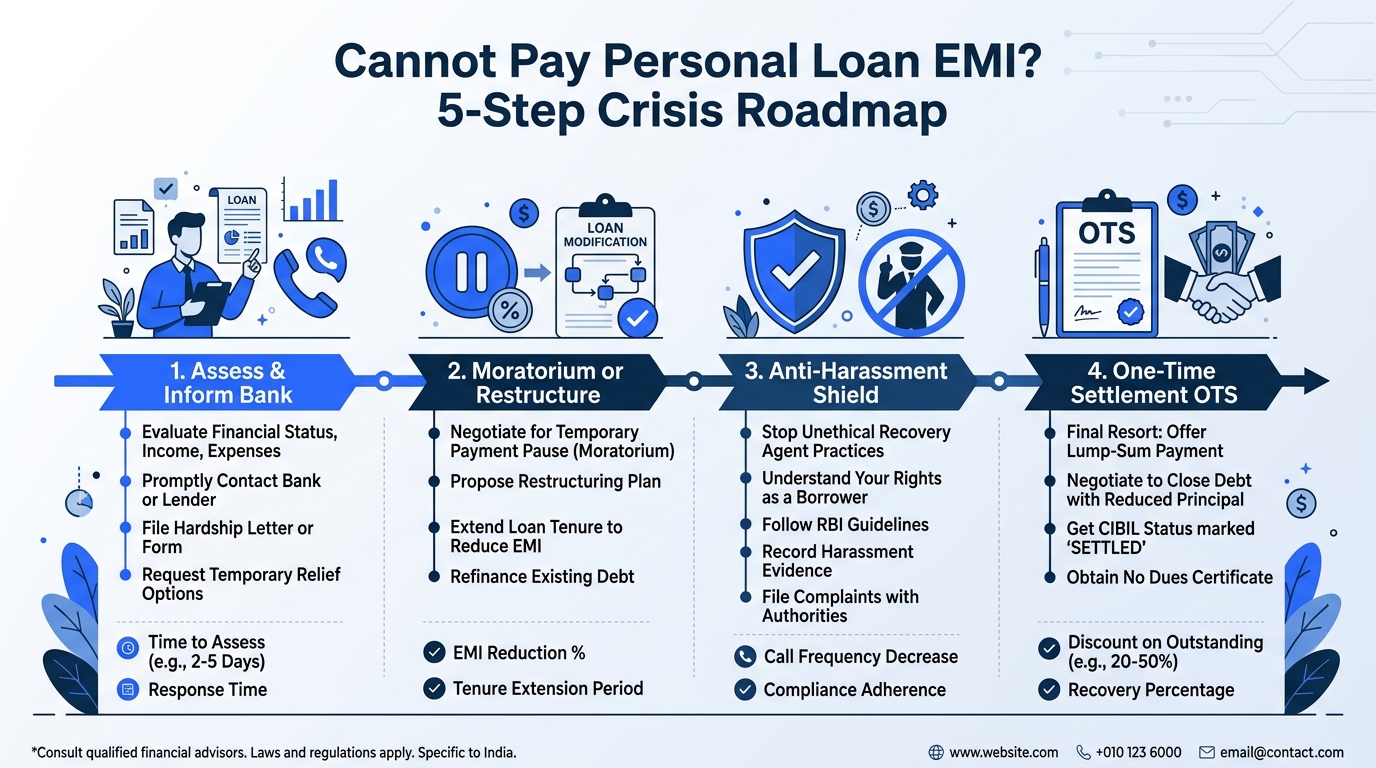
- Restructuring & Settlement Pathways: If you face proven financial distress, you can request a 3–6 month moratorium, tenure extension, or a formal One-Time Settlement (OTS) with a 40%–60% waiver.
- Rebuilding Roadmap: A loan settlement sets your balance to ₹0 and enables a full credit score rebound to 750+ within 18–24 months using secured credit instruments.
1. Emergency Triage: 5 Things to Do in 24 Hours
Finding yourself unable to pay an upcoming personal loan EMI triggers immense psychological panic. In this state of acute anxiety, borrowers frequently make catastrophic errors—such as borrowing from predatory 7-day Chinese loan apps, maxing out credit card cash advances, or ignoring phone calls until legal notices land.
Take a deep breath. Follow this structured 5-step emergency triage protocol immediately:
1Stop the Debt Spiral: Freeze All New Borrowing Immediately
Never take a fresh high-interest loan (especially peer-to-peer apps or instant NBFC micro-loans) to pay off an existing personal loan EMI. Rolling over debt at 36%–48% interest transforms a manageable ₹2 Lakh problem into an unpayable ₹10 Lakh catastrophe in 6 months.
2Ring-Fence Essential Survival Funds
Prioritize your hierarchy of expenses. Your family's food, house rent, children's school fees, utility bills, and critical medical insurance must always be protected before servicing unsecured loan EMIs. Banks cannot freeze your physical life.
3Send a Written Hardship Intimation to the Lender Before the Due Date
Proactive communication separates a genuine stressed borrower from a wilful defaulter. Send a registered email to your bank's customer care and Principal Nodal Officer stating your inability to pay next month's EMI due to verifiable hardship (e.g., termination letter, salary cut slip, hospital bills).
4Revoke NACH / e-Mandate or Maintain Separate Operating Accounts
When an EMI bounces, banks repeatedly attempt auto-debit sweeps, slapping ₹500–₹1,000 bounce fees on every attempt and wiping out whatever small savings you have left for groceries. Request an e-mandate cancellation or shift your essential survival cash to a separate bank account where you have no credit lines.
5Engage an Empaneled Legal Debt Relief Advocate
Engaging a legal debt advisory team like SettleLoans ensures all bank notices, Section 138/25 summons, and recovery agent communications are channeled through formal legal representation under the RBI Fair Practices Code.
2. Can You Go to Jail? Dispelling 5 Big Loan Default Myths
Third-party recovery agencies routinely exploit borrowers' legal ignorance to induce panic, threatening police raids, criminal FIRs, and instant asset forfeiture. Let us examine the statutory legal reality established under Indian law and Supreme Court jurisprudence:
Legal Reality Check: Recovery Agent Threats vs. Actual Indian Law
| Common Agent Threat | Legal Reality under Indian Law | Governing Statute / Court Precedent | Your Defense Action |
|---|---|---|---|
| "Police will arrest you tonight for EMI default" | False. Loan default is a civil breach of contract. Police have zero authority to arrest or summon you. | Civil Procedure Code (CPC 1908) & Supreme Court guidelines | Demand the agent's ID; file an extortion FIR if threatened. |
| "We will seize your house, car, and furniture" | False. Personal loans are unsecured. SARFAESI Act only applies to pledged property. | SARFAESI Act 2002 (Secured Assets Only) | Remind the lender that no hypothecation or mortgage exists. |
| "We will visit your office and call your boss" | Illegal. Calling employers, friends, or relatives is a severe regulatory offense. | RBI Master Circular on Recovery Agents (2022/2023) | Lodge complaint on RBI CMS portal against the lender. |
| "Section 138 / Cheque bounce means instant jail" | Misleading. Sec 138 NI Act is bailable. You appear via counsel, furnish bail, and settle. | Negotiable Instruments Act, 1881 (Sec 138) | Engage an advocate to represent you in magistrate court. |
| "Your financial life is permanently over" | False. Settlement closes the debt with ₹0 balance. Score recovers to 750+ in 18–24 months. | CICRA Act 2005 & Credit Bureau Rebuilding Models | Follow the structured 5-pillar credit rebuild plan. |
Check Your Loan Settlement Options
Answer 2 quick questions to evaluate your settlement eligibility.
1. What type of loan do you want to settle?
3. The 30-to-180-Day Chronology
Understanding the bank's internal operational lifecycle removes the fear of the unknown. When you miss consecutive EMIs, your loan moves through strictly defined regulatory categories established by the Reserve Bank of India:
Days 1 – 30: SMA-0 (Special Mention Account - 0)
Stage 1What Happens: Automated SMS and IVR voice calls are triggered. Your bank levies an ECS/NACH bounce fee (₹450–₹1,000) and begins calculating 24%–36% penal interest on the unpaid installment. Soft collection tele-callers remind you to clear dues.
Days 31 – 60: SMA-1 (Special Mention Account - 1)
Stage 2What Happens: The 30+ Days Past Due (DPD) tag is transmitted to CIBIL, causing your score to drop by 40–70 points. The loan is assigned to the bank's internal collection floor. Call intensity increases, and pre-default warning emails are issued.
Days 61 – 90: SMA-2 (Special Mention Account - 2)
Stage 3What Happens: The account is flagged for imminent default. In many cases, the bank assigns the portfolio to external third-party recovery agencies. A formal Loan Recall Notice or 60-day default demand letter is drafted.
Day 91+: NPA Classification (Non-Performing Asset)
Stage 4What Happens: Under RBI Prudential Norms, the loan is formally classified as an NPA. The bank makes mandatory loss provisioning in its books. Tele-calling subsides, and the account transfers to the Stressed Assets Recovery Branch (SARB) or legal department.
Days 91 – 180+: Legal Notices, Lok Adalat & Settlement Window
Stage 5What Happens: The bank issues formal legal notices under Section 138 of the NI Act (for bounced security cheques) or Section 25 of the Payment and Settlement Systems Act (for bounced NACH). The bank invites you to National Lok Adalat or opens compromise One-Time Settlement (OTS) discussions to clear the bad debt.
4. All Viable Relief Options Explored
Depending on whether your cash flow disruption is temporary (e.g., 3-month transition between jobs) or permanent (e.g., severe disability, permanent business closure), you have distinct financial and legal remedies available:
Comprehensive Evaluation of Personal Loan Relief Pathways
| Relief Mechanism | Best Suited For | Financial Impact | CIBIL Score Impact | Long-Term Outcome |
|---|---|---|---|---|
| 1. EMI Moratorium (3–6 Months) | Temporary job loss / medical emergency with expected recovery in 90 days. | Payment holiday; interest accrues and is added to principal. | Minimal / Protected | Loan resumes with slightly higher EMI or extended tenure. |
| 2. Loan Restructuring (Tenure Extension) | Permanent 30%–40% salary reduction; borrower can pay smaller EMIs. | Tenure stretched from 3 to 5 years; monthly EMI drops by 35%–50%. | Marked "Restructured" (-30 to -60 pts) | Full loan repaid over longer period; credit rebounds in 12 months. |
| 3. Secured Debt Consolidation | Multiple unsecured loans totaling >₹10 Lakhs with high interest (18%–24%). | Replace multiple loans with single low-cost Gold Loan or LAP (8.5%–10.5%). | Positive (+20 to +50 pts) | Drastically reduced interest burden; single easy monthly EMI. |
| 4. One-Time Settlement (OTS) | Severe, irreversible financial distress; borrower cannot pay full principal. | Lump-sum settlement at 40%–60% waiver; balance forgiven. | Marked "Settled" (-75 to -150 pts) | Account closed with ₹0 balance; legal immunity; rebuild in 18–24 mo. |
Official Template: Hardship Intimation Letter to Bank Nodal Officer
To: The Principal Nodal Officer / Branch Manager, [Bank Name]
Subject: Formal Intimation of Financial Hardship & Request for Loan Restructuring / Moratorium — Loan A/C: [Your Loan Account Number]
Dear Sir/Madam,
I am writing to formally bring to your notice that due to [unforeseen job termination / acute medical emergency / business loss on DD/MM/YYYY], I am experiencing severe financial distress and will be temporarily unable to service my monthly EMI of ₹[Amount] due on [Date].
I have maintained a clean repayment track record in the past. To prevent an involuntary default, I formally request your bank to grant me: (a) A 3 to 6-month EMI moratorium, OR (b) A restructuring of my loan tenure from [Current Tenure] to [Proposed Extended Tenure] to reduce my monthly outflow.
Attached herewith are supporting documents (Termination Letter / Medical Discharge Summary / Bank Statements) validating my hardship. I request you to pause coercive collection actions while this application is processed under RBI Fair Practices Code.
Yours sincerely,
[Your Full Name]
[Contact Number] | [PAN Number]
5. How to Legally Stop Recovery Agent Harassment
When an EMI is overdue by more than 30 days, aggressive third-party collection agencies often resort to unlawful, intimidating tactics. The Reserve Bank of India (RBI) has enacted stringent directives to protect borrower dignity. Any breach by recovery agents is an actionable offense.
ACTIONS STRICTLY ILLEGAL UNDER RBI GUIDELINES (Circular RBI/2022-23/108):
- Calling borrowers before 8:00 AM or after 7:00 PM in the evening.
- Calling friends, relatives, neighbours, or workplace colleagues regarding your debt.
- Visiting your workplace unannounced or causing a public scene at your residence.
- Using abusive, threatening, or derogatory language during calls or messages.
- Refusing to produce official bank identity cards and authorized agency mandate letters.
- Sending fake legal notices formatted like court summons with fraudulent judicial emblems.
The 3-Step Escalation Protocol to Stop Harassment Permanently:
Step 1: Record All Evidence & File Formal Nodal Grievance
Record all threatening phone calls, save abusive WhatsApp chats, and take photographs of visiting agents. Send a legal email to the bank's Principal Nodal Officer quoting the RBI Fair Practices Code.
Step 2: Lodge a Complaint on the RBI Integrated Ombudsman Portal (CMS)
If the bank fails to halt harassment within 48 hours, file an immediate complaint on cms.rbi.org.in under the Reserve Bank - Integrated Ombudsman Scheme, 2021. The RBI penalizes non-compliant lenders heavily.
Step 3: Police Complaint for Criminal Intimidation
If agents threaten physical harm, extortion, or trespass, file a formal complaint at your local police station under IPC Sections 503 (Criminal Intimidation), 506 (Punishment for Intimidation), 384 (Extortion), and 441 (Criminal Trespass).
6. One-Time Settlement (OTS) Playbook
When full repayment is mathematically impossible, a structured One-Time Settlement (OTS) is the most pragmatic legal exit. In an OTS, the bank waives 100% of penal interest, late fees, and a substantial portion of the principal balance in exchange for a single or tiered lump-sum payment.
THE 3 MANDATORY RULES OF AUTHENTIC LOAN SETTLEMENT:
- Rule 1: Never Pay on Verbal or WhatsApp Promises: Only pay when you possess an official OTS Sanction Letter generated on the bank's registered letterhead, carrying an authorized signatory's stamp and signature.
- Rule 2: Deposit Exclusively into Your Loan Account: Never transfer money into personal collection agent accounts, third-party agency UPI IDs, or cash. Always pay via NEFT/RTGS directly into your specific loan account number.
- Rule 3: Collect the No Dues Certificate (NDC): Mandate the issuance of a formal NDC / Closure Letter within 15 to 30 days of making the final agreed settlement tranche.
Illustrative Case Study: Personal Loan OTS Haircut Breakdown
| Loan Ledger Component | Contractual Bank Claim | Negotiated OTS Settlement | Total Borrower Savings |
|---|---|---|---|
| Original Disbursed Principal | ₹5,00,000 | ₹2,50,000 (50% Principal Haircut) | ₹2,50,000 Waived |
| Accrued Regular Interest | ₹1,20,000 | ₹0 (100% Waived) | ₹1,20,000 Waived |
| Penal Interest & Late Charges | ₹85,000 | ₹0 (100% Waived) | ₹85,000 Waived |
| Legal & Notice Charges | ₹25,000 | ₹0 (100% Waived) | ₹25,000 Waived |
| Total Settlement Payable | ₹7,30,000 | ₹2,50,000 | ₹4,80,000 (65.7% Total Relief) |
7. Restoring Your Financial Health
A common misconception is that a personal loan default permanently ruins your creditworthiness. Under the Credit Information Companies (Regulation) Act, 2005 (CICRA), historical defaults remain on bureau reports for up to 7 years, but credit underwriting algorithms weigh recent payment discipline far more heavily than past distress.
The 24-Month Roadmap to 750+ CIBIL Recovery Post-Settlement
| Phase & Timeline | Action Plan & Strategy | Recommended Credit Tool | Target Score |
|---|---|---|---|
| Phase 1: Months 0 – 3 | Secure NDC, verify ₹0 balance across all 4 bureaus (CIBIL, Experian, CRIF, Equifax). | ₹25,000 FD-Backed Secured Card (IDFC WOW / Kotak 811) | 560 – 610 |
| Phase 2: Months 4 – 12 | Maintain Credit Utilization Ratio (CUR) below 25%; automate 100% on-time bill payments. | Secured Card + Utility Bill Autopay | 650 – 700 |
| Phase 3: Months 13 – 24 | Add a low-ticket installment loan to diversify credit mix; zero hard inquiries. | Fintech Consumer Durable Loan / 2-Wheeler Loan | 720 – 760+ |
| Phase 4: Month 25+ | Full institutional credit eligibility restored for home loans and prime cards. | Standard Bank Credit Lines & Home Loans | 770 – 800 (Prime) |
8. Legal Framework & Judicial Protections
You are protected by robust statutory laws enacted by the Parliament of India and landmark rulings delivered by the Supreme Court of India:
RBI Master Direction on Compromise Settlements (June 2023)
Mandates all commercial banks and NBFCs to establish board-approved compromise settlement policies, authorizing lenders to settle NPAs without prejudice to regulatory prudential norms.
Supreme Court Ruling: ICICI Bank vs. Prakash Kaur (2007)
The Supreme Court held that banks and recovery agencies cannot deploy musclemen or illegal force to recover loans. Recovery must strictly adhere to statutory judicial procedures.
Reserve Bank - Integrated Ombudsman Scheme, 2021
Provides a single, cost-free grievance redressal window for borrowers to penalize banks and NBFCs for unfair collection practices, billing errors, or delay in issuing No Dues Certificates.
Legal Services Authorities Act, 1987 (Lok Adalat Settlement)
Empowers National Lok Adalats to adjudicate pre-litigation and pending bank recovery disputes. An award passed by Lok Adalat is final, binding, and non-appealable in any court of law.

Settle Loan is India's trusted debt relief and loan settlement platform. We help borrowers overcome financial distress by negotiating with banks and NBFCs to legally settle personal loans and credit card debts. With our transparent, performance-based approach, you can achieve debt freedom and regain your financial peace of mind.
COMPUTER
9. Frequently Asked Questions (FAQ)
Immediate answers to the most critical legal, financial, and credit questions when you cannot pay your personal loan EMI in India.
Do not panic and do not take high-interest instant loan apps or credit card cash advances to roll over the debt. Your immediate first step is to protect your essential household survival funds (rent, food, medicine). Then, send a formal written Hardship Intimation Letter to your bank's Branch Manager and Nodal Officer before the EMI presentation date. Explain your genuine financial hardship (job layoff, medical emergency, business loss) with documentary proof and request an immediate restructuring, tenure extension, or temporary moratorium.
No. Inability to pay an unsecured personal loan is strictly a civil dispute (breach of contract), not a criminal offence under Indian law. The police have zero jurisdiction to intervene in loan recovery, summon you to a police station, or arrest you for default. Criminal provisions only apply if you submitted forged documents or committed intentional fraud. If a bank initiates cheque bounce proceedings under Section 138 of the Negotiable Instruments Act, it is a bailable magistrate court proceeding, not an instant police arrest.
When your account lacks sufficient funds on the EMI presentation date: 1) Your bank levies an ECS/NACH bounce fee ranging from ₹450 to ₹1,000 + GST; 2) The lender imposes penal interest (often 24% to 36% p.a. on the overdue component); 3) The lender reports a 30+ Days Past Due (DPD) tag to CIBIL, causing a temporary 40–70 point score dip; 4) The bank initiates automated SMS reminders and calls from their internal soft-collection team.
Under the RBI Master Circular on Recovery Agents and Supreme Court directives in ICICI Bank vs. Prakash Kaur: Recovery agents can ONLY call between 8:00 AM and 7:00 PM; they must carry formal bank identification and authorization letters; they are strictly forbidden from contacting your relatives, friends, or employer; and they cannot use abusive language or make unannounced home visits to humiliate you. You can file an instant grievance on the RBI CMS portal (cms.rbi.org.in) and lodge a police complaint under IPC Sections 503/506 for criminal intimidation.
No. Personal loans are 100% unsecured credit facilities. There is no underlying collateral or hypothecated asset. The SARFAESI Act, 2002 applies exclusively to secured loans (like mortgages and auto loans) and cannot be invoked for personal loans. The bank cannot seize your property or attach your salary without filing a civil recovery suit (Summary Suit under Order 37 CPC) and winning a formal execution decree from a civil court, a process that takes several years.
Loan Restructuring alters the loan repayment schedule (e.g., stretching a 36-month loan into 60 months or offering a 6-month EMI moratorium) to reduce your monthly cash outflow. You still pay 100% of the principal and accrued interest, and your CIBIL reflects "Restructured". One-Time Settlement (OTS) is a compromise agreement where the lender accepts a discounted lump sum (typically 40% to 60% of total outstanding dues) to permanently close the account, forgiving the residual balance. The CIBIL status is marked as "Settled" with a zero balance.
The optimal window for a favorable OTS negotiation begins after the loan has been classified as a Non-Performing Asset (NPA) for 90 to 180 days. At this stage, banks have already made mandatory provisioning in their balance sheets under RBI prudential norms and are eager to recover a substantial portion of the principal rather than incurring prolonged legal expenses.
Yes. National Lok Adalats organized by NALSA are among the most advantageous forums for settling personal loan disputes. In Lok Adalats, banks offer significant waivers on penal interest and legal costs before a judicial officer. Any settlement award signed in Lok Adalat has the force of a final civil court decree that cannot be appealed or reopened by the bank.
You must never make a settlement payment without first receiving a formal OTS Sanction Letter issued on the bank's official letterhead stating your loan account number, settlement amount, and payment schedule. Within 15 to 30 days following payment, you must collect the official No Dues Certificate (NDC) / Closure Certificate confirming that no further claims exist and instructing credit bureaus to update the balance to ₹0.
Rebuilding your CIBIL score from sub-600 to 750+ takes 18 to 24 months of structured credit discipline: 1) Secure a Fixed Deposit (FD)-backed credit card (e.g., IDFC FIRST WOW or Kotak 811); 2) Utilize less than 25% of the credit limit monthly; 3) Automate 100% on-time bill payments; 4) Avoid applying for unsecured loans for 12 months; 5) Verify via credit bureau portals that your settled account displays ₹0 outstanding balance.
Official Regulatory Sources & Legal Authorities
- Reserve Bank of India (RBI) — Master Circular on Loans, Recovery Agents & Fair Practices Code
- TransUnion CIBIL — Credit Information Companies (Regulation) Act, 2005 Dispute Guidelines
- Supreme Court of India — Landmark Jurisprudence on Debtor Protection & Recovery Norms
- National Legal Services Authority (NALSA) — Lok Adalat Debt Dispute Resolution Framework
- RBI Complaint Management System (CMS) — Integrated Ombudsman Scheme Portal