1. Understanding CIBIL Score Thresholds: How Institutional
In the Indian retail banking ecosystem, an unsecured personal loan represents the highest-risk credit product in a commercial lender's portfolio. Because personal loans require zero collateral, hypothecation, or asset pledging, credit institutions rely almost entirely on algorithmic risk assessment engines. At the center of this underwriting architecture sits the TransUnion CIBIL score—a three-digit numerical summary ranging between 300 and 900 that quantifies a borrower's statistical Probability of Default (PD).
When an applicant submits an online loan application, the lending system queries the credit bureau via an automated API call. The resulting Credit Information Report (CIR) is parsed by the bank's credit policy engine. While scores between 750 and 900 are classified as "Prime" and receive instant approval with preferential interest rates, applicants falling below the 750 benchmark encounter steep friction, manual credit underwriter interventions, or immediate algorithmic rejection.
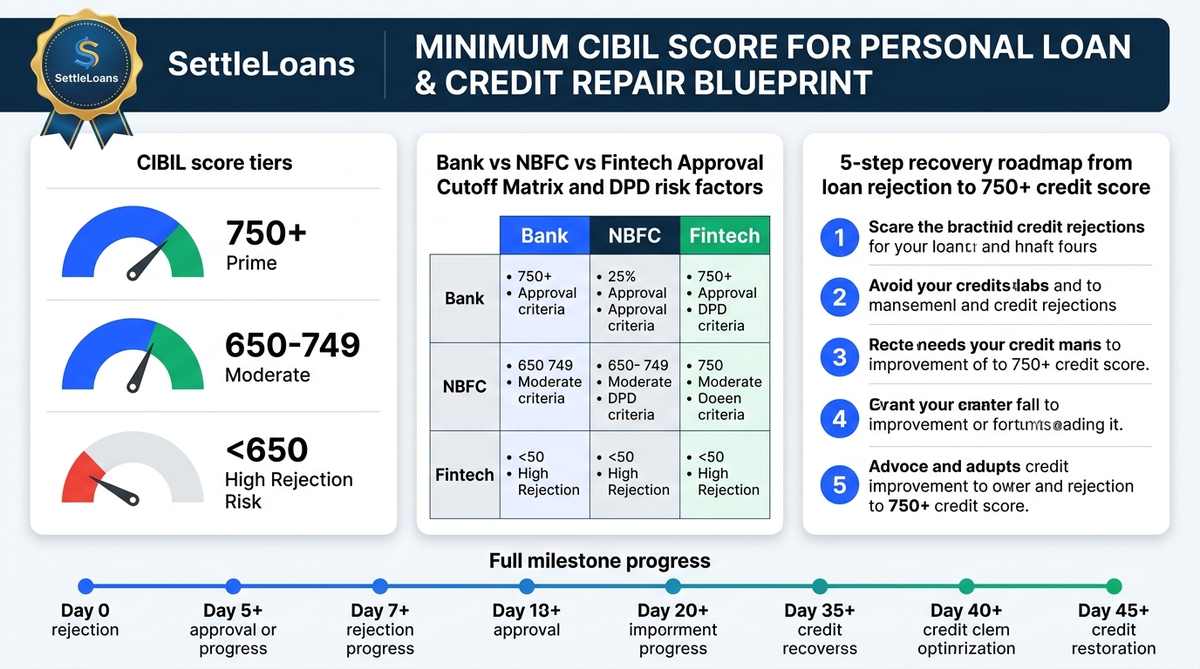
Understanding where your credit score sits along the institutional risk curve is critical for diagnosing why a past application was turned down and charting an effective path toward financial recovery. The following breakdown illustrates the five standardized scoring tiers utilized across major Indian financial institutions:
| CIBIL Score Tier | Credit Risk Classification | Standard Approval Probability | Indicative Interest Rate Band |
|---|---|---|---|
| 750 – 900 | Prime / Low Risk | Very High (90%+) | 10.50% – 13.50% p.a. |
| 700 – 749 | Near-Prime / Moderate Risk | Moderate (60% – 75%) | 13.50% – 17.00% p.a. |
| 650 – 699 | Sub-Prime / Elevated Risk | Low to Selective (30% – 45%) | 18.00% – 24.00% p.a. |
| 550 – 649 | High Risk / Impaired Credit | Very Low (< 15%) | 24.00% – 36.00% p.a. (NBFCs only) |
| 300 – 549 | Severe Default / Distressed | Universal Rejection (0%) | Ineligible for Unsecured Credit |
2. Bank vs. NBFC Minimum CIBIL Score Cutoffs: Institutional Underwriting Matrix
Institutional credit policies vary substantially between Tier-1 commercial banks, public sector banking institutions, and Non-Banking Financial Companies (NBFCs). Tier-1 private and public banks operate under stringent capital adequacy requirements and aggressive low-risk mandates governed by the Reserve Bank of India. Consequently, these institutions maintain unyielding CIBIL cutoffs of 750 and above for unsecured personal loans.
In contrast, specialized NBFCs and digital fintech platforms employ alternative credit scoring algorithms that factor in auxiliary data points—such as bank statement cash flows, employer tier classifications, and utility transaction consistency. However, this flexibility comes at a severe price: NBFCs compensate for taking on sub-prime borrowers by charging punitive interest rates, inflated processing fees, and stringent prepayment penalties.
Institutional CIBIL Cutoffs & Underwriting Criteria (2026)
| Lending Institution | Minimum CIBIL Cutoff | Mandatory Income Requirement | Primary Rejection Triggers |
|---|---|---|---|
| State Bank of India (SBI) | 750+ | ₹15,000 – ₹25,000 / month | Any DPD > 30 in last 12 months; unclosed settled accounts. |
| HDFC Bank | 750+ | ₹25,000 – ₹50,000 / month | Score below 750; FOIR exceeding 50%; multiple recent hard inquiries. |
| ICICI Bank | 750+ | ₹30,000 / month | Past "Written-Off" status; unserviced credit card dues. |
| Axis Bank | 750+ | ₹25,000 / month | DPD entries > 000 in past 24 months; high credit utilization (> 40%). |
| Bajaj Finance (NBFC) | 700 – 720 | ₹25,000 / month | Active SMA-1 or SMA-2 classification; ongoing collection disputes. |
| Tata Capital / Poonawalla | 675 – 700 | ₹20,000 / month | Unresolved cheque bounces (Section 138); high leverage ratio. |
| Fintech Lenders (KreditBee, Navi) | 650 | ₹15,000 / month | Negative bank balance remarks; active NACH mandate bounces. |
Check Your Loan Settlement Options
Answer 2 quick questions to evaluate your settlement eligibility.
1. What type of loan do you want to settle?
3. The Hidden Underwriting Criteria: FOIR, DTI Ratios & DPD Repayment Strings
A frequent source of bewilderment among loan applicants is receiving an outright loan rejection despite possessing a CIBIL score of 760 or higher. The explanation lies in multi-dimensional underwriting models. A three-digit credit score is merely the initial qualification gate; credit underwriters evaluate two additional technical metrics before sanctioning unsecured funds: the Fixed Obligation to Income Ratio (FOIR) and historical Days Past Due (DPD) payment strings.
FOIR calculates the aggregate percentage of an applicant's net monthly salary that is already committed toward existing loan EMIs, credit card minimum due payments, and other recurring statutory debts. Under standard banking guidelines, the maximum permissible FOIR threshold is strictly capped:
FOIR (%) = [ Total Existing Monthly Debt EMIs + Proposed Loan EMI ] / [ Net Verified Monthly Take-Home Salary ] × 100
If an individual earns ₹80,000 net monthly and pays ₹42,000 in existing car and home loan EMIs, their current FOIR is 52.5%. Any new personal loan application will be automatically rejected on leverage capacity grounds, regardless of an exceptional 780 CIBIL score.
Simultaneously, underwriters conduct forensic audits of the 36-month DPD grid inside your Credit Information Report. If the grid contains numerical entries such as "030", "060", or "090" within the preceding 12 months, underwriting engines flag the profile as experiencing active financial stress, prompting immediate rejection.
4. Why Personal Loans Get Rejected Below 750: Asset Classification & RBI Provisioning
To understand why banks enforce strict cutoffs, one must look at commercial banking balance sheet mechanics. Under Reserve Bank of India Prudential Norms on Income Recognition, Asset Classification and Provisioning (IRACP), banks are legally mandated to set aside capital reserves (provisions) against potential loan losses.
When a bank lends to a prime borrower (750+ CIBIL), the regulatory provisioning requirement is minimal (typically 0.40% for standard assets). However, when lending to sub-prime applicants, actuarial models predict higher delinquency transitions into Non-Performing Assets (NPAs). Once a loan defaults past 90 DPD, the bank must provision 15% to 100% of the loan amount from its operating profits, eroding corporate profitability.
| Borrower Credit Profile | Delinquency Risk Rating | Bank Provisioning Burden | Lender Underwriting Response |
|---|---|---|---|
| Score 750 – 900 | Standard Asset (0.5% – 1% Default Probability) | 0.40% Standard Capital Provision | Instant Digital Approval; Unsecured Sanctions up to ₹25–40 Lakhs. |
| Score 650 – 749 | Elevated Risk (4% – 8% Default Probability) | Higher Internal Risk-Weighted Buffer | Requires Co-Applicant, Income Verification, Lower Sanctioned Limits. |
| Score Below 650 | High NPA Potential (18%+ Default Probability) | 15% to 100% Stressed Provisioning Threat | Automated Hard Rejection; Unsecured Lending Completely Prohibited. |
5. The Reality of Personal Loans at 550–650: Risk-Based Pricing & Compounding Traps
A common marketing promise across digital media claims that distressed borrowers can easily secure "Guaranteed Personal Loans with 550 CIBIL Score." As institutional debt settlement strategists, SettleLoans advises extreme caution. In commercial banking reality, genuine unsecured personal loans at competitive rates do not exist for credit profiles below 600.
When unregulated intermediaries or peripheral lending entities offer loans to individuals in the 550–650 range, they deploy an aggressive mechanism known as Risk-Based Pricing (RBP). The lender prices the extreme probability of default directly into the contract through exorbitant interest rates ranging from 28% to 42% per annum, steep upfront processing deductions of 5% to 10%, and severe daily bounce penalties.
Taking a high-interest unsecured loan to service existing overdue debts inevitably triggers a catastrophic debt spiral. Borrowers quickly find themselves allocating 80% or more of their monthly earnings toward penal interest, resulting in inevitable default, asset attachment risks, and total credit ruin.
6. The Trap of Predatory Digital Loan Apps: Regulatory Violations & Coercive Tactics
When rejected by legitimate commercial banks due to a low CIBIL score, desperate borrowers frequently fall prey to predatory instant loan apps operating across digital app stores and social messaging channels. These entities specifically target distressed borrowers with deceptive slogans promising "No CIBIL Check Required" and "Instant Disbursal in 5 Minutes."
These entities routinely violate the Reserve Bank of India Guidelines on Digital Lending (2022). Rather than providing standard 12-to-60 month repayment tenures, they disburse micro-loans with 7-to-15 day repayment cycles. The borrower receives only 60% to 70% of the sanctioned principal after deducting massive upfront processing charges, while being billed for the full amount plus 100%+ annualized interest.
Upon inevitable default, these entities deploy illegal collection practices: harvesting personal contacts, sending defamatory messages to family members, and threatening public humiliation. Borrowers must understand that borrowing from unverified digital platforms never repairs a low CIBIL score; it exacerbates financial distress and legal exposure.
7. Forensic Credit Diagnostics: Auditing Settled, Written-Off & Overdue Tags
If your loan application was rejected, the immediate strategic priority is not to apply at another bank, but to conduct a rigorous forensic audit of your official Credit Information Report. Each speculative application generates a "Hard Inquiry" that penalizes your CIBIL score by 5 to 10 points. Submitting multiple applications within days signals desperate credit-seeking behavior to automated underwriting models.
When auditing your credit file from TransUnion CIBIL or Experian, examine the Account Information section for specific adverse reporting tags that trigger instant algorithmic rejection:
Active DPD Strings (030, 060, 090+)
Indicates live, rolling payment delays on existing credit cards or active loans. Lenders reject any new credit until all active overdue amounts are regularized.
Written-Off / Loss Asset Status
Signifies that a previous lender deemed the debt uncollectible after 180+ days of delinquency. The lender retains full legal recovery rights, preventing any new bank approval.
Settled Account Remark
Indicates that a prior loan was closed via a negotiated compromise where the bank waived part of the principal or interest. Automated algorithms flag this loss event.
Erroneous Reporting / Bureau Desynchronization
Clerical errors where a fully repaid loan continues to display an open balance. Under Section 21 of CICRA 2005, borrowers can file statutory disputes to expunge false entries within 30 days.
8. Strategic Debt Settlement (OTS): The Lawful Catalyst for Credit Reconstruction
For borrowers trapped with multiple delinquent personal loans, mounting penal interest, and relentless recovery agent harassment, continuing to service unmanageable minimum payments is mathematically unsustainable. The most effective, lawful solution to resolve financial distress is executing a formal One-Time Settlement (OTS) under Reserve Bank of India compromise frameworks.
Under RBI Master Directions, all commercial banks and NBFCs maintain board-approved OTS policies allowing distressed borrowers facing genuine financial hardship (such as job loss, critical medical illness, or business failure) to settle outstanding dues for a negotiated discounted lump sum. The bank calculates the Net Present Value (NPV) of immediate recovery versus prolonged litigation costs, frequently waiving 100% of accumulated penal interest and 40% to 65% of outstanding principal dues.
Engaging legal advocates from SettleLoans ensures your rights are protected throughout the OTS negotiation. Our advocates serve formal legal notices under the RBI Fair Practices Code, halt unlawful recovery harassment, negotiate directly with authorized bank settlement committees, and secure a binding No Dues Certificate (NDC) confirming complete legal discharge of your loan obligations.
9. The 18–24 Month Score Rebound Blueprint: Proven Steps to Rebuild 750+ CIBIL
A past loan settlement or default does not permanently end your credit future. Credit scoring algorithms operate on rolling mathematical weighting models: recent financial discipline over the preceding 12 to 24 months carries significantly higher scoring weight than historical delinquencies. By executing a structured score reconstruction plan, borrowers can systematically restore their CIBIL score from sub-550 levels back to 750+ prime status:
| Rebuilding Phase | Core Milestone Actions | Recommended Financial Instrument | Target CIBIL Score |
|---|---|---|---|
| Phase 1 (Months 1–3) | Obtain official NDC; verify ₹0 outstanding balance across all 4 bureaus; halt all hard loan inquiries. | Secured Fixed Deposit Credit Card (FD backing ₹25,000 – ₹50,000) | 550 – 620 |
| Phase 2 (Months 4–12) | Maintain Credit Utilization Ratio strictly below 25%; automate 100% on-time full statement payments. | Secured Card with Daily Micro-Transactions & Utility Autopay | 640 – 710 |
| Phase 3 (Months 13–18) | Introduce a small consumer installment loan to create healthy credit mix; eliminate all DPD strings. | Small Consumer Durable / 2-Wheeler Loan with Perfect Repayment | 720 – 745 |
| Phase 4 (Months 19–24+) | Achieve institutional prime borrower status; qualify for standard unsecured cards and home loans. | Standard Unsecured Prime Credit Lines & Bank Loans | 750 – 800+ (Prime) |
Rule 1: Keep Credit Utilization Ratio (CUR) Strictly Below 30%
If your secured credit card has a limit of ₹50,000, keep monthly spending capped under ₹15,000. Utilizing more than 30% of your sanctioned credit limit signals credit hunger to scoring algorithms and suppresses score growth.
Rule 2: Eliminate Hard Credit Inquiries
Do not submit speculative loan applications across multiple bank websites or fintech portals. Each hard inquiry deducts 5 to 10 points and flags credit desperation. Pull your own report as a "soft inquiry" with zero score impact.
Rule 3: Upgrade "Settled" to "Closed" When Liquidity Permits
If your financial circumstances improve down the road, you can approach the original lender to repay the waived balance from your OTS. The bank will issue a revised No Dues Certificate and update your credit bureau remark from "Settled" to "Closed."

Settle Loan is India's trusted debt relief and loan settlement platform. We help borrowers overcome financial distress by negotiating with banks and NBFCs to legally settle personal loans and credit card debts. With our transparent, performance-based approach, you can achieve debt freedom and regain your financial peace of mind.
COMPUTER
10. Frequently Asked Questions (FAQ)
Authoritative answers to the most urgent questions regarding minimum CIBIL score requirements, loan rejection causes, and credit reconstruction in India.
For premier public and private sector banks such as SBI, HDFC, ICICI, and Axis Bank, the standard minimum CIBIL score cutoff for unsecured personal loans is 750. While select Non-Banking Financial Companies (NBFCs) and fintech lenders evaluate applicants with scores between 650 and 700, applicants below 650 face near-universal rejections or punitive interest rates exceeding 24% to 36% per annum.
Securing an unsecured personal loan from mainstream regulated banks with a CIBIL score below 600 is statistically improbable. Scores under 600 signify serious historical delinquency, active loan defaults, or settled account remarks. Applicants in this tier must focus on resolving legacy defaults through legal debt settlement, obtaining a No Dues Certificate, and rebuilding their score to 750+ using secured credit instruments.
Personal loans are 100% unsecured facilities backed by zero physical collateral. Under RBI risk-weighted asset norms, a low CIBIL score indicates high probability of default (PD). Even with high monthly income, banks mandate minimum credit scores to control non-performing asset (NPA) provisioning requirements and verify disciplined financial management.
FOIR measures the percentage of your net monthly income committed toward existing EMIs and credit card minimum payments. Most institutional lenders cap permissible FOIR at 40% to 50%. If your FOIR exceeds 50%, lenders will reject your personal loan application even if your CIBIL score is above 750 due to over-leveraged repayment capacity.
Unregistered instant loan apps targeting low-score borrowers frequently engage in predatory lending, imposing exorbitant processing fees of 20% to 30%, annualized interest rates exceeding 60% to 120%, and unauthorized access to personal phone contacts leading to aggressive harassment and privacy violations in violation of RBI Digital Lending Guidelines.
A "Settled" or "Written-Off" tag on a Credit Information Report indicates that a previous lender suffered a financial loss through a negotiated compromise or uncollected debt. Automated bank algorithms flag these records as high credit risk, leading to immediate algorithmic rejection until the borrower actively reconstructs their credit profile.
When stuck with delinquent, mounting debts that cause continuous loan rejections, executing a formal OTS with advocate representation caps financial liability, eliminates escalating penal interest, stops recovery harassment, and secures an official No Dues Certificate (NDC) to halt ongoing negative DPD reporting.
With a disciplined credit repair roadmap—including clearing outstanding overdue balances, adopting a secured Fixed Deposit credit card, maintaining credit utilization below 25%, and eliminating hard inquiries—borrowers can systematically rebuild their score from 550 to 750+ within 18 to 24 months.
The rejection itself is not recorded as a specific negative event in your CIBIL report. However, the associated "hard inquiry" generated by the lender during underwriting reduces your score by 5 to 10 points. Submitting multiple speculative applications in rapid succession creates a flurry of hard inquiries that severely degrades your credit score.
Official Regulatory Sources & Legal Authorities
- Reserve Bank of India (RBI) — Master Directives on Compromise Settlements & Prudential Norms
- TransUnion CIBIL — Credit Information Companies (Regulation) Act, 2005 Compliance Portal
- Supreme Court of India — Landmark Judgments on Fair Debt Recovery & Borrower Privacy Rights
- Insolvency and Bankruptcy Board of India (IBBI) — Individual Debt Resolution Standards
- RBI Integrated Ombudsman Scheme — Consumer Credit Reporting Grievance Redressal Mechanism