1. Why "Settled" Status Blocks Your Credit Profile in India
When you experience severe financial distress—such as job loss, medical emergency, or business failure—entering into a One-Time Settlement (OTS) with your lender is an invaluable legal lifeline. It halts aggressive debt recovery harassment, protects you from legal prosecution under Section 138 of the Negotiable Instruments Act or Section 25 of the Payment and Settlement Systems Act, and permanently caps your financial liability.
However, once the settlement payment is completed, thousands of borrowers in India encounter an unexpected wall years later: their CIBIL report displays a permanent "Settled" tag. When applying for a critical home loan, business expansion facility, or prime credit card, automated bank underwriting systems reject their applications instantly, regardless of their current high income or post-settlement financial stability.
The Legal Reality of a "Settled" Account in CIBIL
Under the Credit Information Companies (Regulation) Act, 2005 (CICRA), licensed credit bureaus (TransUnion CIBIL, Experian, CRIF High Mark, Equifax) do not make qualitative judgments about why you settled. When a bank accepts a discounted payoff, it writes off the unpaid balance as a commercial loss. The bank reports this account as "Settled" (indicating a financial loss to the lender) rather than "Closed" (which denotes 100% full repayment with zero haircut).
Automated credit approval algorithms at Tier-1 banks (such as SBI, HDFC, ICICI, and Axis Bank) flag any account with a "Settled" or "Written-Off" status as a high-risk historical default. The automated decision engine rejects the application at Stage 1, long before a human credit officer even reviews your latest salary slips or income tax returns.
Furthermore, under Section 21 of CICRA 2005, credit bureaus retain this historical account status for up to 7 years. If you settled your loan 2, 3, or 4 years ago, waiting passively for the tag to disappear means enduring several more years of credit rejection or being forced into exorbitant 24%–36% interest rates from predatory fintech lenders.
2. "Settled" vs. "Closed" vs. "Written Off"
To successfully navigate credit restoration, you must understand the exact terminology used by TransUnion CIBIL and Indian banking institutions. The table below delineates the statutory differences between the three primary post-default statuses:
| Evaluation Metric | "Closed" Status (Clean) | "Settled" Status (Compromise) | "Written Off" (Default) |
|---|---|---|---|
| Legal Definition | 100% of principal, interest, and contractual dues repaid in full without haircut. | Borrower paid a discounted compromise amount; lender waived remaining balance. | Lender classified debt as unrecoverable non-performing asset (NPA); 100% loss booked. |
| CIBIL Score Impact | Positive (+30 to +60 pts boost over tenure). | Negative drop (-75 to -150 pts at settlement). | Catastrophic plunge (-150 to -250+ pts drop). |
| Prime Loan Eligibility | Immediate approval at lowest rack rates (8.35%–8.8%). | Blocked on automated systems; manual approval only after 24–36 mo. | 100% Rejected across all regulated banks and NBFCs. |
| Residual Legal Liability | ₹0 — Fully discharged with unconditional closure letter. | ₹0 — Legally capped under terms of OTS Sanction Letter. | Active — Bank or Asset Reconstruction Company (ARC) can litigate. |
| Bureau Retention Period | Permanent positive history on credit report. | Retained for up to 7 years under CICRA 2005. | Retained for up to 7 years or until legal suit disposal. |
| Upgrade Viability | Not Applicable (Already Optimal). | 100% Upgradable to "Closed" by paying waived balance. | Requires full OTS or total repayment to upgrade. |
As the matrix proves, "Settled" is not an irreversible life sentence. Because you already completed the initial compromise and hold an official OTS agreement, you have the statutory right under Reserve Bank of India customer service guidelines to settle the remaining residual balance and upgrade your record to a pristine "Closed" status.
Check Your Loan Settlement Options
Answer 2 quick questions to evaluate your settlement eligibility.
1. What type of loan do you want to settle?
3. 6-Step Roadmap: Removing 'Settled' Status to 'Closed'
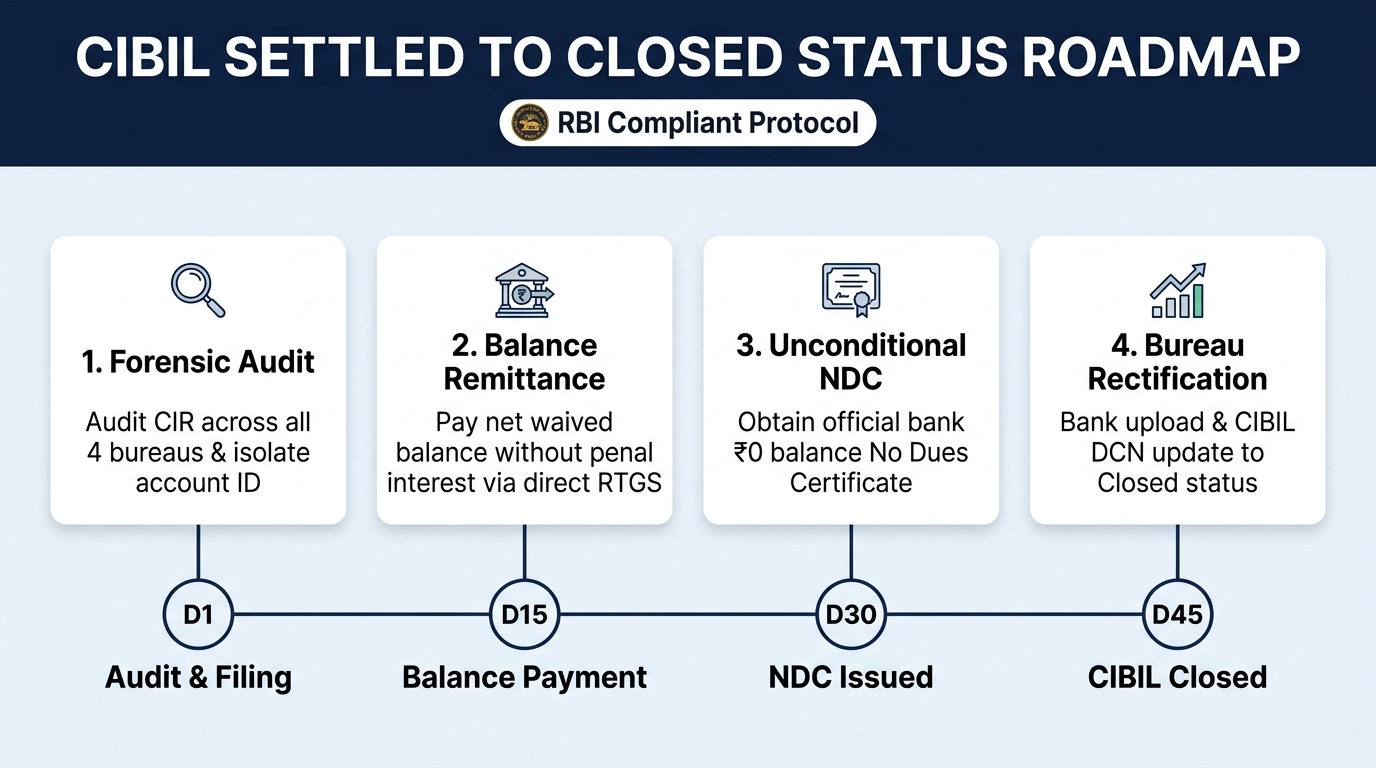
Converting a settled loan into a closed account requires navigating both banking operations and credit bureau dispute frameworks. Follow this rigorously tested 6-step legal protocol to achieve 100% status upgrade:
Step 1: Conduct a Forensic Audit of Your Official Credit Information Report (CIR)
Obtain fresh, official Credit Information Reports from all four licensed credit bureaus: TransUnion CIBIL, Experian India, CRIF High Mark, and Equifax. Do not rely on third-party marketing apps that provide compressed summaries.
- Isolate the exact Account Number and Member Reference ID of the settled facility.
- Note the reported Current Balance, Amount Overdue, and Written-off Amount (Total vs. Principal).
- Verify whether the entry is tagged as "Settled", "Post-Write Off Settled", or mistakenly tagged as an active "Written Off" default.
Step 2: Submit a Formal Written Application to the Bank's Stressed Asset / Nodal Department
Do not negotiate verbally with local branch executives or recovery agents. Draft a formal representation on legal stationery addressed to the bank's Stressed Assets Resolution Branch (SARB) and Principal Nodal Officer (PNO).
Step 3: Negotiate Residual Waiver Terms & Remit Payment via Verifiable Channels
Ensure the bank does not attempt to levy retroactive 24%–36% penal interest or late charges from the date of settlement. The payable figure must strictly be the net principal haircut and base contractual interest that was waived during the OTS.
Make the payment exclusively via NEFT / RTGS directly to your designated loan account number or via a Banker's Cheque made out to the bank. Retain the UTR confirmation number, stamped deposit challan, and digital bank debit statement.
Step 4: Secure the Unconditional Full & Final No Dues Certificate (NDC)
Within 7 to 15 working days of receipt of payment, the bank must issue an unconditional No Dues Certificate (NDC) or Full Closure Letter on official corporate letterhead, signed by an authorized branch officer with employee code and bank seal.
Step 5: Monitor the Bank's 30-Day Mandatory Credit Bureau Data Submission
Under Reserve Bank of India Master Directions, all commercial banks, regional rural banks, and NBFCs are mandated to upload updated borrower credit files to all four credit information companies at least once every month (typically on or before the 10th of each calendar month). Wait 30 to 45 days after receiving your NDC to allow this automated data pipeline to refresh.
Step 6: File an Online CIBIL Dispute Resolution with NDC if the Record Fails to Update
If CIBIL continues reflecting "Settled" after 45 days, log into cibil.com and submit a formal dispute under the Dispute Resolution Section.
Select the affected account, choose "Account Status Incorrect," upload clear PDF copies of your NDC and payment receipts, and submit. TransUnion CIBIL will assign a unique Dispute Control Number (DCN) and route the case directly to the bank's compliance cell for mandatory 30-day verification.
4. Cost-Benefit Analysis: Paying Residual Debt vs Rebuilding
Upgrading your account from "Settled" to "Closed" requires paying real capital to your past lender. Is it always worth it? The answer depends entirely on your immediate financial goals, the size of the original haircut, and how much time has elapsed since the settlement.
| Borrower Scenario | Recommended Action | Financial Rationale & ROI |
|---|---|---|
| Planning a Home Loan (₹40L–₹2Cr+) within the next 6–18 months | Pay Residual Balance & Convert to "Closed" Immediately | A "Settled" tag increases home loan interest rates by 1.25%–2.50% or causes outright rejection. Paying ₹1 Lakh–₹2 Lakh now saves ₹10 Lakh–₹30 Lakh in interest over a 20-year home loan. |
| Small Settlement Haircut (Waived amount under ₹40,000) | Pay Residual Balance & Close Account | The nominal payment completely cleanses your bureau file and permanently restores prime banking relationships at negligible cost. |
| Government, PSU, or Financial Sector Career Background Checks | Pay Residual Balance & Secure NDC | Institutions like RBI, SEBI, PSU banks, and defense contracts conduct strict CIR audits. A "Settled" or "Written Off" tag can trigger disqualification during vigilance clearance. |
| Large Haircut (Waived amount ₹5L–₹20L+) with NO immediate large borrowing plans | Rebuild Naturally with Secured Credit Cards (Do NOT pay) | Paying large capital is financially inefficient if you only need modest credit. Rebuilding with an FD-backed card achieves a 750+ score in 18–24 months for zero extra payment. |
| Settlement occurred 5+ years ago (Nearing 7-year CICRA expiry) | Wait for Natural 7-Year Bureau Purge | Under Section 21 of CICRA 2005, the record will automatically age out within 12–24 months. Capital is better allocated to investments or liquidity reserves. |
5. Beware of CIBIL Clearance Agents: Scams vs Reality
The desperation to remove a "Settled" mark has spawned a thriving black market of cyber fraudsters on WhatsApp, Telegram, and deceptive social media advertisements pretending to be "CIBIL Officers," "Credit Score Hackers," or "Guaranteed Negative Remark Erasers."
| Evaluation Factor | Legitimate Legal Banking Route (SettleLoans) | Fraudulent "CIBIL Clearing Agent" Scams |
|---|---|---|
| Mechanism Used | Direct settlement reversal petition with bank Stressed Assets branch and PNO. | Fictitious promises of "database hacking," "insider bureau access," or forged letters. |
| Payment Recipient | 100% of residual balance paid directly to the lending bank's verified loan account. | Demands upfront cash or UPI transfers to personal accounts / anonymous crypto wallets. |
| Legal Documentation | Official bank NDC on corporate letterhead + verified bureau DCN reference number. | Provides photoshopped PDF screenshots that vanish upon actual bureau refresh. |
| Bureau Compliance | 100% Compliant with RBI Master Directions & Section 21 of CICRA 2005. | Illegal under Indian Penal Code (IPC 420 for fraud) and IT Act Section 66. |
| Long-term Validity | Permanent status update to "Closed" recognized by all Indian financial institutions. | Zero change on official bureau servers; borrower loses fees and remains blocked. |
Golden Rule of Credit Bureau Integrity
Neither TransUnion CIBIL nor any lawyer, advocate, or agency has administrative access to manually edit, delete, or alter your payment history. Credit bureaus are strictly repository engines. Data is updated exclusively when the regulated lending institution transmits an encrypted, authenticated monthly batch feed. Any entity promising to "delete" a remark without bank clearance is committing criminal fraud.
6. Bank Delays Updating CIBIL: RBI Ombudsman Rights
In many instances, borrowers dutifully pay the full settlement or residual balance, yet the branch staff fails to update the back-office Core Banking System (CBS) or omits uploading the revised status during the monthly bureau run. If you find yourself in this deadlock, Indian banking law provides powerful statutory recourse.
Principal Nodal Officer (PNO)
Escalate via registered email to the bank's Principal Nodal Officer citing your payment UTR and NDC. Banks are mandated to respond within 14 working days.
CIBIL Online Dispute (DCN)
File an official dispute on cibil.com. The bureau independently triggers a 30-day notice to the bank's central credit reporting division.
RBI Integrated Ombudsman
Lodge a complaint on the RBI CMS Portal (cms.rbi.org.in) under Clause 10 for deficiency in credit information reporting.
Statutory Compensation: ₹100 Per Day for Unresolved Credit Reporting Delays
Under RBI circular RBI/2023-24/72 (Framework for Compensation to Customers for Delayed Updation of Credit Information), if a regulated bank or credit bureau fails to resolve a credit misreporting grievance or update a verified closure within 30 calendar days of receiving a formal dispute, the institution is legally obligated to pay compensation of ₹100 per calendar day directly into the borrower's bank account until the record is rectified.
7. Rebuilding Your CIBIL Score to 750+ Post-Closure
Whether you have successfully upgraded your account to "Closed" or are waiting out the post-settlement seasoning period, you must actively inject positive payment data to accelerate your credit score recovery. Follow this proven 4-pillar rehabilitation roadmap:
1. Open a Fixed Deposit (FD)-Backed Secured Credit Card
Apply for an instant secured credit card against a term deposit of ₹25,000 to ₹50,000 (e.g., IDFC FIRST WOW, Kotak 811 Dream Different, or OneCard). Because these cards require zero CIBIL checks or income proof, approval is guaranteed. They report monthly active repayment data to all 4 credit bureaus.
2. Strictly Enforce the 30% Credit Utilization Ratio (CUR) Rule
Never utilize more than 30% of your available card limit in any single billing cycle. For example, on a ₹50,000 limit card, ensure your monthly statement balance remains under ₹15,000. Low credit utilization signals financial discipline to bureau algorithms.
3. Automate 100% On-Time Full Bill Payments 5 Days in Advance
Never pay just the "Minimum Amount Due" (MAD), which triggers 42% annualized interest and high revolving debt flags. Set up automated auto-debit for the Total Amount Due at least 5 business days prior to the payment due date to prevent technical bounce errors.
4. Avoid Multiple Hard Inquiries for Unsecured Loans
Every rejected personal loan or credit card application generates a "Hard Inquiry" on your CIR, shaving 5 to 10 points off your score and branding you as "credit hungry." Refrain from applying for any unsecured loans for at least 12 to 18 months while your score rebuilds.

Settle Loan is India's trusted debt relief and loan settlement platform. We help borrowers overcome financial distress by negotiating with banks and NBFCs to legally settle personal loans and credit card debts. With our transparent, performance-based approach, you can achieve debt freedom and regain your financial peace of mind.
COMPUTER
8. Frequently Asked Questions (FAQ)
Clear, definitive legal answers to the most common questions regarding loan settlements, CIBIL disputes, and account closure upgrades.
Yes, but only by converting it to "Closed" through legitimate banking channels. A "Settled" entry cannot be erased by credit repair agents or third-party hackers. To remove the negative impact, you must approach the original lender, pay the remaining waived balance (the haircut amount waived during the One-Time Settlement), secure an unconditional No Dues Certificate (NDC), and mandate the bank to report the account as "Closed" to TransUnion CIBIL, Experian, CRIF High Mark, and Equifax.
Under Section 21 of the Credit Information Companies (Regulation) Act, 2005 (CICRA), credit bureaus in India maintain historical records, including "Settled" remarks and written-off losses, for a statutory duration of up to 7 years. While the severity of the score penalty diminishes after 24 to 36 months if you rebuild on secured credit lines, automated underwriting algorithms for large loans (e.g., home loans) will continue detecting the tag until it is officially updated to "Closed".
The 6-step legal procedure entails: 1) Pull your comprehensive CIR report to isolate the loan account number and member ID; 2) Submit a formal settlement closure application to the bank's Stressed Asset / Principal Nodal Officer requesting the exact balance calculation; 3) Remit the residual waived amount via NEFT/RTGS with documented transaction references; 4) Obtain the physical and digital Full & Final No Dues Certificate stating ₹0 balance and full closure; 5) Allow 30–45 days for the lender's automated monthly credit bureau feed; 6) Verify the updated status on CIBIL or raise an online CIBIL Dispute attaching your NDC.
You only need to repay the pure principal and base contractual interest that was waived during your initial One-Time Settlement (OTS). You do NOT have to pay extortionate penal interest, compounded late fees, or bouncing charges that accumulated during default, provided your legal representation establishes that only the genuine principal-interest balance is being cleared to obtain closure.
Upgrading from "Settled" to "Closed" immediately eliminates the red flag that causes algorithmic rejections by prime lenders. The numerical credit score reflects a progressive jump of 40 to 90 points within 3 to 6 months. More importantly, your eligibility for prime home loans (at 8.35%–8.75%), auto loans, and premium credit cards is completely unlocked.
No. This is an illegal scam. Any individual or agency claiming they can "delete," "hack," or "clear" a settled status from CIBIL servers for an upfront fee is committing fraud. In India, credit bureaus operate under strict RBI surveillance and update data exclusively through encrypted, automated batch uploads submitted directly by regulated banks and NBFCs.
Under RBI Master Directives on Customer Service and the Fair Practices Code, regulated lending institutions cannot arbitrarily refuse a debtor's legitimate request to pay off residual dues. If your local branch stalls, you should escalate in writing to the bank's Principal Nodal Officer (PNO). If unresolved within 30 days, submit a complaint to the RBI Integrated Ombudsman under Clause 10 of the CMS portal.
You should immediately file an online CIBIL Dispute Resolution via the TransUnion CIBIL consumer portal under the "Account Information" tab, uploading your No Dues Certificate and bank transaction receipts. By RBI circular RBI/2023-24/72, credit bureaus and banks must resolve credit data discrepancies within 30 calendar days or pay a mandatory statutory compensation of ₹100 per day of delay to the borrower.
Not always, but it makes approval faster and secures significantly lower interest rates (saving ₹5 Lakh–₹25 Lakh in interest over a 20-year tenure). If your settlement occurred over 3 years ago and your CIBIL score is rebuilt above 730, select Housing Finance Companies (HFCs) and NBFCs can sanction loans based on manual underwriting, provided you furnish the original OTS sanction letter and ₹0 NDC.
Yes. If you cannot afford to repay the waived amount right now, you can rebuild your CIBIL score to 750+ over 18 to 24 months by subscribing to a Fixed Deposit (FD)-backed secured credit card, keeping your Credit Utilization Ratio (CUR) below 30%, paying all bills 5 days before the due date, and maintaining zero fresh defaults or multiple unsecured inquiries.
Official Regulatory Sources & Statutory References
- Reserve Bank of India (RBI) — Master Directions on Compromise Settlements & Customer Protection
- TransUnion CIBIL — Credit Information Companies (Regulation) Act, 2005 Dispute Guidelines
- Supreme Court of India — Landmark Jurisprudence on Fair Practices Code & Recovery Ethics
- Insolvency and Bankruptcy Board of India (IBBI) — Individual Debt Resolution Standards
- eCourts Services — National Judicial Data Grid for Debt Recovery Matters & Lok Adalat Awards