- Statutory Conciliation Forum: Lok Adalat operates under the Legal Services Authorities Act, 1987. It is strictly a conciliation body aimed at mutual compromise, possessing zero powers to pass adverse default orders, levy criminal penalties, or issue arrest warrants.
- Voluntary Participation: Receiving a Pre-Litigation Case (PLC) notice from the District Legal Services Authority (DLSA) does not make court appearance mandatory. Non-appearance simply returns the file to the lender without creating contempt of court or immediate legal liability.
- large OTS Discounts (40% to 75%): Because senior bank recovery managers and Stressed Asset Resolution Branch (SARB) officers have on-the-spot sanctioning powers during Lok Adalat sessions, borrowers routinely obtain 100% penal fee waivers and deep principal haircuts.
- Final Civil Court Decree (No Appeals): Under Section 21 of the LSA Act read with Section 96(3) of the Code of Civil Procedure (CPC), an award signed in Lok Adalat becomes an unappealable civil decree, permanently barring the bank from future lawsuits or Section 138 / Section 25 PSSA litigation.
- Zero Court Fees & 30-Day NDC Mandate: There are zero filing or court fees in Lok Adalat. Once the compromised amount is remitted, RBI Circular RBI/2023-24/60 statutorily obligates the bank to deliver a stamped No Dues Certificate within 30 days under penalty of ₹5,000 per day.
Demystifying Lok Adalat: An ADR Conciliation Forum
Receiving an official-looking postal envelope or an urgent WhatsApp message carrying the heading "Notice for National Lok Adalat" often triggers severe panic among Indian retail borrowers. Distressed people struggling with overdue personal loan EMIs, credit card balances, or micro-enterprise credit lines frequently misinterpret this document as a criminal court summons, an imminent arrest warrant, or an immediate police attachment case. In reality, the institutional architecture of Lok Adalat represents the complete opposite: it is India's premier, borrower-friendly Alternative Dispute Resolution (ADR) mechanism designed specifically to bypass adversarial court trials and help voluntary, discounted debt compromises.
Lok Adalat, literally translating to "People's Court," was granted statutory recognition under the Legal Services Authorities Act, 1987 (Act No. 39 of 1987). Lok Adalats function to reduce judicial backlog across Indian courts. They are organized periodically by NALSA, SLSAs, DLSAs, and Taluk Committees at national, state, and district levels. A typical Lok Adalat bench comprises a Presiding Judicial Officer (either a sitting or retired District Judge or Civil Judge) sitting alongside a co-member, who is usually an experienced legal advocate, academician, or social worker.
Crucially, Lok Adalat does not function as an adjudicatory court. The presiding bench has no statutory authority to conduct witness cross-examinations, examine evidence under the Indian Evidence Act, declare a borrower guilty of financial default, impose punitive monetary fines, or issue search warrants. Under Section 19(5) and Section 20(3) of the Legal Services Authorities Act, the sole legal jurisdiction of a Lok Adalat bench is to act as a neutral conciliator. The bench exists exclusively to persuade, guide, and help a voluntary compromise between the creditor bank and the borrower. If both parties do not arrive at a consensual agreement of their own free will, the bench cannot impose any decision or unilateral order on either party.
Lok Adalat Notices: Decoding DLSA Pre-Litigation Summons
To respond strategically to a Lok Adalat notice, a borrower must first determine whether the notice represents a Pre-Litigation Conciliation Notice or a Post-Litigation Court Referral. Lending institutions use both channels depending on the recovery lifecycle of the NPA. These lenders include public sector banks, private lenders like HDFC, ICICI, and Axis Bank, and major NBFCs like Bajaj Finance.
Category 1: Pre-Litigation Lok Adalat Notice (PLC Notice)
Issued under Section 19(5)(ii) of the Legal Services Authorities Act, a Pre-Litigation Case notice is generated before formal litigation begins. It precedes any civil suit, Section 138 NI Act cheque bounce complaint, or Section 25 PSSA NACH bounce petition. The bank submits a bulk list of delinquent loan accounts to the DLSA, which then issues an administrative invitation to explore an out-of-court One-Time Settlement (OTS). This notice carries zero judicial liability; it is purely an invitation to negotiate.
Category 2: Post-Litigation Pending Matter Referral
If a formal civil recovery suit or Section 138/PSSA complaint is pending, the trial judge can refer the dispute to a National Lok Adalat under Section 20(1) of the LSA Act. This occurs whenever there is a reasonable possibility of an amicable compromise. In this scenario, attending the Lok Adalat session allows the borrower to close the ongoing court case permanently without facing a prolonged, stressful trial.
Borrowers must also remain vigilant against deceptive tactics deployed by third-party recovery agencies. Unscrupulous recovery agents frequently forge simulated "Lok Adalat Final Summons" on WhatsApp, complete with fake police logos, fictitious advocate stamps, and urgent countdown timers threatening arrest within 24 hours. A legitimate Lok Adalat notice contains an authentic Pre-Litigation Case (PLC) Number. It clearly names the DLSA or TLSC, specifies the exact courtroom within the court complex, and provides official court registry contact details.
Check Your Loan Settlement Options
Answer 2 quick questions to evaluate your settlement eligibility.
1. What type of loan do you want to settle?
Is Lok Adalat Attendance Mandatory? Debunking Arrest Myths
The most pervasive myth spread by aggressive recovery tele-callers is that ignoring a Lok Adalat notice constitutes contempt of court, which will trigger immediate non-bailable arrest warrants (NBWs) or police visits to the borrower's residence. This threat is completely baseless and legally impossible under Indian jurisprudence.
Under the Legal Services Authorities Act, 1987, attendance at a pre-litigation Lok Adalat is 100% voluntary. Section 20(3) explicitly mandates that the Lok Adalat bench shall proceed to dispose of any reference only with the consent and willing participation of both parties. If a borrower chooses not to appear on the scheduled date, the Presiding Officer has zero statutory authority to issue bailable warrants, non-bailable warrants, police summons, or property attachment directives. The bench simply marks the pre-litigation case record with the standard administrative notation: "Matter Disposed of as Unsettled / Returned to Originating Institution."
Following non-appearance at a pre-litigation Lok Adalat, the legal status of the debt reverts entirely to the status quo ante. The bank retains its standard civil remedies—such as issuing statutory legal notices or filing civil suits—but suffers no advantage, while the borrower suffers no legal disadvantage or judicial censure. Attending Lok Adalat is highly beneficial for borrowers. It shifts talks away from abusive recovery call centers into a regulated judicial forum. There, senior bank decision-makers hold authority to grant large settlement discounts.
Zero Court Fees & Fee Refund Protections in Lok Adalat
Traditional civil litigation in India is notorious for prohibitive legal costs, mandatory ad-valorem court fees (often ranging between 5% and 10% of the disputed claim amount), process fees, and advocate retainers that compound over years. Lok Adalat eliminates these financial barriers completely through an extraordinary statutory cost framework.
Under the regulations governing National Lok Adalats, zero court fees are payable by either the borrower or the financial institution for starting, presenting, or concluding a pre-litigation conciliation. There are no stamp duty levies, registry charges, or procedural application costs. Both parties enter the forum completely free of administrative friction, ensuring that every rupee committed goes directly toward reducing the core debt rather than paying judicial taxes.
When a lawsuit is already pending before a regular Civil Court, Section 21(1) of the Legal Services Authorities Act, 1987 provides an incentive. Read with Section 16 of the Court Fees Act, 1870, it allows large savings:
When a pending court dispute is successfully settled in a Lok Adalat, court fees are refunded. The full fee paid in the suit is refunded under the Court Fees Act, 1870. The court registry issues a formal Court Fee Refund Certificate authorizing 100% reimbursement to the plaintiff, significantly lowering the bank's litigation sunk costs and making them far more receptive to granting large principal waivers.
National Lok Adalat Loan Settlement Workflow & Conciliation Flow
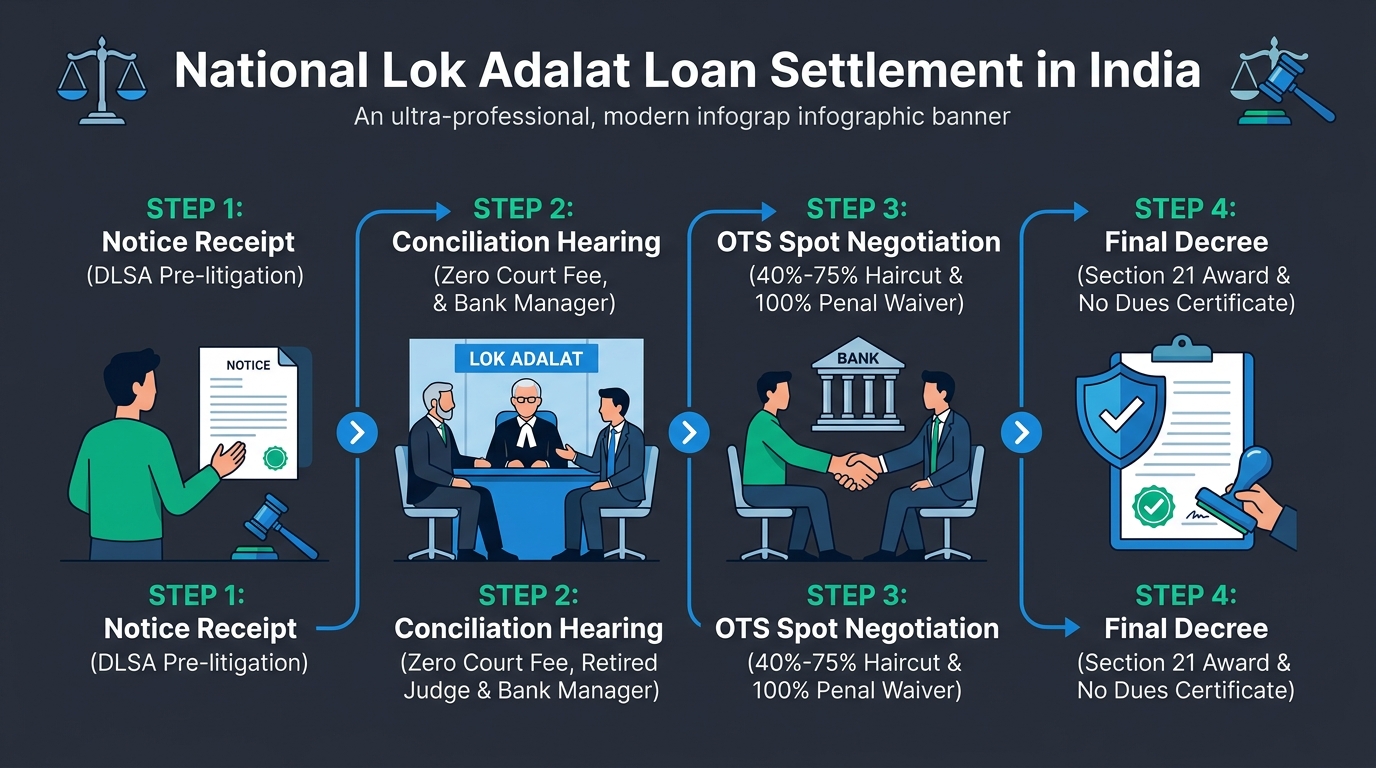
How to Secure Highest Haircut on the Spot at Lok Adalat
Securing an aggressive 40% to 75% debt haircut at Lok Adalat is not a matter of emotional pleading. It is an analytical exercise rooted in banking regulations and asset classification rules established by the Reserve Bank of India. To negotiate effectively before the Lok Adalat bench, borrowers must understand how commercial banks evaluate non-performing assets on their balance sheets.
Under the RBI Master Directions on Prudential Norms on Income Recognition, Asset Classification and Provisioning (IRACP), once an unsecured loan defaults past 90 days, it is classified as a Non-Performing Asset (Sub-Standard). If default extends past 12 months, the loan deteriorates into a Doubtful Asset (D1, D2, D3). Banks must then lock 25% to 100% of the loan amount in capital provisioning from operating profits. For unsecured credit, banks must maintain 100% provisioning against Loss Assets.
During National Lok Adalat sessions, bank credit committees and SARB officers face pressure to liquidate legacy NPAs. Settling enables them to reverse costly provisioning reserves and recover capital without spending lakhs on litigation advocates. To justify a deep settlement haircut to their internal audit teams and the Central Vigilance Commission (CVC), bank officers use the Net Present Value (NPV) Recovery Valuation Formula:
Where C_t represents estimated recoveries, r is the discount rate, and deductions account for 3–5 years of court friction and capital locked in NPA provisions.
Presenting a documented hardship dossier proves genuine financial distress. When borrowers provide medical invoices, job termination letters, or business closure filings, recovery officers recognize that prolonged litigation will yield far less than an immediate cash compromise. so, banks systematically agree to:
- 100% Complete Waiver: Total elimination of accumulated penal interest, compounding overdue interest, late payment fines, cheque bounce fees, and legal notice levies.
- 20% to 50% Principal Haircut: Direct reduction of the original disbursed principal loan balance based on NPA aging and documented borrower hardship.
- Flexible Payment Windows: Sanctioning either a lump-sum spot clearance or a structured 2 to 3-month milestone installment schedule.
The Lok Adalat Hearing Day Playbook: From Court Entry to Final Decree
Navigating the physical District Court complex on the day of a National Lok Adalat requires a clear, methodical action plan. The conciliation process follows five distinct procedural phases:
1Registry Verification & Bench Allocation
Arrive at the designated District Court Complex by 9:30 AM. Check the master display board or DLSA help desk to locate the specific Lok Adalat Bench assigned to your lending bank (e.g., Bench No. 4 for SBI, Bench No. 7 for HDFC Bank/ICICI Bank). Present your notice and obtain the daily cause list serial number.
2Direct Conciliation with Senior Bank Officers
before formally presenting before the Judicial Bench, meet directly with the bank's authorized Stressed Asset Manager or Chief Manager seated at the dedicated bank resolution desk. Present your financial hardship dossier, show your current genuine repayment capacity, and propose a concrete OTS settlement figure (e.g., 30%–45% of total ledger demand).
3Judicial Conciliation Before the Lok Adalat Bench
Once an initial agreement or talks gap is established, the matter is called before the Presiding Judge. The judge reviews the loan ledger and questions excessive penal interest charges. After evaluating the borrower's hardship, the bench persuades the bank manager to approve a fair, realistic settlement amount.
4Drafting and Signing the Joint Settlement Memo
When terms are finalized, a formal Joint Statement of Compromise (Settlement Memo) is drafted. Ensure that the settlement award explicitly records all key terms. It must state the exact compromise sum, full waiver of balance dues, specific payment deadlines, account details, and a binding covenant to withdraw all court complaints.
5Pronouncement of the Statutory Lok Adalat Award
The Presiding Judicial Officer and co-member sign and seal the formal Lok Adalat Award. Certified copies of the Award are handed over to both the borrower and the bank on the spot, providing permanent, unassailable legal closure.
Section 21 Legal Force: Finality of Lok Adalat Awards
One of the most powerful legal safeguards of settling a loan through Lok Adalat is the absolute statutory finality conferred upon the compromise agreement. Unlike informal bank settlement letters that can occasionally be disputed or mismanaged by changing branch staff, a Lok Adalat settlement carries the full weight of a judicial decree.
Under Section 21(1) of the Legal Services Authorities Act, 1987, every Lok Adalat award is deemed a Civil Court decree. In addition, Section 21(2) establishes that awards are final and binding on all parties. Crucially, no appeal shall lie to any court against the award.
This statutory bar on appeals is reinforced by Section 96(3) CPC 1908. The section mandates that no appeal can be made from a consent decree passed with the agreement of both parties. The Supreme Court of India has repeatedly upheld this doctrine (notably in State of Punjab & Anr. v. Jalour Singh & Ors. and PT Thomas v. Thomas Job), holding that a Lok Adalat award can only be challenged in extraordinarily rare instances of proven criminal fraud via a writ petition under Article 226/227 of the Constitution. For all practical commercial purposes, once the Lok Adalat decree is sealed, the bank is permanently barred from reopening the loan, demanding residual balances, or reviving recovery litigation.
Post-Settlement Protocols: RBI 30-Day NDC Mandate and CIBIL Trajectory
Concluding the Lok Adalat hearing is only the first part of complete debt freedom; executing flawless post-settlement compliance is equally vital. Borrowers must follow strict verification protocols when remitting the agreed settlement funds:
Essential Post-Settlement Execution Checklist:
- Direct Loan Account Remittance: Never pay settlement funds in cash to person recovery agents or transfer to personal UPI IDs. Remit funds directly into your specific loan account number via RTGS/NEFT/IMPS or via a crossed Account Payee Demand Draft drawn in favour of the bank.
- Preserve Transaction Receipts: Retain bank deposit counterfoils, RTGS UTR transaction slips, and digital transfer confirmations alongside the certified copy of the Lok Adalat Award.
- Mandatory 30-Day NDC Delivery: Under RBI Circular RBI/2023-24/60 (Responsible Lending Conduct), all regulated commercial banks and NBFCs are statutorily mandated to issue a formal No Dues Certificate (NDC) / Loan Closure Certificate within 30 calendar days of settlement clearance. Delays beyond 30 days obligate the lender to pay mandatory relief of ₹5,000 per day directly to the borrower.
Settling a loan for less than the total balance causes the bank to report the account as 'Settled' or 'Post-Lok Adalat Settled'. This updates CIBIL, Experian, Equifax, and CRIF High Mark to reflect an outstanding balance of ₹0. While a 'Settled' status results in an immediate credit score adjustment of 50 to 100 points, it instantly halts destructive Days Past Due (DPD) compounding. By obtaining a secured credit card against a small fixed deposit, maintaining credit use below 30%, and ensuring flawless on-time repayments, borrowers systematically rebuild their credit score back to 750+ within 12 to 24 months.
Comparing Resolution Channels: Solo vs Agency vs SettleLoans
Understanding how different approaches impact settlement outcomes at National Lok Adalat is critical for achieving optimal financial relief. The comparative matrix below highlights key structural differences:
| Resolution Parameter | Unassisted Borrower | Third-Party Recovery Agency | SettleLoans Legal Representation |
|---|---|---|---|
| Legal Representation Level | Self-representation without procedural expertise | Tele-callers lacking legal authority | Empanelled Senior Banking Advocates |
| Average Haircut Achieved | 15% – 30% (Limited Interest Waiver) | 0% – 15% (Often Misleading / Unapproved) | 40% – 75% Principal & Total Charge Waiver |
| Harassment Protection | None; persistent calls and home visits continue | Aggressive, intrusive collection tactics | Immediate Cease-and-Desist Legal Notices |
| Hardship Dossier Preparation | Unstructured; frequently rejected by bank | Not provided | Forensic Audit & CVC-Compliant Hardship File |
| Award Text & Decree Audit | Unverified; risk of open liabilities | No legal verification | Meticulous Section 21 Award & Decree Forensics |
| Post-Payment NDC Guarantee | Frequent administrative delays by branch | Zero post-payment support | Enforced 30-Day RBI NDC & CIBIL Bureau Update |
Expert Legal Representation for National Lok Adalat Debt Resolution
While hiring a lawyer to attend Lok Adalat is not mandatory by statute, navigating aggressive bank recovery committees, complex NPV valuation calculations, and judicial decree drafting requires specialized expertise. SettleLoans provides complete advocate-led representation, preparing your legal defense, stopping recovery harassment, and securing maximum settlement haircuts with unassailable court decrees.

Settle Loan is India's trusted debt relief and loan settlement platform. We help borrowers overcome financial distress by negotiating with banks and NBFCs to legally settle personal loans and credit card debts. With our transparent, performance-based approach, you can achieve debt freedom and regain your financial peace of mind.
COMPUTER
Frequently Asked Questions on Lok Adalat Loan Settlement in India
Lok Adalat (People's Court) is a statutory alternative dispute resolution (ADR) conciliation forum established under the Legal Services Authorities Act, 1987. It is NOT a regular trial court. It does not conduct cross-examinations, does not impose punitive sentences, and has zero power to issue arrest warrants or police orders. A Lok Adalat bench comprises a presiding retired or sitting judicial officer alongside an experienced advocate or social worker whose sole statutory mandate is to help borrowers and bank officials negotiate a mutually agreeable, voluntary compromise settlement.
No, attending Lok Adalat is 100% voluntary. Under Section 20 of the Legal Services Authorities Act, 1987, Lok Adalat exercises conciliation jurisdiction based strictly on mutual consent. If you do not attend or choose not to participate, no arrest warrant, ex-parte penalty, or default judgment can be passed against you. The Lok Adalat bench simply records the matter as 'Disposed of as Not Settled' and returns the file to the lender. However, attending Lok Adalat is strongly recommended because it offers an exceptional opportunity to secure direct 40% to 75% loan waivers from senior bank managers.
No, hiring an advocate is not legally mandatory to attend Lok Adalat. Borrowers have the full statutory right to represent themselves directly before the bench. However, having a specialized debt settlement advocate represent you or review the draft terms is highly advantageous. An experienced advocate verifies that your financial hardship documents (such as medical records, salary slips, or business loss audits) are formally submitted, protects you from aggressive bank recovery pressure, and ensures that the final Lok Adalat Award text contains explicit full-and-final extinguishment clauses and guaranteed No Dues Certificate issuance.
In National Lok Adalat sessions, banks and NBFCs typically approve discounts ranging between 40% and 75% of the total outstanding demand for unsecured personal loans and credit cards. In virtually every approved compromise, 100% of accumulated penal interest, late payment penalties, bounce charges, and administrative costs are completely waived off. also, for seasoned Non-Performing Assets (NPAs past 180 to 360+ days), banks regularly agree to a 20% to 50% write-off on the core principal amount, depending on the borrower's documented financial distress.
No. One of the greatest statutory advantages of Lok Adalat is that there is zero court fee payable by either party. also, under Section 21(1) of the Legal Services Authorities Act, 1987, read with Section 16 of the Court Fees Act, 1870, if a formal civil suit was already pending in a regular court and the parties resolve the dispute in Lok Adalat, the entire court fee previously deposited by the plaintiff is fully refunded. This zero-fee structure significantly reduces resolution costs for both borrowers and financial institutions.
Yes, a Lok Adalat Award is 100% legally binding and final. Under Section 21 of the Legal Services Authorities Act, 1987, every award passed by a Lok Adalat is deemed to be a formal decree of a Civil Court. Crucially, under Section 96(3) of the Code of Civil Procedure (CPC), 1908, no appeal lies against any decree passed by the court with the consent of parties. Once the settlement terms are signed and the award is pronounced, the bank is permanently barred from filing any fresh lawsuit, Section 138 cheque bounce case, or Section 25 PSSA complaint for the settled debt.
If a borrower signs a Lok Adalat consent decree but defaults on the agreed payment schedule or installment deadline, the bank can directly file an Execution Petition under Order XXI of the Code of Civil Procedure in the competent civil court to enforce the award. Because the Lok Adalat award carries the force of a civil court decree, the bank does not need to prove the loan default again in a regular trial. Therefore, borrowers must ensure they negotiate a realistic settlement figure and payment timeline that they can execute without fail.
Following full payment of the agreed settlement sum, the lending institution updates the loan account status with credit bureaus (CIBIL, Experian, Equifax, CRIF) as 'Settled' or 'Post-Lok Adalat Settled' with a ₹0 balance. While a 'Settled' remark causes an initial credit score drop of 50 to 100 points, it halts continuous negative overdue compounding (DPD). Under RBI Circular RBI/2023-24/60, the bank is legally obligated to deliver an official stamped No Dues Certificate within 30 days of payment, subject to a ₹5,000 per day relief penalty for unjustified delays.
A genuine Lok Adalat notice is officially issued by the District Legal Services Authority (DLSA) or Taluk Legal Services Committee (TLSC), bears a distinct Pre-Litigation Case (PLC) Number or Lok Adalat Case Number, specifies the physical District Court complex venue and date, and is served via registered post, speed post, or official DLSA channels. Fake notices forged by recovery agents often lack a verifiable PLC number, feature dramatic threats of police arrest within 24 hours, or instruct the borrower to transfer funds to personal UPI handles.
Yes. While banks prefer immediate lump-sum payment on the day of the Lok Adalat session or within 7 to 15 days, borrowers facing liquidity constraints can negotiate a structured installment plan of 2 to 3 monthly tranches. When agreeing to installment terms, ensure that the exact due dates, amounts, and bank account details are explicitly recorded in the signed Lok Adalat Award memo before the Presiding Officer.