- PSU Institutional Accountability: Unlike private NBFCs, Bank of Baroda operates under Central Vigilance Commission (CVC) oversight and strict Delegation of Financial Powers (DOFP), meaning branch managers cannot offer arbitrary verbal discounts without formal committee audit.
- SARB & ZSAMB Centralization: Defaulted retail exposures past 90 days are escalated from local branches to specialized Stressed Assets Recovery Branches (SARB), where compromise approvals require documented Net Present Value (NPV) recovery analysis.
- 40% to 60% Haircut Range: Seasoned Non-Performing Assets (NPAs) classified as Doubtful or Loss Assets qualify for 40% to 60% principal write-offs alongside 100% elimination of penal interest, bounce charges, and legal levies.
- National Lok Adalat Finality: Settlements sanctioned through quarterly National Lok Adalat benches carry the statutory weight of a non-appealable Civil Court Decree, ensuring total closure of Section 25 PSSA and Section 138 NI Act litigation.
- RBI 30-Day NDC Protection: Under RBI Circular RBI/2023-24/60, Bank of Baroda must deliver an official stamped No Dues Certificate and update credit bureaus within 30 days of settlement, backed by a mandatory ₹5,000 per day penalty for delays.
Resolving Debt Default in Bank of Baroda
Bank of Baroda stands as India's second-largest public sector undertaking bank following its historic tripartite amalgamation with Dena Bank and Vijaya Bank. Bank of Baroda manages an extensive retail lending footprint across India. This encompasses Baroda Salary Classic accounts, schemes for defense personnel and government staff, and digital pre-approved loans via bob World. so, the institution manages a massive unsecured retail loan book. However, resolving an unsecured loan default with Bank of Baroda represents a vastly different operational and legal challenge compared to dealing with aggressive private fintech lenders or non-banking financial companies (NBFCs).
As a state-owned financial institution governed by the Banking Companies (Acquisition and Transfer of Undertakings) Act, 1970, Bank of Baroda functions under intense statutory scrutiny. Every officer within the bank is subject to governance oversight by the Central Vigilance Commission (CVC), the Comptroller and Auditor General (CAG) of India, and the Prevention of Corruption Act, 1988 (POCA). so, Bank of Baroda officials cannot grant ad-hoc, informal, or discretionary debt waivers. Private lenders often empower tele-calling agencies to offer quick settlement concessions over phone calls. In contrast, public sector bankers face severe disciplinary action if a settlement lacks an irrefutable audit trail. The proposal must clearly prove genuine borrower insolvency.
To navigate this public sector governance framework successfully, distressed borrowers must understand the precise bureaucratic mechanics of Bank of Baroda's internal Compromise Settlement Policy. Concessions are never granted out of sympathy. They are sanctioned strictly because a well-documented legal and financial dossier proves to the bank's Credit Committee that immediate compromise recovery yields a superior economic outcome compared to decades of protracted, expensive civil court litigation.
The Non-Performing Asset (NPA) Lifecycle and Stressed Assets Division
When a borrower misses a monthly equated installment (EMI) on a Bank of Baroda personal loan, the account does not immediately become eligible for a One-Time Settlement. Bank of Baroda tracks loan delinquency through structured Special Mention Account (SMA) buckets mandated by the Reserve Bank of India's Prudential Framework for Resolution of Stressed Assets:
Account is in early default. Handled by automated SMS reminders, bob World app notices, and internal branch tele-calling desks. Base branch encourages immediate payment.
Elevated credit stress. Telephonic follow-ups intensify, empanelled collection agents may conduct residential visits, and the loan account incurs compounded penal charges.
Account is classified as a Non-Performing Asset. Interest income recognition stops, and the file is marked for transfer to specialized recovery branches.
The defining turning point in Bank of Baroda's recovery architecture occurs between Day 90 and Day 120 past due. At this juncture, the base branch where the loan originated forfeits administrative control over the loan file. The delinquent account is transferred to Bank of Baroda's specialized asset resolution verticals: the Stressed Assets Recovery Branch (SARB) or the Zonal Stressed Asset Management Branch (ZSAMB).
This institutional transfer is critically advantageous for distressed borrowers. Base branch managers in Bank of Baroda have almost zero discretionary authority to sacrifice loan principal; their operational mandates require them to pursue 100% recovery of ledger dues to protect branch audit ratings. Conversely, SARB officers are tasked solely with stressed asset resolution, NPA reduction, and capital recovery. They possess delegated financial powers to negotiate large principal concessions under the bank's board-approved compromise policies.
also, as an NPA ages on Bank of Baroda's balance sheet, RBI provisioning guidelines mandate heavy capital write-offs. For a Substandard NPA (up to 12 months delinquent), the bank provisions 15% of the outstanding balance. Over time, an unsecured personal loan transitions into Doubtful Asset status (D1: 25%, D2: 40%, D3: 100%) or Loss Asset status (100% written off). By this stage, Bank of Baroda has already absorbed the economic loss on its profit and loss statement. In these advanced stages, recovering 40% to 50% of the loan principal in liquid cash represents an immediate profit recovery and provision reversal for the bank.
Check Your Loan Settlement Options
Answer 2 quick questions to evaluate your settlement eligibility.
1. What type of loan do you want to settle?
Banker's Right of General Lien, CIF Auto-Sweeps, and Jurisdictional Limits
One of the most immediate hazards confronting a defaulting Bank of Baroda personal loan borrower is the sudden freezing or debiting of their savings, salary, or deposit accounts. This action is carried out under the legal doctrine of the Banker's Right of General Lien and Set-Off codified in Section 171 of the Indian Contract Act, 1872.
Under Section 171, in the absence of a contract to the contrary, a bank possesses a statutory general lien. It can hold all goods, securities, and monetary funds deposited by a customer against any general balance of account due from that customer. Bank of Baroda uses a unified Core Banking Solution (CBS) indexed by a singular Customer Identification File (CIF) and PAN. As a result, the bank's automated recovery algorithms can automatically sweep funds from any account held under that CIF:
- Internal Baroda Accounts at Risk: Savings accounts, salary accounts, recurring deposits (RDs), fixed deposits (FDs), and credit balances in overdraft accounts maintained in any Bank of Baroda branch across India can be lawfully attached or swept by the bank.
- Third-Party & External Banks Are Immune: Bank of Baroda has zero legal authority to unilaterally access, freeze, or attach funds maintained in accounts at other independent banks (such as State Bank of India, HDFC Bank, ICICI Bank, Punjab National Bank, or post office accounts).
- Statutory Judicial Prerequisite: To attach funds held at external banking institutions, Bank of Baroda must file a regular civil recovery suit and obtain a formal attachment order before judgment under Order 38 Rule 5 of the Code of Civil Procedure, 1908 (CPC), which requires proving deliberate fraudulent dissipation of assets.
For borrowers in severe financial distress, safeguarding basic living expenses and family survival funds is the primary priority. Distressed borrowers must immediately transition their active salary credits and operational liquidity to an independent banking institution where no loan liabilities exist, preventing unauthorized automated sweeps while compromise talks are underway.
Defending Against Section 25 PSSA, Section 138 NI Act, and SARFAESI Misconceptions
As a personal loan default approaches 90 to 180 days, Bank of Baroda escalates recovery through its panel of empanelled advocates by issuing formal statutory legal notices. Borrowers must understand the precise legal nature of these notices to avoid panic and mount an effective legal defense:
Section 25 of the Payment and Settlement Systems Act, 2007 (PSSA)
When an automated National Automated Clearing House (NACH) mandate or electronic clearing service (ECS) mandate dishonours due to insufficient funds, Bank of Baroda serves a statutory demand notice under Section 25 PSSA. The statute grants the borrower a mandatory 15-day cure period from the date of receipt to discharge the dishonoured installment. If unaddressed, the bank can technically institute a quasi-criminal complaint before a Metropolitan Magistrate or Judicial Magistrate First Class (JMFC). However, serving a well-reasoned advocate reply within 15 days documenting genuine insolvency and proposing an amicable OTS routinely stops magistrate court filings.
Section 138 of the Negotiable Instruments Act, 1881 (NI Act)
If the borrower provided post-dated cheques (PDCs) or security cheques at the time of loan sanction and those cheques bounce upon presentation, BOB issues a demand notice under Section 138. Like Section 25 PSSA, a statutory 15-day window is provided. An advocate-drafted reply can contest incorrect penal calculations and establish the lack of criminal intent (mens rea). It also requests compromise settlement under Section 147 of the NI Act, which makes cheque bounce offenses compoundable at any stage. This successfully converts adversarial litigation into constructive compromise talks.
Debunking SARFAESI Act Threats on Unsecured Personal Loans
Third-party recovery agents frequently issue unlawful threats claiming that Bank of Baroda will issue a Section 13(2) notice under the SARFAESI Act, 2002 to attach the borrower's residential home or auction household furniture. This is legally impossible. The SARFAESI Act strictly applies only to secured credit facilities where an explicit registered or equitable mortgage over immovable property was created. Unsecured personal loans carry zero mortgage rights; Bank of Baroda cannot attach physical property without obtaining a full civil court money decree, a process requiring 3 to 7 years in Indian civil courts.
Borrowers must never ignore a statutory legal notice. Under Indian evidence law, failure to reply to a formal legal notice can lead to an adverse inference in judicial cases. A timely, robust advocate response serves as the official opening gambit that shifts the borrower's file from aggressive collection harassment into formal, high-level SARB compromise cases.
Bank of Baroda Personal Loan Settlement Workflow & Approval Flow
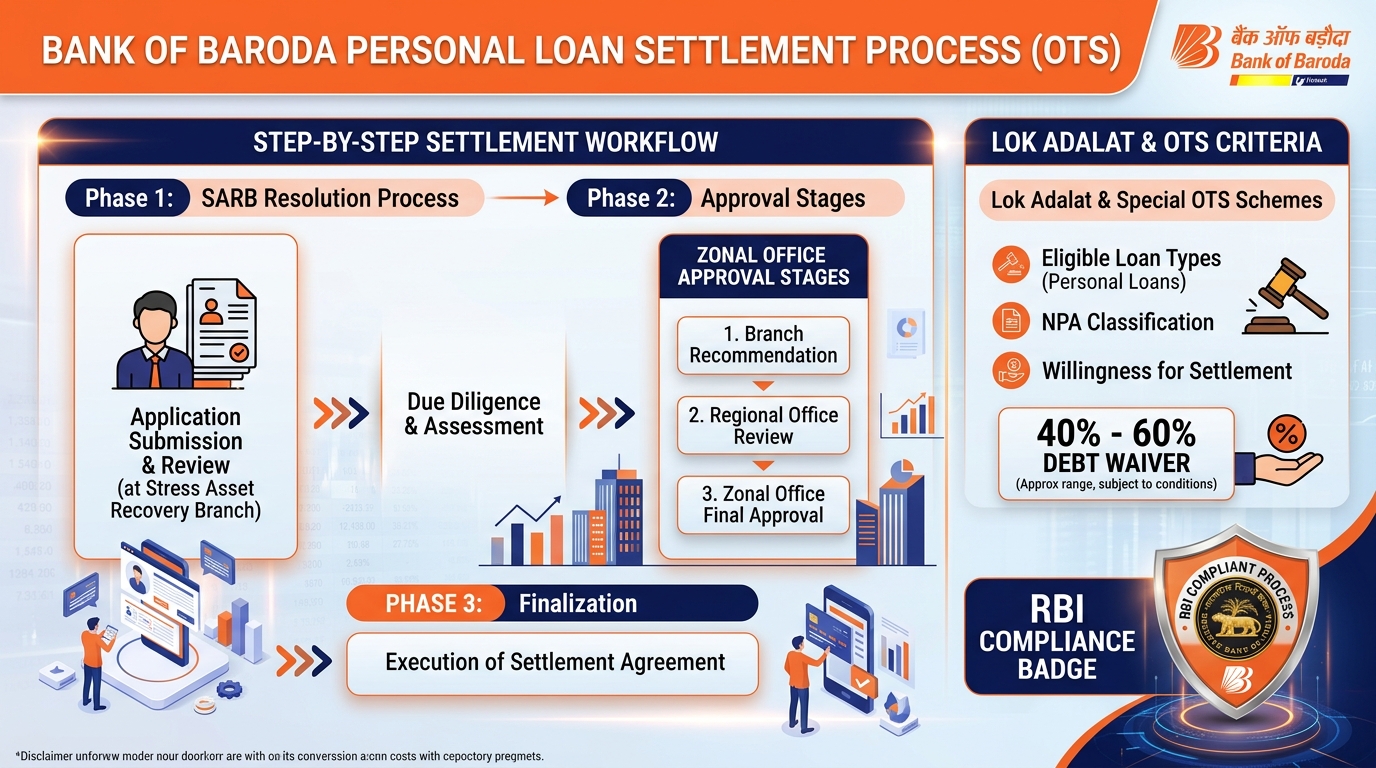
Bank of Baroda Compromise Policy Guidelines & Financial Formulas
Bank of Baroda governs debt settlements under its Board-approved Compromise Settlement Scheme for Stressed Retail Assets, formulated in strict compliance with the RBI Master Directions on Prudential Norms. The core guiding principle of the policy is the Non-Discretionary and Non-Discriminatory treatment of distressed borrowers, evaluated through a rigorous financial metric known as Net Present Value (NPV) Recovery Valuation.
When a SARB recovery officer prepares a compromise proposal for the Zonal Credit Committee, they must satisfy clear financial criteria. They must prove that an immediate lump-sum settlement or milestone payment yields a higher net present value than pursuing multi-year litigation in Civil Courts or Debt Recovery Tribunals (DRT). The valuation benchmark is mathematically calculated as follows:
Where C_t represents estimated recoveries, r is the discount rate, and deductions account for 3–5 years of court friction and capital locked in NPA provisions.
Based on this NPV valuation framework, Bank of Baroda structures its debt waiver parameters across two distinct components:
Penal & Interest Waivers: 100% Elimination
All accumulated uncapitalized interest, penal interest rates (often 24% p.a.), late payment penalties, NACH bounce charges, and processing fees are 100% written off upon OTS approval.
Principal Haircut: 40% to 60% Concession
Depending on the loan aging bucket (Substandard, Doubtful, or Loss Asset), borrowers with authenticated involuntary hardship secure a 40% to 60% reduction on the contractual principal balance.
Procedural Stages and Approval Authorities in Bank of Baroda
Executing a legally sound, maximum-haircut One-Time Settlement with Bank of Baroda requires adhering to a structured procedural methodology:
Loan Ledger Audit & Forensic Deconstruction
Obtain the full Statement of Account (SOA) directly from Bank of Baroda. Legally segregate the initial principal disbursed, total installments paid, outstanding contractual principal, and unlawful compound penal charges added post-default.
Comprehensive Hardship Dossier Compilation
Compile a verified hardship dossier establishing involuntary financial distress: medical discharge summaries, termination letters, salary reduction slips, GST surrender certificates, or audited ITRs showing business winding-up, backed by a sworn affidavit.
Submission to Competent Zonal Authority
Bypass base branch roadblocks and submit the formal OTS petition directly to the Competent Authority under Bank of Baroda's Delegation of Financial Powers:
- Assistant General Manager (AGM) / Regional Head: Sanction powers for personal loans up to ₹15 Lakhs.
- Deputy General Manager (DGM) / Zonal Manager: Sanction powers for exposures up to ₹50 Lakhs.
- Zonal Credit Committee (ZCC) / General Manager (GM): Sanction authority for high-value debt exposures above ₹50 Lakhs.
Sanction Letter Issuance & Payment Verification
Upon committee approval, ensure Bank of Baroda issues a physical stamped OTS Sanction Letter on bank letterhead. Remit funds strictly through direct RTGS/NEFT into your loan account number and collect immediate bank acknowledgment.
Resolving Bank of Baroda Defaults via Statutory Lok Adalat Benches
One of the most secure avenues for settling a Bank of Baroda loan is through the National Lok Adalat. Organized quarterly across India by the National Legal Services Authority (NALSA) and State Legal Services Authorities under the Legal Services Authorities Act, 1987, it provides complete judicial finality.
Bank of Baroda regularly refers delinquent retail loan accounts to Lok Adalat pre-litigation benches to reduce its gross NPA ratios before quarter-end financial disclosures. During these Lok Adalat sessions, Bank of Baroda deputes authorized officers carrying pre-approved settlement mandates and special discount grids that permit deeper haircuts (often 45% to 60% principal waivers) than standard branch talks.
The most decisive advantage of a Lok Adalat settlement is its judicial finality:
Under Section 21 of the Legal Services Authorities Act, 1987, an award made by a Lok Adalat is deemed to be a Decree of a Civil Court. The award is final and binding on both Bank of Baroda and the borrower. Crucially, under Section 21(2), no appeal shall lie to any court against the award of the Lok Adalat.
This statutory finality provides complete legal protection. Once the compromise sum specified in the Lok Adalat award is remitted, Bank of Baroda is legally barred from reopening the loan ledger. The bank cannot sell the residual balance to Asset Reconstruction Companies (ARCs). It is also barred from pursuing pending Section 25 PSSA or Section 138 NI Act complaints.
Verifying Bank Letterhead Sanctions, ₹0 NDC Mandate, and Credit Repair
A compromise settlement is only as legally binding as the records that certifies it. Borrowers must perform rigorous legal forensics on any settlement letter provided by Bank of Baroda before remitting a single rupee:
Mandatory Clauses in an Authentic Bank of Baroda OTS Sanction Letter
- Official Bank Letterhead & Stamped Seal: Must be printed on authentic Bank of Baroda stationery bearing the branch/SARB seal, reference number, date, and signature of an authorized officer (Scale-IV AGM / Scale-V DGM) with their official Employee Code.
- Explicit Debt Extinguishment Clause: Must state unambiguously that the agreed settlement sum constitutes full and final satisfaction of all claims, and that all remaining principal, interest, and charges are completely waived and extinguished.
- Mandatory Withdrawal of Court Cases: Must include a clear covenant that Bank of Baroda will unconditionally withdraw all pending legal notices, Section 25 PSSA complaints, Section 138 petitions, and civil suits upon clearance of the settlement amount.
- Credit Bureau Reporting Commitment: Must stipulate that the bank will report the account status as 'Settled' or 'Post-Write-Off Settled' with an outstanding balance of ₹0 to CIBIL, Experian, Equifax, and CRIF High Mark.
Following complete payment, RBI Circular RBI/2023-24/60 imposes a strict statutory mandate: Bank of Baroda must issue a formal No Dues Certificate (NDC) / Loan Closure Certificate within 30 calendar days. If the bank defaults on this timeline, it is statutorily liable to pay relief of ₹5,000 for each day of delay directly to the borrower.
Regarding credit score impact, a 'Settled' tag causes an immediate temporary drop of 75 to 150 points in credit score and a mandatory 12-month cooling window under RBI compromise directives. However, because the loan ledger is closed with ₹0 balance, ongoing negative DPD compounding stops completely. By obtaining a secured credit card against a fixed deposit, maintaining credit use under 30%, and ensuring flawless on-time payments, borrowers successfully rebuild their CIBIL score back to 750+ within 18 to 24 months.
Comparing Resolution Pathways: Self-talks vs. Collection Channels vs. Legal Advocacy
The strategic path chosen by a distressed borrower determines whether their Bank of Baroda settlement succeeds or results in unfulfilled promises. The following matrix illustrates the decisive operational differences across resolution channels:
| Resolution Parameter | Unassisted person | Outsourced Recovery Agent | SettleLoans Legal Advocacy |
|---|---|---|---|
| Authority Level Engaged | Local Branch Clerk / Officer | Third-Party Tele-Caller (No Authority) | SARB Head / Zonal Credit Committee |
| Average Haircut Achieved | 10% – 20% (Interest Waiver Only) | 0% – 15% (Often Misrepresented) | 40% – 60% Principal & Charge Waiver |
| Harassment Defense | None; persistent calls continue | Severe; aggressive field visits | Immediate Cease-and-Desist Notice |
| Notice Reply (Sec 25/138) | Ignored or unrepresented | Not provided | Formal Advocate Statutory Reply |
| Sanction Letter Integrity | Uncertain; often informal email | High risk of fake / unapproved text | Verified Stamped Bank Letterhead |
| NDC & CIBIL Closure | Frequent administrative delays | No post-payment follow-up | Enforced 30-Day RBI NDC Delivery |
Expert Legal Representation for Bank of Baroda Loan Resolution
Resolving a defaulted Bank of Baroda personal loan requires deep familiarity with public sector banking regulations, CVC compliance safeguards, SARB delegation thresholds, and statutory magistrate court procedures. SettleLoans provides end-to-end legal and financial representation, protecting your family from recovery pressure and securing verified bank sanctions.

Settle Loan is India's trusted debt relief and loan settlement platform. We help borrowers overcome financial distress by negotiating with banks and NBFCs to legally settle personal loans and credit card debts. With our transparent, performance-based approach, you can achieve debt freedom and regain your financial peace of mind.
COMPUTER
Frequently Asked Questions on Bank of Baroda Personal Loan Settlement
What is the Bank of Baroda personal loan settlement process and how does it work?
The Bank of Baroda personal loan settlement process is a formal compromise resolution executed under Bank of Baroda's Board-approved Compromise Settlement Policy and RBI Prudential Norms. When an unsecured personal loan defaults beyond 90 days and turns into a Non-Performing Asset (NPA), recovery jurisdiction moves from the base branch to the Stressed Assets Recovery Branch (SARB) or Zonal Stressed Asset Management Branch (ZSAMB). The borrower submits a detailed One-Time Settlement (OTS) proposal accompanied by verifiable hardship evidence. The Competent Authority (Regional Manager, Zonal Credit Committee, or General Manager) evaluates the proposal against Net Present Value (NPV) recovery benchmarks. Upon approval, BOB issues an official stamped OTS Sanction Letter, and payment directly into the loan ledger extinguishes all outstanding liabilities, culminating in a ₹0 No Dues Certificate (NDC).
What percentage of debt haircut does Bank of Baroda typically approve on personal loans?
On unsecured personal loans and clean retail facilities, Bank of Baroda typically approves debt waivers between 40% and 60% of the total ledger balance. The permissible haircut depends on the account's NPA classification age (Substandard, Doubtful D1/D2/D3, or Loss Asset), the bank's existing provisioning coverage (which reaches 100% on seasoned NPAs), and the borrower's documented financial insolvency. Accrued penal interest, uncapitalized late payment charges, and cheque bounce penalties are completely waived (100% deduction) in all sanctioned settlements.
What is the role of BOB's Stressed Assets Recovery Branch (SARB) and ZSAMB?
The Stressed Assets Recovery Branch (SARB) and Zonal Stressed Asset Management Branch (ZSAMB) are specialized recovery verticals within Bank of Baroda dedicated exclusively to resolving non-performing retail, MSME, and commercial debt. Base branch managers in PSU banks operate under strict procedural scrutiny and possess negligible discretionary authority to grant principal concessions. When files are transferred to SARB, specialized recovery officers with delegated financial powers evaluate OTS proposals, conduct legal due diligence, assess litigation cost trade-offs, and recommend structured compromise approvals to the Zonal Office.
Can Bank of Baroda freeze or debit money from other bank accounts under Section 171?
Under Section 171 of the Indian Contract Act, 1872 (Banker's General Lien and Right of Set-Off), Bank of Baroda is legally entitled to freeze, hold, or debit balances from any savings account, current account, fixed deposit, or recurring deposit maintained with Bank of Baroda under the same Customer Identification File (CIF) or PAN. However, Bank of Baroda has zero legal power to unilaterally freeze or debit accounts held at external banks (such as SBI, HDFC Bank, ICICI Bank, or Axis Bank) without an explicit attachment order issued by a competent Civil Court or Debt Recovery Tribunal (DRT).
Can a defaulted Bank of Baroda personal loan be settled through the National Lok Adalat?
Yes. Bank of Baroda actively participates in the quarterly National Lok Adalat organized across India by the National Legal Services Authority (NALSA) and State Legal Services Authorities (SLSA). Bank of Baroda empowers its attending officers with pre-approved settlement mandates and special OTS discount bands (often 45% to 60% concessions). A settlement award passed in Lok Adalat carries the statutory force of a non-appealable Civil Court Decree under Section 21 of the Legal Services Authorities Act, 1987, ensuring permanent extinguishment of claims and immediate disposal of pending Section 25 PSSA or Section 138 NI Act cases.
How should borrowers handle Section 25 PSSA and Section 138 notices from Bank of Baroda?
When NACH auto-debit mandates or repayment cheques bounce, Bank of Baroda's empanelled advocates serve statutory legal notices under Section 25 of the Payment and Settlement Systems Act, 2007 (PSSA) or Section 138 of the Negotiable Instruments Act, 1881. Borrowers must never ignore these notices. A formal legal reply drafted by experienced debt defense advocates must be served within the mandatory 15-day window, setting out bona fide financial hardship, challenging incorrect penal calculations, and placing a formal One-Time Settlement offer on record to forestall criminal court complaint filings.
Why is Bank of Baroda's OTS process more formal than private banks?
As a Public Sector Undertaking (PSU) bank, Bank of Baroda operates under the oversight of statutory bodies including the Central Vigilance Commission (CVC), the Comptroller and Auditor General (CAG) guidelines, and the Prevention of Corruption Act (POCA). so, bank officials cannot offer undocumented or ad-hoc concessions. Every rupee of principal sacrifice must be justified through an ironclad paper trail establishing that the borrower has no attachable unencumbered assets and that immediate OTS recovery yields a higher Net Present Value (NPV) than prolonged civil litigation.
How does settling a Bank of Baroda personal loan impact your CIBIL score and credit report?
Upon receipt of the full settlement amount, Bank of Baroda reports the loan ledger to credit bureaus (CIBIL, Experian, Equifax, CRIF High Mark) with the status 'Settled' or 'Post-Write-Off Settled' and an outstanding balance of ₹0. This halts active Days Past Due (DPD) compounding and legal reporting, though it results in an immediate 75 to 150 point credit score reduction and a mandatory 12-month cooling window under RBI guidelines. Borrowers can systematically rebuild their CIBIL score back to 750+ within 18 to 24 months through secured credit lines and pristine repayment discipline.
What safety precautions are essential before remitting settlement funds to Bank of Baroda?
Borrowers must adhere to five mandatory safeguards: (1) Never pay based on oral assurances or WhatsApp messages from recovery agents; (2) Insist on receiving an authentic OTS Sanction Letter printed on official Bank of Baroda letterhead with bank seal and officer signature; (3) Verify that the letter explicitly declares the payment as full and final satisfaction of all liabilities with complete debt extinguishment; (4) Deposit the settlement sum strictly into your designated Bank of Baroda loan account number via NEFT, RTGS, or branch cash deposit counter—never into third-party or personal accounts; (5) Secure an immediate stamped bank deposit acknowledgement.
What is the statutory timeline for Bank of Baroda to issue the No Dues Certificate (NDC)?
Under RBI Circular RBI/2023-24/60, Bank of Baroda is legally mandated to issue a formal No Dues Certificate (NDC) / Loan Closure Certificate and update credit bureau records within 30 calendar days of receiving the final settlement tranche. If the bank fails to issue the NDC within 30 days without lawful cause, it is statutorily obligated to pay relief of ₹5,000 for each day of delay directly to the borrower.