- Strict 3-Year Window: Banks must file recovery suits within 36 months of default under Articles 19 and 55 of the Limitation Act, 1963.
- Mandatory Dismissal: Under Section 3, civil courts must dismiss late recovery suits even if the borrower does not bring it up.
- Revival Traps: Signing balance letters under Section 18 or paying token sums under Section 19 restarts the 3-year clock.
- Remedy vs. Right: Court recovery powers expire. But credit bureau records remain until cleared through an OTS.
1. The 3-Year Statutory Bar
Indian civil law protects those who act on time. When a borrower defaults on an unsecured loan, credit card, or credit line, the bank cannot wait forever to sue. The Limitation Act, 1963 sets a strict time limit for filing recovery claims in court.
Section 3 of the Limitation Act requires courts to dismiss any suit filed after this period. This rule applies even if the borrower does not raise it as a defense. If a lender sues after 36 months, the judge must reject the case.
However, limitation stops the court remedy without erasing the debt. The lender cannot get a court order or attach assets. Yet the bank can still hold internal funds and report the default to credit bureaus until resolved via settlement.
2. Articles 19, 55 & CPC Recovery
Under the Limitation Act, 1963, bank defaults fall under Article 19 (loans disbursed) and Article 55 (breach of contract). Once an EMI default happens, the 3-year countdown begins right away.
| Debt Category &. Legal Forum. | Statutory Governing Provision. | Prescribed Limitation Window. | Statutory Legal Consequence of Belated Filing. |
|---|---|---|---|
| Unsecured Personal Loans &. Credit Cards. | Limitation Act 1963, Articles 19 &. 55. | 3 Years from first default. | Plaint rejected under Order 7 Rule 11(d) CPC. recovery suit dismissed. |
| Summary Suits under Order 37 CPC. | Order 37 CPC with Article 55. | 3 Years from recall notice. | Unconditional Leave to Defend granted. no summary decree. |
| Debts Recovery Tribunal (DRT Claims >. ₹20L). | RDB Act 1993, Section 24 with Limitation Act. | 3 Years from default / NPA date. | Original Application (OA) barred. DRT cannot issue recovery certificate. |
| SARFAESI Act Secured Asset Enforcement. | SARFAESI Act 2002, Section 36. | 3 Years from default date. | Section 13(4) possession notices declared void by DRT. |
| Section 138 NI Act Cheque Dishonor. | NI Act Section 138 with Limitation Act. | Cheque must cover legal debt. | Quashing of criminal complaint under Section 482 CrPC / 528 BNSS. |
This time limit applies across all debt recovery forums. Under Section 24 of the RDB Act, DRTs cannot hear cases filed after 3 years. Under Section 36 of the SARFAESI Act, banks cannot take asset actions if the debt is time-barred. Creditors lose their legal power to sue after 36 months.
Check Your Loan Settlement Options
Answer 2 quick questions to evaluate your settlement eligibility.
1. What type of loan do you want to settle?
3. The Critical Debt Revival Traps
Lenders and collection agencies use simple tricks to reset the legal clock. Borrowers must watch out for three common debt traps.
Under Section 18 of the Limitation Act, signing a written balance confirmation within 3 years restarts the whole 3-year clock. Agents often ask borrowers to sign balance forms or restructure papers. Signing gives the bank a fresh 36 months to sue.
Under Section 19, making any part payment on principal or interest resets the clock. Telecallers often urge borrowers to pay just ₹500 via UPI. That small payment gives the bank legal proof to restart the 3-year limit.
For debts older than 3 years, Section 25(3) of the Indian Contract Act creates a risk. If you sign a new promise to pay an expired loan, it becomes a valid new contract. Never sign payment letters for old debts.
4. Bank NPA Accounting, AUCA Technical Write-Offs
Under RBI IRAC rules, unpaid loans turn into NPAs and doubtful assets. After 3 to 4 years of default, banks must set aside 100% loss provisions against unsecured bad loans.
Banks then move these loans to an Advances Under Collection Account (AUCA) or write them off. Filing court cases requires 5% to 10% in court fees and takes 5 to 8 years. Suing on old debts leads to a negative net return for the bank.
Where C_t is the expected recovery yield over 4 to 7 years. Deductions include court fees, legal costs. And lost interest on tied-up capital.
Because lawsuits are slow and costly, lenders prefer to settle. They accept deep 80% to 90% waivers through a One-Time Settlement rather than fighting in court.
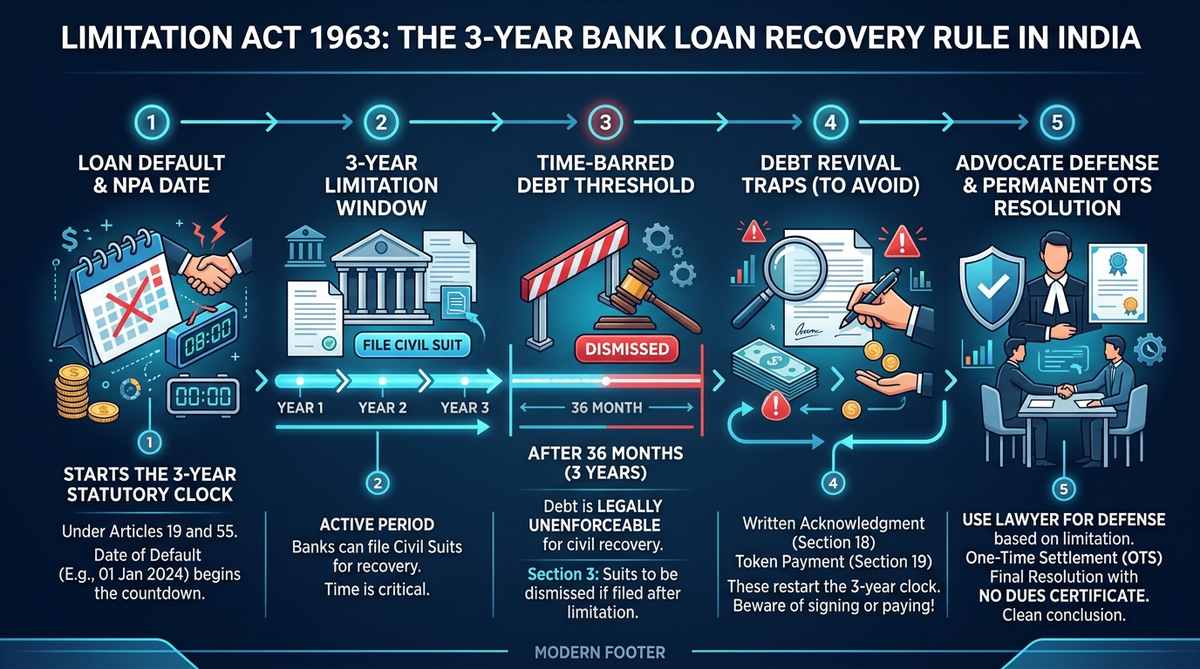
5. Statutory Limitation & Time-Barred Debt Visual Roadmap
The visual guide below shows the full timeline from first default and the active suit window to limitation protection, traps, and OTS closure.
6. Handling Harassment
Collection agencies chase 4-to-5-year-old debts because they earn 20% to 40% commissions on recoveries. Since they cannot sue in court, they use phone calls, home visits. And fake legal notices to scare borrowers.
In ICICI Bank v. Prakash Kaur and Shanti Devi Sharma v. State, the Supreme Court held that loan defaults are civil matters. It banned the use of musclemen, threats. And abuse. The RBI Fair Practices Code also bans calls before 8 AM or after 7 PM, workplace harassment. And contacting relatives.
If you get harsh calls, ask for the caller's DRA certificate. Refuse to sign balance sheets or send token money. Hire an advocate to send a formal cease-and-desist notice under the Limitation Act.
7. Responding to Belated Legal Notices, Lok Adalat
When you get a legal notice for an old loan, check the default date. Many notices skip dates to trick you into a written reply that revives the debt under Section 25(3). An advocate reply must assert that the claim is time-barred and deny liability.
Lok Adalat notices for old loans are for voluntary settlement, not court trials. A Lok Adalat cannot pass orders against you without your consent. You can use Lok Adalat to seal an 80% to 90% waiver settlement into a binding court order.
If a bank files an Order 37 CPC summary suit, you must appear within 10 days and file for Leave to Defend. Citing limitation under Section 3 gives you a solid defense to dismiss the case under Order 7 Rule 11.
8. Banker's Lien, Official No Dues Certificate
Even though the Limitation Act stops court suits, unresolved loans carry two problems: banker's lien and bad credit records.
Under Section 171 of the Indian Contract Act, banks can take money from your other accounts in the same bank. But they have no power over your accounts in other banks.
Unpaid loans also stay marked as "Written-Off". on CIBIL. The best way forward is an advocate-led OTS. Banks accept 10% to 20% payments on old debts, issue a No Dues Certificate. And update CIBIL to "Settled". with a ₹0 balance.
9. Active Debt vs. Time-Barred Debt Comparative Strategy
Here is how active defaults compare to time-barred debts in legal power and settlement leverage:
| Legal &. Strategic Dimension. | Active Debt (Within 36 Months). | Time-Barred Debt (Beyond 36 Months). |
|---|---|---|
| Civil Court Money Recovery Suits. | Enforceable. bank can obtain a money decree. | Barred by law. mandatory dismissal under Section 3 Limitation Act. |
| Summary Suits under Order 37 CPC. | Bank can seek quick summary judgment. | Plaint rejected. unconditional leave to defend under Order 7 Rule 11. |
| DRT Original Applications (>. ₹20 Lakhs). | Valid under Section 19 of RDB Act, 1993. | Barred by Section 24 RDB Act. DRT cannot issue recovery orders. |
| Section 138 NI Act Cheque Bounce Validity. | Valid criminal prosecution for active debt. | Unenforceable debt. criminal case can be quashed by High Court. |
| Banker's Right of Set-Off (Same Bank). | Active on any deposits within the same bank. | Active in same bank. But no access to other banks. |
| Borrower Negotiation Leverage. | Moderate. bank can still file a lawsuit. | Very high. bank has no legal power to enforce recovery in court. |
| Target OTS Haircut Potential. | 40% to 60% principal waiver. | 80% to 90% total balance waiver. |
| Revival Vulnerability Risk. | Normal loan terms apply. | High risk. signed letters (Sec 18) or token UPI payments (Sec 19) restart the clock. |
10. SettleLoans Legal Defense & Time-Barred Debt Advisory
Resolving old defaulted loans requires experienced legal help. SettleLoans checks default dates and sends legal notices to stop recovery calls under RBI rules. We file Leave to Defend forms in court and negotiate deep-waiver settlements with official No Dues Certificates.

Settle Loan is India's trusted debt relief and loan settlement platform. We help borrowers overcome financial distress by negotiating with banks and NBFCs to legally settle personal loans and credit card debts. With our transparent, performance-based approach, you can achieve debt freedom and regain your financial peace of mind.
COMPUTER
11. FAQs: Limitation Act 3 Years for Bank Loan Recovery
Direct answers to essential questions on statutory limitation, court dismissal rules, debt revival traps. And borrower rights in India.
What is the 3-year limitation period for bank loan recovery in India?
Under Articles 19 and 55 of the Limitation Act 1963, lenders have 3 years from default to file a civil recovery suit. Under Section 3, courts must dismiss late suits even if the borrower does not bring it up.
Does the Limitation Act extinguish the debt itself or merely bar the legal remedy?
Limitation stops court recovery actions. But it does not erase the debt. Lenders lose the right to sue or attach assets in court. But they can still report defaults to credit bureaus and hold funds in accounts within their own bank.
What is Section 18 of the Limitation Act and why is it a dangerous trap for borrowers?
Section 18 states that signing a written debt acknowledgment within 3 years restarts a fresh 3-year period. This gives the bank another 36 months to file a lawsuit.
How does a token payment under Section 19 revive a dying loan liability?
Under Section 19, any part payment of principal or interest resets the 3-year clock. Even a ₹500 UPI transfer restarts the full 36-month legal timeline from the payment date.
What happens if a borrower promises to pay a debt that is already time-barred?
Under Section 25(3) of the Indian Contract Act 1872, a new written promise to pay an expired debt creates a fresh, binding contract. Borrowers should never sign repayment forms for 4-to-5-year-old loans.
Does the 3-year limitation rule apply to Debts Recovery Tribunals (DRTs) and SARFAESI proceedings?
Yes. Section 24 of the RDB Act 1993 applies limitation rules to DRTs. Also, Section 36 of the SARFAESI Act 2002 forbids property actions if the claim is older than 3 years.
Can a bank file a Section 138 cheque bounce criminal case on a time-barred debt?
No. Section 138 of the Negotiable Instruments Act requires a legally valid debt. Courts hold that bouncing a cheque for an expired debt cannot lead to a criminal conviction unless revived under Section 25(3).
Can a bank freeze accounts or exercise banker's lien for a time-barred loan?
Under Section 171 of the Indian Contract Act, banks can hold funds in your other accounts in the same bank. However, they have no power over accounts you hold in other banks.
Why do collection agencies aggressively harass borrowers on 4–5 year old loans?
Third-party agencies earn 20% to 40% fees on written-off debts. Because they cannot sue in court, they rely on phone pressure, fake legal threats. And home visits.
How can a borrower achieve permanent legal closure and clean up their CIBIL score?
You can resolve it through a lawyer-led One-Time Settlement (OTS). Since banks have no court leverage, they accept 80% to 90% waivers. Once paid, the bank issues a No Dues Certificate and updates CIBIL to ₹0 balance.