- The Settlement Trap: The agreed OTS payment is only the first step. The loan stays active until bank staff zero out the master ledger.
- Mandatory Physical Branch NDC: Email receipts have weak legal weight in court. You must get a physical No Dues Certificate with a branch stamp and officer code.
- NPCI NACH Mandate cancel: Auto-debits continue on monthly cycles until you cancel them through both banks under RBI rules.
- Credit Bureau ₹0 Balance Mandate: The loan status must show 'Settled&apos. or 'Closed'. Both 'Current Balance&apos. and 'Amount Overdue&apos. must show exactly ₹0 on CIBIL.
- Immunity from Zombie Debt &. ARCs: Doing all five closure steps stops banks from selling your settled debt to recovery firms.
1. The Illusion of Settlement
Many borrowers believe paying the settlement closes their loan right away. But in banking practice, payment is only the first step. When you transfer funds via RTGS or NEFT, the loan contract remains open until manual processing ends.
In major banks like SBI, HDFC, ICICI, and Axis Bank, loans run on Core Banking Solutions like Finacle or BaNCS. When a loan defaults past 90 days, it turns into an NPA and moves to recovery suspense ledgers.
Your payment often sits in a branch suspense account first. Branch staff must manually enter write-off vouchers to clear the balance. If staff forget this step, the system keeps adding interest and penal fees. You may face fresh collection calls months later.
2. Step 1: Bank Ledger Zeroing
The first step is checking that your master ledger inside the Core Banking Solution shows ₹0. A loan account has separate ledgers for principal, interest, penal fees. And legal costs. In an OTS, the bank waives balance fees and a share of principal.
To close the account, the bank credits your payment and debits its bad-debt reserves. Ask for a Statement of Account from your home branch. Check that every sub-ledger shows a balance of exactly ₹0.00.
Check that the account status flag changes from "NPA". to "Settled &. Closed". If the statement shows any balance, report it to the bank Nodal Officer immediately.
Check Your Loan Settlement Options
Answer 2 quick questions to evaluate your settlement eligibility.
1. What type of loan do you want to settle?
3. Step 2: Securing the Physical Branch No Dues Certificate
Borrowers often rely on an email or digital receipt as proof of loan closure. But in Indian courts, an email only proves you made a payment. It does not prove the bank gave up its right to claim the rest under the Indian Contract Act, 1872.
You must get an original physical No Dues Certificate on bank letterhead. It must show your loan number, PAN, borrower name. And a ₹0 balance statement. It must also carry the branch manager's signature, employee code. And official round stamp.
Under RBI Circular RBI/2023-24/60, lenders must release property papers and give the final No Dues Certificate within 30 days of settlement. If a lender delays without valid cause, they must pay you ₹5,000 per day of delay.
For car loans or property loans, the lender must provide Form 35 for the RTO or sign a Deed of Reconveyance to release property liens.
4. Step 3: NPCI NACH
A frequent problem after settlement is recurring auto-debits on your salary account. When you took the loan, you set up a NACH mandate or e-Mandate through the NPCI clearing network.
The NPCI network operates separately from branch settlement desks. Automated debit attempts continue on your EMI dates unless bank staff cancel the mandate in the NPCI portal. Each failed debit triggers bounce fees of ₹450 to ₹590 across both banks.
Repeated bounces can lead to wrongful notices under Section 25 of the Payment and Settlement Systems Act, 2007 (PSSA). Under RBI circular DPSS.CO.CHD.No./2019-20, you have the right to cancel mandates. Submit a written cancel form to your loan bank and savings bank with your OTS letter.
5. 5-Step End-to-End Loan Account Closure Protocol
Getting full legal protection after loan settlement requires completing all 5 steps of the banking closure protocol:
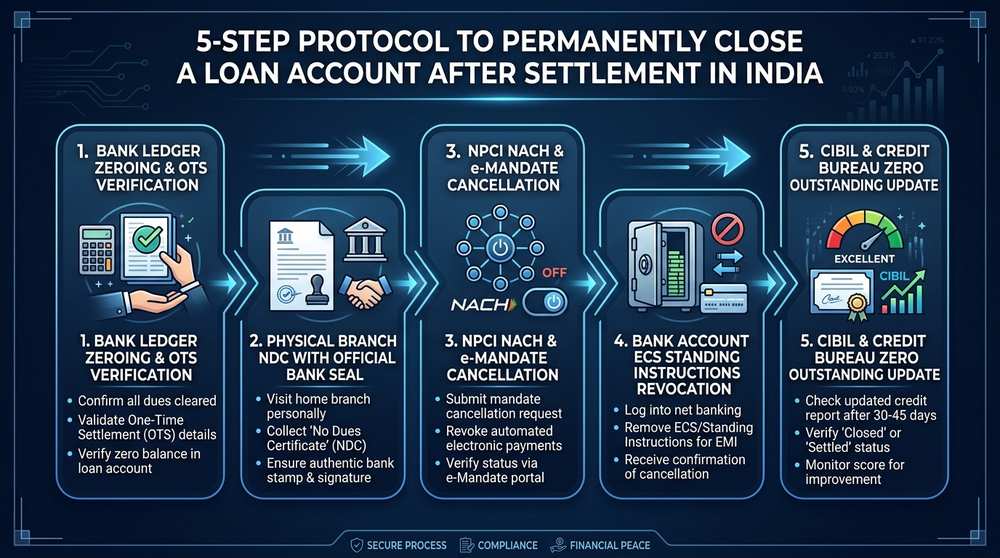
6. Step 4: Canceling Electronic Clearing Service (ECS)
Older loans and internal accounts often use legacy ECS debits or internal Standing Instructions (SI). If your salary account is in the same bank, the bank may have automated recovery sweep rules on file.
Under RBI Master Directions on Customer Service, you have the right to cancel standing instructions at any time. Submit a stamped Standing Instruction Revocation form to your branch. Get a Service Request (SR) number confirming that auto-debits are stopped.
Leaving an active Standing Instruction is risky. If salary or business funds enter your account, internal systems may sweep the money to cover old waived amounts. Written cancel prevents this issue.
7. Step 5: Credit Bureau Rectification (CIBIL, Experian,
The final proof of loan closure happens in credit bureau records: CIBIL, Experian, Equifax, and CRIF High Mark. Under Section 19 of the CICRA Act 2005, banks must send accurate monthly updates within 30 days.
After a settlement, the bureau status changes to "Settled" or "Post-Write-Off Settled". Most importantly, the "Current Balance" and "Amount Overdue" must show exactly ₹0.
Download your credit report 30 to 45 days after receiving your NDC. If it shows an overdue balance, raise an online dispute on the CIBIL portal with your OTS letter and NDC. Under RBI rules, lenders must resolve reporting errors within 30 days.
8. Defending Against Zombie Debt Revival, ARC Assignments
Borrowers who skip proper closure face the risk of zombie debt. Banks often bundle old unpaid loans and sell them to Asset Reconstruction Companies (ARCs) under Section 5 of the SARFAESI Act, 2002. Settled accounts sometimes get included in these bulk sales by mistake.
Years later, an ARC may send legal notices demanding the old balance with added interest. Without a stamped No Dues Certificate, proving your settlement becomes very hard.
With your 5-step paperwork in hand, advocates can send a strong legal reply. We cite the Indian Contract Act, Section 308 of the Bharatiya Nyaya Sanhita (BNS). And the Consumer Protection Act, 2019. Faced with proof, ARCs must drop all recovery claims.
9. NPA Accounting, Net Present Value (NPV)
Banks agree to settlements because of RBI rules on Non-Performing Assets. When a loan turns into a loss asset, the bank must set aside 100% bad-debt provisions from its profits. This locks up capital and hurts bank returns.
When you offer a settlement, the bank compares the cash offer with the Net Present Value (NPV) of a slow court case:
Where E(Recovery_t) is expected cash recovery over 3 to 5 years, r is the discount rate. And deductions include lawyer fees and court stamp costs.
A settlement lets the bank release locked loss reserves back into profits. It removes bad loans from bank books. Permanent closure helps both your financial peace and the bank balance sheet.
10. Settlement vs Permanent Closure Matrix
Reviewing structural differences shows why retail borrowers must enforce the complete 5-step post-settlement closure protocol:
| Closure Dimension. | Informal / Incomplete Settlement. | Flawless 5-Step Permanent Closure. | Legal Impact &. Consequence. |
|---|---|---|---|
| Core Banking Ledger Status. | Active in shadow NPA suspense ledger. | Formally zeroed out via P&L write-off voucher. | Stops phantom interest and fees. |
| No Dues Certificate (NDC). | Email or digital receipt only. | Physical letter with branch seal and officer code. | Valid legal proof in court. |
| NPCI NACH &. e-Mandates. | Active on automated clearing system. | Cancelled via sponsor and destination banks. | Stops bounce fees and Sec 25 PSSA notices. |
| Credit Bureau Record. | Shows active overdue balance / open write-off. | Reported as 'Settled&apos. with exactly ₹0 balance. | Stops negative marks. allows score to rebuild. |
| Zombie ARC Risk. | High risk of loan sale and fresh demands. | 100% legal protection with complete papers. | Final closure with no residual dues. |
11. SettleLoans Permanent Closure Legal Support
Dealing with bank paperwork requires experienced legal guidance. SettleLoans provides complete legal support. We audit Core Banking ledgers. We secure physical branch No Dues Certificates within the 30-day RBI limit. We cancel NACH mandates and fix credit bureau records to close your loan permanently.

Settle Loan is India's trusted debt relief and loan settlement platform. We help borrowers overcome financial distress by negotiating with banks and NBFCs to legally settle personal loans and credit card debts. With our transparent, performance-based approach, you can achieve debt freedom and regain your financial peace of mind.
COMPUTER
12. FAQs: Permanent Loan Account Closure Protocol
Direct legal answers to common questions on bank ledger reconciliation, branch No Dues Certificates, NPCI mandate cancellations. And credit bureau updates.
Does paying the One-Time Settlement (OTS) amount automatically close my loan account in the bank database?
No. Paying the settlement amount is just the payment step. The loan stays open in the bank system until staff enter a write-off voucher to clear the balance. You must verify that the status changes to Settled and Closed.
What is the difference between an email settlement confirmation and an authentic branch No Dues Certificate (NDC)?
An email confirmation only shows money was received. A real No Dues Certificate must be on official bank letterhead. It must state a ₹0 balance, show the loan number. And carry the branch manager's signature and round seal.
What are the legal time limits for a bank to issue a No Dues Certificate under RBI rules?
Under RBI Circular RBI/2023-24/60, banks and NBFCs must release property papers and issue a No Dues Certificate within 30 days of settlement. If they delay without cause, they must pay you ₹5,000 per day.
Why do banks continue presenting NACH and ECS auto-debits after a loan is settled?
NACH and e-Mandates run on automated clearing schedules via NPCI, separate from branch desks. Unless the bank cancels the mandate in the NPCI portal, auto-debits continue and cause heavy bounce fees.
How do I permanently cancel an active NACH or e-Mandate after loan settlement?
Submit a written Mandate cancel Request to your loan bank and your savings bank. Attach your settlement letter and payment receipt. Under RBI rules, banks must process mandate cancellations within 48 to 72 hours.
Can an Asset Reconstruction Company (ARC) revive a loan after it has been settled with the original bank?
An ARC cannot collect settled debt if you have a valid settlement letter, payment proofs. And an authentic No Dues Certificate. Giving copies of your stamped NDC immediately stops any ARC claim.
How is a settled loan reported in CIBIL, and can the outstanding balance remain above ₹0?
The loan status changes to 'Settled' or 'Post-Write-Off Settled'. Most importantly, the Current Balance and Amount Overdue must show exactly ₹0. If it shows an overdue balance, file an immediate CIBIL dispute.
What should I do if my bank refuses to issue a No Dues Certificate after receiving settlement funds?
Submit a complaint to the bank Principal Nodal Officer. If unresolved within 30 days, file an online complaint with the RBI Banking Ombudsman for an immediate NDC and ₹5,000 per day delay penalty.
How long does it take for a credit score to recover after permanent loan account closure?
Once your loan shows a ₹0 balance, monthly negative reporting stops. By paying existing cards on time or using a fixed deposit credit card, you can rebuild your score back to 750+ within 18 to 24 months.