- Statutory Revocation Right: Under RBI rules on e-Mandates, you can cancel NACH and ECS debits via net banking without lender approval.
- Protection Against Wage Draining: Section 7 of the Payment of Wages Act, 1936 and Article 21 protect workers from deductions that wipe out basic earnings.
- Zero Criminal Intent in cancel: Stopping auto-debits due to financial hardship is a lawful civil step, not criminal fraud or cheating.
- Stop Recurring Bounce Fees: Revoking mandates ends the costly cycle of ₹295 to ₹590 bounce fines on failed debit hits.
- Path to Institutional 55% OTS: Stopping automated debits moves delinquent loans to bank NPA desks, opening talks for large principal waivers.
1. Demystifying ECS, NACH & e-Mandates
For many workers in India, salary day brings huge stress. Multiple personal loans, credit cards, and EMIs hit your account at once. Automated systems clear wages right after payroll deposit. This cash drain leaves zero funds for rent, food, school fees, or medical bills.
Understand how bank debits work in India:
NPCI runs the National Automated Clearing House (NACH). It replaced the old Electronic Clearing Service (ECS). NACH uses a 20-digit Universal Mandate Reference Number (UMRN) to run auto-debits.
Banks use e-Mandates verified via Net Banking or Debit Cards. Internal Standing Instructions (SI) allow the same bank to sweep funds directly.
If income drops, repeated debit hits cause heavy harm. Lenders present debits multiple times per month. Each failure brings ₹295 to ₹590 in bounce fees. These penalty charges pile up fast. They grow your debt without lowering the principal balance.
2. Statutory Legal Rights on Mandate Cancellation
Recovery agents often say auto-debits cannot be stopped. This is false. Under RBI rules, mandates are conditional permissions. You can revoke them at any time.
Under RBI Circular DPSS.CO.OD.No.1328/06.08.005/2019-20 (Circular RBI/2019-20/200), your bank must offer a simple way to cancel e-mandates. Your bank cannot ask for lender approval before stopping the debit.
This regulatory mandate is fortified by statutory labor laws and constitutional rulings in India:
This law limits wage cuts. It stops lenders from taking basic living wages needed for survival.
The Supreme Court ruled that Article 21 protects livelihood. Banks cannot run sweeps that leave families destitute.
Under Section 3 of NPCI NACH Guidelines, banks must honor cancel requests. Banks must mark future debit tries as "Mandate Cancelled by Customer".
Revoking an ECS mandate cancels the debit tool. It does not erase the debt. However, stopping the debit protects your wages and ends penalty fees. It lets you negotiate a fair settlement.
Check Your Loan Settlement Options
Answer 2 quick questions to evaluate your settlement eligibility.
1. What type of loan do you want to settle?
3. The Threat of Section 25 PSSA & Section 138 NI Act
Recovery agents often threaten arrest or fraud cases when you cancel debits. These threats are baseless under statutory law.
Here is how the statutory provisions actually work:
Section 25 of the Payment and Settlement Systems Act, 2007 (PSSA)
Section 25 PSSA covers failed electronic debits, similar to Section 138 of the Negotiable Instruments Act, 1881. If a debit fails, the lender sends a 30-day notice. However, Section 25 cases are bailable civil debt matters. Police cannot arrest you at the summons stage. Courts grant bail as a matter of right.
Debunking Criminal Fraud & Section 420 IPC / Section 318 BNS Allegations
The Supreme Court ruled that loan default due to hardship is a civil breach, not criminal cheating. Cheating requires proving bad intent from the start. If you paid early EMIs, police have no power to file an FIR or arrest you.
Formal Prior Revocation as Legal Shield
A formal cancel notice proves you acted in good faith with no guilty mind (mens rea). If the lender still files a Section 25 case, your lawyer can move the court to refer the case to Lok Adalat for an instant settlement.
Stopping an auto-debit will not send you to jail. It turns a cash drain into a fair talk on debt terms.
4. NPA Balance Sheet Accounting & NPV Models
Stopping an ECS mandate helps you get a better settlement. Under Reserve Bank of India (RBI) Prudential Norms on Income Recognition, Asset Classification and Provisioning (IRACP), overdue loans move through set stages.
When auto-debits stop and EMIs pause, the loan progresses through these categories:
| default Classification. | Overdue Aging Timeline. | Mandatory RBI Capital Provision. | Settlement / Haircut Scope. |
|---|---|---|---|
| Special Mention Account (SMA-0/1). | 1 – 60 Days Overdue. | Standard Asset Capital Allocation. | Penal Interest &. Bounce Fee Waivers. |
| SMA-2 (Imminent Default). | 61 – 90 Days Overdue. | 5% General Capital Provision. | Restructuring &. Tenure Extension. |
| Substandard NPA. | 91 – 365 Days Overdue. | 25% Unsecured Provisioning. | 35% – 45% Principal Haircut. |
| Doubtful NPA (D1/D2). | 12 – 24+ Months Overdue. | 100% Unsecured Capital Provision. | 45% – 65% Principal Haircut. |
| Loss Asset / Written-Off. | Identified Loss / Technical Write-off. | 100% Full Balance Sheet Write-Off. | 55% – 75% Principal Haircut. |
When an unsecured loan stays unpaid for 90 days, the bank must set aside capital in reserves. Bank credit committees evaluate settlements using the Net Present Value (NPV) Recovery Formula:
In this formula, C_t is expected cash recovery. And r is the discount rate. Deductions cover court trials, lawyer fees. And capital locked in NPA reserves.
Section 25 PSSA court cases take years and cost banks heavy fees. Banks prefer an immediate 35% to 55% settlement to recover cash quickly.
5. Salary Account ECS Mandate Cancellation
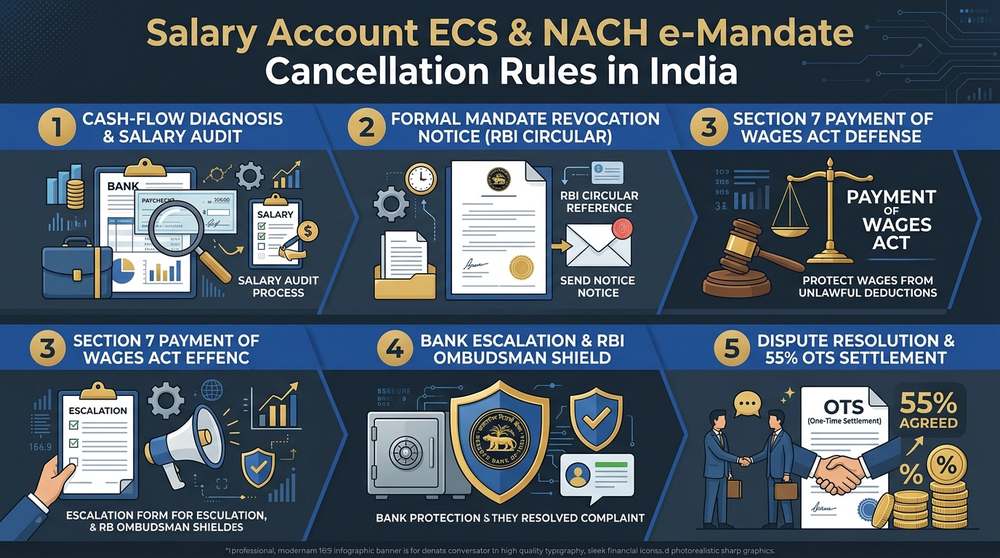
The roadmap below explains the 5-stage process: diagnosing salary cash drain, revoking the mandate legally, invoking Section 7 Wages Act protections, escalating bank delays. And securing an official 55% settlement.
6. The Emergency 4-Stage Legal Protocol to Revoke ECS / NACH
Stopping loan auto-debits requires a formal, written process. Never rely on verbal talks with branch clerks. Follow our proven 4-stage revocation protocol:
Stage 1: Digital Mandate Revocation via Destination Net Banking
Log in to net banking (such as HDFC, ICICI, SBI, or Axis). Go to "Accounts / Requests >. e-Mandates / NACH Mandates >. View / Cancel Mandate". Find the lender UMRN and cancel it. Download the receipt.
Stage 2: Physical Branch Stop-Payment Requisition with Stamped Acknowledgment
Submit a written letter to your branch manager citing RBI Circular RBI/2019-20/200. List the UMRN and loan number. Demand a physical receiving stamp with date.
Stage 3: Written Financial Hardship Intimation to Lending Institution
Send a letter to the lender grievance desk. Cite Section 7 of the Payment of Wages Act. Ask them to pause debit batches while you explore restructuring.
Stage 4: Escalation to Principal Nodal Officer & RBI Integrated Ombudsman
If the bank delays cancel, file a complaint on the RBI CMS portal (cms.rbi.org.in) for service delay and non-compliance.
This paper trail proves you acted in good faith. It protects you from false claims and stops unfair legal notices.
7. Converting Stopped Auto-Debits into an Institutional
Stopping auto-debits gives you breathing room. But the goal is to close the debt permanently. You need a legally binding One-Time Settlement (OTS) with a deep waiver.
Our advocates guide the settlement process through these clear steps:
Gather proof of hardship like job loss letters, medical bills, or pay cuts. This proves inability to pay old EMIs.
We demand full removal of penal fees and a 45% to 65% principal waiver based on NPA age.
We ensure the settlement letter permanently cancels all ECS and NACH mandates.
We split the settlement into 2 to 4 monthly payments for easy handling.
8. Sanction Letter Forensics & NDC for Mandate Debt
Watch out for fake settlement letters from rogue recovery agents. Agents often make fake letters on WhatsApp to hit targets. Paying without checking can lead to your money being treated as regular interest, leaving the loan active.
- Official Registered Letterhead: The letter must use official bank letterhead. It must show a reference number and contact info for the credit committee.
- Accurate Borrower Identifiers: It must state your full legal name, PAN number, and 16-digit loan account number.
- Full Debt closure Clause: It must state that paying the agreed settlement sum cancels all remaining principal, interest. And legal claims.
- Direct Official Bank Payment: Pay only to the official loan account via RTGS, NEFT, or a branch counter. Never pay to personal UPI handles or agent accounts.
Under RBI Circular RBI/2023-24/60 (Responsible Lending Conduct), all banks and NBFCs must release property deeds and cancel ECS mandates within 30 calendar days of settlement. They must also deliver an official No Dues Certificate (NDC). If the lender delays past 30 days, they must pay you ₹5,000 per day of delay.
Understanding CIBIL Bureau Reporting & Credit Score Rehabilitation
After settlement, the lender updates credit bureaus (CIBIL, Experian, Equifax, CRIF) to "Settled" with a ₹0 balance. This stops monthly default flags. You can get a secured card against a fixed deposit, keep usage under 30%. And pay on time. This rebuilds your CIBIL score to 750+ within 18 to 24 months.
9. ECS Stop-Payment vs Legal Revocation Matrix
Review the different ways to handle recurring ECS loan mandates:
| Action Mechanism. | Operational Execution. | Salary Protection Scope. | Resolution Timeframe. | Final Legal Effect. |
|---|---|---|---|---|
| Net Banking e-Mandate Revocation. | Digital net banking / mobile app UMRN cancel. | Immediate stop to automated digital debit hits. | Instant / 24–48 Hours. | Auto-debit stopped. loan balance remains active. |
| Physical Branch Stop-Payment Request. | Written requisition under RBI Circular RBI/2019-20/200. | Protects account from future clearing batches. | 2 – 4 Working Days. | Mandate revoked. risk of branch clerk resistance. |
| RBI Banking Ombudsman Complaint. | Formal grievance for illegal refusal to stop mandate. | Enforces regulatory compliance on destination bank. | 30 – 45 Days. | Directs bank compliance &. potential payout. |
| Advocate-Led 55% OTS Resolution. | Comprehensive legal defense &. institutional negotiation. | Total salary protection + 45%–65% debt haircut. | 15 – 30 Days. | Full debt closure with official ₹0 NDC. |
10. SettleLoans Legal Defense for ECS Mandates
Handling RBI circulars, Section 25 PSSA. And recovery agents requires expert legal help. SettleLoans protects salaried borrowers across India. We cancel ECS and NACH mandates legally, shield salary accounts from wage draining, defend against Section 25 PSSA notices. And negotiate 45% to 65% principal waivers with official No Dues Certificates.

Settle Loan is India's trusted debt relief and loan settlement platform. We help borrowers overcome financial distress by negotiating with banks and NBFCs to legally settle personal loans and credit card debts. With our transparent, performance-based approach, you can achieve debt freedom and regain your financial peace of mind.
COMPUTER
11. FAQs: Salary Account ECS Mandates & Legal Remedies
Clear, authoritative. And legally verified answers to critical questions regarding ECS mandate cancellations, auto-debit revocation rules. And loan settlement in India.
Can I legally stop or cancel an ECS or NACH mandate on my salary account?
Yes. You have a legal right to stop auto-debits. Under RBI Circular RBI/2019-20/200, you can cancel any ECS or NACH mandate at your bank. Your bank must process the request. They cannot ask for lender approval.
Can a bank refuse to stop an ECS mandate if the loan has outstanding dues?
No. A bank cannot deny your cancel request due to loan arrears. Cancelling the mandate leaves the debt active. But the payment authorization belongs to you. Under RBI rules, you can revoke it anytime.
Is stopping a loan ECS mandate considered criminal fraud or cheating?
No. Stopping an ECS or NACH mandate is not a crime. It is not cheating under Section 420 or Section 318 BNS. Loan default due to hardship is a civil dispute. Fraud applies only if you used fake papers to get the loan.
What happens if a lender files a Section 25 PSSA case after ECS mandate cancellation?
Section 25 PSSA covers electronic mandate bounces. If you cancel the mandate and inform the lender, you prove good faith. If the lender files a case, advocates can use court mediation to get an affordable OTS.
How does Section 7 of the Payment of Wages Act protect salaried employees?
Section 7 of the Payment of Wages Act, 1936 stops deductions that take away living wages. The Supreme Court ruled under Article 21 that lenders cannot strip away basic survival income.
How can I stop ECS auto-debits through internet banking or mobile apps?
Log in to net banking or your mobile app. Go to 'e-Mandates / NACH'. Find the lender UMRN and click 'Cancel Mandate'. Save the receipt. You can also submit a written form at your branch.
How do banks calculate penal bounce charges and can they be waived?
When a debit bounces, banks charge fees from ₹295 to ₹590 per hit. Under RBI Circular RBI/2023-24/53, banks cannot compound penal fees. All bounce fees can be fully waived in debt settlement.
Can cancelling an ECS mandate lead to a better One-Time Settlement (OTS) offer?
Yes. When debits stop and payments cross 90 days, the loan becomes an NPA. Banks must set aside capital reserves for bad loans. To avoid court costs, lenders agree to OTS deals with 45% to 65% waivers.
What should I do if my bank branch manager ignores my ECS cancellation letter?
If a branch manager ignores your letter, act fast. Have an advocate send a legal notice to the bank Principal Nodal Officer (PNO). You can also file a complaint on the RBI Integrated Ombudsman portal (cms.rbi.org.in).
How long does it take to obtain a No Dues Certificate after settling a loan?
Under RBI Circular RBI/2023-24/60, banks must release loan papers, cancel mandates. And issue a No Dues Certificate within 30 days. If the bank delays past 30 days, they must pay ₹5,000 per day of delay.