
If you are facing severe harassment from bank recovery agents or have received a legal notice (like an arbitration or Lok Adalat summons) for a personal loan default, a specialized loan settlement lawyer acts as your primary legal shield. They take over all communications with the bank, halt the illegal intimidation tactics using RBI guidelines, and negotiate a formal settlement to close your loan for a fraction of the original outstanding amount, completely protecting you from the psychological distress of debt recovery.
Why Do You Need a Personal Loan Settlement Lawyer in India?
Falling into the debt trap of an unsecured personal loan can be an overwhelming experience. Unlike secured loans (such as home or auto loans) where the bank has collateral to seize, an unsecured personal loan gives the bank no direct asset to recover its losses. As a result, banks and Non-Banking Financial Companies (NBFCs) often resort to high-pressure, aggressive, and sometimes illegal recovery tactics to force borrowers into submission.
The power dynamic is incredibly skewed. On one side, you have massive financial institutions with armies of legal advisors, call centers, and third-party recovery agencies. On the other side, you have an individual borrower who is already suffering from genuine financial hardship—perhaps due to a medical emergency, job loss, or business failure. This is exactly where a Personal Loan Settlement Lawyer steps in to level the playing field.
A dedicated advocate will immediately provide:
- A Legal Buffer: All communication from the bank goes through your legal counsel, shielding you from direct abuse.
- Protection of Rights: Ensuring that banks strictly adhere to the Fair Practices Code mandated by the Reserve Bank of India (RBI).
- Negotiation Power: Leveraging legal knowledge to negotiate a One Time Settlement (OTS) that strips away exorbitant penal interest and late fees.
How Can an Advocate Stop Bank Recovery Harassment?
One of the most terrifying aspects of defaulting on a personal loan in India is dealing with third-party recovery agents. These agents are often incentivized based on the amount they collect, leading to severe behavioral breaches, including verbal abuse, calling at odd hours, visiting workplaces, and harassing family members.
A qualified advocate utilizes several legal tools to bring an immediate halt to this harassment:
Sending a Formal Cease & Desist Notice
The lawyer drafts a robust legal notice addressed to the bank's grievance redressal officer and the branch manager, officially documenting the harassment and demanding an immediate cessation of all illegal recovery activities, citing specific RBI regulations.
Filing a Police Complaint for Criminal Intimidation
If recovery agents cross the line into physical threats, defamation, or severe mental harassment, the lawyer can help you file an FIR under Sections 503 (Criminal Intimidation) and 506 of the Indian Penal Code against the agents and the bank officials.
Approaching the Banking Ombudsman
If the bank fails to respond to the legal notice within 30 days, your advocate will escalate the matter to the RBI Banking Ombudsman, providing evidence of the harassment. The RBI takes a very strict view of banks that violate their fair recovery guidelines.
Legal Protection Against Fake Arbitration and Lok Adalat Notices
A very common, yet highly illegal, tactic used by rogue collection agencies is sending forged legal documents. Borrowers often receive documents titled "Warrant of Arrest," "Final Arbitration Summons," or "Lok Adalat Notice" formatted with fake seals and stamps that look like official court documents.
When you hire a settlement lawyer, the first thing they do is verify the authenticity of any legal notice you receive.
- Arbitration Notices: Unless you have explicitly agreed to arbitration in your loan agreement, and the arbitrator is an independent third party, arbitration notices sent arbitrarily by recovery agencies hold no legal weight. A lawyer will draft a strong rebuttal challenging the jurisdiction of the biased arbitrator.
- Lok Adalat Summons: Lok Adalats are meant for amicable, voluntary settlement. You cannot be forced or arrested for not attending a Lok Adalat. Your advocate can either represent you at the Lok Adalat to negotiate a fair deal or legally decline the summons if the terms are not favorable.
The Process of Negotiating a Settlement Through a Lawyer
Negotiating a loan settlement is not about simply asking the bank for a discount. It requires establishing genuine financial hardship and presenting a compelling legal and financial argument as to why the bank should accept a lesser amount rather than pursue expensive and prolonged litigation.
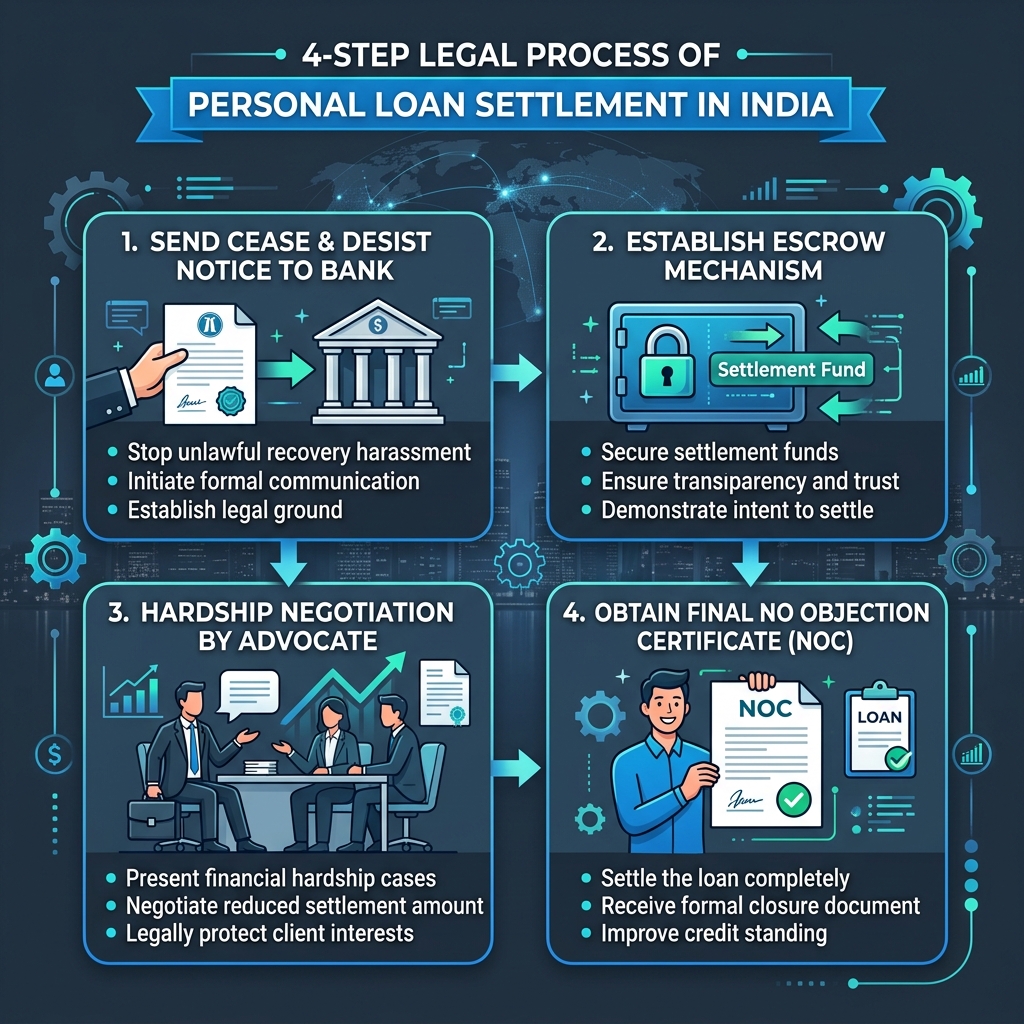
The 4-Step Legal Settlement Workflow:
- Financial Evaluation & Hardship Profiling: The lawyer analyzes your outstanding statements, income loss proofs, medical bills, or business failure documents to build a solid "hardship profile".
- The Hardship Proposal Letter: A legally drafted letter is sent to the bank's recovery head, proposing a One Time Settlement (OTS). This letter highlights that pursuing legal action against you would yield nothing as you are practically insolvent, making a settlement the most pragmatic choice for the bank.
- Aggressive Back-and-Forth Negotiation: The bank will initially reject or counter-offer. Your lawyer handles these negotiations, ensuring that all late fees, penal interest, and processing charges are completely stripped from the final settlement figure.
- Securing the Settlement Letter & NOC: Crucially, no payment is made until the bank issues a formal, written settlement agreement on their letterhead. Once the agreed amount is paid, the lawyer ensures the bank issues a legally binding No Objection Certificate (NOC) and closes the loan account.
Understanding Your Rights Under RBI Guidelines
The Reserve Bank of India (RBI) has laid down strict guidelines for banks and NBFCs regarding the recovery of dues. A knowledgeable lawyer uses these guidelines as the foundation of your defense:
- Right to Privacy: Recovery agents cannot discuss your debt with your employer, neighbors, or extended family members. Doing so is a gross violation of your privacy and actionable in a court of law.
- Right to Dignified Treatment: The use of abusive language, physical threats, or muscle-men (bouncers) is strictly prohibited.
- Restricted Calling Hours: Calls for recovery can only be made between 08:00 AM and 07:00 PM.
- The SARFAESI Act Does NOT Apply to Personal Loans: Often, agents threaten borrowers with the SARFAESI Act, claiming they will seize property. Your lawyer will remind you (and the bank) that the SARFAESI Act 2002 applies only to secured loans, not unsecured personal loans or credit cards.
Steps to Take if You Receive a Legal Notice for Loan Default
If a bank serves you with a legitimate legal notice for defaulting on a personal loan, time is of the essence.
What NOT to do
- Do not ignore the notice hoping it goes away.
- Do not panic and make partial payments without a written settlement agreement.
- Do not avoid court summons if one is officially served.
What YOU SHOULD do
- Contact a loan settlement lawyer immediately.
- Gather all loan documents, statements, and evidence of financial hardship.
- Ensure your lawyer drafts and dispatches a comprehensive reply within the stipulated time limit (usually 14 or 30 days).
Cost-Benefit Analysis: Hiring a Lawyer vs. Dealing with Banks Directly
Many borrowers hesitate to hire legal counsel because they fear the fees. However, when dealing with a massive financial burden, navigating the system without a professional often proves vastly more expensive.
When you deal directly with the bank, their primary objective is to extract the maximum possible amount from you. Conversely, a lawyer acts as a protective barrier. While there is a professional fee involved in hiring an advocate, this cost is almost always dramatically offset by the massive reduction in the settlement amount they negotiate for you.
| Comparison Factor | Hiring a Lawyer | Dealing Directly with Banks |
|---|---|---|
| Harassment Protection | Immediate stop via Cease & Desist legal notice. | Continuous harassment from multiple recovery agencies. |
| Settlement Amount | Negotiated reduction up to 50-70% based on legal leverage. | Banks push for full payment plus late fees. |
| Legal Protection | Defense against fake notices and Section 138 cases. | Vulnerable to fake arbitration and intimidation tactics. |
| Overall Cost | Legal fees are vastly offset by the principal amount saved. | Often results in paying full amount or accepting bad restructuring. |
What to Look for When Choosing a Loan Settlement Advocate
Not all lawyers specialize in banking and debt resolution. When selecting an advocate to represent you in a personal loan dispute, look for the following criteria:
- Specialization in Debt Relief: They should have a proven track record specifically in negotiating unsecured debt and dealing with Indian banks/NBFCs.
- Knowledge of RBI Circulars: A deep understanding of RBI's Fair Practices Code and recent ombudsman rulings is essential.
- Transparent Fee Structure: Ensure the lawyer operates on a clear fee structure, with no hidden costs. Avoid agencies that demand a large percentage of the "saved amount" without transparency.
- Clear Communication: Your lawyer should be accessible and willing to explain the legal jargon to you, keeping you updated at every step of the negotiation process.
Facing severe financial distress is not a crime. You have legal rights, and you deserve to be treated with dignity. If you are struggling to manage your personal loan debt and are facing harassment, seeking professional legal counsel is the smartest and safest step toward regaining control of your financial life.
Frequently Asked Questions
Yes, it is entirely legal. Loan settlement is a mutual agreement between the borrower and the bank/NBFC where the lender agrees to accept a lesser amount than what is owed, usually due to the borrower's genuine financial hardship.
Yes. A lawyer can send a formal 'cease and desist' legal notice to the bank and its recovery agents. Under RBI guidelines, banks must communicate respectfully. If harassment continues, a lawyer can file a police complaint for criminal intimidation or approach the Banking Ombudsman.
While outcomes vary based on individual circumstances and the bank's policies, a skilled settlement lawyer can often negotiate a waiver of 30% to 70% on the outstanding principal, entirely waiving off the late payment penalties and penal interest.
Ignoring a legal notice is highly inadvisable. It can lead to ex-parte orders where the court or arbitrator rules in favor of the bank without hearing your side. Always consult a lawyer to draft and send a proper reply within the stipulated time.
A simple failure to repay a loan is a civil breach of contract, not a criminal offense. However, if you issued a security cheque that bounced, the bank can file a criminal case under Section 138 of the Negotiable Instruments Act. A lawyer is crucial in defending such cases.
Yes. When a loan is settled for less than the due amount, the bank reports it as 'Settled' rather than 'Closed' to credit bureaus, which negatively impacts your CIBIL score. A lawyer can sometimes negotiate to have it reported as 'Closed', though this is difficult.
Recovery agencies often send documents formatted to look like official court summons or arbitration notices to scare borrowers. These are illegal. A lawyer can verify the authenticity of any notice and take action against the agency for forgery and coercion.
Yes. Lok Adalats are alternative dispute resolution forums. If you receive a Lok Adalat notice, an advocate can represent you, present your hardship, and negotiate a favorable settlement without you having to face the bank's legal team alone.
The process usually takes between 3 to 6 months. It involves halting the harassment, establishing communication, presenting financial hardship proofs, and multiple rounds of negotiation before reaching a final, documented settlement.
An NOC or 'No Dues Certificate' is the official document from the bank confirming that your loan account is closed and they have no further claims against you. Your lawyer ensures you receive a valid NOC after the settlement amount is paid.
Legal References & Citations
- 1. Reserve Bank of India (RBI) - Guidelines on Fair Practices Code for NBFCs
- 2. RBI Circular on Recovery Agents - Engagement of Recovery Agents by Banks
- 3. The Negotiable Instruments Act, 1881 - Section 138 (Dishonour of cheque)
- 4. Indian Penal Code, 1860 - Sections 503 & 506 (Criminal Intimidation)