- Article 226 legal Shield: Invokes special High Court plenary writ powers against illegal recovery actions and police inaction.
- Article 21 Dignity Protection: Enforces basic rights to privacy, personal liberty. And freedom from forceful harassment.
- Mandamus for Police Protection: Commands the DGP and Police Chief to deploy immediate security and register extortion FIRs.
- Binding Restraining Injunction: Issues judicial stay orders against recovery agents, backed by Contempt of Courts Act trial.
- 50%–70% OTS Compromise: Leverages judicial pressure to force bank zonal committees into structured debt settlement and NDC closure.
1. Constitutional Jurisprudence
Loan defaults are civil disputes under Indian law. Banks can use civil suits or debt tribunals like the DRT to recover money. But banks and NBFCs cannot use musclemen or threats. When recovery agents use verbal abuse, home visits. or extortion, they break the law. This turns a simple civil default into a serious crime.
Article 226 of the Constitution of India gives High Courts broad powers. High Courts can issue legal writs like Mandamus, Prohibition. and Certiorari. These writs order police and banks to follow the law. Article 226 allows High Courts to step in whenever citizens face injustice, harassment. or police inaction.
Illegal debt recovery violates Article 21 of the Constitution. This article protects your right to life, dignity. and personal liberty. In Justice K.S. Puttaswamy v. Union of India (2017), the Supreme Court confirmed that privacy is a basic right. Recovery agents cannot enter your home unlawfully or call your employer. A High Court writ gives borrowers strong legal protection against harassment.
Constitutional Mandate: The High Court as the Protector of Fundamental Liberties
Article 226 gives High Courts the power to stop unlawful corporate actions. When bank agents threaten borrowers and local police fail to act, the High Court steps in. The court protects your personal safety and basic rights.
2. Statutory Legal Framework, Maintainability of Writs
Banks often argue that private lenders are not subject to writ petitions. They claim borrowers must use civil courts, DRT. or the Banking Ombudsman instead.
The Supreme Court has rejected these bank arguments. In Federal Bank Ltd. v. Sagar Thomas (2003) and Zee Telefilms (2005), the Apex Court ruled clearly. High Courts can issue writs against private banks when they break RBI rules or violate basic human rights.
In an Article 226 harassment writ, the State Government, DGP. and Police Chief are made main banks. The bank and its agency are added as co-banks. The writ directs the police to register FIRs, investigate threats. and provide safety to the borrower.
| Judicial Authority / Landmark Case. | Core Legal Principle Established. | Application in High Court Article 226 Writs. |
|---|---|---|
| ICICI Bank Ltd. v. Prakash Kaur (2007) 2 SCC 711 | Absolute judicial ban on deploying musclemen, goons. or illegal force for debt recovery. | Primary foundation for securing restraining orders against bank collection agencies. |
| Whirlpool Corporation v. Registrar of Trade Marks (1998) | Alternate remedy is not an absolute bar where basic rights or principles of natural justice are breached. | Defeats bank preliminary objections claiming the borrower must go to DRT or civil court. |
| United Bank of India v. Satyawati Tondon (2010) | High Court writ action is justified in special cases involving grave abuse of power. | Protects borrowers from unlawful physical dispossession and threats. |
| K.S. Puttaswamy v. Union of India (2017) 9-Judge Bench | Right to Privacy and informational sanctity are intrinsic parts of Article 21 basic liberties. | Used to penalize illegal third-party contact, social shaming. And workplace slander. |
| RBI Master Direction on Recovery Agents (DOR.ORG.REC.65) | Regulated entities are strictly liable for all acts of harassment, abusive calls. or illegal visits. | Proves bank deficiency and legal violation in High Court pleadings. |
In ICICI Bank v. Prakash Kaur, the Supreme Court ruled that banks cannot use musclemen for recovery. Banks must follow the law. High Courts across India issue strict orders based on this ruling. These orders stop recovery visits and mandate police inquiries against abusive agents.
Check Your Loan Settlement Options
Answer 2 quick questions to evaluate your settlement eligibility.
1. What type of loan do you want to settle?
3. Threshold for Constitutional Intervention
A writ petition requires clear proof of two things. First, you must show illegal harassment by the bank or its agents. Second, you must show that local police failed to take action on your complaint. Simple loan reminders do not qualify. You must prove real threats, extortion, trespass. or severe harassment.
Under the Bharatiya Nyaya Sanhita (BNS) and IPC, aggressive recovery tactics are criminal offenses:
Extortion & Threat to Person (BNS Sec. 308 / IPC 384)
Threatening a borrower to demand instant cash is extortion. Using physical fear or public shame to collect money creates direct criminal liability for agents and bank officers.
Criminal Intimidation & Abuse (BNS Sec. 351, 352 / IPC 506)
Threatening injury, bad language. or reputation damage is criminal threats. The law strictly punishes agents who use foul words over phone calls or in person.
Criminal Trespass & Lurking (BNS Sec. 329 / IPC 441, 447)
Entering your house without permission is criminal trespass. Agents cannot enter your home uninvited or block your apartment gate.
Defamation & Privacy Breach (BNS Sec. 356 / IT Act Sec. 66E)
Telling neighbours or employers about your loan is illegal. Sending abusive messages or photos violates both criminal slander and IT privacy laws.
When you report harassment to the police station and they take no action, you can file a writ. The High Court issues a Writ of Mandamus. This writ orders police officers to register your FIR and protect your family immediately.
4. Bank NPA Accounting, Provisioning Burdens
A High Court writ gives borrowers strong leverage in debt settlement talks. Under RBI IRACP rules, banks must set aside cash reserves for unpaid loans.
When a loan passes 90 days of default, the bank marks it as an NPA. Over time, the bank must lock up to 100% of the loan amount in loss reserves:
| NPA status Category. | Overdue default Duration. | RBI Mandatory Capital Provision. | bank Settlement Urgency. |
|---|---|---|---|
| Special Mention Account (SMA-2). | 61 – 90 Days Overdue. | 5% General Reserve Requirement. | Waiver of Penal Interest & Late Fees. |
| Substandard NPA. | 91 – 365 Days Overdue. | 25% Unsecured Provision Drag. | 30% – 45% Principal Haircut Sanctions. |
| Doubtful NPA 1 (D1). | 12 – 24 Months Default. | 100% Unsecured Capital Provision. | 45% – 60% Principal Haircut Sanctions. |
| Doubtful NPA 2 / Loss Asset. | 24+ Months / Complete Write-Off. | 100% Full Balance Sheet Write-Off. | 60% – 75% Principal Haircut Sanctions. |
Filing a High Court writ forces the bank to spend heavy legal fees. Senior executives must appear and file sworn sworn statements. This risks court penalties and public criticism for the bank.
Where C_t is estimated recovery, r is discount rate. and deductions cover High Court advocate costs, reputation risks. and locked capital reserves.
Fighting a writ petition costs banks significant money and time. To avoid court strictures, bank zonal heads prefer approving a One-Time Settlement (OTS). This offers 50% to 70% principal waivers and a clean No Dues Certificate.
5. High Court Article 226 Writ Petition
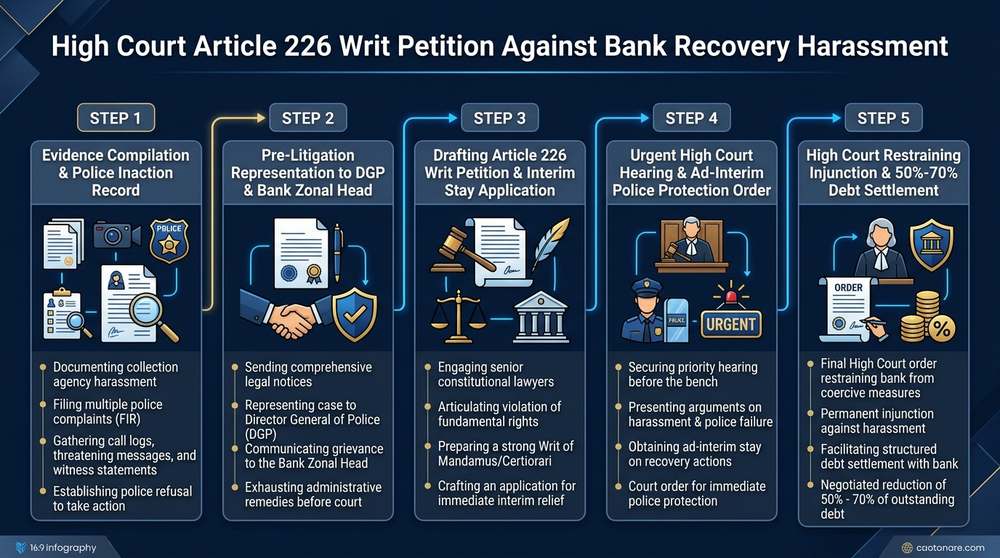
The visual roadmap below details the 5-stage writ process. It covers collecting call evidence, filing the petition, getting stay orders. and negotiating a complete loan settlement.
6. Step-by-Step Article 226 High Court Writ Petition
Filing an Article 226 Writ Petition in the High Court follows a clear 5-step legal process:
Your advocate sends a formal notice to the DGP, Police Chief. and Bank Managing Director. The notice gives 48 hours to stop recovery harassment. If they do not act, this creates official proof of police inaction.
Your advocate drafts the petition with exact facts, call dates. and Article 21 violations. The petition asks the court for police protection and an immediate stay on recovery visits.
Your advocate attaches all audio recordings, WhatsApp messages. and CCTV clips. These are filed with a legal certificate under Section 65B of the Evidence Act (Section 63 BSA).
In urgent cases involving physical threats, your senior advocate mentions the case at 10:30 AM before the Chief Justice Bench. This secures an immediate same-day court hearing.
The High Court Bench issues notice to the bank and orders local police to protect the borrower. The court strictly bars bank agents from contacting or visiting the borrower.
7. Enforcing Judicial Restraining Orders
A High Court order carries complete legal authority under Article 215 of the Constitution. A certified copy is served on the Police Chief and Bank Managing Director immediately.
If any recovery agent contacts the borrower after a stay order, they face direct Contempt of Court under the Contempt of Courts Act, 1971.
Civil Contempt (Section 2(b) Contempt Act)
Willful disobedience of a court order is civil contempt. Bank directors are personally liable if their recovery agencies violate court stay orders.
Criminal Contempt (Section 2(c) Contempt Act)
Threatening a borrower after court orders is criminal contempt. Courts take immediate action against agencies that interfere with justice.
Personal Appearance of Bank Heads
The High Court can summon bank chairmen or CEOs in person to explain violations before the judge.
Penalties: Jail and Fines (Section 12)
Courts can punish contempt with up to six months of simple imprisonment or heavy financial fines.
The fear of contempt orders forces banks to recall recovery files immediately and assign senior managers to settle the account.
8. Strategic Settlement Leverage
A High Court writ ends collection harassment. It also creates powerful legal leverage for negotiating a One-Time Settlement (OTS).
When faced with active High Court actions, bank zonal committees prefer resolving the dispute out of court:
The High Court Dual-Track Resolution Plan
A formal OTS sanction letter provides: . (1) 100% waiver of penal interest and late fees. (2) A 50% to 70% discount on principal. (3) An official No Dues Certificate (NDC). (4) Full credit report updates across CIBIL, Experian, Equifax. and CRIF High Mark. Once paid, both parties withdraw the High Court petition with mutual consent.
9. Bank Recovery Harassment Legal Redressal Comparative
The table below compares the High Court writ with other legal options:
| Legal Forum / Channel. | Governing Law. | Speed of Relief. | Police Enforcement. | Settlement Leverage. |
|---|---|---|---|---|
| High Court Article 226 Writ. | Constitution of India Art. 226 & 21. | Immediate (Same day / 48 Hours). | Maximum (Binding Mandamus to DGP). | Maximum (Forces 50%–70% OTS). |
| District Consumer Court. | Consumer Protection Act, 2019. | Moderate (30 – 90 Days). | Moderate (Monetary damages). | High (Threat of fines helps OTS). |
| RBI Integrated Ombudsman. | RBI Ombudsman Scheme. | Moderate (60 – 120 Days). | Low (Regulatory review only). | Moderate (Bank Nodal review). |
| Local Police Station FIR. | Bharatiya Nagarik Suraksha Sanhita (BNSS). | Unpredictable (Initial delay). | High once registered. | High (Halts local agents). |
| Debt Recovery Tribunal (DRT). | SARFAESI Act 2002. | Slow (Tribunal backlog). | Secured property disputes only. | Moderate (Recast). |
| Advocate-Led bank OTS Negotiation. | Bank settlement Policy & Hardship help. | Fast (30 – 45 Days). | Legal shield via pre-court case notices and hardship dossiers. | Direct & Highest (Fastest path to debt closure and NDC). |
10. SettleLoans High Court Constitutional Legal Defense
Facing criminal threats, physical harassment. And relentless debt pressure can be an overwhelming ordeal for people and business owners. At SettleLoans, our specialized team of senior High Court banking advocates, legal court case specialists. And seasoned debt compromise negotiators provides an unyielding shield for distressed borrowers across India.
From drafting high-impact pre-court case representations to Police Commissioners and filing emergency Article 226 Writ Petitions to securing ad-interim restraining orders and negotiating 50% to 70% One-Time Settlements, we stand with you every step of the way to restore your dignity, personal safety. And financial freedom.

Settle Loan is India's trusted debt relief and loan settlement platform. We help borrowers overcome financial distress by negotiating with banks and NBFCs to legally settle personal loans and credit card debts. With our transparent, performance-based approach, you can achieve debt freedom and regain your financial peace of mind.
COMPUTER