- The Settlement Dilemma: Settling a loan eliminates legal liability but leaves a Settled mark on credit reports, triggering automated rejections from bank underwriting engines.
- Guaranteed Banker's Lien Approval: Fixed Deposit backed credit cards operate under Section 171 of the Indian Contract Act, requiring zero credit score checks or income verification.
- Identical Bureau Transmission: Scheduled banks report secured cards to TransUnion CIBIL, Experian, Equifax, and CRIF High Mark as standard active revolving tradelines.
- Strict Utilization Discipline: Holding Credit Utilization Ratio (CUR) below 30% and clearing balances prior to statement generation accelerates score recovery.
- The 750+ CIBIL Trajectory: Twelve to eighteen months of uninterrupted on-time repayments overpowers historical settlement marks, unlocking prime unsecured credit.
1. The Post-Settlement CIBIL Trap and Auto-Rejection Algorithms
Executing a formal One-Time Settlement (OTS) eliminates recovery pressure, but it places the borrower's credit profile into an institutional freeze. Under Section 15 of the Credit Information Companies (Regulation) Act, 2005 (CICRA), banks report the closure to TransUnion CIBIL, Experian, CRIF High Mark, and Equifax. The account is marked Settled alongside historical 90+ Days Past Due (DPD) flags, notifying lenders of a principal haircut.
Modern retail lending systems rely on automated rule-based underwriting engines rather than underwriter discretion. These automated engines apply knockout rules that reject applicants displaying a Settled flag within the preceding 36 months, regardless of current salary. Disheartened borrowers often apply across multiple lenders, generating inquiry spikes that reduce their CIBIL score further and trigger credit-hungry warnings.
2. Statutory Framework: CICRA 2005 and RBI Master Directions
Navigating credit recovery requires understanding the statutory boundaries governing credit reporting. Under CICRA 2005, credit bureaus maintain historical repayment records submitted by member banks. Section 17 and Section 21 mandate factual accuracy, preventing credit bureaus from arbitrarily erasing an authentic Settled remark without formal lender confirmation and a valid No Dues Certificate.
The RBI Master Direction on Credit Card and Debit Card – Issuance and Conduct Directions, 2022 (updated 2024) outlines prudential standards for regulated entities. Crucially, no RBI regulation prohibits commercial banks or NBFCs from issuing credit to individuals with past settlements. In the absence of wilful default declarations, borrowers retain full civil rights to restore creditworthiness through secured instruments anchored in Section 171 of the Indian Contract Act, 1872.
Check Your Loan Settlement Options
Answer 2 quick questions to evaluate your settlement eligibility.
1. What type of loan do you want to settle?
3. The Mechanics of FD-Backed Secured Credit Cards
Secured credit cards operate on collateral security rather than unencumbered cash flows or historical bureau scores. The applicant opens a Fixed Deposit (FD) with the issuing institution. Under Section 171 of the Indian Contract Act, 1872, the bank establishes a Banker's General Lien over the deposit. If the cardholder defaults, the bank holds the statutory right to liquidate deposit funds to satisfy outstanding statement balances.
Because lender credit risk is zero, banks waive CIBIL score minimums, previous settlement checks, and income proofs like salary slips or tax returns. Approval is guaranteed upon deposit booking. The cardholder continues earning term deposit interest (6.5% to 7.75% per annum) while receiving a revolving credit limit equal to 80% to 100% of the deposit sum.
4. Bank Underwriting Algorithms & Credit Recovery Formula
Under Basel III and RBI capital adequacy norms, unsecured revolving credit carries risk weights of 125% to 150%, forcing banks to allocate reserves against potential defaults. In contrast, cash-collateralized credit lines carry a 0% risk weight, insulating lenders from credit loss. In the TransUnion CIBIL scoring model, your score is calculated across Payment History (35%), Credit Utilization (30%), Credit Age (15%), Credit Mix (10%), and Inquiries (10%).
Where S_base is the post-settlement baseline score (550–620), P_t represents on-time payment cycles, CUR_t is the monthly credit utilization ratio capped under 30%, A_t reflects account seasoning, and Penalty_Settled decays exponentially over time as active repayment data overpowers historical settlement marks.
By introducing an active secured card tradeline, you inject positive data into the 35% Payment History and 30% Utilization categories. Because scoring engines prioritize recent credit conduct, 12 to 18 cycles of on-time payments systematically dilute the statistical significance of the prior settlement mark.
5. Secured Credit Card Rehabilitation Visual Roadmap
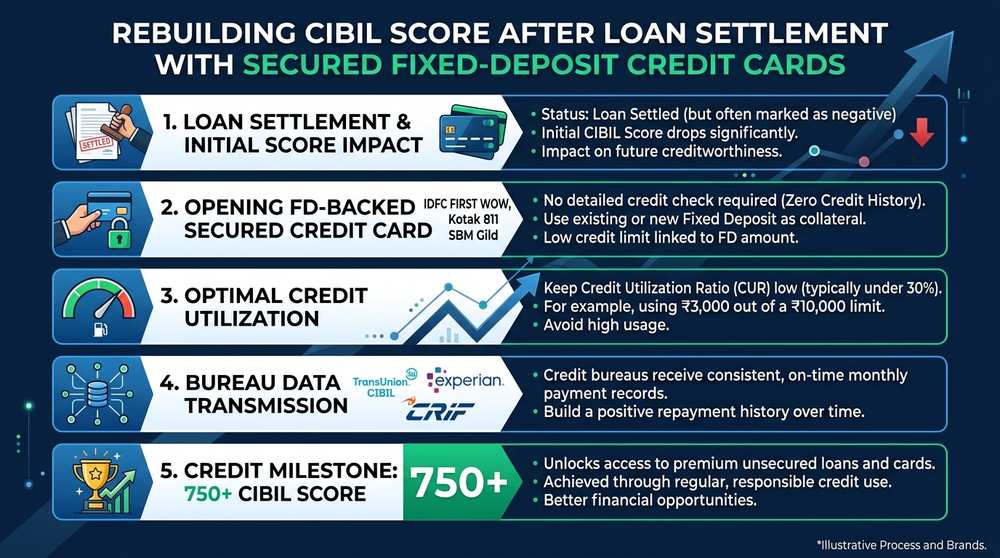
The visual roadmap below details the complete 5-stage institutional progression from completing a loan settlement and managing the initial score decline, to opening an FD-backed card, optimizing monthly credit utilization, transmitting fresh data to credit bureaus, and reaching the coveted 750+ CIBIL milestone.
6. Top Secured Cards Compared: IDFC, Kotak, and SBM
Selecting an appropriate secured card requires evaluating three core criteria: lifetime free maintenance, 100% digital KYC onboarding, and reliable monthly data reporting to TransUnion CIBIL, Experian, and CRIF High Mark. Three financial products currently dominate the Indian retail credit rehabilitation landscape:
Backed by an IDFC FIRST Bank fixed deposit starting at ₹10,000, this card offers lifetime free maintenance, zero joining fees, and a credit limit equal to 100% of the deposit. It features 0% foreign exchange markup, earns up to 7.5% annual deposit interest, and completes onboarding digitally via Video KYC.
Paired with Kotak Mahindra Bank's digital account, this card requires a minimum ₹10,000 deposit and provides a credit limit of 90% of the deposit amount. With zero annual fees, domestic reward points, and disciplined 30-day bureau reporting cycles, it provides dependable monthly score updates.
Issued by SBM Bank India through fintech partnerships, these cards offer low entry thresholds starting from ₹2,000 to ₹5,000 and credit limits between 90% and 100%. Featuring instant virtual issuance and zero annual fees, they provide an accessible starting point for borrowers with limited capital.
7. CUR Calibration Under 30% and Payment Forensics
Obtaining a secured card is only the prerequisite step; managing utilization within credit bureau parameters dictates the speed of recovery. Spending ₹9,500 on a ₹10,000 card produces a 95% Credit Utilization Ratio (CUR). Even when paid in full before the due date, this high reported utilization depresses bureau scores.
Credit bureaus record utilization based on your Statement Generation Date rather than the payment due date. Keep your statement balance between 20% and 30% of the card limit. For larger transactions, make mid-cycle payments two days before the statement date to lower the reported balance. Establish an automated Standing Instruction (SI) to debit the Total Amount Due, ensuring no inadvertent missed payments disrupt your rehabilitation timeline.
8. Credit Bureau Reporting Trajectory from 580 to 750+
Commercial banks submit Credit Information Reports (CIR) to TransUnion CIBIL, Experian, Equifax, and CRIF High Mark between the 1st and 15th of each month. Rebuilding your score follows a predictable four-stage trajectory over 12 to 18 billing cycles:
The secured card appears as an active revolving facility in standard status (000 DPD), halting score decline and stabilizing the baseline between 580 and 620.
Consecutive on-time cycles and low utilization establish repayment discipline, moving the score upward by 35 to 55 points into the 640–675 range.
The account crosses the one-year maturity mark. Historical settlement weight recedes, consolidating scores between 690 and 725 for entry-tier financing.
With 18 cycles of flawless payments, CIBIL scores reliably exceed 750, unlocking pre-approved unsecured cards and standard personal loans.
9. Secured Cards Comparative Technical Evaluation Matrix
The matrix below compares key specifications across India's leading secured credit cards to assist settled borrowers in selecting the best product for their financial profile:
| Card Name & Issuer | Minimum FD Threshold | Sanctioned Credit Limit | Annual & Renewal Fees | Forex Markup Rate | Bureau Reporting Consistency |
|---|---|---|---|---|---|
| IDFC FIRST WOW Credit Card | ₹10,000 | 100% of Fixed Deposit | Zero (Lifetime Free) | 0.00% (Industry Best) | Exceptional (All 4 CICs) |
| Kotak 811 DreamDifferent | ₹10,000 | 90% of Fixed Deposit | Zero (Lifetime Free) | 3.50% Standard Rate | Disciplined 30-Day Cycle |
| SBM Bank Magnet Credit Card | ₹5,000 | 90% to 100% of FD | Zero (Lifetime Free) | 1.99% Discounted Rate | Prompt Multi-Bureau |
| SBM Gild Gold-Backed Card | ₹2,000 | 90% of Fixed Deposit | Zero (Lifetime Free) | 2.50% Standard Rate | Reliable Reporting |
Borrowers with ₹10,000 or more in available liquidity will benefit most from IDFC FIRST WOW's 100% credit limit and 0% forex markup. Those managing stricter cash reserves can utilize SBM Bank's lower deposit minimums to begin building positive repayment history immediately.
10. SettleLoans Strategic Rehabilitation & Legal Advisory
Completing a loan settlement is only the first step toward financial stability. Borrowers frequently find that former lenders delay issuing official No Dues Certificates (NDCs), misreport settled accounts as active write-offs, or neglect to update bureau records. SettleLoans provides comprehensive legal and financial guidance across India: enforcing compliance under RBI Circular RBI/2023-24/60, lodging formal bureau rectification disputes under CICRA, and structuring customized credit rebuilding plans to elevate scores from sub-600 levels back into the 750+ prime tier.

Settle Loan is India's trusted debt relief and loan settlement platform. We help borrowers overcome financial distress by negotiating with banks and NBFCs to legally settle personal loans and credit card debts. With our transparent, performance-based approach, you can achieve debt freedom and regain your financial peace of mind.
COMPUTER
11. Frequently Asked Questions on Post-Settlement Cards
Direct, verified answers from banking litigation and credit recovery specialists addressing secured credit cards, CIBIL rebuilding, and post-settlement credit eligibility.
Why are unsecured credit cards auto-rejected after loan settlement?
When an unsecured loan is settled, lenders report status code Settled to credit bureaus. Automated bank underwriting systems apply knockout rules rejecting applicants with recent settled flags, regardless of income.
What is a secured credit card and why is approval guaranteed?
A secured card is backed by a Fixed Deposit under Section 171 of the Indian Contract Act. Because the bank holds a legal lien over the deposit, lender credit risk is zero, guaranteeing approval without credit score checks.
Do secured cards report to TransUnion CIBIL, Experian, and CRIF?
Yes. Banks report secured cards to all four RBI-licensed credit bureaus as standard active revolving facilities, making positive payment records indistinguishable from unsecured cards.
Which secured credit card is best after loan settlement?
The IDFC FIRST WOW Card and Kotak 811 DreamDifferent Card lead the segment. IDFC WOW provides a 100% limit against FD, zero fees, and 0% forex markup. Kotak 811 DreamDifferent offers a 90% limit with standard domestic rewards.
What is the optimal Credit Utilization Ratio (CUR) to rebuild CIBIL fast?
Keep your Credit Utilization Ratio below 30%, and ideally under 20%. Bureaus record balances on statement dates, so making mid-cycle payments before statement generation lowers reported utilization.
How many months does it take to rebuild CIBIL score from 580 to 750+?
With disciplined usage, zero late payments, and low utilization, rebuilding from sub-600 to 750+ typically takes 12 to 18 months of regular bureau reporting.
Does the fixed deposit continue to earn interest while backing the card?
Yes. The Fixed Deposit earns prevailing term interest rates (6.5% to 7.75% per annum compounding quarterly). The deposit cannot be withdrawn while the card account remains open.
Can applying for multiple credit cards after settlement harm my score?
Yes. Each application triggers a hard inquiry, lowering scores by 5 to 10 points and signaling credit hunger. Avoid applying for unsecured cards until secured card usage pushes your score above 750.