- Zero Direct Police Power: Section 138 Negotiable Instruments Act is a quasi-criminal, non-cognizable, and bailable offense; local police cannot register an automatic FIR or arrest borrowers without court warrants.
- The Golden 15-Day Statutory Cure Window: Following cheque dishonour, lenders must issue a 30-day demand notice, providing borrowers a mandatory 15 calendar day cure window before any court cause of action arises.
- Blank Security Cheque Legal Defence: Depositing pre-signed blank security cheques without reconciling actual outstanding debt or serving ledger adjustments violates established Supreme Court precedents.
- Seamless Compounding via Section 147 NI Act: Negotiating a structured One-Time Settlement (OTS) enables immediate compounding of the offence, compelling the complainant bank to withdraw court proceedings permanently.
1. Cheque Bounce Under Section 138 NI Act: Legal Rules
Jab koi udhardata (borrower) kisi commercial bank, non-banking financial company (NBFC), ya personal lender se loan leta hai, toh loan sanctioning ke dauran aksar lender dwara multiple blank signed cheques "security deposit" ke taur par jama karwaye jate hain. Jab borrower ki financial sthiti bigadti hai aur consecutive monthly installments (EMIs) miss hoti hain, toh lenders aksar in blank security cheques par manmani rakam bharkar bina borrower ki prior intimation ke unhe clearinghouse mein deposit kar dete hain. Account mein balance na hone ke kaaran jab cheque return memo ke sath "Funds Insufficient" ya "Account Closed" likhkar wapas aata hai, toh Section 138 of the Negotiable Instruments Act, 1881 ke tahat statutory dispute generate hota hai.
Section 138 NI Act ka mool uddeshya banking transactions aur commercial credibility ko banaye rakhna hai. Lekin kanoon ke mutabiq, kisi bhi cheque ke bounce hone par criminal prosecution chalane ke liye ek sarvopari shart ka pura hona anivarya hai: cheque kisi 'Legally Enforceable Debt or Liability' ke settlement ke liye issue kiya gaya hona chahiye. Yadi bank ne loan sanctioning ke samay liya gaya ek purana blank security cheque present kiya hai aur us par aisi rakam likh di hai jismein unconstitutional compound penal interest, arbitrary late charges, aur collection fees shamil hain, toh wahan debt legally enforceable liability ki legal definition se bahar chala jata hai.
Hon'ble Supreme Court of India ne landmark judgments jaise Indus Airways Pvt Ltd v. Magnum Aviation Pvt Ltd tatha Dashrathbhai Trikambhai Patel v. Hitesh Mahendrabhai Patel (2022) mein spasht vyavastha di hai ki yadi cheque presentation ki tareekh par cheque par darshayi gayi rakam borrower ke actual crystallized debt se match nahi karti ya partial payments ko account ledger mein credit nahi kiya gaya hai, toh Section 138 ki criminal complaint sustain nahi kar sakti. Isliye, cheque bounce hone par ghabrane ke bajaye transaction ke legal mechanics ko samajhna aapka pehla defensive kadam hai.
2. Criminal Intimidation vs Bail Reality: Why Police Cannot Arrest You for Cheque Bounce
Cheque bounce hone ke baad banks aur NBFCs ke third-party recovery agents dwara borrowers ko sabse jyada daraane ke liye criminal intimidation ka sahara liya jata hai. Agents phone karke ya WhatsApp par aisi warning dete hain ki "Local police station se sub-inspector aapke ghar arrest karne aa raha hai" ya "Aapke khilaf Section 420 aur 406 IPC ke tahat non-bailable FIR darj ho chuki hai." Yeh poori tarah se gair-kanooni aur misleading tactic hoti hai jo borrower ke psychological panic ka fayda uthane ke liye create ki jati hai.
Code of Criminal Procedure, 1973 (CrPC) aur Bharatiya Nagarik Suraksha Sanhita (BNSS) ke tahat, Section 138 NI Act ek Non-Cognizable, Bailable, aur Compoundable Offense hai. Is kanooni classification ke tin spasht matlab hain jo har borrower ko maloom hone chahiye:
Pehla: No Automatic Police Jurisdiction. Non-cognizable offense hone ke kaaran local police station ke paas na toh cheque bounce par direct FIR darj karne ki power hoti hai aur na hi bina kisi magistrate ke written warrant ke kisi vyakti ko arrest karne ka adhikar hota hai. Police aisi complaints par sidhe action nahi le sakti.
Doosra: Private Complaint Before Judicial Magistrate. Bank ko cheque bounce case shuru karne ke liye Judicial Magistrate First Class (JMFC) ya Metropolitan Magistrate (MM) ki adalat mein ek formal Private Criminal Complaint file karni padti hai. Magistrate pehle complainant ka statement (pre-summoning evidence) record karta hai aur documents verify karne ke baad hi borrower ko preliminary Court Summons jari karta hai.
Teesra: Absolute Right to Bail. Bailable offense hone ke kaaran adalat mein pesh hone par bail pana borrower ka kanooni adhikar (statutory right) hai. Magistrate court first appearance par hi simple personal bond aur local surety par bail grant kar deti hai. Isiliye, recovery agents ki police arrest ki khokhli dhamkiyon se bilkul darne ki zaroorat nahi hai.
Check Your Loan Settlement Options
Answer 2 quick questions to evaluate your settlement eligibility.
1. What type of loan do you want to settle?
3. The 15-Day Statutory Notice Window & Mandatory Limitation Timelines
Negotiable Instruments Act mein litigation initiate karne ke liye behad kade statutory time limits tay kiye gaye hain. Yadi bank inme se kisi bhi limitation deadline ko miss kar deta hai ya timeline ka ullekhit ullanghan karta hai, toh complaint technical grounds par dismiss hone yogya ho jati hai.
Section 138 ke antargat char mukhya samay seemayein (timelines) lagu hoti hain:
1. Cheque Presentation Window (3 Months): Cheque uspar likhi gayi date se 3 mahine ke bheetar bank clearinghouse mein present kiya jana anivarya hai. 3 mahine ke baad present kiya gaya cheque stale mana jata hai aur uspar Section 138 lagu nahi hota.
2. Demand Notice Dispatch (30 Days from Memo): Bank ko drawee bank se Cheque Return Memo prapt hone ki tareekh se 30 calendar days ke bheetar borrower ko formal written legal notice bhejna padta hai.
3. Borrower Cure Period (15 Days from Notice Receipt): Legal notice borrower ko deliver hone ki tareekh se agle 15 dinon tak borrower ko "cure period" milta hai. In 15 dinon ke dauran bank koi court complaint file nahi kar sakta. Yeh 15 din borrower ke paas advocate ke zariye solid rejoinder bhejne ya dispute settle karne ka sabse shaktishali samay hota hai.
4. Court Complaint Filing Limitation (30 Days): Yadi 15 din ke cure period ke bheetar payment nahi hota ya notice ka koi compromise conclusion nahi nikalta, tab 16ve din se bank ke paas agle 30 dinon ke bheetar competent Magistrate Court mein complaint darj karne ka samay hota hai. Yadi bank is 30-day window ke baad complaint file karta hai, toh use Section 142(1)(b) ke tahat delay condonation ki rigorous application lagani padti hai.
4. Bank Accounting Dynamics: NPA Provisioning, Court Friction & Net Present Value (NPV)
Commercial banks cheque bounce hone par criminal notice bhejte hain, lekin antatah wahi bank loan ko 40% se 60% ke bhari discount par settle karne ke liye raazi kyu ho jate hain? Iske peeche Reserve Bank of India (RBI) ke asset classification rules aur banking balance sheet ka financial mathematics hota hai. Jab koi borrower 90 din tak default rehta hai, toh RBI ke Income Recognition, Asset Classification and Provisioning (IRAC) norms ke antargat bank ko us loan ko Sub-Standard ya Doubtful NPA mark karna padta hai.
NPA ghoshit hone ke baad bank ko apne khud ke profits mein se 15% se lekar 100% tak provisioning reserve ke roop mein freeze rakhna padta hai. Iske alawa, Section 138 trial court mein litigation chalane ke liye bank ko private advocates ki appearance fees, procedural expenses, aur administrative costs uthane padte hain. Magistrate courts mein pending lakho cases ke bojh ke kaaran ek cheque bounce case ko trial se hokar final judgment tak pahunchne mein aamtaur par 3 se 5 saal ka samay lag jata hai.
Bank ki Credit Risk Committee aur Asset Recovery Branch hamesha Net Present Value (NPV) benchmark par recovery options ka aakalan karti hai:
Where C_t represents estimated recoveries, r is the discount rate, and deductions account for 3–5 years of court friction and capital locked in NPA provisions.
Is mathematical model ke anusar, agle 4 saal court mein bhatakne aur advocate fees kharch karne ke baad anishchit recovery prapt karne ke mukable, bank ko aaj bina court friction ke One-Time Settlement (OTS) ke zariye 45%–55% discounted cash prapt karna balance sheet ke liye kahin adhik faydemand lagta hai. Isiliye, structured legal reply ke baad mamla litigation se nikal kar OTS compromise table par convert ho jata hai.
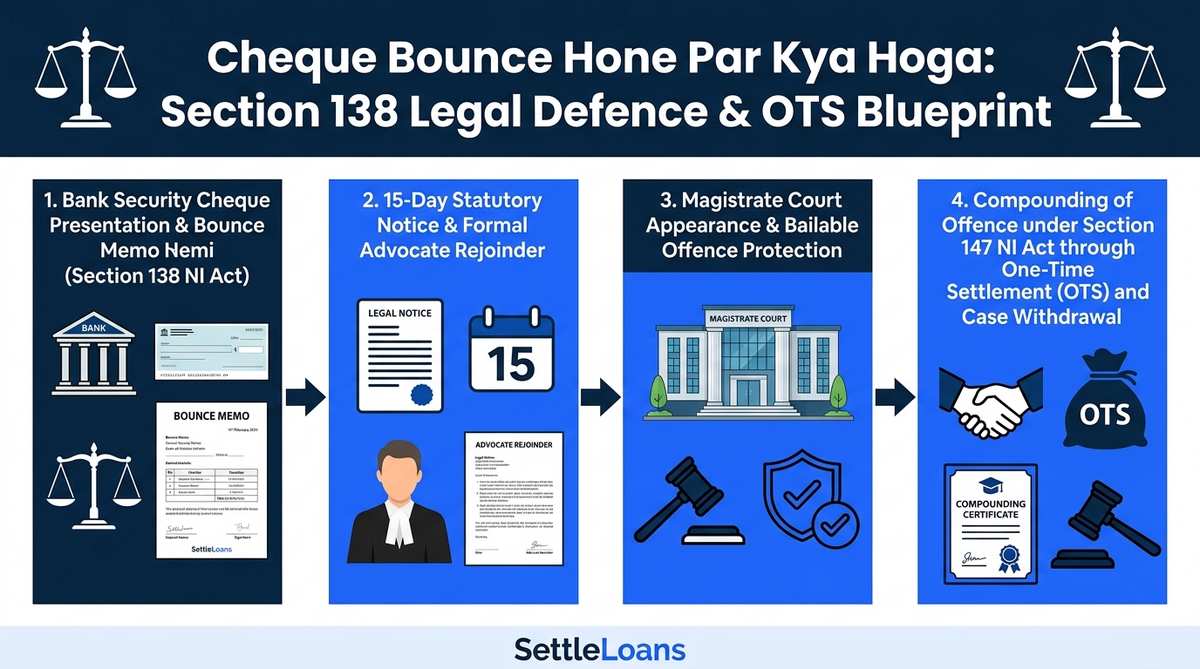
Cheque Bounce Hone Par Kya Hoga: 4-Stage Legal Defence & OTS Blueprint
6. Advocate Reply Drafting Strategy: Challenging Security Cheque Misuse & Penal Figures
Jab bank ka Section 138 demand notice aapke registered address par receive hota hai, toh sabse pehli aur sabse prabhavi legal action hoti hai 15 din ke bheetar ek formal Advocate Rejoinder dispatch karna. Ek seasoned banking advocate dwara draft kiya gaya rejoinder bank ki criminal complaint ko shuruat mein hi challenge kar deta hai aur future court proceedings ke liye borrower ke paksh mein certified documentary evidence create karta hai.
Ek robust legal notice reply mein char mukhya statutory grounds shamil kiye jate hain:
Ground 1: Misuse of Undated Blank Security Cheque. Reply mein yeh record par laya jata hai ki disputed cheque kisi crystallized debt ke bhugtan ke liye issue nahi kiya gaya tha, balki loan disbursement ke samay ek blank security instrument ke roop mein handover kiya gaya tha. Bank dwara bina prior ledger intimation ke cheque par arbitrary figures bharna breach of contract aur fiduciary trust ka ullanghan hai.
Ground 2: RBI Fair Lending Guidelines Violations. RBI ke Circular on 'Penal Charges in Loan Accounts (2024)' ke tahat banks default par compound interest ya excessive penal surcharges nahi laga sakte. Reply mein bank se complete itemized statement of accounts aur ledger breakdown ki mang ki jati hai, jisse unke inflated figures legally expose ho jate hain.
Ground 3: Recording Bona Fide Hardship & Absence of Mens Rea. Cheque bounce mamlon mein criminal culpability tabhi banti hai jab intentional fraud ya deception prove ho. Advocate reply mein borrower ki genuine economic hardship (jaise job loss, business downturn, ya medical crisis) ko record par lakar yeh establish kiya jata hai ki default unintentional tha.
Ground 4: Proposal for Amicable Debt Resolution. Reply ke conclusion mein Section 89 CPC aur Section 147 NI Act ke principles ka hawala dete hue bank ko mamla litigation mein kheenchne ke bajaye Alternative Dispute Resolution (ADR) ya Lok Adalat ke zariye mutually agreeable One-Time Settlement par resolve karne ka formal offer diya jata hai.
7. Magistrate Court Summons, Furnishing Bail, and Personal Exemption Under Section 205 CrPC
Yadi notice ke baad bhi bank Judicial Magistrate Court mein Section 138 ke tahat Private Criminal Complaint file karta hai, toh court preliminary verification ke baad borrower ke naam par Court Summons dispatch karti hai. Summons aane ka matlab yeh bilkul nahi hota ki aapko jail bheja ja raha hai; summons ka matlab sirf yeh hai ki adalat aapko matter mein apna paksh rakhne ke liye nirdharit tareekh par bulawa bhej rahi hai.
Court Summons receive hone par nimnlikhit steps follow karne chahiye:
1. Never Evade or Ignore Court Summons: Summons ko ignore karne par Magistrate bailable warrant (BW) aur uske baad non-bailable warrant (NBW) jari kar sakta hai. Isliye court hearing date par vakalatnama file karke appear hona behad zaroori hai.
2. Instant Bail on First Appearance: Bailable offense hone ke kaaran aapka advocate adalat mein Section 436 CrPC ke tahat Bail Application lagata hai. Ek local surety (zamanti) ya nominal cash security jama karne par Magistrate usi waqt bail grant kar deta hai.
3. Application for Permanent Exemption (Section 205 CrPC): Yadi borrower kisi doosre shahar mein rehta hai, senior citizen hai, ya severely ill hai, toh uska advocate Section 205 CrPC ke antargat regular physical appearance se permanent exemption ki application file kar sakta hai, jisse advocate khud borrower ke behalf par hearings represent karta hai.
8. Compounding of Offence Under Section 147 NI Act: How Loan Settlement (OTS) Formally Withdraws Cases
Section 138 Negotiable Instruments Act ki sabse anokhi visheshta iska Section 147 hai, jo is offense ko "Compoundable" banata hai. Indian criminal law mein compounding ka matlab hota hai dono pakshon ke beech samjhauta (compromise) hona, jiske baad criminal case permanently khatam ho jata hai aur borrower par acquittal (doshmukt) ka legal effect padta hai. Supreme Court of India ne Damodar S. Prabhu v. Sayed Babalal H. (2010) tatha M/s Meters and Instruments Pvt Ltd v. Kanchan Mehta (2018) ke landmark faislon mein spasht kiya hai ki Section 138 cases ka primary objective compensation aur recovery hai, na ki criminal punishment.
Jab borrower SettleLoans ke legal counsel ke madhyam se bank ke sath One-Time Settlement (OTS) negotiate karta hai, toh mamla nimnlikhit disciplined procedure se withdraw karwaya jata hai:
Step 1: Sanction of Formal OTS Letter. Bank ke Zonal Credit Committee dwara official letterhead par settlement figure aur installment breakdown ke sath stamped OTS Sanction Letter issue kiya jata hai.
Step 2: Payment Execution into Loan Account. Agreed discounted settlement amount ka bhugtan sidhe designated bank loan account mein RTGS/NEFT ya demand draft ke dwara kiya jata hai.
Step 3: Filing Joint Application Under Section 147 NI Act. Full settlement payment hone ke baad, bank ka panel advocate aur borrower ka advocate Magistrate Court ke samaksh ek Joint Compromise and Compounding Application submit karte hain. Bank court ko formal statement deta hai ki unka pura claim satisfy ho chuka hai.
Step 4: Judicial Disposal & No Dues Certificate. Magistrate court compounding application ko allow karke criminal complaint ko dismissed as settled ghoshit karti hai. Bank borrower ko stamped No Dues Certificate (NDC) issue karta hai aur CIBIL credit bureaus ko zero-balance status report karta hai.
9. Comparative Evaluation Matrix: Cheque Dishonour vs. Alternate Banking Recovery Mechanisms
Lenders borrower ke default par alag-alag kanooni dastavez aur statutes ka prayog karte hain. Niche di gayi comparative matrix table aapko Section 138 Cheque Bounce, Section 25 PSSA NACH Bounce, Order 37 CPC Summary Suit, aur Arbitration Act ke beech ke kanooni antar aur defensive remedies ko spasht roop se darshati hai:
| Recovery Mechanism | Governing Statute | Legal Classification | Mandatory Response Window | Primary Defence & Compounding Strategy |
|---|---|---|---|---|
| Physical Cheque Bounce | Section 138 Negotiable Instruments Act | Quasi-Criminal / Bailable | 15 Days from Notice Receipt | Challenge security cheque misuse; compound offence under Section 147 via OTS |
| Electronic NACH / e-Mandate Bounce | Section 25 Payment & Settlement Systems Act | Quasi-Criminal / Bailable | 15 Days from Notice Receipt | Establish electronic mandate technical errors & bona fide financial hardship |
| Civil Recovery Summary Suit | Order 37 Code of Civil Procedure (CPC) | Pure Civil Proceeding | 10 Days for Leave to Defend | File Leave to Defend challenging compound penal interest; seek ADR under Sec 89 |
| Sole Arbitrator Proceeding | Arbitration & Conciliation Act, 1996 | Alternate Dispute Forum | 30 Days (Section 21) | Object to unilateral arbitrator appointment under Perkins Eastman ruling |
| National Lok Adalat Settlement | Legal Services Authorities Act, 1987 | Statutory Compromise Forum | Pre-Litigation Hearing Date | Obtain 100% penal waiver; secure non-appealable final consent award |

Settle Loan is India's trusted debt relief and loan settlement platform. We help borrowers overcome financial distress by negotiating with banks and NBFCs to legally settle personal loans and credit card debts. With our transparent, performance-based approach, you can achieve debt freedom and regain your financial peace of mind.
COMPUTER
Frequently Asked Questions: Cheque Bounce Legal Defence & Case Withdrawal
Cheque bounce hone par sabse pehla legal step kya hota hai?
Kya cheque bounce hone par police sidhe ghar aakar arrest kar sakti hai?
Loan lete waqt diya gaya Security Cheque bounce hone par kya Section 138 lagu hota hai?
Section 138 notice aane ke baad 15 din ka samay kyu critical hota hai?
Court summons aane par bail lene ka procedure kya hota hai?
Section 147 NI Act ke tahat cheque bounce case compound kaise hota hai?
Kya cheque bounce case chalte waqt bank ke sath loan settlement ho sakta hai?
Cheque bounce case mein maximum punishment ya penalty kya ho sakti hai?
Kya har cheque bounce par bank doosre shahar ya state mein case kar sakta hai?
- Negotiable Instruments Act, 1881 – Section 138, 142, and 147 Statutory Compounding Provisions
- Reserve Bank of India (RBI) – Master Directions on Fair Practices Code & Fair Lending Charges
- Payment and Settlement Systems Act, 2007 – Section 25 Electronic Clearing Mandate Regulations
- National Legal Services Authority (NALSA) – National Lok Adalat Pre-Litigation Cheque Dispute Guidelines
- RBI Integrated Ombudsman Scheme – Online Portal for Harassment & Banking Grievances