- Zero SARFAESI Foreclosure: Unsecured study loans have no property mortgage. Parental pensions are fully protected under Section 60(1)(g) CPC.
- Parental Legal Shield: Recovery harassment against resident parents violates RBI guidelines. It also breaches the Senior Citizens Act, 2007.
- No Foreign Credit Impact: Indian defaults do not link with US, UK, or Canadian credit bureaus. They do not affect foreign visas.
- Unviable Foreign Litigation: Suing abroad costs too much for Indian banks. This pushes lenders to agree to an out-of-court OTS.
- 40%–70% OTS Waivers: A formal settlement delivers large principal waivers. It removes 100% of penal interest and gives ₹0 CIBIL clearance.
1. Anatomy of the Study Abroad Loan Crisis
Over the past decade, many Indian students took large education loans. They went for Master degrees in the US, UK, Canada, Ireland, and Australia. Specialized NBFCs gave unsecured loans from ₹30 Lakhs to over ₹1 Crore. Key lenders include Avanse, InCred, Auxilo, and HDFC Credila. Major banks like SBI (Global Ed-Vantage), Bank of Baroda, and Canara Bank also gave large loans.
However, job markets have slowed down globally. Tech layoffs and visa cuts hit hard. US H-1B limits, UK Graduate Route changes, and Canadian work permit caps caused severe job stress. Moratorium periods end quickly. Then, large monthly EMIs of ₹70,000 to ₹1,50,000 begin immediately.
Students abroad face job loss or low wages. High currency exchange rates make monthly payments impossible. Lenders cannot easily sue students in foreign courts. So, Indian banks and collection agencies target parents in India. Most of these parents are retired senior citizens. Resolving this crisis needs a clear legal defense, RBI protection. And a structured One-Time Settlement (OTS).
2. Legal Status of Co-Borrowers & Parents
In most study abroad loans, banks ask parents to sign as a "Co-Borrower". or "Co-Obligant". Under Section 128 of the Indian Contract Act, 1872, the liability of a co-borrower is equal to the principal debtor. This lets lenders ask parents in India for money when the student defaults overseas. The bank does not have to exhaust all foreign steps first.
Most NBFC study loans (Avanse, InCred, Auxilo, Credila up to ₹75 Lakhs) are fully unsecured. No property mortgage is created. Therefore, lenders have no power under the SARFAESI Act, 2002 to seize or auction parental homes.
For loans from public sector banks with mortgaged property, lenders may issue Section 13(2) notices under SARFAESI. Even in secured defaults, legal defense can challenge bank actions and route the loan to a fair OTS.
In unsecured loan defaults, lenders can only file regular civil suits or summary suits under Order 37 CPC. Crucially, Section 60(1)(g) of the Code of Civil Procedure, 1908 (CPC) protects essential family assets. Government pensions, provident funds, gratuity. And basic household items cannot be attached. Lenders cannot freeze pension accounts or evict parents.
Check Your Loan Settlement Options
Answer 2 quick questions to evaluate your settlement eligibility.
1. What type of loan do you want to settle?
3. Statutory Protections for Aging Parents
When study loans cross 60 to 90 days past due, collection agents often target resident parents. They make unannounced home visits and threatening phone calls. Indian law gives strong statutory tools to stop this abuse immediately:
1. Maintenance and Welfare of Parents and Senior Citizens Act, 2007
Under this law, senior citizens aged 60 and above have a legal right to live with dignity. Harassing elderly parents causes illegal mental cruelty. Parents can file a complaint before the Maintenance Tribunal headed by the Sub-Divisional Magistrate (SDM). The SDM can issue protection orders and direct police aid.
2. RBI Master Directions on Recovery Agents & Fair Practices Code
Under RBI Master Circular RBI/2022-23/108 (Fair Practices Code), banks and NBFCs must follow strict rules. Agents cannot call or visit before 8:00 AM or after 7:00 PM. They cannot use foul words, visit offices without consent, or reveal debt to others. All agents must hold valid ID cards.
3. Criminal Law Remedies under Bharatiya Nyaya Sanhita (BNS) / IPC
Entering a home without permission or threatening harm is a crime. These acts violate Sections 329, 126, and 351 of the Bharatiya Nyaya Sanhita, 2023 (earlier Sections 441, 341, and 506 IPC). Formal legal notices force recovery agencies to stop all field visits.
By issuing legal notices to the bank Nodal Officer and filing complaints on the RBI Banking Ombudsman CMS portal, families gain full legal safety. This turns emotional harassment into a calm, lawful settlement talk.
4. Bank Accounting, Provisioning Burden
Getting a large waiver in an OTS depends on bank rules. Indian lenders follow the RBI Prudential Norms on Income Recognition, Asset Classification, and Provisioning (IRACP). Banks must follow these strict accounting rules.
When an abroad study loan stays unpaid for over 90 days, it becomes a Non-Performing Asset (Gross NPA). Under RBI rules, the bank cannot book interest income. It must lock its own profits into bad debt reserves:
| NPA Classification Stage. | Overdue Horizon (DPD). | Mandatory Bank Provisioning Requirement. | Lender Commercial Stance. |
|---|---|---|---|
| Special Mention Account (SMA-2). | 61 to 90 Days overdue. | Standard asset buffer. | High phone calls and home visits. |
| Sub-Standard Asset (Unsecured). | Up to 12 Months as NPA. | 25% provisioning on total unsecured dues. | Bank sends formal legal notices. |
| Doubtful Asset (D1 / D2). | 1 to 3 Years as NPA. | 100% provisioning on unsecured balance. | Lender is very open to deep OTS waivers. |
| Loss Asset / Technical Write-Off. | Identified as Uncollectible. | 100% full loss write-off in bank books. | Maximum OTS waiver up to 70%. |
Where C_t is the money recovered from parents over time. The letter r is the bank cost of funds. Long court delays of 3 to 6 years and locked capital reduce bank returns. This makes an early cash settlement far more attractive to the lender.
When legal advocates submit a formal OTS with proof of foreign job loss, banks look at the numbers. An instant cash payment gives a higher Net Present Value (NPV) than years of court delay. This financial reality gives borrowers strong negotiation leverage.
5. Abroad Education Loan Settlement Roadmap
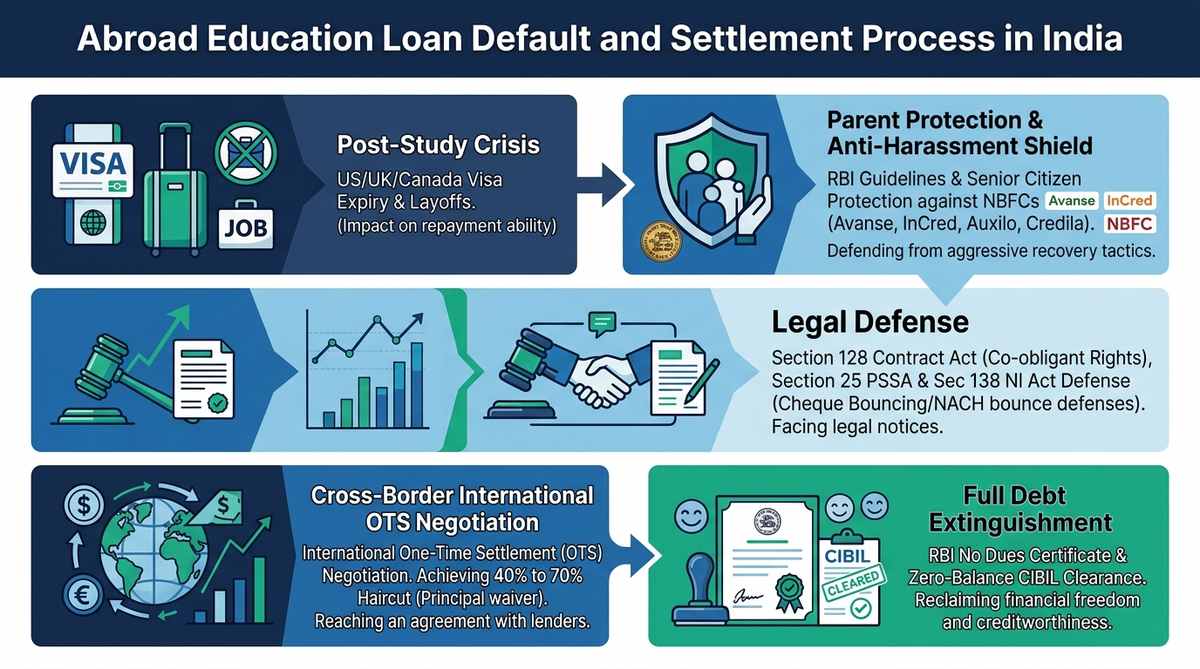
The visual flowchart below shows the 5-stage roadmap: from foreign job loss and parent protection to advocate talks, bank sanction letter. And full CIBIL clearance.
6. Judicial Defense: Section 138 NI Act, NACH Bounces,
When recovery calls fail, lenders may start court actions against resident parents. Families should understand each legal tool to defend themselves effectively:
Lenders often deposit old security cheques taken at loan sign-up. When these cheques bounce, the bank sends a 15-day notice and files a court case. Under Section 147 of the NI Act, cheque bounce cases are compoundable by law. Legal advocates file formal court replies and stop non-bailable warrants. They settle the matter out of court. This leads to full case dismissal.
Failed NACH auto-debits lead to notices under Section 25 of the PSSA. Like cheque bounce cases, these are quasi-criminal, bailable. And compoundable. Counsel shows that auto-debits failed due to real financial hardship. This prevents harsh court orders and moves the case to an OTS.
Some lenders file summary civil suits in District Court for fast money decrees. A borrower has exactly 10 days to enter an appearance and apply for Leave to Defend. Advocates show valid disputes like illegal penal interest and unclear terms. The court then grants unconditional leave to defend. This pushes the bank to settle.
For bank claims over ₹20 Lakhs, public sector banks can file an Original Application before the DRT. DRT courts face huge case backlogs of 3 to 7 years. Because of this delay, banks readily use DRT Lok Adalats to agree on an OTS and close the case.
A strong court defense protects families from sudden orders. It proves to the lender that long court battles will only waste money without recovery.
7. Structuring an International OTS
Getting a good One-Time Settlement on a study loan needs a clear, fact-based plan. You cannot just call customer care or plead poverty to field recovery agents. The case must go straight to the bank Zonal Stressed Asset Resolution Branch (SARB) or Credit Committee in four clear steps:
Gather solid proof of financial distress. This includes visa expiry notices, layoff letters, rent receipts, foreign cost-of-living bills. And parent medical records.
Show tax returns like US Form 1040, Canadian T4, or UK P60. This proves the student owns no foreign real estate or large assets that can be seized.
Ask for a full loan ledger audit. Under RBI Circular RBI/2023-24/53 (Fair Lending Practice), all penal interest and late fees must be removed.
Present the settlement offer (usually 30% to 60% of principal) as a one-time help from close family. It is offered only for full and final closure.
Never send money based on verbal or WhatsApp promises from recovery agents. Agents often promise to stop legal cases after a small token payment. In reality, banks use token money to clear interest arrears while continuing legal cases. Pay only after you receive an official, signed bank settlement sanction letter.
8. Sanction Letter Audit & Verification
Reaching an agreement is only the first step. To ensure permanent closure and avoid future collection by Asset Reconstruction Companies (ARCs), you must verify the sanction letter carefully:
1. Mandatory Sanction Letter Clauses & Entity Verification
The letter must come on official bank letterhead with a reference number, date, stamp. And officer signature. It must state the exact loan account number, full names, and PAN numbers of student and parents. It must specify the final settlement amount and due dates. It must also promise full case withdrawal upon payment.
2. Delivery of RBI No Dues Certificate (NDC) Within Mandatory 30 Days
Under RBI Master Circular RBI/2023-24/60 (Responsible Lending Conduct), lenders must issue an official No Dues Certificate (NDC) within 30 days. They must also return all security cheques. If the bank delays beyond 30 days, it must pay ₹5,000 per day of delay to the borrower.
3. Rectification of Credit Bureau Records (CIBIL, Experian, Equifax, CRIF)
Under CICRA rules, the bank must report the settlement to CIBIL, Experian, Equifax, and CRIF within 30 days. The status becomes "Settled" with a ₹0 balance for both student and parents. This stops negative score drops and helps rebuild your CIBIL score back above 750 over 18 to 24 months.
Many students worry that an Indian loan settlement will hurt their US FICO score, Canadian credit score, or UK credit file. In fact, credit bureaus are separate by country. Foreign credit bureaus never import Indian CIBIL records. Settling your Indian loan clears all legal risk in India without hurting your overseas credit file.
9. Education Debt Resolution Matrix
When faced with an education loan default, families must evaluate the difference between fighting long court cases and doing an advocate-led One-Time Settlement:
| Strategic Parameter. | one-sided Default / Contested Litigation. | Advocate-Led Cross-Border OTS. |
|---|---|---|
| Parental Safety &. Dignity. | Continuous harassment and home visits. | 100% legal safety under Senior Citizens Act and RBI rules. |
| Total Financial Liability. | Heavy penal interest and ongoing legal fees. | 40% to 70% overall waiver with zero penal interest. |
| Resolution Timeline. | 3 to 7 years in Magistrate, Civil, or DRT courts. | 45 to 90 days from hardship filing to closure. |
| Legal Risk Profile. | Risk of Section 138 warrants and court decrees. | Full case compounding, acquittal. And case withdrawal. |
| CIBIL Bureau Status. | Active default status dropping score below 550. | Updated to Settled with a clean ₹0 balance for all borrowers. |
| Asset Security. | Risk of long civil court attachment suits. | Total closure of all lender claims on family assets. |
| Peace of Mind. | Severe stress for parents and student. | Clean closure, RBI No Dues Certificate. And a fresh start. |
10. SettleLoans Cross-Border Legal Defense
Resolving big study loan defaults requires strong domestic legal defense and skilled financial talks. SettleLoans helps students abroad and their resident parents in India. Our banking advocates shield aging parents from recovery harassment. We manage Section 138 NI Act and Section 25 PSSA court notices. We negotiate directly with bank credit heads to secure 40% to 70% One-Time Settlements with official No Dues Certificates and clean credit bureau updates.

Settle Loan is India's trusted debt relief and loan settlement platform. We help borrowers overcome financial distress by negotiating with banks and NBFCs to legally settle personal loans and credit card debts. With our transparent, performance-based approach, you can achieve debt freedom and regain your financial peace of mind.
COMPUTER
11. FAQs: Abroad Education Loan Default & Settlement
Clear, legally verified answers to common questions on abroad study loan defaults, parent rights, and One-Time Settlements in India.
Can Indian banks or NBFCs seize my parents' house or pension for an unsecured abroad education loan?
No. Unsecured loans from NBFCs like Avanse, InCred, Auxilo, or HDFC Credila have no property collateral. Lenders have no mortgage rights under the SARFAESI Act. They cannot auction homes without court orders. Also, Section 60(1)(g) of the Code of Civil Procedure, 1908 protects pensions and provident funds from civil attachment.
What is the legal liability of parents who signed as co-borrowers or co-obligants?
Under Section 128 of the Indian Contract Act, 1872, co-borrower liability is equal to the student. Lenders can legally ask resident parents for repayment. But lenders cannot use threats or harassment. Any recovery must follow civil court process. Borrowers can present valid financial hardship in court.
Can recovery agents visit my parents' home or call them at odd hours under RBI regulations?
No. RBI Master Directions on Fair Practices Code (RBI/2022-23/108) ban calls or visits before 8:00 AM or after 7:00 PM. Agents cannot use abusive words or threaten families. They cannot contact neighbors or employers. You can report violations to the RBI Banking Ombudsman and local police.
Can an education loan default in India impact my visa, immigration, or credit score in the US, UK, or Canada?
No. Indian credit bureaus like CIBIL do not share data with foreign bureaus in the US, UK, or Canada. An Indian loan default does not show up on foreign credit reports. It does not affect foreign work visas, OPT, H-1B filings, or permanent residency.
Can lenders file criminal cases under Section 138 NI Act or Section 25 PSSA for education loan defaults?
Lenders may present security cheques or NACH mandates that bounce. They issue notices under Section 138 NI Act or Section 25 PSSA. These cases are compoundable under Section 147 NI Act. Banking advocates file legal replies and prevent warrants. They help record an agreed out-of-court settlement.
How much waiver or haircut can be negotiated in an abroad education loan One-Time Settlement (OTS)?
For unsecured study loans with foreign job hardship, lenders often approve waivers between 40% and 70% of total dues. All penal charges and late fees are removed, along with a cut in the principal amount.
What is the process to ensure both student and parents receive clean CIBIL reports and No Dues Certificates?
You must get an official bank sanction letter before paying. It must name both student and parents. Once paid, the lender must issue a No Dues Certificate within 30 days under RBI circular RBI/2023-24/60. The bank must update credit bureaus to Settled with a ₹0 balance.
Why do NBFCs like Avanse, InCred, and Auxilo prefer an out-of-court OTS over fighting international court cases?
Suing overseas students in foreign courts is very costly and slow. After 90 days of default, RBI rules force lenders to lock capital into NPA provisions. A fast lump-sum settlement gives the bank better net recovery than years of court battles.