- Zero Airport Arrest Risk: Unsecured loan default is purely a civil contractual dispute. Immigration desks at Indian airports have zero jurisdiction to detain travelers for unpaid retail bank loans.
- 100% Remote Consular POA: You can execute a Special Power of Attorney through your nearest Indian Embassy or Consulate, legally appointing defense counsel in India to manage all negotiations.
- Significant 40%–70% OTS Waivers: Under RBI stressed asset provisioning rules, banks prefer a discounted cash recovery today over expensive, multi-year cross-border litigation.
- Immediate Shield for Indian Relatives: RBI regulations strictly forbid recovery agents from intimidating or contacting parents or relatives who are not legal co-borrowers.
- Court Compounding via Section 205 CrPC: Pending Section 138 cheque bounce or NACH bounce matters are defended by counsel without requiring your physical presence, followed by full compounding.
1. The Cross-Border Default Dilemma and Banking Recovery Pressures
Thousands of Indian professionals relocate each year to economic hubs across the United Arab Emirates, Saudi Arabia, Qatar, Singapore, the United Kingdom, Canada, and the United States. Many depart with active unsecured personal loans, credit card balances, or professional lines of credit originated while working in India. When unexpected cross-border financial shocks emerge—such as corporate restructuring, overseas tech layoffs, escalating foreign living expenses, or adverse currency exchange fluctuations—servicing high-interest Indian EMIs simultaneously becomes financially unsustainable.
As automated NACH mandates bounce in India, lenders initiate aggressive recovery workflows. When digital collection calls fail to reach overseas phone numbers, recovery desks routinely redirect their pressure onto the borrower's permanent residential address in India. Elderly parents, spouses, and extended family members are subjected to coercive home visits, threatening phone calls, and unauthorized claims asserting that the non-resident borrower will face immediate arrest by immigration officials upon landing at an Indian airport.
"Under the Reserve Bank of India Master Direction on Debt Recovery and Fair Practices Code, regulated entities and their outsourced recovery agents are explicitly barred from contacting, intimidating, or exerting debt recovery demands on third parties, including parents, siblings, or friends who have not executed formal guarantees or co-borrower covenants."
— RBI Master Direction on Fair Practices Code for Lenders (DBR.No.Dir.BC.10/13.03.00/2015-16)
These aggressive tactics exploit the physical distance and legal information vacuum experienced by non-residents. Living thousands of miles away, borrowers often endure acute psychological stress, fearing that an unresolved financial dispute in India could permanently jeopardize their passport, overseas employment visa, or right to visit family back home. Understanding the strict legal boundaries governing Indian debt recovery is the vital first step toward reclaiming peace of mind and executing a permanent, structured debt resolution.
2. Debunking the Myth: Can an NRI Be Arrested at Indian Immigration?
The most pervasive fear among non-residents with defaulted Indian loans is the prospect of being detained at airport immigration desks upon arrival at Delhi, Mumbai, Bengaluru, Kochi, or Hyderabad. This anxiety is systematically manufactured by unethical third-party collection agents who falsely threaten to issue "airport warrants" or place the borrower's name on international "defaulter watchlists." Under Indian constitutional law and criminal procedure, these claims are entirely baseless.
Defaulting on an unsecured personal loan or credit card constitutes a pure civil breach of contract under the Indian Contract Act, 1872. Under Article 21 of the Indian Constitution, personal liberty cannot be deprived except according to procedure established by law. The Supreme Court of India has consistently held that inability to repay debt due to bona fide financial distress is not a crime, and law enforcement agencies have no statutory mandate to register an FIR or initiate an arrest for civil debt default.
Furthermore, the issuance of a Look Out Circular (LOC) is strictly regulated by the Ministry of Home Affairs (MHA) through codified Office Memoranda. LOCs are exceptional administrative instruments reserved exclusively for individuals accused of cognizable economic offenses threatening national security, massive banking frauds exceeding prescribed multi-crore statutory thresholds, or fugitives evading active criminal warrants under CBI or Enforcement Directorate (ED) investigations.
Viraj Chetan Shah v. Union of India (Bombay High Court, 2024)
High Court Ruling on Bank LOCsThe Bombay High Court decisively quashed the clause empowering public sector bank chairmen to issue Look Out Circulars against retail debtors, holding that the fundamental right to travel abroad under Article 21 cannot be curtailed to enforce private civil debt recoveries without direct statutory authority.
Arrest at an airport is legally possible only if a criminal magistrate has issued a Non-Bailable Warrant (NBW) due to an individual repeatedly evading judicial summons in an active criminal prosecution (such as fraud or forgery under Section 420 IPC / Section 318 BNS). In standard loan disputes, banks operate strictly within civil and quasi-criminal recovery frameworks, where legal representation readily manages all court appearances without personal detention.
Check Your Loan Settlement Options
Answer 2 quick questions to evaluate your settlement eligibility.
1. What type of loan do you want to settle?
3. The Remote Legal Bridge: Executing a Power of Attorney (POA) from Abroad
Non-residents do not need to incur exorbitant travel expenses, take extended employment leave, or endure logistical disruption to resolve Indian banking liabilities. Under the Powers of Attorney Act, 1882, an NRI can legally delegate authority to an empaneled debt settlement advocate or trusted family representative in India through a properly executed Special Power of Attorney (Special POA).
A Special POA limits the attorney's mandate strictly to negotiating loan restructuring or One-Time Settlement terms with designated financial institutions, reviewing and accepting compromise sanction letters, remitting approved settlement amounts, and securing formal No Dues Certificates and case compounding orders. This ensures total legal protection while preventing any misuse of broader discretionary powers.
Consular Attestation or Apostille Abroad
In countries that are signatories to the Hague Convention (such as the US, UK, Canada, and EU member states), the POA document is signed before a local Notary Public and certified with an Apostille Certificate. In non-apostille jurisdictions (including the UAE, Saudi Arabia, Qatar, and Singapore), the NRI visits the Consular Wing of the Indian Embassy or High Commission, signs the document in the presence of a Consular Officer under the Diplomatic and Consular Officers (Oaths and Fees) Act, 1948, and obtains official embassy stamping.
Adjudication and Stamping in India (90 Days)
Once the physically stamped POA is dispatched by courier to India, the attorney holder must present the document before the District Registrar or Collector of Stamps within 90 calendar days of its physical arrival in India. Under Section 18 of the Indian Stamp Act, 1899, the document is officially adjudicated upon payment of applicable state stamp duty, rendering it fully enforceable before all Indian banking authorities, tribunals, and courts.
Once the adjudicated Special POA is on record, all communications from the bank's recovery division are legally redirected to your appointed legal counsel. This immediately halts intrusive phone calls and visits to your family members, ensuring that all discussions proceed through structured, formal legal channels.
4. Bank Accounting Mechanics: Net Present Value (NPV) & Stressed Assets
To understand why Indian commercial banks and NBFCs readily agree to substantial One-Time Settlement (OTS) waivers, one must examine banking accounting rules under the Reserve Bank of India (Prudential Framework for Resolution of Stressed Assets) Directions, 2019. Banks do not evaluate non-resident debt settlements through emotional lenses; they operate strictly on mathematical risk assessments and balance sheet capital efficiency.
When a loan account remains unpaid beyond 90 days, it is classified as a Non-Performing Asset (NPA). Under RBI provisioning mandates, banks must lock away significant portions of their operating profits as risk provisions against bad loans:
Sub-Standard Asset (NPA up to 12 Months)
Requires 15% provisioning on secured balances and 25% on unsecured exposure.
Doubtful Asset (D1 to D3: 1 to 3+ Years of Default)
Provisioning escalates aggressively from 25% up to 100% of the unsecured loan principal.
Loss Asset (Identified Uncollectible Debt)
Requires full 100% provisioning write-off on the bank's books.
When a borrower resides abroad, the lender faces severe legal hurdles in pursuing cross-border debt recovery. Executing an Indian civil court money decree in a foreign jurisdiction (such as under reciprocity provisions with the UAE or UK) requires years of complex international litigation, foreign advocate retainers, and diplomatic service of summons. The total legal cost often exceeds the value of the original personal loan.
Banks apply a Net Present Value (NPV) recovery formula:
// BANK COMPROMISE SETTLEMENT EVALUATION
NPV(Recovery) = [Immediate Cash Offer] > [Expected Court Recovery × Probability] ÷ (1 + r)^t - [Cross-Border Legal Costs]
Because an immediate lump-sum settlement of 40% to 50% yields a vastly superior Net Present Value compared to uncertain, protracted foreign litigation, bank credit committees and Stressed Assets Resolution Committees (SARC) are commercially motivated to approve formal One-Time Settlements and release locked capital provisions back into their profitability pools.
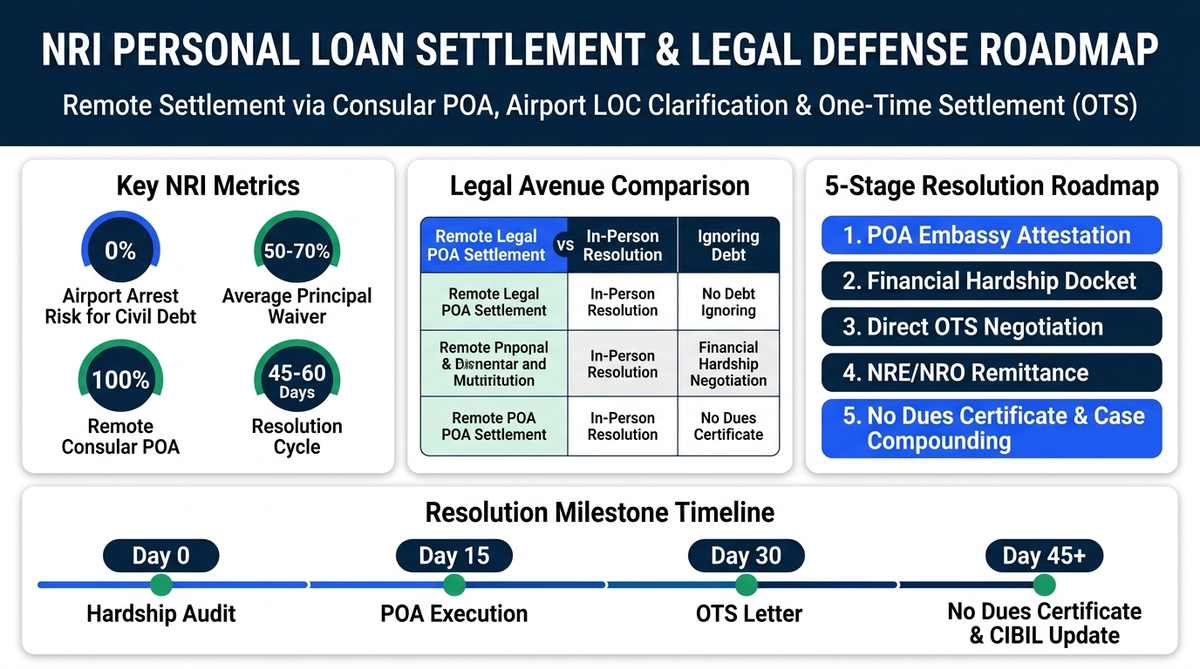
6. Step-by-Step Remote Settlement Workflow: From Default to No Dues Certificate
Executing an NRI debt settlement requires a disciplined, multi-stage legal and financial process. Bypassing statutory safeguards or relying on informal verbal assurances from recovery agents can lead to fraud or continued legal exposure. The established protocol followed by SettleLoans ensures total transparency and legal finality:
Comprehensive Debt & Legal Audit
Our legal team reviews your original loan agreements, loan account statements, payment history, and any statutory notices issued under Section 138 of the Negotiable Instruments Act or Section 25 of the Payment and Settlement Systems Act. We calculate the exact principal balance and strip away illegitimate penal interest and compound bounce charges.
Drafting and Consular Execution of Special POA
We draft a customized Special Power of Attorney tailored strictly to your banking disputes. You sign and attest the document before the Indian Embassy or Consulate abroad. Upon arrival in India, our team completes statutory adjudication under Section 18 of the Indian Stamp Act.
Legal Representation & Cease-and-Desist Enforcement
We place our formal Vakalatnama and POA on record with the bank's central stressed asset management vertical. An immediate cease-and-desist notice is issued to the bank's Principal Nodal Officer, strictly forbidding third-party contact or visits to your family residence in India.
Financial Hardship Docketing & Official OTS Sanction
We compile a structured Financial Hardship Dossier (documenting foreign cost-of-living increases, salary revisions, or medical liabilities) and negotiate directly with the Stressed Assets Resolution Committee. We secure a formal, written One-Time Settlement Sanction Letter issued directly on official bank letterhead detailing the discounted compromise figure, payment milestones, and closure commitments.
FEMA Remittance, Judicial Compounding & No Dues Certificate
You remit the agreed settlement funds directly from your NRE/NRO account or foreign wire transfer to the lending institution. Upon credit confirmation, our advocates file compounding petitions under Section 147 NI Act to dispose of any pending court matters, followed by obtaining the unconditional No Dues Certificate (NDC) and verifying CIBIL bureau updates.
7. Foreign Exchange & FEMA Compliance in NRI Loan Settlement
Settling an Indian debt from abroad requires strict compliance with the Foreign Exchange Management Act (FEMA), 1999 and RBI Master Directions on Non-Resident Banking Accounts. Never make cash transfers or payments to personal accounts of recovery agents or unverified intermediaries. All settlement remittances must follow lawful, auditable banking channels.
Non-residents can utilize three authorized mechanisms to pay approved OTS amounts:
- Non-Resident External (NRE) Account: Funds held in freely repatriable NRE accounts can be transferred directly to the lending institution via RTGS/NEFT against the OTS sanction letter.
- Non-Resident Ordinary (NRO) Account: Rupee funds originating from legitimate Indian income or past savings in NRO accounts can be debited directly for loan settlement.
- Direct Inward SWIFT Wire Remittance: The NRI can initiate an international wire transfer in foreign currency (USD, AED, GBP, EUR, SGD) directly to the lending bank's nodal Nostro account, specifically referencing the Loan Account Number and Settlement Sanction Reference.
Regarding taxation, loan waivers obtained through genuine distress settlements on personal (non-business) loans do not constitute taxable income under the Income Tax Act, 1961, as confirmed by numerous Income Tax Appellate Tribunal (ITAT) rulings, ensuring that you do not incur unintended tax liabilities in India post-settlement.
8. Managing Criminal & Quasi-Criminal Notices: Section 138 & NACH Defense
Banks frequently attempt to establish leverage against non-residents by depositing archived security cheques (PDCs) collected during loan origination. When these cheques or automated NACH electronic mandates bounce, lenders issue statutory 15-day demand notices under Section 138 of the Negotiable Instruments Act, 1881 or Section 25 of the Payment and Settlement Systems Act, 2007.
If a magistrate issues court summons while you are residing overseas, there is no need to panic or make emergency travel arrangements. Under Section 205 and Section 317 of the Code of Criminal Procedure (CrPC) (and corresponding provisions of the Bharatiya Nagarik Suraksha Sanhita, BNSS), the magistrate possesses judicial discretion to dispense with the personal physical appearance of the accused and permit representation entirely through an authorized advocate.
Your defense advocate appears on your behalf, presents the overseas residency proof, furnishes the necessary personal bond through your local attorney holder, and challenges the validity of inflated security cheques under the landmark Supreme Court ruling in Dashrathbhai Trikambhai Patel v. Hitesh Mahendrabhai Patel (2022). Once the OTS terms are fulfilled, the entire criminal proceeding is compounded under Section 147 of the NI Act, resulting in complete legal acquittal and zero criminal record.
9. Comparative Resolution Matrices
The comparative tables below highlight the legal, financial, and operational distinctions between resolving debts remotely through a Consular POA, attempting an in-person return, or ignoring unpaid liabilities.
Table 1: Remote Legal POA Settlement vs. In-Person Return vs. Ignoring Debt
| Strategic Dimension | Remote Legal Settlement via Consular POA | Traveling to India in Person | Ignoring Defaulted Dues Abroad |
|---|---|---|---|
| Travel & Logistics Cost | Zero travel expense; small consular attestation fee | High flight costs, local lodging, lost foreign work days | Zero immediate cost; severe long-term financial penalties |
| Legal Representation | Handled entirely by empaneled defense advocates | Self-representation under aggressive bank pressure | Zero defense; risk of ex-parte court summons |
| Family Harassment Protection | Immediate formal cease-and-desist to bank nodal officers | Family remains exposed during visit preparations | Persistent, escalating harassment of elderly parents |
| Negotiation Leverage | High; structured hardship docketing & NPV modeling | Moderate; banks sense urgency to return overseas | Zero leverage; compound penal charges escalate |
| CIBIL & Legal Closure | Permanent No Dues Certificate & Case Compounding | Permanent No Dues Certificate if fully settled | Permanent 'Wilful Defaulter' / 'Written Off' credit tag |
Table 2: Comparison of Legal Channels Invoked by Indian Lenders
| Channel Parameter | One-Time Settlement (OTS via POA) | Section 138 NI Act (Cheque Bounce) | Civil Summary Suit (Order 37 CPC) | DRT (Secured Loans > ₹20L) |
|---|---|---|---|---|
| Legal Nature | Consensual Compromise Resolution | Quasi-Criminal Statutory Complaint | Civil Contractual Recovery Suit | Statutory Tribunal Recovery |
| NRI Physical Appearance | Never required; executed via POA | Dispensed with under Sec 205 CrPC | Never required; advocate represents | Never required; advocate represents |
| Resolution Timeline | 45 to 60 calendar days | 18 to 36 months if litigated | 3 to 7 years in civil court | 2 to 5 years before Presiding Officer |
| Financial Outcome | 40% to 70% waiver on total balance | 100% compoundable upon settlement | Decree for full principal + interest | Attachment of mortgaged Indian assets |
10. Post-Settlement Credit Rehabilitation & Long-Term Financial Freedom
Securing the official No Dues Certificate (NDC) marks the formal conclusion of all legal disputes and financial liabilities with the lending institution. However, non-residents must also take proactive steps to ensure their credit bureau records (TransUnion CIBIL, Experian, CRIF High Mark) accurately reflect the settlement.
Under RBI mandates, banks must submit updated loan repayment records to all four credit bureaus within 30 calendar days of account closure. The account status will transition from active default to "Settled" or "Post-Write-Off Settled", and the outstanding balance will reflect zero. While a settled tag carries a temporary credit score reduction, it eliminates the devastating impact of an ongoing active default and removes all barriers to future financial interactions in India.
Should you choose to re-establish an Indian credit profile for future investments, you can rebuild your CIBIL score to 750+ within 12 to 24 months by opening a Fixed Deposit (FD)-backed secured credit card through your NRO account and maintaining disciplined, automated monthly repayments.

Settle Loan is India's trusted debt relief and loan settlement platform. We help borrowers overcome financial distress by negotiating with banks and NBFCs to legally settle personal loans and credit card debts. With our transparent, performance-based approach, you can achieve debt freedom and regain your financial peace of mind.
COMPUTER
Frequently Asked Questions on NRI Personal Loan Settlement
Yes, Non-Resident Indians can execute complete debt settlements remotely without setting foot in India. Under the Powers of Attorney Act, 1882, you can execute a Special Power of Attorney (POA) attested at the nearest Indian Embassy or Consulate abroad. This grants legal standing to an empaneled debt settlement advocate or trusted family member in India to represent you before bank credit committees, negotiate One-Time Settlement (OTS) waivers, and sign necessary discharge agreements on your behalf.
No, absolutely not. Defaulting on an unsecured personal loan or credit card is purely a civil dispute. Under Indian jurisprudence and Article 21 of the Constitution, civil debt default is not a cognizable criminal offense. Immigration authorities at Indian airports (Delhi, Mumbai, Bengaluru, Kochi, Hyderabad) have zero statutory power to stop, question, or detain passengers over unpaid bank loans or collection agency claims.
No. Routine retail loan defaults do not meet the statutory criteria for Look Out Circulars. Under Ministry of Home Affairs (MHA) Office Memoranda and landmark rulings by the High Courts of Delhi and Bombay (such as Viraj Chetan Shah v. Union of India), LOCs are strictly reserved for economic offenses threatening national sovereignty or large-scale financial fraud under CBI/ED investigations. Public and private sector banks cannot issue LOCs for standard unsecured personal loan defaults.
The NRI executes a Special Power of Attorney drafted by legal counsel, signs it before a Consular Officer at the Indian Embassy/Consulate (or obtains an Apostille certificate in Hague Convention nations), and couriers the original document to India. The authorized attorney holder must present the document to the District Registrar or Collector of Stamps for adjudication and stamp duty payment under Section 18 of the Indian Stamp Act, 1899 within 90 days of its arrival in India.
Depending on the duration of default, asset classification under RBI provisioning norms, and documented overseas financial hardship, NRIs typically secure 40% to 70% waivers on total outstanding balances. Banks routinely agree to a 100% waiver of accumulated penal interest, late fees, and bounce charges, requiring payment solely against a heavily discounted compromise principal.
Under the Foreign Exchange Management Act (FEMA), 1999, settlement payments must be routed through legitimate banking channels. Payments can be remitted from the borrower's Non-Resident External (NRE) or Non-Resident Ordinary (NRO) account, or sent via direct SWIFT inward wire remittance to the lending bank, citing the unique Loan Account Number and official OTS Sanction Letter reference.
If a lender deposits a security cheque that bounces, your defense advocate in India can file an application under Section 205 or Section 317 CrPC to dispense with your physical personal appearance in court. The advocate represents you, furnishes the required surety/bail bond, and moves the matter for immediate compounding under Section 147 of the Negotiable Instruments Act upon fulfillment of the OTS agreement.
No, third-party harassment is strictly illegal under the RBI Fair Practices Code. Recovery agents are legally prohibited from visiting, calling, or intimidating parents, spouses, or relatives who are not co-borrowers or legal guarantors. SettleLoans issues immediate cease-and-desist notices to bank management and files formal complaints with the RBI Ombudsman, holding lenders liable for agent misconduct.
Upon receipt of the final settlement installment, the lending institution is mandated under RBI guidelines to issue an official, unconditional No Dues Certificate (NDC) or No Objection Certificate (NOC) within 21 to 30 days. This formal document certifies that the loan account is fully closed and no ongoing or future liability exists against the borrower.
Following settlement, the bank updates credit bureaus (CIBIL, Experian, CRIF High Mark) with the status "Settled" or "Post-Write-Off Settled". While this halts active recovery proceedings and eliminates default reporting, the score experiences a temporary dip. Non-residents can steadily rebuild their Indian credit score to 750+ within 12 to 24 months using secured fixed-deposit credit cards.
Authoritative Legal & Regulatory Sources
- Ministry of External Affairs (MEA) — Consular Services & Power of Attorney Attestation Guidelines
- Reserve Bank of India (RBI) — Master Direction on Stressed Assets Resolution & Non-Resident Accounts
- Supreme Court of India — Judgments on Section 138 NI Act & Fundamental Right to Travel
- Ministry of Home Affairs (MHA) — Office Memoranda & Guidelines on Look Out Circulars (LOC)
- Reserve Bank of India (RBI CMS) — Integrated Ombudsman Scheme & Anti-Harassment Redressal