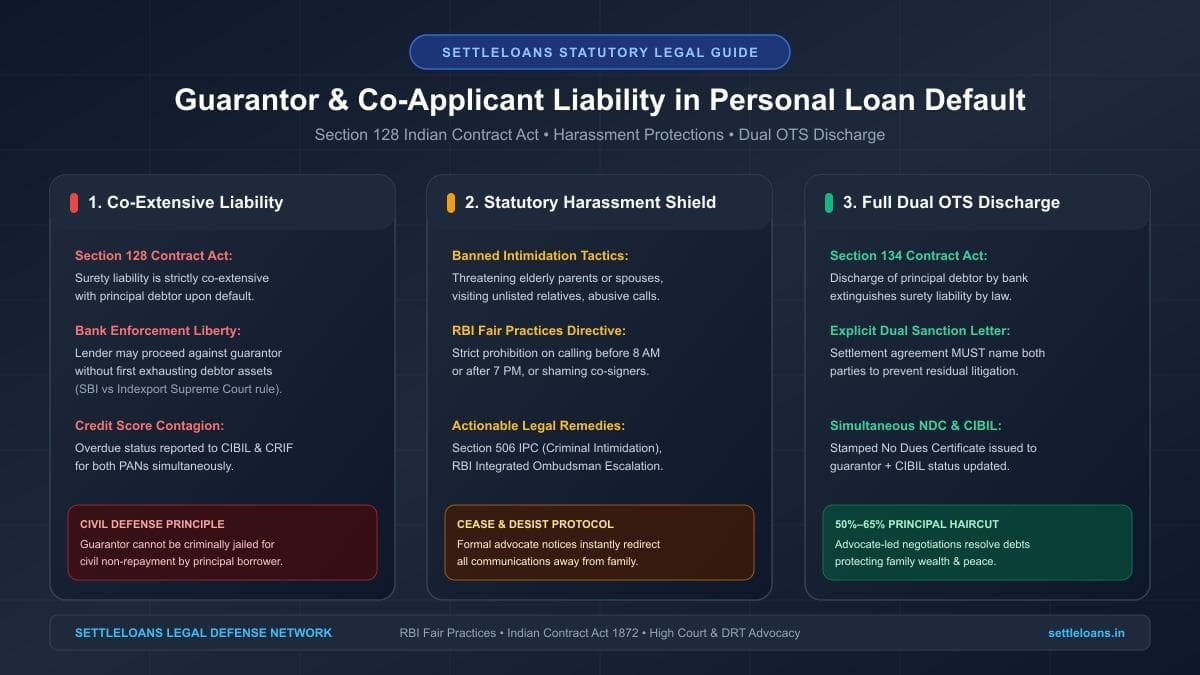
- Co-Extensive Statutory Liability: Under Section 128 of the Indian Contract Act, 1872, the lender can demand payment from the guarantor as soon as the principal borrower defaults, without first exhausting all legal remedies against the borrower.
- Zero Criminal Arrest Exposure: Personal loan default is solely a civil contractual dispute. Collection agents cannot arrest, jail, or register an FIR against an aging parent or spouse who co-signed the loan.
- Strict Ban on Family Harassment: RBI Master Directions and IPC Section 506 strictly prohibit recovery agencies from calling, abusing, or visiting unlisted relatives, workplaces, or elderly family members.
- Simultaneous Dual OTS Discharge: Under Section 134 of the Contract Act, an advocate-negotiated compromise settlement must explicitly name both parties to ensure complete release, No Dues Certificates, and CIBIL status closure.
- Right of Subrogation: Under Section 140 and 145, any payment made by a guarantor confers full legal rights to recover those sums directly from the principal debtor.
1. The Agony of Family Co-Signers
Defaulting on an unsecured personal loan with a guarantor causes acute emotional distress and familial discord. Often, an aging parent, spouse, or sibling serves as a co-signer. When financial emergencies strike—such as job loss, hospitalization, or business failure—EMIs quickly default. The impact then reverberates beyond the primary borrower. Within weeks of reaching 90-day Non-Performing Asset (NPA) status, aggressive collection agencies often shift pressure tactics toward vulnerable co-signers.
To navigate institutional recovery maneuvers and formulate an effective legal defense, one must first master the foundational distinction between a co-applicant and a guarantor (or surety) under Indian banking jurisprudence:
A co-applicant is a primary joint borrower from the inception of the credit contract. In retail banking, lenders frequently require spouses or working family members to join as co-applicants to pool household income for higher eligibility. A co-applicant shares direct, primary, joint, and several liability alongside the principal borrower from day one.
Under Section 126 of the Indian Contract Act, 1872, a contract of guarantee is a tripartite contract to perform the promise, or discharge the liability, of a third person in case of their default. The guarantor acts as a collateral safety net rather than a primary recipient of the disbursed funds.
Regardless of whether an person executed the agreement as a joint borrower or as an independent surety, Indian commercial law binds both parties to rigorous legal rules. Understanding these boundaries is the first step toward neutralizing unlawful collection harassment and executing an airtight resolution.
2. Section 128 of the Indian Contract Act
Guarantor liability in India is codified in Section 128 of the Indian Contract Act, 1872. It sets a firm statutory rule: “The liability of the surety is co-extensive with that of the principal debtor.” This applies unless otherwise provided by the contract. This provision carries profound legal consequences for family members who signed loan documents.
The term co-extensive means the guarantor's liability matches the borrower's liability exactly. The moment a scheduled installment defaults, the bank or NBFC acquires an actionable cause of action against the guarantor. The lender can demand the full ledger balance, including accrued interest, penal interest, and legal costs.
Landmark Supreme Court Rulings on Co-Extensive Liability
State Bank of India v. Indexport & Ors. (1992) 3 SCC 159
A landmark three-judge bench of the Supreme Court held that the creditor is not required to exhaust its legal remedies against the principal debtor or execute against mortgaged assets before case against the guarantor. The decree is enforceable against the guarantor simultaneously or independently.
Bank of Bihar Ltd. v. Dr. Damodar Prasad & Anr. (1969) 1 SCR 620
The apex court established that postponing the liability of the surety until the creditor has exhausted all remedies against the principal debtor would defeat the entire commercial objective of obtaining a guarantee.
Industrial Finance Corporation of India v. Cannanore Spinning Mills (2002) 5 SCC 54
The Supreme Court reaffirmed that the liability of the guarantor arises immediately upon default and is independent of the insolvency or financial disability of the principal borrower.
While the bank possesses the legal liberty to start civil cases or arbitration against the guarantor directly, this liability is strictly commercial and monetary. It does not grant lenders or their recovery agents the legal authority to deploy criminal intimidation, physical harassment, or arbitrary asset confiscation.
Check Your Loan Settlement Options
Answer 2 quick questions to evaluate your settlement eligibility.
1. What type of loan do you want to settle?
3. Recovery Agent Harassment Against Family
Because civil recovery in Indian courts entails significant procedural friction and delays, unregulated third-party collection agencies routinely exploit the psychological vulnerability of family co-signers. Agents frequently target elderly parents or spouses with fabricated claims, alleging that failure to pay will result in immediate police detention, home attachment, public shaming in residential colonies, or disqualification from government pensions.
Borrowers and co-signers must recognize that such coercive behavior represents a blatant violation of statutory civil protections, constitutional privacy rights under Article 21, and explicit Reserve Bank of India directives:
RBI Fair Practices Code (FPC)
RBI Master Directions strictly prohibit lenders and their outsourced agents from contacting debtors or guarantors before 8:00 AM or after 7:00 PM, calling workplace colleagues, using profane language, or making misleading legal threats.
Section 503 & 506 IPC (Criminal Intimidation)
Threatening bodily injury, reputation damage, or illegal arrest to force an aging parent or spouse to pay a defaulted debt constitutes criminal intimidation punishable by up to two years of imprisonment.
Section 383 & 384 IPC (Extortion)
Intentionally inducing severe mental terror or fear of injury to extract money under duress satisfies the essential penal ingredients of extortion under Indian law.
Section 138 NI Act Immunity for Non-Signers
Criminal cases under Section 138 of the Negotiable Instruments Act or Section 25 of the PSSA for cheque/NACH bounce apply solely to the specific person who signed the instrument, not to non-signing guarantors.
4. Bank Accounting: NPA Provisioning & NPV Recovery Formula
To negotiate effectively from strength, borrowers must understand how lenders evaluate bad debts. Under RBI Prudential Norms on Advances, overdue credit lines face strict classification. Once an unsecured loan remains overdue for 90 days, it is formally classified as a Non-Performing Asset (NPA).
This classification triggers mandatory capital provisioning that penalizes institutional profitability:
- Substandard Assets (0 to 12 months as NPA): Mandatory 15% provisioning on the total outstanding exposure.
- Doubtful Assets-1 (12 to 24 months as NPA): 100% full provisioning against unsecured balances.
- Doubtful Assets-2 & Loss Assets: Complete 100% write-off from the bank active asset portfolio, absorbing precious shareholder capital.
When a bank contemplates filing a civil suit under Order 37 CPC or starting institutional arbitration against both the borrower and guarantor, its risk officers conduct a Net Present Value (NPV) recovery valuation. starting formal litigation requires depositing 1% to 3% upfront court fees, retaining external legal counsel, and enduring 3 to 5 years of procedural backlog in district courts, with minimal recovery prospects against distressed retail borrowers.
Where C_t represents estimated recoveries across time periods t, r is the bank discount rate, and deductions account for multi-year court expenses and regulatory capital locked in mandatory NPA provisioning reserves.
Protracted litigation against guarantors results in negative net present values for lenders. For this reason, bank settlement committees have strong commercial incentive to execute an OTS. They routinely offer 45% to 65% principal waivers in exchange for prompt, lump-sum capital recovery.
6. Legal Representation Shielding Co-Signers from Coercion
When an person borrower or an anxious family guarantor attempts to reason with collection agents, third-party agencies frequently intensify their pressure, perceiving family emotional distress as leverage to force urgent liquidations. In contrast, formal legal representation by experienced banking advocates fundamentally transforms the operational dynamic.
Upon engagement, our legal defense team applies a structured multi-tiered intervention:
Formal Representation & Cease-and-Desist Service
Advocates serve formal legal notices and Vakalatnama on the bank zonal collection head and Principal Nodal Officer, mandating that all future notice must occur solely through legal counsel. Third-party calling to family members ceases immediately.
Criminal Counter-Notices for Harassment (Section 506 IPC)
Collection agents sometimes visit elderly relatives, use abusive language, or issue false arrest threats. When this occurs, our advocates compile call logs and messages. We lodge formal complaints with the State Cyber Crime Police and local District Magistrate to halt illegal harassment.
Escalation to RBI Integrated Ombudsman
Under the Reserve Bank - Integrated Ombudsman Scheme, 2021, regulated entities face severe institutional penalties and relief orders up to ₹20 Lakhs for recovery agent misconduct against family co-signers.
Comprehensive Dual-Party OTS Dossier Submission
Advocates submit an exhaustive financial distress dossier directly to the bank competent settlement authority, securing significant principal haircuts while ensuring absolute legal immunity for both parties.
7. Sections 133–141 Indian Contract Act
A critical area of legal defense that unrepresented borrowers frequently overlook is the statutory framework governing the discharge and release of sureties under Chapter VIII of the Indian Contract Act, 1872. Indian law provides extensive protections where a guarantor is automatically released from liability due to the unilateral actions of the creditor bank:
Section 133: Discharge of Surety by Variance in Terms of Contract
Under Section 133, any contract variance made without the surety's consent discharges the guarantor. This applies to subsequent transactions, including unilateral credit limit increases, restructuring terms, or revised loan tenure.
Section 134: Discharge of Surety by Release or Discharge of Principal Debtor
Under Section 134, the surety is discharged if the creditor releases the principal debtor. Any act or omission by the creditor that legally discharges the debtor also releases the guarantor completely.
Section 135: Discharge by Composition, Extension of Time, or Agreement Not to Sue
Under Section 135, a composition contract between the creditor and debtor discharges the surety. If the bank promises extra time or agrees not to sue the debtor, the guarantor is discharged unless they expressly assent.
Section 139: Discharge of Surety by Creditor Act or Omission Impairing Surety Remedy
If the creditor does any act which is inconsistent with the rights of the surety, or omits to do any act which his duty to the surety requires him to do. also, the eventual remedy of the surety himself against the principal debtor is thereby impaired, the surety is discharged.
Section 140 & 145: Right of Subrogation & Implied Promise to Indemnify
Under Section 140, subrogation rights protect the guarantor. When a surety pays the guaranteed debt, they inherit all legal rights of the creditor. The guarantor can then recover that full payment from the principal debtor.
8. Sanction Letter Forensics: Dual NDC & CIBIL Rectification
Unrepresented settlements often lead to serious errors. A borrower settles an account, only for the bank to pursue the guarantor for residual balances or waived interest. Lenders rely on reservation clauses in boilerplate letters to preserve recovery avenues against co-signers. Professional legal drafting prevents this risk.
To guarantee complete, irrevocable legal closure for both parties, our legal team conducts rigorous sanction letter forensics before any settlement remittance is executed:
1. Explicit Dual-Party Naming
The formal OTS sanction letter on official bank letterhead must explicitly name the primary borrower, all co-applicants, and guarantors alongside their respective PAN numbers, declaring total discharge.
2. Complete Waiver & Non-Recourse
The letter must confirm that the agreed sum constitutes full satisfaction of all claims, explicitly waiving residual ledger balances and prohibiting future claims against the guarantor.
3. Dual Stamped NDC & CIBIL Update
Under RBI Circular RBI/2023-24/60, the bank must deliver a physical bank-stamped No Dues Certificate to both parties within 30 days and update credit bureau records to Settled / Closed.
9. Legal Matrix: Borrower vs Co-Applicant vs Personal Guarantor
The following comparative matrix outlines the jurisdictional liabilities, statutory exposure, and settlement protections across different borrower classifications in Indian retail lending:
| Legal Parameter | Primary Borrower | Co-Applicant (Joint Debtor) | Personal Guarantor (Surety) |
|---|---|---|---|
| Statutory Definition | Principal Debtor (Contract Act) | Joint & Several Co-Borrower | Surety under Section 126 |
| Timing of Liability | Immediate upon disbursement | Immediate upon disbursement | Triggered upon borrower default (Section 128) |
| Section 138 NI Act Exposure | Liable if cheque / NACH signed | Liable only if cheque / NACH signed | Zero criminal exposure unless cheque signed |
| Civil Recovery Action | Order 37 CPC / Civil Suit / DRT | Order 37 CPC / Civil Suit / DRT | Order 37 CPC / Civil Suit / DRT (Co-extensive) |
| Banker General Lien (Sec 171) | Applicable across bank accounts | Applicable across joint accounts | Restricted; subject to strict challenge |
| CIBIL Impact on Default | Direct DPD & Default Tagging | Direct DPD & Default Tagging | Direct DPD & Default Tagging on PAN |
| OTS Discharge Effect | Discharged upon full payment | Discharged if named in OTS letter | Discharged under Section 134 if dual OTS executed |
| Recovery from Primary Debtor | Not Applicable | Internal contribution rights | Full Subrogation rights under Section 140 |
10. SettleLoans Family Defense Framework
Navigating institutional recovery aggressive outreach against aging parents, spouses, and family co-signers requires seasoned legal counsel who specialize in banking laws, the Indian Contract Act, and RBI fair practice guidelines. SettleLoans provides comprehensive legal defense for borrowers and guarantors across India. We halt recovery harassment through formal cease-and-desist notices and enforce protections under Sections 128 to 141. also, we negotiate directly with bank zonal committees. This secures maximum principal waivers and authentic No Dues Certificates that safeguard both PAN records.

Settle Loan is India's trusted debt relief and loan settlement platform. We help borrowers overcome financial distress by negotiating with banks and NBFCs to legally settle personal loans and credit card debts. With our transparent, performance-based approach, you can achieve debt freedom and regain your financial peace of mind.
COMPUTER
11. FAQs: Guarantor & Co-Applicant Loan Default Liability
Legally verified answers to essential questions regarding guarantor liability, Section 128 protections, recovery harassment of family members, and dual OTS settlements.
What is the legal difference between a co-applicant and a guarantor in an Indian loan?
A co-applicant is a primary co-borrower who shares direct, joint, and several liability from the inception of the credit facility, often having their income combined for loan eligibility. A guarantor (or surety under Section 126 of the Indian Contract Act) is a third party who undertakes to discharge the liability of the principal debtor only upon default. However, under Section 128, the bank can pursue either party once a default occurs.
Can a bank legally start recovery directly against the guarantor before exhausting remedies against the primary borrower?
Yes. Under Section 128 of the Indian Contract Act, 1872, the liability of the guarantor is co-extensive with that of the principal debtor. The Supreme Court of India in State Bank of India v. Indexport (1992) and Bank of Bihar v. Damodar Prasad (1969) established that a creditor is not bound to exhaust remedies against the principal debtor before suing or case against the guarantor, unless specifically restricted in the loan contract.
Can recovery agents harass or threaten an elderly parent or spouse who co-signed a defaulted loan?
No. Harassment, verbal abuse, visiting elderly relatives at unreasonable hours, using threatening language, or shaming family members violates the RBI Master Direction on Fair Practices Code, Article 21 of the Constitution, and Sections 503 and 506 of the Indian Penal Code (Criminal Intimidation). Aggrieved co-signers can issue formal legal notices, file cyber crime complaints, and approach the RBI Ombudsman.
Can a guarantor or co-applicant be sent to jail if the primary borrower defaults on a personal loan?
No. Inability to repay an unsecured personal loan is strictly a civil breach of contract, not a criminal offense. Neither the borrower nor the guarantor can be arrested or imprisoned for genuine financial default. Criminal liability only arises if the co-signer personally signed dishonored cheques under Section 138 of the NI Act or provided forged KYC documents.
Does a One-Time Settlement (OTS) entered into by the primary borrower automatically protect the guarantor?
Under Section 134 of the Indian Contract Act, the discharge of the principal debtor through a contract by which the creditor releases him generally discharges the surety. However, banks frequently insert reservation of rights clauses in standard settlement drafts. Therefore, it is critical that the OTS sanction letter and No Dues Certificate explicitly name both the principal borrower and the guarantor, providing unconditional dual discharge.
How does a personal loan default affect the guarantor's CIBIL score and credit report?
Credit bureaus like CIBIL, Experian, CRIF High Mark, and Equifax report default and Days Past Due (DPD) metrics identically on both the principal borrower's and the guarantor's PAN records. When the account is settled through an OTS, both credit profiles reflect a 'Settled' status until the records are legally updated with zero remaining overdue balances.
Can the bank seize the guarantor's personal property or freeze their salary account for an unsecured loan?
For an unsecured personal loan, a bank cannot arbitrarily seize movable or immovable assets without obtaining a formal decree from a Civil Court (or DRT for claims exceeding ₹20 Lakhs) and filing execution cases under Order 21 CPC. However, if the guarantor holds deposit accounts in the same lending bank, the institution may attempt to exercise a general banker's lien under Section 171 of the Contract Act, which can be legally contested.
What rights does a guarantor have against the primary borrower after paying or settling the bank's dues?
Under Section 140 of the Indian Contract Act (Doctrine of Subrogation) and Section 145 (Implied promise to indemnify surety), upon discharging the debt of the principal debtor, the guarantor steps into the shoes of the creditor and possesses full legal rights to recover all settled amounts, interest, and related expenses from the principal borrower through a civil recovery suit.
What essential terms must be included in an OTS sanction letter to protect the co-applicant and guarantor?
The OTS sanction letter must contain: (1) explicit naming and PAN numbers of both primary borrower and co-applicants/guarantors, (2) unambiguous confirmation that the agreed settlement sum represents full and final satisfaction of all institutional claims, (3) withdrawal of all pending civil, arbitration, or Section 138 cases, and (4) commitment to issue a bank-stamped No Dues Certificate and update credit bureaus within 30 days.