- Absolute Pension Attachment Immunity: Under Section 60(1)(g) of the Code of Civil Procedure (CPC), 1908 and Section 11 of the Pensions Act, 1871, pension disbursements, gratuity, and provident funds cannot be attached or seized by any civil court decree.
- Banker's Lien on Pension is Illegal: Lenders cannot exercise a general banker's lien under Section 171 of the Indian Contract Act to freeze or unilaterally debit dedicated pension accounts to recover overdue personal loans or credit cards.
- Senior Citizens Act Statutory Defense: Coercive recovery tactics against elderly individuals violate the Maintenance and Welfare of Parents and Senior Citizens Act, 2007 and constitutional livelihood protections under Article 21.
- Deep Compassionate OTS Waivers: Commercial banks operate structured compassionate compromise settlement policies allowing 45% to 70% total waivers for superannuated borrowers experiencing chronic medical illnesses and diminished earning capacity.
- Zero Risk to Homestead Property: Unsecured lenders possess no mortgage charge over self-occupied residential property and cannot initiate summary possession under SARFAESI laws against unsecured personal loan or card defaults.
1. Statutory Pension Immunity: The Absolute Protective Shield
For millions of senior citizens, superannuated public servants, defense veterans, and family pensioners across India, retirement earnings represent the solitary economic lifeline sustaining their daily food, medical prescriptions, and basic human dignity. When unforeseen financial shocks—such as severe illness, surgical hospitalization, or business losses suffered by dependent adult children—result in default on personal loans or credit card balances, commercial lending institutions frequently subject elderly borrowers to intense collection pressure. In many egregious cases, banks attempt to confiscate monthly pension credits or assert that court bailiffs will attach retirement corpus.
Under the Indian jurisprudence framework, Parliament and the judiciary have erected an unassailable statutory fortress protecting retirement benefits from creditor claims. The cornerstone of this protection is codified under Section 60(1)(g) of the Code of Civil Procedure, 1908 (CPC), which explicitly declares that stipends and pensions allowed to pensioners of the government or payable from any service pension fund established by the Central or State Governments, as well as political pensions, are strictly exempt from attachment or sale in execution of any civil decree.
Under Section 11 of the Pensions Act, 1871, no pension granted or continued by Government on account of past services, and no money due or to become due on account of any such pension or allowance, shall be liable to seizure, attachment, or sequestration by process of any court in India at the instance of a creditor. This statutory bar operates unconditionally against all civil recovery claims.
Under Section 3 of the Provident Funds Act, 1925, Section 60(1)(k) CPC, and Section 13 of the Payment of Gratuity Act, 1972, retirement gratuity, General Provident Fund (GPF), Public Provident Fund (PPF), and commuted pension corpus are entirely protected from court execution, attachment, and recovery freezes.
The Supreme Court of India has reiterated in landmark judgments, including Union of India v. Jyoti Chit Fund & Finance and subsequent rulings, that the legislative objective behind Section 60(1)(g) CPC and Section 11 of the Pensions Act is rooted in sovereign public policy: to ensure that an individual who has rendered service to the nation or superannuated from economic life is not reduced to destitution or stripped of the bare means of subsistence by commercial money decrees. Consequently, civil courts hold zero statutory authority to issue attachment warrants against pension funds.
2. Unlawful Banker's Lien, Direct Mandate Debits & Account Freezes on Pension Accounts
While commercial banks are well aware that civil courts cannot attach a pension, aggressive collection departments often resort to extra-judicial coercion by manipulating internal banking software. The most prevalent predatory practice involves applying a purported "General Banker's Lien" under Section 171 of the Indian Contract Act, 1872 or executing unauthorized internal ledger transfers to sweep monthly pension credits from a savings account to service defaulted credit cards or unsecured personal loans held within the same banking institution.
This internal appropriation of pension funds is completely unlawful. Indian judicial precedents, affirmed across multiple High Court benches (including the High Courts of Delhi, Bombay, Madras, and Kerala), have firmly established that a bank's contractual right of lien or set-off under common law cannot override the express statutory mandate of Parliament. When funds credited to an account are identifiable as statutory pension disbursements, the bank stands in a fiduciary capacity as a disbursing agent, not a privileged creditor.
Under the Payment and Settlement Systems Act, 2007 and RBI circulars, every account holder holds the sovereign legal right to cancel or revoke an electronic NACH/ECS mandate by serving written notice on their home branch. Continued auto-debits after mandate revocation constitute unauthorized transactions.
Banks cannot unilaterally place a "total debit freeze" or "lien mark" on a pensioner's operative savings account without an express judicial freeze order issued under Section 102 CrPC or an attachment order from a competent revenue court. Extra-judicial account freezing violates RBI Fair Practices Codes.
Where a lending bank persists in unauthorized internal sweeping, pensioners are legally entitled under Central Treasury Rules to submit an application to their Pension Sanctioning Authority (PSA) or CPPC to migrate their pension disbursement account to another scheduled public sector bank.
In multiple landmark judgments, the Supreme Court has clarified that pension funds do not lose their character as exempt retirement maintenance simply because they have been electronically credited to a savings bank account. As long as the monetary inflows are directly traceable to monthly pension disbursements, the protective umbrella of Section 60(1)(g) CPC and Section 11 of the Pensions Act remains fully operative, prohibiting banks from freezing the balance or enforcing unilateral set-offs.
Check Your Loan Settlement Options
Answer 2 quick questions to evaluate your settlement eligibility.
1. What type of loan do you want to settle?
3. The Senior Citizens Act, 2007, Constitutional Dignity & Anti-Harassment Protections
Beyond civil execution exemptions, elderly borrowers in India are endowed with special human rights protections under social welfare legislation and constitutional mandates. The Maintenance and Welfare of Parents and Senior Citizens Act, 2007 was enacted by Parliament to guarantee that senior citizens (individuals aged 60 years and above) can live with security, peace, and dignity. The coercive deployment of collection agents who intimidate elderly borrowers at their residential doorstep directly infringes upon these statutory rights.
The Reserve Bank of India (RBI), through its comprehensive Master Direction on Fair Practices Code for Lenders and specific circulars on recovery agent conduct (including RBI Circular RBI/2022-23/108), has instituted strict regulatory prohibitions against abusive debt collection methods. Regulated entities, including public and private sector banks as well as Non-Banking Financial Companies (NBFCs), bear strict vicarious liability for the actions of their recovery agents.
- • Zero communication before 8:00 AM or after 7:00 PM under any circumstances.
- • Absolute prohibition against abusive, threatening, or derogatory language.
- • Total bar on contacting third parties, adult children, neighbors, or former colleagues.
- • Mandatory identity card and formal bank authorization letter display during any home visit.
- • Section 351 BNS (Criminal Intimidation): False threats of police arrest or jail.
- • Section 356 BNS (Defamation): Disclosing debt status to neighbors or society guards.
- • Section 329 BNS (Criminal Trespass): Entering premises without lawful authorization.
- • Maintenance Tribunal complaints under the Senior Citizens Act for elder mental harassment.
When senior citizens face intimidation from aggressive collection callers, the most effective response is not submission to panic, but the immediate service of a formal legal cease-and-desist notice drafted by debt defense advocates. By putting the bank's Principal Nodal Officer, Managing Director, and the RBI Ombudsman on statutory notice regarding agent misconduct, elderly borrowers create an immediate legal barrier that halts unlawful home visits and shifts the conversation to institutional settlement channels.
4. Bank NPA Accounting, Provisioning Realities & The NPV Recovery Formula for Superannuated Borrowers
To negotiate a favorable debt settlement, one must understand how commercial banks evaluate defaulted loans on their balance sheets. Under the RBI Master Circular on Prudential Norms on Income Recognition, Asset Classification and Provisioning (IRACP), once an unsecured personal loan or credit card overdue crosses 90 days, the account is categorized as a Non-Performing Asset (NPA). Over subsequent quarters, the account migrates from Sub-Standard (15% provisioning) to Doubtful-1 (25%), Doubtful-2 (40%), Doubtful-3 (100%), and eventually Loss Asset status.
For superannuated senior citizens, bank recovery committees confront a decisive economic reality: the borrower possesses no future employment salary to attach under Order 21 Rule 48 CPC, and statutory pension disbursements are completely protected by Section 60(1)(g) CPC. Filing a regular civil suit against a 70-year-old pensioner involves paying substantial ad-valorem court fees, engaging litigation counsel for 3 to 5 years, and ultimately securing an unexecutable paper decree.
Where C_t represents estimated recoverable cash flows over time t, r is the bank discount rate, and deductions account for zero statutory attachability of pension assets, 100% capital provisioning strain under RBI IRACP norms, and substantial legal friction costs.
Because the Net Present Value (NPV) of dragging a superannuated pensioner through multi-year civil litigation is frequently negative, bank management committees are economically incentivized to accept a compassionate One-Time Settlement (OTS). By writing off accumulated penal interest, compounding fees, and a substantial portion of the principal balance, the bank instantly recovers liquid capital, releases locked regulatory provisioning, and cleanses its NPA books.
5. Visual Pension Protection & Compassionate OTS Roadmap
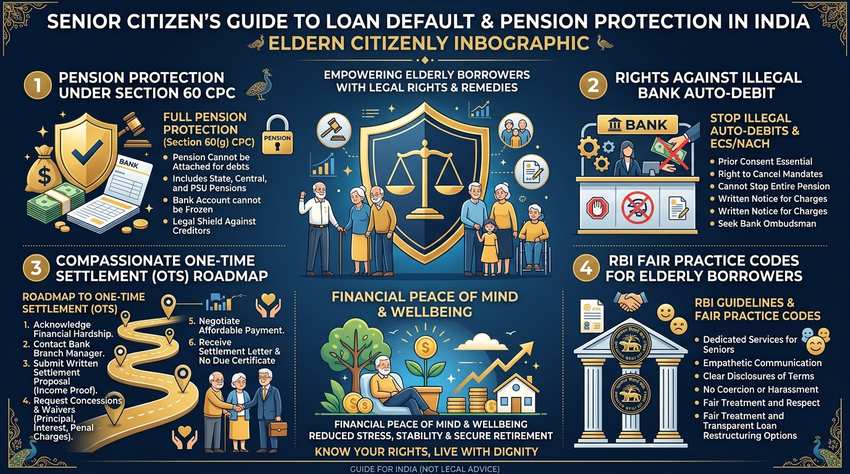
Figure 1.0: Senior Citizen Legal Shield & Compassionate Settlement Architecture. Illustrating the multi-layered statutory protections under Section 60(1)(g) CPC, Section 11 of the Pensions Act 1871, the Senior Citizens Act 2007, and the structured 6-step roadmap to concluding an advocate-led compassionate One-Time Settlement (OTS) with full No Dues Certificate closure.
6. Compassionate One-Time Settlement (OTS): Medical Hardship, Superannuation & Deep Waivers
A Compassionate One-Time Settlement (OTS) is an institutional compromise agreement authorized under a bank's board-approved recovery policy and RBI compromise settlement frameworks. Unlike commercial settlements negotiated for active business enterprises, a senior citizen settlement evaluates bona fide human factors: the borrower's superannuation status, fixed monthly pension, lack of secondary income streams, and catastrophic medical expenditures.
When presenting a formal settlement docket on behalf of an elderly borrower, seasoned debt defense advocates establish a clear evidentiary trail demonstrating that default arose from genuine supervening impossibility rather than willful non-compliance. Under these compassionate parameters, banks routinely approve deep financial concessions:
Complete elimination of all penal interest charges, compounding late fees, legal recovery overheads, and retroactive bounce fees added by the lender post-default.
Submission of medical summaries, hospital discharge reports, and pharmacy records documenting heavy recurring health costs to justify principal reductions between 45% and 70%.
Structuring the negotiated compromise figure into 2 to 4 manageable monthly tranches aligned with the pensioner's family assistance or modest personal savings.
By framing the settlement under board-approved compassionate OTS policies, bank sanction authorities are protected from internal vigilance audits, as the approval adheres strictly to documented hardship criteria and RBI recovery guidelines.
7. Step-by-Step Senior Citizen Legal Defense Protocol: From Cease-and-Desist to Final Closure
Resolving debt distress for senior citizens requires a methodical, multi-stage legal protocol that protects the pensioner's immediate mental health while engineering a legally binding, discounted final compromise. SettleLoans employs a 4-stage institutional defense model designed specifically for elderly borrowers:
Serving formal statutory notices upon the bank Managing Director, Principal Nodal Officer, and collection agency heads. The notice cites Section 60(1)(g) CPC, the Senior Citizens Act 2007, and RBI recovery guidelines, directing the immediate cessation of home visits, third-party calls, and unlawful debit sweeps under threat of criminal and regulatory prosecution.
Formally revoking all NACH/e-mandates with the home branch to stop recurring bounce charges. If the pension account is held with the lending bank, advocates assist in filing a direct treasury diversion request to route future pension credits to a secure, neutral public sector bank account.
Compiling an incontrovertible hardship dossier: superannuation certificate, pension payment order (PPO), hospital bills, pathology reports, prescription costs, and household expenditure statements demonstrating lack of disposable surplus and requesting a 45%–70% OTS waiver.
Engaging directly with the bank's Circle Head or National Compromise Committee to secure a formal, digitally verifiable One-Time Settlement sanction letter with zero ambiguity and guaranteed issuance of the No Dues Certificate.
8. Sanction Letter Forensics, RBI No Dues Certificate (NDC) Mandate & CIBIL Resolution
A debt settlement is only as good as the legal validity of the sanction letter issued by the lender. Many senior citizens fall prey to fraudulent verbal promises made by field collection agents who issue forged receipt slips or fake settlement letters on unauthorized letterheads, only for the bank to demand the remaining balance months later.
Before remitting any settlement funds, senior citizens must ensure their settlement letter passes rigorous forensic verification:
- • Issued directly from official corporate domain or physical bank stationery with unique reference number.
- • Explicit mention of exact loan account number and borrower full legal name.
- • Clear statement that payment of the agreed OTS amount constitutes full and final settlement with zero residual claim.
- • Unconditional undertaking to withdraw all pending legal notices, arbitration cases, or civil suits.
Under RBI Circular RBI/2023-24/60, banks must issue an official, zero-balance No Dues Certificate (NDC) and update credit bureaus (CIBIL, Experian, CRIF High Mark, Equifax) within 30 days of settlement payment. Failure to comply obligates the lender to pay a mandatory statutory penalty of ₹5,000 per day of delay directly to the borrower.
Following NDC release, the loan status in credit bureau reports reflects as "Settled" or "Post-Write-Off Settled" with a total outstanding balance of ₹0. For senior citizens who no longer require commercial credit lines or home mortgages, this zero-liability status permanently eliminates the risk of harassment, legal action, or creditor claims against estate assets.
9. Comparative Legal Matrix: Illegal Banker Actions vs. Actual Civil Law Rights vs. SettleLoans OTS Shield
The table below provides a side-by-side comparative analysis of the common illegal threats made by bank recovery agents, the actual governing statutory provisions under Indian law, and the institutional defense provided by SettleLoans advocates.
| Recovery Threat / Action | Governing Indian Law & Precedents | Actual Legal Reality & SettleLoans Shield |
|---|---|---|
| Attachment of Pension & Gratuity Funds | Section 60(1)(g) CPC & Section 11 of Pensions Act, 1871 | Absolute statutory immunity. Civil courts have zero jurisdiction to attach pension funds or retirement gratuity corpus. |
| General Banker's Lien on Pension Account | Section 171 Contract Act vs. Supreme Court Precedents | Unlawful. Banker's lien cannot override statutory pension protections. Banks must release frozen pension funds immediately. |
| Threat of Police Arrest / Jail for Default | Article 21 Constitution & Section 351 BNS (Criminal Intimidation) | Loan default is strictly a civil breach of contract. False arrest threats constitute criminal intimidation by recovery agents. |
| Seizure of Self-Occupied Residence | SARFAESI Act vs. Unsecured Contract Law | Unsecured personal loans hold zero mortgage on property. Lenders cannot initiate SARFAESI summary possession. |
| Harassment at Home / Calling Adult Children | RBI Master Direction on Fair Practices & Senior Citizens Act | Strictly illegal. Third-party disclosure violates banking privacy. Cease-and-desist notice invokes RBI Ombudsman penalties. |
| Compounding Penal Interest Accumulation | RBI Compromise Settlement Framework (June 2023) | 100% penal interest and late fee waiver under structured compassionate OTS with 45%–70% principal reduction. |
10. SettleLoans: Compassionate Legal Defense & Debt Resolution for Senior Citizens
At SettleLoans, we believe that senior citizens and pensioners who have dedicated decades of their lives to their families and country deserve to live their golden years with absolute tranquility, dignity, and freedom from financial harassment. Our specialized senior citizen debt defense practice combines deep civil litigation expertise with compassionate negotiation strategies to deliver total debt relief.
Whether you are facing aggressive collection calls, unlawful debit sweeps from your pension savings account, or confusing court notices, our senior banking advocates step in to shield you completely. We take over all creditor communication, ring-fence your statutory pension rights under Section 60 CPC, and negotiate a formal, deeply discounted One-Time Settlement that permanently closes your loan files.

Settle Loan is India's trusted debt relief and loan settlement platform. We help borrowers overcome financial distress by negotiating with banks and NBFCs to legally settle personal loans and credit card debts. With our transparent, performance-based approach, you can achieve debt freedom and regain your financial peace of mind.
COMPUTER