- Civil Court Injunction Protection: Distressed borrowers facing unannounced visits, verbal abuse, or workplace intimidation can secure an ad-interim restraining order under Order 39 Rules 1 and 2 CPC.
- Supreme Court Precedent (Shanti Devi): Apex court rulings strictly mandate that debt recovery must adhere to judicial procedure; employing third-party musclemen constitutes a criminal offense and civil tort.
- The 3 Pillars of Injunction: To obtain an immediate ex-parte stay, applicants must show a Prima Facie Case, Balance of Convenience, and Irreparable Injury to reputation and bodily safety.
- Contempt of Court Consequences: Violating a civil court stay order triggers Order 39 Rule 2A CPC cases, civil imprisonment up to 3 months, and punitive prosecution under the Contempt of Courts Act, 1971.
- Transition to 45%–65% OTS: Securing a judicial stay neutralizes collection intimidation, creating compelling leverage to negotiate an institutional One-Time Settlement with large principal waivers.
1. Demystifying Stay Orders Against Coercive Recovery
Defaulting on a personal loan, credit card, or business credit often triggers aggressive collection tactics. Recovery agencies deploy coercive methods like unannounced home visits, workplace trespassing, shouting before neighbors, and continuous threatening phone calls. These illegal practices cause severe psychological anguish, professional humiliation, and acute domestic instability.
Many borrowers mistakenly believe that defaulting on a loan strips them of their civil liberties and that banks possess unrestricted power to dispatch collection squads to their doorsteps. Under Indian jurisprudence, this assumption is completely false. A loan default is purely a civil breach of contract governed by the Indian Contract Act, 1872, and the Code of Civil Procedure (CPC), 1908. A default does not confer any criminal culpability or grant lenders the legal right to enforce private extrajudicial coercion.
When lenders bypass established legal recovery procedures, borrowers have powerful legal remedies. You can approach the competent City Civil Court, District Court, or High Court for protection. Courts grant emergency judicial stay orders and injunctions under Order 39, Rules 1 and 2 of the Code of Civil Procedure, 1908, read with Section 38 of the Specific Relief Act, 1963.
Grants an interlocutory restraining order preventing the defendant bank, its officers, employees, and recovery agencies from approaching within a specified perimeter (such as 500 meters) of your residence, workplace, or family members pending suit disposal.
Establishes the substantive legal right to prevent breach of an obligation. It perpetually restrains the lending institution from deploying extrajudicial, coercive, defamatory, or unlawful recovery mechanisms not sanctioned by statutory civil court procedures.
It is vital to understand what a stay order achieves. It does not erase underlying debt or prevent lawful judicial actions, such as Order 37 suits, DRT cases for debts over ₹20 Lakhs, or arbitration. However, an injunction erects a solid legal barrier against physical harassment, intimidation, unlawful home entries, public defamation, and telephone threats.
2. Statutory Protections, RBI Rules & Safeguards
The Indian legal system provides robust statutory, regulatory, and constitutional protections against coercive debt recovery. When petitioning a civil court for an interim stay order, advocates anchor the plaint upon three pillars: constitutional rights, binding RBI regulations, and landmark Supreme Court jurisprudence.
Under Article 21 of the Constitution, every citizen possesses the fundamental right to life, personal liberty, and human dignity. In the landmark nine-judge Constitution Bench ruling in Justice K.S. Puttaswamy (Retd.) v. Union of India (2017), the Supreme Court unequivocally affirmed that the Right to Privacy and the right to be left alone are intrinsic facets of Article 21. Third-party recovery agents visiting a borrower's residence, shouting defamatory remarks in housing societies, or contacting colleagues and distant relatives constitute direct infringements of constitutional dignity and privacy.
RBI Master Directions: Fair Practices Code for Lenders & Recovery Agents
The RBI has established strict regulatory standards governing debt collection. These are codified in the Master Direction – Fair Practices Code and Circular on Recovery Agents (RBI/2022-23/108). Commercial banks and NBFCs must follow these rules strictly. Any deviation constitutes an actionable regulatory offense:
Landmark Supreme Court Precedents on Recovery Harassment
In ICICI Bank Ltd. v. Shanti Devi Sharma & Ors. (2008) 7 SCC 532, the Supreme Court delivered a decisive condemnation of bank recovery practices, declaring: "We are governed by a rule of law in this country. The recovery of loans or the seizure of vehicles could be done only through legal means. The banks cannot employ goondas to take possession by force." The court held bank managing directors and executives vicariously responsible for the tortious actions of outsourced recovery agents.
Similarly, in landmark rulings like Sardar Trilok Singh (1979) and Citicorp Maruti Finance Ltd. (2012), the Supreme Court took a firm stance. The Court ruled that forcible asset repossession or physical recovery without a court decree violates civil law. Such conduct constitutes criminal offenses punishable under the IPC and BNS.
3. Documenting Agent Harassment into Actionable Breach
Securing an emergency stay order from a civil judge requires incontrovertible documentary and electronic evidence. Judges do not grant restraining orders based on generalized claims or unsubstantiated allegations. To establish an ironclad case of actionable harassment, borrowers must systematically preserve and catalog every interaction with collection agents.
| Harassment Category | Specific Illegal Action | Violated Legal Statute / Regulation | Primary Evidentiary Proof |
|---|---|---|---|
| Residential Trespassing | Entering home uninvited, refusing to leave, shouting at gate | Section 441/447 IPC (Criminal Trespass) & Section 329 BNS | CCTV footage, society gate visitor register, mobile video |
| Verbal Abuse & Threats | Threatening physical violence, arrest, or property seizure | Section 503/506 IPC (Criminal Intimidation) & Section 351 BNS | Call recordings, WhatsApp voice notes, witness statements |
| Workplace Defamation | Confronting HR/colleagues, creating office scene | Section 499/500 IPC (Defamation) & RBI Fair Practices Code | Office security logs, HR email records, colleague affidavits |
| Off-Hours Calling | Calling before 8:00 AM or after 7:00 PM; repeated spamming | RBI Circular RBI/2022-23/108 & TRAI UCC Regulations | Itemized telecom call records, time-stamped call logs |
| Third-Party Shaming | Messaging parents, siblings, references, or social contacts | Article 21 Right to Privacy & IT Act Section 72A | Screenshots of SMS/WhatsApp messages sent to relatives |
When compiling an evidence dossier under advocate guidance, electronic records require proper certification. Audio, video, and text logs must include a Certificate under Section 65B of the Indian Evidence Act, 1872 (or Section 63 BSA, 2023). This certificate renders digital evidence fully admissible in court during ad-interim hearings.
4. Bank NPA Accounting, Provisioning & NPV Valuation
To understand why a court stay order gives borrowers immense strategic leverage, one must examine the internal financial and accounting mechanics of commercial banks. When a borrower misses three consecutive monthly EMIs (90 days past due), the loan account is classified as a Non-Performing Asset (NPA) under RBI Prudential Norms.
Under RBI Income Recognition and Asset Classification (IRAC) guidelines, banks are legally mandated to lock away their own operating capital as loan loss provisions against NPAs:
| NPA Classification Stage | Delinquency Timeline | Mandatory Bank Provisioning | Institutional Settlement Willingness |
|---|---|---|---|
| Special Mention Account (SMA-2) | 61 to 90 Days Past Due | Standard Provisioning (0.4% – 5%) | Low (Insistence on regularizing EMIs) |
| Sub-Standard NPA | 90 Days to 12 Months | 15% to 25% Capital Locked | Moderate (Waiver of late penal interest) |
| Doubtful NPA 1 (D1) | 12 to 24 Months | 25% to 40% Capital Locked | High (30% – 45% Principal Haircut) |
| Doubtful NPA 2 / Loss Asset | 24+ Months / Written-Off | 100% Full Provisioning / Balance Sheet Loss | Maximum (45% – 65% Principal Haircut) |
When a borrower serves a civil court stay order on the bank, the lender's recovery machinery is frozen. The bank cannot deploy outsourced collection agencies, cannot seize assets extrajudicially, and cannot pressurize the borrower. Meanwhile, the loan continues to age into deeper NPA provisioning buckets, forcing the bank to lock 100% of the loan amount in non-yielding reserves.
When evaluating whether to maintain active litigation or accept a structured One-Time Settlement, bank credit committees calculate the Net Present Value (NPV) of Recovery:
Here, C_t represents estimated recoveries over time, and r is the institutional discount rate. Deductions account for 3–5 years of court friction and advocate retainers. They also include regulatory exposure from Ombudsman inquiries and capital locked in NPA provisions.
Defending a civil injunction suit and litigating recovery costs banks lakhs in legal expenses. In addition, it locks large balance sheet capital in NPA reserves. so, bank credit committees overwhelmingly prefer an upfront 35% to 55% lump-sum settlement rather than fighting a borrower protected by a court stay order.
5. 5-Stage Legal Injunction & Protection Visual Roadmap
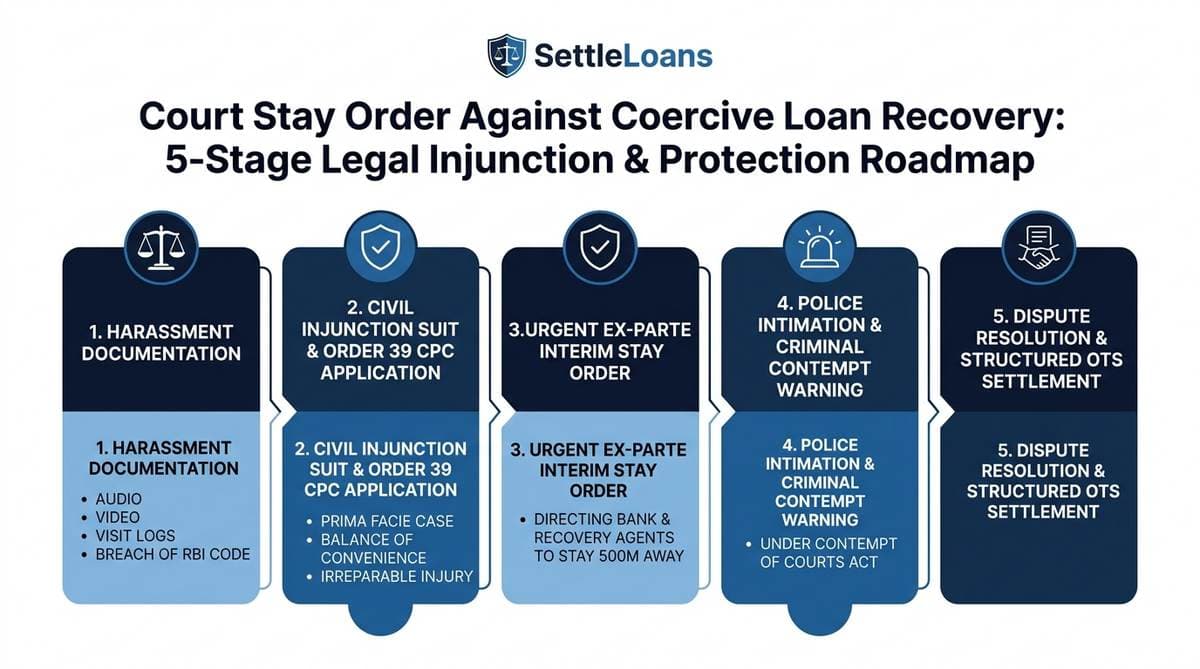
The roadmap below illustrates the structured 5-stage institutional progression. It guides you from documenting recovery harassment to securing an urgent civil court stay order under Order 39 CPC. It also covers enforcing police protection and concluding an official compromise settlement with full debt discharge.
6. Blueprint: Obtaining Urgent Court Stay Orders
Navigating civil court procedure requires precise legal drafting and swift strategic execution. Experienced debt defense advocates execute an established 5-stage protocol to petition the court and obtain immediate interim relief:
Stage 1: Statutory Demand Notice & Pre-Litigation Notice
Your advocate serves a formal legal notice upon the bank's Managing Director, Principal Nodal Officer, and recovery agency head. The notice catalogs specific harassment incidents and cites RBI Fair Practices Code violations. It demands the immediate withdrawal of recovery agents and warns of civil and criminal cases within 48 hours.
Stage 2: Drafting the Civil Plaint & Order 39 Interlocutory Application
Advocates draft a comprehensive Plaint for Permanent Injunction and Damages under Section 38 of the Specific Relief Act before the City Civil Court or Senior Civil Judge having territorial jurisdiction over the borrower's residence. Accompanying the plaint is an Interlocutory Application (IA) under Order 39, Rules 1 and 2 read with Section 151 CPC praying for urgent ad-interim restraining orders.
Stage 3: Establishing the Three Pillars of Civil Injunction
During the initial motion hearing, your counsel shows the mandatory tripartite test established by Indian courts: (1) Prima Facie Case: showing genuine financial hardship, willingness to resolve debt lawfully, and clear evidence of tortious harassment. (2) Balance of Convenience: Proving that the lender will suffer no irreparable injury if required to follow due process, whereas the borrower faces acute personal peril. And (3) Irreparable Injury: Establishing that damage to bodily security, mental health, and social reputation cannot be compensated by monetary damages alone.
Stage 4: Securing the Ad-Interim Ex-Parte Restraining Order
Recognizing the urgent threat of intimidation or workplace defamation, the civil judge issues an ad-interim injunction order. The order restrains the bank, its officers, servants, and agents from entering your premises. It also bars them from contacting third parties or attempting forcible recovery pending further orders.
Stage 5: Police Intimation & Contempt of Court Enforcement
Certified copies of the court stay order are formally served on the local Station House Officer (SHO) of the jurisdictional police station and the bank's Zonal Office. If any recovery agent breaches the restraining order, advocates immediately file an application under Order 39 Rule 2A CPC for civil imprisonment and contempt, prompting immediate police intervention and criminal detention of violating agents.
This judicial protection fundamentally alters the balance of power, shifting the borrower from a defensive position of terror into an empowered position of strength.
7. Injunction Leverage for 45%–65% One-Time Settlement
A civil stay order is not meant to foster endless court litigation; rather, it provides the safe, protected environment required to negotiate a comprehensive financial resolution. Once the threat of recovery harassment is eliminated by court order, borrowers can negotiate directly with senior bank authorities on equitable terms.
By presenting a structured financial hardship dossier while the bank faces NPA provisioning costs and litigation friction, our legal team guides the settlement process through disciplined stages:
Compile verified documentary proof of bona fide distress—such as medical hospitalization bills, job termination notices, audited business balance sheets showing insolvency, or salary reduction letters—justifying inability to pay the full contractual sum.
Demand 100% complete waiver of accumulated penal interest, bounce charges, legal fees, and recovery expenses, while securing a 45% to 65% reduction on the core principal outstanding balance based on NPA aging.
Ensure that the formal settlement agreement incorporates an explicit covenant: upon payment of the agreed settlement sum, the borrower withdraws the civil injunction suit and the bank unconditionally closes all legal claims.
Structure the compromised settlement sum into 2 to 4 manageable monthly installments, allowing the borrower to gather necessary funds without facing renewed financial strain.
8. Sanction Letter Forensics, Direct Remittance & ₹0 NDC
A critical danger during debt resolution is falling victim to unauthorized settlement promises made by unauthorized tele-callers or rogue collection agencies. Unscrupulous intermediaries often fabricate fake settlement letters on forged bank letterheads or instruct borrowers to transfer funds to personal UPI handles or agency accounts. A borrower must never disburse settlement money without thorough forensic verification.
- Official Bank Letterhead & Sanction Number: Must be generated directly from the bank's core banking portal, carrying a verifiable settlement sanction reference number and signature of a Scale-IV / Zonal Credit Manager.
- Exact Account & PAN Verification: Must accurately state your full legal name, permanent account number (PAN), and exact 16-digit loan account identifier.
- Unconditional Debt Extinguishment Recital: Must state that upon receipt of the agreed compromised sum, all remaining principal, interest, late fees, and legal liabilities stand completely discharged.
- Remittance Strictly to Official Bank Loan Account: Payment must be deposited directly into your designated bank loan account via RTGS/NEFT or bank-branch counter draft, never into third-party accounts.
Under RBI Circular RBI/2023-24/60, lenders must adhere to strict post-settlement timelines. They are legally mandated to issue an official No Dues Certificate (NDC) / Loan Closure Letter within 30 calendar days. They must also update credit bureaus (CIBIL, Experian, Equifax, CRIF High Mark). Any unjustified delay beyond 30 days makes the bank liable to pay relief of ₹5,000 for each day of delay directly to the borrower.
Understanding CIBIL Bureau Reporting & Credit Score recovery
Following settlement, the bank updates credit bureau records with the status remark "Settled" or "Post-Write-off Settled" with a current outstanding balance of ₹0. While this causes a temporary credit score dip of 70 to 120 points, it halts compounding default accumulation and eliminates collection harassment forever. By securing a secured fixed-deposit credit card, keeping credit use below 30%, and ensuring timely utility payments, settled borrowers systematically rebuild their credit score back above 750 within 18 to 24 months.
9. Legal Matrix: Injunction vs FIR vs Ombudsman vs OTS
Evaluating the different legal mechanisms available to borrowers facing coercive recovery clarifies why a civil court injunction provides the fastest, most potent protective shield:
| Legal Mechanism | Statutory Authority | Speed of Protection | Enforcement Power | Ultimate Outcome |
|---|---|---|---|---|
| Civil Injunction (Order 39 CPC) | Code of Civil Procedure, 1908 & Specific Relief Act | 24 to 72 Hours (Ad-interim ex-parte stay) | High: Order 39 Rule 2A civil jail & contempt cases | Immediate physical shield; forces 45%–65% OTS dialogue |
| Police FIR / Complaint | Sections 351/329 BNS & Sections 506/447 IPC | 3 to 15 Days (Varies by local police discretion) | Moderate: Criminal inquiry against person agents | Deters physical visits; requires active follow-up |
| RBI Banking Ombudsman | RBI Integrated Ombudsman Scheme, 2021 | 30 to 45 Days | Regulatory: Fines bank for deficiency in service | Compels bank compliance; does not grant instant stay |
| National Lok Adalat | Legal Services Authorities Act, 1987 | Quarterly Lok Adalat Schedule | Judicial Consent Decree (Non-appealable) | Consensual settlement; requires prior bank agreement |
| Advocate-Led OTS | Institutional Bank Policy & Contract Law | 15 to 30 Days | Binding Contractual Closure with ₹0 NDC | Permanent debt extinguishment with 45%–65% principal haircut |
10. SettleLoans Legal Defense & Civil Injunction Advisory
Confronting coercive bank recovery requires seasoned debt litigation advocates. Counsel must understand how to navigate civil courts, invoke Order 39 CPC, and stop agent intimidation. SettleLoans provides end-to-end representation across India. We compile electronic evidence, serve statutory notices, and secure urgent stay orders. also, we negotiate directly with zonal authorities to achieve 45% to 65% principal haircuts backed by bank-stamped No Dues Certificates.

Settle Loan is India's trusted debt relief and loan settlement platform. We help borrowers overcome financial distress by negotiating with banks and NBFCs to legally settle personal loans and credit card debts. With our transparent, performance-based approach, you can achieve debt freedom and regain your financial peace of mind.
COMPUTER
11. FAQs: Court Stay Orders & Loan Recovery Defense
Direct, legally verified answers to critical questions regarding civil court injunctions, Order 39 CPC stay orders, recovery agent restrictions, and debt resolution procedures in India.
What is a civil court stay order against bank loan recovery?
A court stay order against loan recovery is a judicial injunction granted under Order 39, Rules 1 and 2 of the Code of Civil Procedure (CPC), 1908, or Section 38 of the Specific Relief Act, 1963. It legally restrains a bank, NBFC, or its third-party recovery agents from deploying coercive tactics, intimidating the borrower, making unannounced home or workplace visits, or executing extrajudicial asset seizures without following statutory legal due process.
Can a civil court stop a bank from recovering a genuine loan debt?
A civil court does not permanently cancel or extinguish a lawful debt; however, it has full judicial authority to grant an injunction restraining illegal, coercive, or tortious methods of recovery. Under settled Supreme Court jurisprudence, banks must recover outstanding dues strictly through due process of law (such as filing civil summary suits or DRT cases) and cannot resort to physical intimidation, trespassing, or public shaming.
What are the three legal pillars required to obtain an Order 39 CPC stay order?
To obtain an ad-interim stay or temporary injunction, the applicant must establish three mandatory legal prerequisites before the civil court: (1) A Prima Facie Case showing a valid legal dispute or unlawful harassment; (2) Balance of Convenience tilting in favor of the borrower whose life, liberty, or business reputation is at stake; and (3) Irreparable Injury that cannot be adequately compensated in monetary terms if coercive recovery continues.
Can I obtain an emergency stay order if recovery agents visit my home or office?
Yes. If recovery agents visit your residential premises without prior written notice, breach permissible calling hours (8:00 AM to 7:00 PM), shout slogans, harass family members, or enter your workplace, you can file an urgent civil suit for permanent injunction accompanied by an interlocutory application under Order 39 Rules 1 and 2 CPC for immediate ex-parte restraining orders.
What happens if a bank or recovery agency violates a court stay order?
Violating a civil court injunction constitutes civil contempt under Order 39 Rule 2A of the CPC and criminal contempt under the Contempt of Courts Act, 1971. The court has the power to attach the bank's property, issue bailable or non-bailable arrest warrants against recovery agency directors and bank officials, and commit violating people to civil imprisonment for up to three months.
How does the landmark Supreme Court ruling in ICICI Bank v. Shanti Devi Sharma protect borrowers?
In the landmark judgment of ICICI Bank Ltd. v. Shanti Devi Sharma (2008), the Supreme Court of India held that banks and financial institutions cannot use musclemen, goons, or third-party recovery agents to humiliate, intimidate, or physically coerce borrowers. The apex court affirmed that debt recovery must be conducted strictly within the bounds of civil law and human dignity protected under Article 21 of the Constitution.
Can a stay order be obtained against SARFAESI property possession for secured loans?
For secured debts governed under the SARFAESI Act, 2002, Section 34 bars civil court jurisdiction over matters the Debt Recovery Tribunal (DRT) is empowered to decide. To halt physical possession under Section 13(4) or Section 14, the borrower must file a Securitisation Application (SA) under Section 17 before the DRT. However, for civil torts, defamation, or physical harassment by recovery agents, civil courts retain jurisdiction to grant protective personal injunctions.
How does obtaining a stay order help in negotiating a One-Time Settlement (OTS)?
Securing a civil court stay order strips the bank of its primary coercive weapon—harassment. Facing active court litigation, advocate fees, potential contempt cases, and mandatory NPA provisioning requirements, the bank's credit committee becomes highly motivated to conclude an amicable One-Time Settlement (OTS) with 45% to 65% principal waivers rather than fighting a protracted 3-to-5 year legal battle.
What evidence is essential to submit before the court for a stay application?
Crucial evidence includes: (1) Time-stamped audio and video recordings of abusive calls or confrontations; (2) CCTV footage of agents trespassing at residential or office gates; (3) Visitor logbook entries; (4) Screenshots of threatening WhatsApp messages or call logs outside permitted hours; (5) Written complaints submitted to the local police station and bank nodal officer; and (6) Medical records proving psychological distress or severe anxiety.
How long does it take for a Civil Court or High Court to grant an interim stay order?
In situations involving extreme urgency, imminent physical threats, or illegal asset seizure attempts, a civil judge or High Court bench can hear an ad-interim stay application and grant an ex-parte injunction within 24 to 72 hours of filing, pending the appearance of the bank's standing counsel.