- Early Stress Recognition under RBI Norms: The RBI Prudential Framework tracks overdue loans across SMA-0 (1–30 days), SMA-1 (31–60 days), and SMA-2 (61–90 days) before NPA tagging.
- The Crucial 61–90 Day SMA-2 Leverage Window: Banks face heavy cash provision rules and audits at Day 90. This makes managers eager to approve pre-NPA settlements in SMA-2.
- Complete Immunity from SARFAESI &. Civil Litigation: Settling before Day 90 stops the bank from issuing SARFAESI Section 13(2) notices, Section 138 NI Act pleas, or DRT claims.
- 100% Penal Charges &. Compound Interest Waivers: Under RBI Fair Lending rules, borrowers can secure full waivers on penal interest, compound fees. And bounce charges.
- Protection of Credit Bureau Profile &. Accelerated Recovery: A pre-NPA settlement prevents an NPA tag on CIBIL and helps rebuild your score to 750+ within 12 to 18 months.
1. Demystifying RBI Special Mention Account (SMA) Framework
When you miss a loan payment, your account does not turn into an NPA overnight. Under Reserve Bank of India (RBI) rules, banks and NBFCs must track late payments through an early stage called Special Mention Accounts (SMA). Major lenders like SBI, HDFC Bank, ICICI Bank, Axis Bank, Kotak, and Bank of Baroda follow this rule.
The RBI created the SMA system as an early-warning tool. It flags debt stress before default becomes permanent. Instead of suing right away, banks use a 90-day review period split into three levels: SMA-0, SMA-1, and SMA-2.
Many borrowers misunderstand this 90-day window. Some panic and borrow from costly apps. Others avoid bank calls. In truth, the SMA window is your best chance to settle. With the help of debt advocates, you can secure fee waivers, longer loan terms, or a One-Time Settlement (OTS) before court action starts.
Knowing how banks classify debt gives you leverage. You can turn early default stress into an affordable settlement.
2. Statutory Architecture
The SMA system is set under the RBI Prudential Framework for Resolution of Stressed Assets (Circular RBI/2018-19/203 dated June 7, 2019). It requires all banks and NBFCs to spot loan stress as soon as an EMI is missed.
The core metric is Days Past Due (DPD). Under RBI Circular RBI/2021-2022/125 on IRACP norms, the DPD counter runs from the exact due date. If an EMI is due on the 5th and unpaid by day-end processing, the loan registers 1 DPD on the 6th morning.
Banks must review stressed accounts within 30 days of default. They must frame a viable Resolution Plan within 180 days.
Under Section 21 and Section 35A of the Banking Regulation Act, 1949, lenders report loans of ₹5 Crores and above to CRILC on weekly and monthly cycles.
Branch staff cannot delay or change SMA tags. Core banking software assigns DPD tags automatically during night batch runs.
Lenders cannot compound penal interest or add extra rates. fines during SMA stages must remain strictly non-interest fees.
When a loan enters SMA-2, CRILC and bureau alerts notify your other lenders. However, under Indian banking law, an SMA tag in one bank does not let another bank recall performing loans without a direct contract breach.
Check Your Loan Settlement Options
Answer 2 quick questions to evaluate your settlement eligibility.
1. What type of loan do you want to settle?
3. Deconstructing SMA-0, SMA-1, and SMA-2
Loan stress moves through four stages based on how long payments are overdue. Here is how term loans, credit lines. And overdrafts are classified:
| SMA Classification. | DPD Threshold (Term Loans). | Revolving Facilities (CC/OD Triggers). | Lender Actions &. Settlement Leverage. |
|---|---|---|---|
| SMA-0. | 1 to 30 Days Overdue. | Balance within limit. But interest unpaid for 1–30 days. | Automated SMS and email reminders. zero legal threat. easy fee waivers. |
| SMA-1. | 31 to 60 Days Overdue. | Balance exceeds sanctioned limit for 31–60 days. | Credit officer calls. great window for restructuring or tenure extension. |
| SMA-2. | 61 to 90 Days Overdue. | Overdraft excess or unrenewed limits for 61–90 days. | High bank urgency. zonal review. best window for 50%–70% OTS waivers. |
| Formal NPA. | 91+ Days Overdue. | Account out of order for more than 90 days. | Mandatory 15%–25% provisioning. SARFAESI Section 13(2) notices. DRT suits. |
In SMA-0 (1–30 DPD), the bank sees default as short-term cash friction. The bank sends digital payment links and reminders. You can clear the single due EMI or adjust payment dates without harming your credit profile.
In SMA-1 (31–60 DPD), the bank sees real cash flow stress. Credit officers track account turnover. Lenders become open to restructuring. For example, funding unpaid interest into a term loan or extending tenure.
Entry into SMA-2 (61–90 DPD) is the turning point. At 61 days overdue, risk teams flag the account. Branch managers face quarterly pressure to avoid new NPAs. This urgency gives you massive leverage to negotiate a compromise OTS.
4. Bank SMA Accounting & Balance Sheet Economics
Banks offer large waivers in SMA-2 because NPA rules are costly. Under RBI Income Recognition and Asset Classification (IRAC) norms, crossing Day 90 triggers two fines:
First, the bank must stop recording interest as income. It must reverse unpaid interest from its books. Second, it must lock cash in loss provisions. Standard loans require just 0.40% provisioning. But a Sub-Standard NPA requires 15% for secured loans and 25% for unsecured loans.
| Asset Classification Tier. | Regulatory Provisioning Required. | Interest Income Recognition. | Bank Commercial Impact. |
|---|---|---|---|
| Standard Performing Asset. | 0.40% baseline provision. | 100% recognized on accrual basis. | Normal return on capital. regular branch earnings. |
| SMA-0, SMA-1, SMA-2. | 0.40% to 5.0% early stress buffer. | Recognized on accrual basis until Day 90. | High pressure to collect before income reversal at Day 90. |
| Sub-Standard NPA (Up to 12 Months). | 15% (Secured) / 25% (Unsecured). | Halted. recognized only on cash receipt. | Heavy capital lock-up. hits quarterly bank profit. |
| Doubtful NPA (1 to 3 Years). | 25% to 100% based on asset age. | Completely frozen. | High drag on balance sheet. pushes loan sale to ARCs. |
If you offer a cash settlement in SMA-2, the bank gets instant recovery. It avoids interest reversals and loss provisioning. Bank credit committees evaluate settlements using the Net Present Value (NPV) Recovery Benchmark:
Cash_Recovery_t is estimated cash flow. r is cost of capital. Deductions include legal fees and capital locked in RBI provisions.
Court battles in DRT take 4 to 6 years with uncertain outcomes. That is why an immediate cash settlement during SMA-2 is mathematically better for the bank.
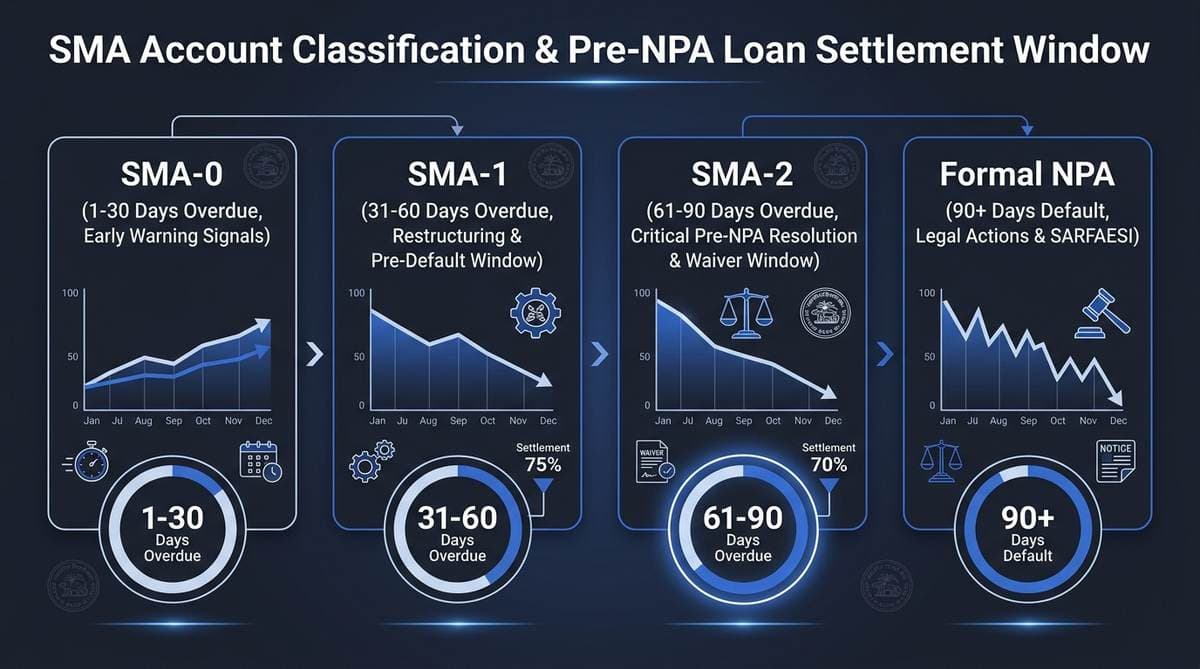
5. SMA Classification & Pre-NPA Settlement Visual Roadmap
The visual roadmap below shows the full path from Day 1 overdue to Day 90 NPA tagging. It highlights the pre-NPA window where you can secure maximum waivers and avoid court action.
6. Strategic Legal Advantage
Handling the pre-90-day SMA window needs proactive legal steps. Borrowers who negotiate alone often face threats from collection agents or demands to sell assets. With legal representation, talks move from recovery agents to the bank credit committee.
A structured legal strategy follows four clear phases:
Phase 1: Notice of Legal Representation & Fair Lending Protection
Advocates serve a formal notice to the bank Nodal Officer. This invokes the RBI Fair Practices Code, halts agent calls and home visits. And requires all talks to be in writing through legal counsel.
Phase 2: Forensic Ledger Audit & Penal Charge Dissection
Our lawyers review loan account statements from start to finish. We dispute unlawful compound interest and late fees under RBI Fair Lending Directives (August 2023 / April 2024).
Phase 3: Financial Hardship Dossier Submission to Zonal Sanction Authorities
We bypass front-line recovery staff. We submit a complete financial hardship dossier directly to the bank Zonal Stressed Asset branch. The file includes income drops, tax files, or medical records to prove genuine distress.
Phase 4: Structuring the Pre-NPA Compromise Settlement or Restructuring
Using the bank need to prevent an NPA tag at Day 90, advocates structure a compromise settlement. This secures full waivers of penal interest and closes the debt with zero court risk.
By presenting a clear legal settlement before Day 90, you get far better terms than after an account goes to court.
7. SMA Settlement Forensic Sanction Checklist
A big risk in SMA-1 and SMA-2 is fake settlement offers from third-party recovery agents. Under pressure to hit monthly targets, agents send unofficial messages promising to settle debt for a small token sum.
If you pay without a formal approval letter from the bank, the bank treats the cash as a normal partial payment. The DPD clock keeps ticking, the loan turns into an NPA at Day 90. And you still owe the full balance.
Before paying any settlement sum, check these five essential safety points:
The sanction letter must be on official bank letterhead with bank logos, approval tracking numbers. And authorized bank signatures.
The letter must state the exact final settlement sum in rupees, with clear payment dates and no hidden penalty terms.
The agreement must confirm that once you pay the settlement sum, all remaining principal, interest. And penal fees are fully waived.
The sanction must stop SARFAESI or Section 138 actions, return original title deeds. And promise a No Dues Certificate within 30 days under RBI rules.
Never pay into personal accounts or agent UPI handles. Always deposit settlement funds directly into your loan account via RTGS, NEFT, or an Account Payee Demand Draft drawn in favor of the bank.
8. Settlement Remittance Execution, Statutory No Dues
Paying the agreed settlement sum fulfills your financial duty. But the legal process ends only when the bank issues a formal No Dues Certificate (NDC) and updates credit bureaus to ₹0 balance.
Under RBI Circular RBI/2023-24/60 (Responsible Lending Conduct), all banks and NBFCs must follow strict settlement timelines:
Lenders must issue a No Dues Certificate (NDC), return all original property deeds or vehicle NOCs. And update credit bureaus (CIBIL, Experian, Equifax, CRIF High Mark) within 30 calendar days. If the bank delays without cause, it must pay payout of ₹5,000 per day of delay directly to the borrower.
Credit Bureau Dynamics: SMA Resolution vs. Post-NPA Default Tagging
Settling debt during the SMA stage gives you much better credit results than waiting for an NPA tag:
- No NPA Tag on Credit Bureau: The loan avoids the "NPA / Loss Asset". mark on CIBIL and Experian. The active balance is set to ₹0.
- Stops Negative DPD Accumulation: Closing the account halts late DPD tracking (such as 90+ or 180+ DPD), limiting credit damage to the 30–60 day mark.
- Faster Credit Score Recovery: Because the loan settled before NPA write-off, you can rebuild your CIBIL score to 750+ within 12 to 18 months, instead of 36+ months.
- Preserves Banking Relationships: A clean pre-NPA closure helps you keep good banking ties with other non-defaulted lenders across India.
9. Pre-NPA (SMA) Settlement vs. Post-NPA Legal Recovery
Comparing pre-NPA settlement with post-NPA litigation shows why acting early protects your rights and finances:
| Resolution Dimension. | Pre-NPA SMA Resolution Window (1–90 Days). | Post-NPA Legal Recovery Phase (91+ Days). |
|---|---|---|
| Statutory Asset Status. | Standard Stressed (SMA-0, SMA-1, SMA-2). | Non-Performing Asset (Sub-Standard / Doubtful / Loss). |
| Bank Capital Provisioning. | Nominal (0.40% to 5.0%). | Mandatory 15% to 25% (up to 100% over time). |
| SARFAESI Legal Exposure. | Zero. Bank has no power under Sec 13(2). | 60-day demand notice and property auction actions. |
| Court Litigation Threat. | Zero active DRT or Summary Suits. | Active DRT suits and Section 138 complaints. |
| Penal Interest Waivers. | Up to 100% penal charges and compound fees waived. | Heavy court fees and legal charges added to debt. |
| CIBIL Restoration Timeline. | Fast recovery (12 to 18 months to reach 750+). | Slow recovery (24 to 36+ months post-settlement). |
| Consortium / CRILC Impact. | Kept within early-stress tracking metrics. | Consortium-wide default alert and credit freeze. |
10. SettleLoans Pre-NPA Legal Defense
Resolving debt during the SMA window requires prompt legal action. SettleLoans helps borrowers across India. We serve formal notices to stop recovery agent calls. We review loan ledgers to remove illegal penal fees. Finally, we negotiate directly with bank zonal authorities to secure pre-NPA compromise settlements and restructuring before Day 90.

Settle Loan is India's trusted debt relief and loan settlement platform. We help borrowers overcome financial distress by negotiating with banks and NBFCs to legally settle personal loans and credit card debts. With our transparent, performance-based approach, you can achieve debt freedom and regain your financial peace of mind.
COMPUTER
11. FAQs: SMA Account Classification
Direct, legally verified answers to critical questions regarding the RBI SMA framework, Days-Past-Due calculation, penal waivers. And pre-NPA settlement rights in India.
What is the RBI Special Mention Account (SMA) classification framework?
The SMA framework is an early-warning system from the Reserve Bank of India (RBI). It helps banks track loan stress before an account becomes a Non-Performing Asset (NPA). Term loans are tracked by Days Past Due (DPD). SMA-0 covers 1 to 30 days overdue. SMA-1 spans 31 to 60 days. SMA-2 covers 61 to 90 days. After 90 days of default, the loan becomes an NPA.
Why is the SMA-2 (61–90 days) stage the most critical window for loan settlement?
SMA-2 is the final 30-day window before an account turns into an NPA at Day 91. At that point, banks must freeze income and set aside 15% to 25% in cash provisions. Branch managers face strict scrutiny for rising NPA numbers. This gives borrowers strong leverage to negotiate fee waivers, loan restructuring, or a pre-NPA settlement.
Can a borrower negotiate a One-Time Settlement (OTS) while an account is in SMA status before NPA?
Yes. Under RBI Master Directions on Stressed Assets, banks and NBFCs can agree to compromise settlements or loan restructuring during SMA stages. Pre-NPA settlements are often faster than post-NPA deals because lenders resolve the debt before mandatory court action starts.
What is the Central Repository of Information on Large Credits (CRILC) and how does SMA reporting work?
CRILC is an RBI database. Banks and NBFCs must report borrower loans of ₹5 Crores and above to CRILC. Lenders report SMA-0, SMA-1, and SMA-2 tags on weekly and monthly cycles. This real-time reporting alerts all consortium lenders about emerging loan stress.
How does negotiating a settlement in the SMA stage protect the borrower from SARFAESI and legal suits?
Under Section 13(2) of the SARFAESI Act, 2002, a bank can only issue a 60-day demand notice after declaring an NPA. Settling during the SMA window clears the debt before Day 90. This prevents the bank from issuing SARFAESI notices, seizing property, or filing DRT cases.
What penal charges and compound interest waivers can be secured during the SMA stage?
Under RBI rules on Fair Lending Practices, banks cannot compound penal interest. During SMA talks, legal advocates often secure 100% waivers on penal interest, bounce fees. And late charges. This lets you settle based on core principal and regular interest.
How does an SMA-stage pre-NPA settlement impact CIBIL and other credit bureau scores?
Settling during the SMA stage keeps the damaging 'NPA' tag off your credit report. While reports show past 30 to 60 DPD entries, closing the account sets the active balance to ₹0. This allows your credit score to recover to 750+ within 12 to 18 months.
What documentation must be verified in a Pre-NPA Settlement Sanction Letter before making payment?
The sanction letter must be on official bank letterhead with digital signatures and approval reference numbers from a senior credit officer. It must state the exact settlement amount, payment dates, full waiver of penal fees. And an agreement to issue a ₹0 No Dues Certificate within 30 days.
What should a borrower do if bank recovery agents start harassing them during SMA-1 or SMA-2?
Borrowers should hire legal counsel to send a formal Notice of Representation to the bank Nodal Officer. Under RBI Fair Practice Codes, agents cannot make threatening calls or visit outside 8 AM to 7 PM. Once legal notice is served, the bank must talk only through your lawyer.