- Absolute Immunity for Essential Assets: Basic clothing, cooking vessels, bedding, spouse Stridhan, agricultural implements, and artisan tools are completely immune from court attachment under Section 60(1)(a)–(c) CPC.
- Statutory Salary Attachment Ceiling: Under Section 60(1)(i) CPC, the first ₹1,000 plus two-thirds of remaining salary, alongside 100% of all statutory allowances (HRA, DA, conveyance), is entirely exempt from civil execution.
- Strict 24-Month Execution Limit: A civil court salary attachment order cannot exceed 24 cumulative months, followed by a mandatory 12-month complete freeze against any further execution decrees.
- Total Protection for Retirement & Insurance: General Provident Fund (GPF), Employee Provident Fund (EPF), Public Provident Fund (PPF), Gratuity, Pensions, and Life Insurance Corporation (LIC) policies enjoy complete statutory immunity under Section 60(1)(g), (k), (ka), and (kb).
- Compromise Settlement Leverage: Because civil court execution takes 2 to 4 years and yields capped recoveries, banks routinely agree to advocate-led One-Time Settlements (OTS) at 45% to 65% principal haircuts backed by official ₹0 No Dues Certificates.
1. The Statutory Architecture of Section 60 CPC:
When borrowers default on unsecured personal loans, business credit facilities, or credit card obligations, financial institutions frequently resort to high-pressure intimidation. Third-party collection agencies and bank legal departments routinely dispatch aggressive notices threatening the immediate seizure of residential homes, the freezing of total monthly salaries, the confiscation of household appliances, and the attachment of family gold. These aggressive assertions intentionally exploit the borrower's unfamiliarity with the foundational principles of Indian civil jurisprudence.
Under the sovereign laws of India, commercial debt recovery is governed strictly by the Code of Civil Procedure, 1908 (CPC). A commercial bank, non-banking financial company (NBFC), or asset reconstruction company (ARC) has zero administrative power to unilaterally confiscate property or garnish wages. To enforce any monetary recovery against an unsecured debtor, the lender must first institute a formal civil suit or summary suit under Order XXXVII CPC, establish contractual breach, pay mandatory ad-valorem court fees, and obtain a formal judicial decree from a competent civil court.
Once a monetary decree is passed, the lender must initiate separate execution proceedings under Order XXI of the CPC. It is at this critical juncture that Section 60 of the Code of Civil Procedure emerges as an impenetrable statutory shield. Enacted to uphold human dignity and prevent financial destitution, Section 60 explicitly defines what property is liable to attachment and sale in execution of a decree, while carving out comprehensive, non-negotiable exemptions that strictly prohibit civil courts, executing officers, and bailiffs from attaching the fundamental necessities of life, livelihood tools, retirement savings, and essential salary components.
Execution is the final enforcement stage of civil litigation. The decree-holder (bank) applies to the executing court for attachment warrants. However, the executing court is bound by Section 60 prohibitions and cannot exceed statutory limits regardless of the total debt quantum claimed.
The Supreme Court of India has established that Section 60 exemptions are founded on overarching public policy. A debtor cannot even voluntarily contract away or waive these statutory protections in a loan agreement; any clause purporting to waive Section 60 exemptions is void ab initio.
2. Complete Forensic Breakdown of Non-Attachable Assets Under Section 60(1) CPC
The proviso to Section 60(1) of the Code of Civil Procedure sets forth an exhaustive statutory catalog of properties and monetary assets that are totally exempt from court attachment or sale. Understanding each specific sub-clause empowers borrowers to recognize illegal recovery threats and file robust objections before executing courts:
Section 60(1)(a): Necessary Wearing Apparel, Cooking Utensils & Bedding
The court bailiff or executing officer is strictly barred from seizing the necessary wearing apparel, cooking vessels, beds, and bedding belonging to the judgment-debtor, their spouse, and children. Furthermore, personal ornaments of religious significance that cannot be parted with by any woman under religious usage—most notably a Mangalsutra, wedding bands, and sanctified bangles—are completely exempt.
Spouse's Jewelry & Stridhan: Absolute Protection Under Hindu Law
Under established Indian civil jurisprudence, a wife's gold jewelry, ancestral gifts, and wedding presents constitute her absolute personal property, known as Stridhan. In executing a decree against a husband for an unsecured personal loan, credit card, or business default where the wife is not a formal co-borrower or guarantor, the bank has zero legal right to attach her Stridhan. Attempts by recovery agents to inventory or threaten the wife's jewelry constitute actionable civil tort and criminal intimidation.
Section 60(1)(b) & (c): Tools of Artisans, Agricultural Implements & Farmer Dwellings
The law protects the judgment-debtor's means of earning a livelihood. Tools of artisans (e.g., professional instruments, computers used by freelance professionals, technician kits), implements of husbandry, seed-grain, and cattle necessary for an agriculturist to cultivate land are totally exempt. Additionally, under clause (c), houses and other buildings occupied by agriculturists, agricultural laborers, or rural domestic servants are fully protected from attachment.
Section 60(1)(g), (k), (ka) & (kb): Pensions, PF, Gratuity & LIC Policies
Statutory retirement savings and social security funds enjoy unshakeable legislative immunity. Under clause (g), civil and military service pensions and political stipends cannot be attached. Under clause (k) and (kb), all compulsory deposits in General Provident Funds (GPF), Public Provident Funds (PPF under the PPF Act), Employee Provident Funds (EPF Act, 1952), and Gratuity (Payment of Gratuity Act, 1972) are completely shielded. Under clause (ka), all moneys payable under a policy of insurance on the life of the judgment-debtor (LIC policies) are totally protected from civil court attachment.
Check Your Loan Settlement Options
Answer 2 quick questions to evaluate your settlement eligibility.
1. What type of loan do you want to settle?
3. The Statutory Salary Attachment Ceiling: Section 60(1)(i) Formula & The 24-Month Rule
For salaried professionals across both public and private sectors, recovery agents frequently threaten that the bank will issue a direct mandate to human resources or payroll to withhold 100% of their monthly remuneration. Under the sovereign legal framework of India, this threat is entirely false. Wage attachment can only occur pursuant to a formal judicial precept issued by an executing civil court, and even then, it is subject to rigorous mathematical deduction caps codified under Section 60(1)(i) of the CPC.
In all civil money decree executions (other than decrees for maintenance), the statutory formula dictates that the first ₹1,000 plus two-thirds of the remainder of salary is completely exempt from court attachment:
Crucially, under Section 60(1)(l) CPC, all statutory allowances—including Dearness Allowance (DA), House Rent Allowance (HRA), Transport/Conveyance Allowance, Medical Allowance, and Children's Education Allowance—are 100% exempt from attachment. The court cannot touch allowances; only net basic salary above ₹1,000 is subjected to the fractional one-third calculation.
Practical Numerical Case Illustration: ₹60,000 Monthly Salary
Consider a salaried borrower with a monthly gross remuneration of ₹60,000, comprising a Basic Pay of ₹30,000 and ₹30,000 in exempt allowances (HRA, DA, Transport Allowance). Applying the Section 60(1)(i) statutory calculation:
| Salary Component | Gross Monthly Amount | Statutory Treatment Under CPC | Attachable Quantum |
|---|---|---|---|
| Allowances (HRA, DA, TA, Medical) | ₹30,000 | 100% Exempt under Section 60(1)(l) CPC | ₹0 (Zero) |
| Basic Pay Exemption Threshold | ₹1,000 | 100% Mandatory Flat Exemption | ₹0 (Zero) |
| Remainder Basic Pay (₹29,000) | ₹29,000 | 2/3rd Statutorily Exempt (₹19,333) | 1/3rd Attachable = ₹9,667 |
| Total Monthly Salary Attachable | ₹60,000 Total Gross | ₹50,333 Statutorily Protected | Maximum ₹9,667 / Month |
Under the second proviso to Section 60(1)(i) CPC, when any portion of a debtor's salary has been attached in execution of a decree for a cumulative duration of 24 months, that salary is granted complete statutory immunity from any further attachment in execution of the same decree. Furthermore, it cannot be attached in execution of any other subsequent decree until a mandatory cooling hiatus of 12 full months has elapsed. A creditor cannot perpetually garnish an employee's earnings.
4. Bank Balance Sheet Accounting, NPA Capital Provisioning & The NPV Recovery Equation
To negotiate effectively against aggressive recovery departments, a borrower must understand how commercial banks evaluate delinquent debts on their balance sheets. When a loan default crosses 90 days of non-payment, Reserve Bank of India (RBI) prudential norms compel the lender to classify the asset as a Non-Performing Asset (NPA) under Income Recognition and Asset Classification (IRAC) guidelines.
Once an account transitions into NPA status, the bank can no longer recognize unrealized interest as income. More critically, the bank must set aside substantial capital provisions from its operating profits to hedge against default risk as the delinquency ages:
| Delinquency Asset Stage | Aging Timeline | Mandatory RBI Capital Provision | Compromise Settlement Scope |
|---|---|---|---|
| SMA-1 / SMA-2 | 31 – 90 Days Overdue | 5% General Asset Provision | Waiver of Penal Interest & Overdue Charges |
| Substandard NPA | 91 – 365 Days Overdue | 25% Full Capital Provision | 35% – 45% Principal Haircut |
| Doubtful NPA 1 (D1) | 12 – 24 Months Default | 100% Capital Lock-in | 45% – 55% Principal Haircut |
| Doubtful NPA 2 / Loss Asset | 24+ Months / Written-Off | 100% Full Balance Sheet Write-Off | 55% – 65% Principal Haircut |
Because pursuing a protracted civil suit through trial and execution takes 2 to 4 years, incurs heavy court fees and advocate retainers, and results in strictly capped Section 60 CPC wage attachments, bank Stressed Asset Resolution Committees evaluate delinquent accounts using the Net Present Value (NPV) of Recovery benchmark:
Where C_t represents estimated recoveries subject to Section 60 CPC wage caps across time, r is the bank's internal discount rate, and deductions account for 3–5 years of court friction, advocate retainers, Ombudsman complaint liabilities, and regulatory capital locked in NPA provisions.
When a bank compares the discounted present value of multi-year litigation against an immediate upfront lump-sum recovery of 35% to 55% via a structured One-Time Settlement (OTS), the financial committee will almost always approve the settlement to release locked capital and purge bad debts from its balance sheet.
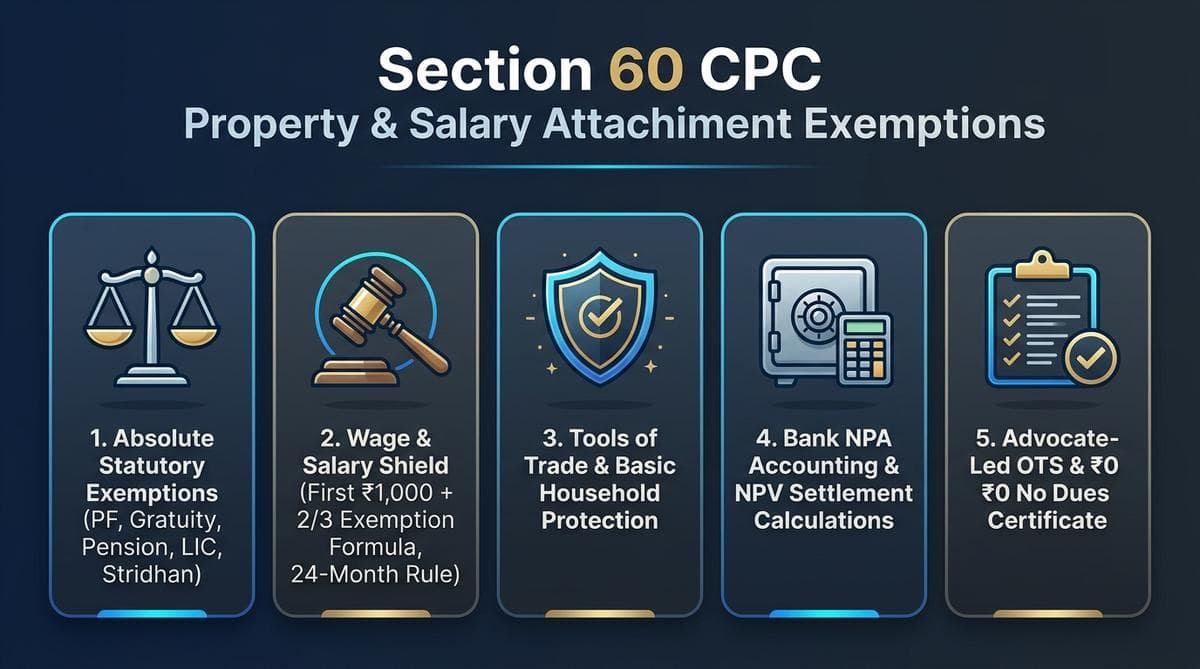
5. Section 60 CPC Property & Salary Attachment Exemptions: Visual Legal Defense Roadmap
The visual roadmap below details the structured 5-pillar statutory defense and debt resolution architecture through which borrowers transition from unlawful collection threats to complete debt extinguishment under a legally verified One-Time Settlement.
6. The 4-Stage Advocate Defense Protocol Against Unlawful Execution & Recovery Harassment
When confronting bank civil execution notices or aggressive collection tactics, borrowers cannot afford passive inaction. Retaining experienced debt defense legal counsel ensures an institutional barrier that prevents default judgments and halts illegal harassment:
Stage 1: Forensic Summons Audit & Appearance Filing
Advocates conduct an immediate forensic examination of the court summons (Order 37 Summary Suit or Order 21 Execution Petition). If served under Order 37, counsel files the mandatory Memorandum of Appearance within 10 calendar days to prevent an ex-parte monetary decree.
Stage 2: Section 60 CPC Exemption Objections & Stay Application
In execution proceedings under Order 21 CPC, advocates file a formal Affidavit of Exemption under Section 60 CPC, demonstrating the protected character of the borrower's salary, Stridhan, and retirement savings, while moving an urgent stay application under Order XXI Rule 26 CPC.
Stage 3: Cease-and-Desist Notice & RBI Ombudsman Escalation
If third-party recovery agents visit the borrower's home, contact employers, or threaten family members, advocates serve an immediate statutory cease-and-desist notice on the bank's Managing Director and lodge an expedited grievance on the RBI Integrated Ombudsman CMS portal (cms.rbi.org.in).
Stage 4: High Court Revision / Writ Intervention
In cases where an executing court erroneously attaches exempt properties or disregards statutory salary caps, counsel files an urgent Civil Revision Petition under Section 115 CPC or a Writ Petition under Article 226/227 before the High Court to set aside the attachment.
7. Negotiating a Discretionary 45%–65% One-Time Settlement (OTS)
The ultimate goal of debt defense is permanently extinguishing civil liability through an institutional One-Time Settlement (OTS). An OTS is a consensual, legally binding compromise contract wherein the lender accepts a discounted lump sum or structured installment payment to close the loan account in full and final satisfaction of all claims.
Our specialized banking advocates structure OTS negotiations directly with the bank's Zonal Settlement Committee, incorporating essential strategic safeguards:
We secure complete 100% waivers of all accumulated penal interest, late fees, and legal expenses, alongside a 45% to 65% reduction on the principal ledger balance based on default vintage.
We compile documented evidence of bona fide distress—such as medical crises, business insolvency, or family dependency—to satisfy internal bank auditing criteria for discretionary compromises.
The settlement terms obligate the bank to formally withdraw all pending civil suits, Section 138 NI Act complaints, and execution petitions before the court upon settlement payment.
Where immediate single-shot lump-sum remittance is unfeasible, we structure the compromised sum across 2 to 4 manageable monthly installments aligned with your financial capacity.
8. Sanction Letter Forensics, Direct Remittance, RBI ₹0 NDC Mandate & Bureau Trajectory
A critical hazard in loan resolution is falling victim to unauthorized settlement promises manufactured by rogue recovery agents. Unscrupulous tele-callers frequently fabricate fake discount letters to collect partial payments that are subsequently misapplied toward overdue penal fees rather than settling the loan. Borrowers must never disburse settlement funds until the approval letter passes rigorous forensic verification.
- Official Bank Letterhead & Central Reference: The letter must be issued on official bank stationery containing a verifiable central reference number and the signature of an authorized Zonal/Scale-IV Manager.
- Unambiguous Account & PAN Details: The document must explicitly state your full legal name, PAN card number, and exact 16-digit loan account number.
- Absolute Debt Extinguishment Recital: The agreement must explicitly declare that upon receipt of the agreed compromised amount, all remaining principal, interest, and legal claims stand completely extinguished.
- Direct Loan Account Remittance: Payment must be made strictly via direct RTGS/NEFT to your specific loan account number or an official bank-stamped demand draft, never to third-party collection accounts.
Under RBI Circular RBI/2023-24/60, all commercial banks and NBFCs are legally mandated to deliver a formal No Dues Certificate (NDC) / Loan Closure Letter and update credit information companies (CIBIL, Experian, Equifax, CRIF High Mark) within 30 calendar days of receiving the agreed settlement sum. If a bank fails to issue the NDC within 30 days, the lender is legally required to pay a mandatory statutory penalty of ₹5,000 for each day of delay directly to the borrower.
Credit Bureau Trajectory & Score Rehabilitation
Following settlement, the bank updates credit bureau records with the status remark "Settled" or "Post-Write-off Settled" with a current outstanding balance of ₹0. While this results in a temporary credit score dip of 70 to 120 points, it completely eliminates default compounding and permanently closes all legal risk. By obtaining a secured fixed-deposit credit card, keeping credit utilization below 30%, and maintaining timely utility payments, settled borrowers systematically rebuild their credit score back above 750 within 18 to 24 months.
9. Comparative Legal Matrix: Recovery Threats vs. Order 21 Attachment vs. Section 60 CPC vs. OTS
Evaluating the legal reality versus recovery agent threats enables borrowers to make confident, strategic decisions regarding asset defense and debt resolution:
| Resolution Pathway | Legal Authority & Scope | Impact on Salary & Assets | Enforcement Timeline | Final Legal Effect |
|---|---|---|---|---|
| Unlawful Recovery Agent Threats | Zero Legal Authority (Illegal Tort & Harassment) | Zero Legal Attachment Power; Null & Void | Immediate / Coercive | Subject to RBI Ombudsman Penalties & Injunctions |
| Civil Court Execution (Order 21 CPC) | Judicial Money Decree Following Full Trial | Section 60(1)(i) Caps Apply; Allowances & Stridhan Exempt | 2 – 4 Years | Strict 24-month execution limit with 12-month hiatus |
| Section 60 CPC Statutory Shield | Mandatory Legislative Exemption Framework | 100% Protection for PF, Gratuity, Pension, LIC & Tools | Immediate Application | Complete statutory bar preventing creditor attachment |
| Advocate-Led 55% OTS | Consensual Institutional Compromise Agreement | 100% Protection; Complete Debt Extinguishment | 15 – 30 Days | Bank-stamped ₹0 No Dues Certificate & Case Withdrawal |
10. SettleLoans Legal Defense & Debt Resolution Advisory
Defending borrowers against aggressive banking litigation requires seasoned legal advocates who master the nuances of Section 60 CPC statutory exemptions, Order XXI execution procedures, Reserve Bank of India Fair Practices Codes, and institutional debt restructuring. SettleLoans provides complete, confidential legal protection across India: serving formal cease-and-desist notices to stop harassment, filing Section 60 CPC exemption briefs before civil courts, escalating violations to the RBI Banking Ombudsman, and negotiating directly with bank zonal committees to secure 45% to 65% principal haircuts backed by official No Dues Certificates.

Settle Loan is India's trusted debt relief and loan settlement platform. We help borrowers overcome financial distress by negotiating with banks and NBFCs to legally settle personal loans and credit card debts. With our transparent, performance-based approach, you can achieve debt freedom and regain your financial peace of mind.
COMPUTER
11. Frequently Asked Questions: Section 60 CPC Property & Salary Attachment
Direct, legally verified answers to critical questions regarding Section 60 CPC exemptions, salary attachment limits, Stridhan protection, and bank debt resolution.
What property is strictly exempted from attachment under Section 60 CPC?
Under Section 60(1) of the Code of Civil Procedure, 1908, courts and bailiffs cannot attach: basic wearing apparel, bedding, and cooking utensils; personal ornaments for religious usage such as a Mangalsutra; tools of artisans and agricultural implements; houses of agriculturists/laborers; books of account; pensions, gratuity, and provident funds (GPF/EPF/PPF); life insurance policy proceeds; and essential proportions of salary as calculated under Section 60(1)(i).
How is the salary attachment limit calculated under Section 60(1)(i) CPC?
In execution of a decree for money (other than maintenance), Section 60(1)(i) CPC exempts the first ₹1,000 plus two-thirds of the remainder of the monthly salary. In addition, under Section 60(1)(l), all statutory allowances (such as HRA, Dearness Allowance, and Conveyance Allowance) are 100% exempt from attachment. Only the remaining one-third of net basic pay above ₹1,000 can be attached.
Can a civil court attach a salary for more than 24 months?
No. Under the second proviso to Section 60(1)(i) CPC, when any portion of a person's salary has been attached in execution of a decree for a cumulative period of 24 months, that salary is granted total statutory immunity from any further attachment in execution of that decree, or any subsequent decree, for a mandatory cooling period of 12 full months.
Can a bank attach my spouse's jewelry (Stridhan) for my personal loan default?
No. A wife's jewelry and personal gifts acquired during marriage constitute her absolute and exclusive property known as 'Stridhan' under Hindu law and established Indian jurisprudence. Unless the spouse is a formal co-borrower or legal guarantor to the loan contract, her assets and Stridhan enjoy complete immunity from attachment for her husband's separate commercial debts.
Are Provident Funds (EPF/PPF) and Gratuity protected from court attachment?
Yes. Under Section 60(1)(k) and (kb) of the CPC, read with Section 10 of the Employees' Provident Funds Act, 1952, Section 3 of the Provident Funds Act, 1925, and Section 13 of the Payment of Gratuity Act, 1972, statutory provident funds and gratuity balances enjoy absolute statutory immunity from court attachment, civil execution decrees, and bank liens.
Can a bank seize agricultural land or farming implements under Section 60 CPC?
Under Section 60(1)(b) CPC, tools of artisans, implements of husbandry, necessary cattle, and seed-grain required for an agriculturist to earn their livelihood are strictly exempt from attachment. Furthermore, agricultural land is broadly protected from summary commercial seizure under regional state civil amendments and debt relief legislation.
Can a bank attach a Life Insurance Corporation (LIC) policy for debt recovery?
Under Section 60(1)(ka) CPC, all moneys payable under a policy of insurance on the life of the judgment-debtor are completely exempt from civil court attachment. Lenders cannot direct insurance companies to liquidate or surrender the policy to satisfy an unsecured commercial debt decree.
What is the difference between bank recovery agent threats and lawful court attachment?
Recovery agents possess zero legal authority to seize property, freeze wages, or enter homes. Lawful attachment requires a bank to file a civil suit, prove the debt, obtain a final money decree under Order 21 CPC, and have a court-appointed bailiff execute the order strictly within the exemption limits of Section 60 CPC.
How can a borrower stop court execution proceedings and resolve the debt?
Borrowers can engage debt defense advocates to file Section 60 CPC exemption objections, apply for stay of execution under Order XXI Rule 26 CPC, and simultaneously initiate negotiations for an advocate-led One-Time Settlement (OTS) to settle the account at a 45% to 65% principal haircut.
What timeline does the RBI mandate for releasing a No Dues Certificate after settlement?
Under RBI Circular RBI/2023-24/60, all regulated lenders must issue an official No Dues Certificate (NDC) and update credit bureau records to reflect a zero balance within 30 calendar days of receiving the agreed settlement amount. Any delay beyond 30 days incurs a mandatory statutory compensation of ₹5,000 per day payable to the borrower.