- Zero Direct DDO Deduction Power: Private banks and NBFCs possess zero administrative authority to direct your Drawing and Disbursing Officer (DDO) or Treasury to deduct salary without a formal civil court execution decree.
- Section 60 CPC Statutory Wage Shield: Indian civil law guarantees that the first ₹1,000 plus two-thirds of your remaining monthly salary, alongside all statutory allowances, is completely immune from civil court attachment.
- CCS Conduct Rules Clarification: Financial distress resulting from bona fide medical, domestic, or economic hardships does not constitute "habitual indebtedness" or moral turpitude under CCS Conduct Rule 16 and cannot justify departmental disciplinary termination.
- Strict Workplace Harassment Prohibition: Under RBI Master Directions, collection agents are legally barred from contacting your departmental superiors, visiting government offices, or threatening vigilance inquiries.
- Confidential OTS Without Service Record Trace: A structured One-Time Settlement (OTS) legally extinguishes the debt, delivers a zero-balance No Dues Certificate, and safeguards your promotion and vigilance clearance without any employer notification.
1. Demystifying Government PSU Employee Loan Default: Service
For employees serving across Central Ministries, State Civil Departments, Indian Railways, Defense Establishments, and Public Sector Undertakings (PSUs), the onset of financial distress carries a psychological terror far exceeding that felt by private sector workers. The primary dread is not merely financial loss, but the haunting specter of losing one's hard-earned public service post, enduring departmental disciplinary inquiries, or suffering the public humiliation of having bank legal notices served directly upon departmental superiors or Drawing and Disbursing Officers (DDOs).
Unscrupulous collection agencies routinely exploit this exact vulnerability. Aggressive tele-callers and third-party recovery agents frequently impersonate court officials, threaten immediate suspension under service conduct rules, fabricate claims of pending vigilance inquiries, and falsely assert that commercial loan defaults trigger summary dismissal from public employment. To dismantle this psychological coercion, public servants must understand the clear statutory demarcation between private civil debt default and official service misconduct under Indian administrative law.
Under Rule 16 of the Central Civil Services (Conduct) Rules, 1964, a government servant is instructed to manage private finances to avoid habitual indebtedness. However, administrative jurisprudence establishes that habitual indebtedness requires continuous, reckless over-leveraging that compromises official integrity or leads to formal insolvency adjudication. Unforeseen default on unsecured commercial loans due to medical crises, family emergencies, or macroeconomic distress does not constitute an act of moral turpitude or corrupt conduct.
Under Rule 17 of the Railway Servants (Conduct) Rules, 1966, as well as standing employment orders across Navratna/Maharatna PSUs (such as BHEL, ONGC, NTPC, and IOCL), the legal threshold for departmental intervention is identical. A lender's commercial dispute cannot be imported into a disciplinary tribunal unless there is evidence of criminal fraud, embezzlement of public funds, or corrupt misuse of official position.
An unsecured personal loan or credit card agreement represents a pure debtor-creditor civil contract governed exclusively by the Indian Contract Act, 1872. The inability to service equated monthly installments (EMIs) constitutes a civil breach of contract, not a criminal transgression against the State. Consequently, commercial lenders possess no legal entitlement to weaponize your employer as a private collection mechanism.
2. Statutory Salary Attachment Laws: Section 60 CPC, DDO Jurisdictional Limits & Maximum Deduction Caps
One of the most persistent myths propagated by recovery personnel is the assertion that a bank can simply issue a letter to your office Treasury or DDO to freeze your salary or enforce monthly pay cuts. Under the sovereign legal framework of India, this assertion is entirely fraudulent. A commercial bank or NBFC has zero administrative authority over government accounting offices.
The sole legal pathway through which any portion of a government servant's salary can be attached for civil monetary recovery is codified under Order XXI, Rule 48 of the Code of Civil Procedure, 1908 (CPC). This procedure requires the lender to:
Institute a formal money recovery suit or summary suit under Order 37 CPC in a competent civil court, pay ad-valorem court fees, and establish contractual liability through protracted trial proceedings spanning 2 to 4 years.
Obtain a final, non-appealable judgment and monetary decree establishing the exact adjudicated quantum of lawful civil liability against the borrower.
Initiate execution proceedings under Order 21 Rule 48 CPC, requesting the executing court to issue a judicial precept directly to the specific disbursing officer.
Even when a civil court issues a formal execution decree, the law establishes strict boundaries to protect the basic subsistence of public servants. Under Section 60(1)(clause i) of the CPC, in all civil debt executions:
Furthermore, under Section 60(1)(clause l), all statutory allowances—including Dearness Allowance (DA), House Rent Allowance (HRA), Transport Allowance (TA), Children Education Allowance, and Uniform Allowance—are 100% exempt from court attachment. Only basic pay is subject to the fractional calculation.
Crucially, under the second proviso to Section 60(1)(i) CPC, when any portion of a government servant's salary has been attached in execution of a decree for a cumulative period of 24 months, that salary is granted total statutory immunity from any further attachment in execution of the same decree, or any subsequent decree for a further mandatory hiatus of 12 full months. These protections ensure that no creditor can indefinitely paralyze a public servant's livelihood.
Check Your Loan Settlement Options
Answer 2 quick questions to evaluate your settlement eligibility.
1. What type of loan do you want to settle?
3. Departmental Notices, Recovery Agent Harassment & Central Administrative Tribunal (CAT) Jurisprudence
When bank recovery departments send informal demand letters directly to a government department, mark copies to the Vigilance Officer, or make abusive phone calls to an administrative branch, they commit severe, actionable violations of Indian law and Reserve Bank of India directives. Under the RBI Master Direction on Fair Practices Code for Lenders, financial institutions are strictly prohibited from:
Illegal Third-Party Disclosure & Workplace Trespass
Contacting an employer, disclosing confidential debt records to colleagues, or sending recovery agents to high-security government establishments or defense cantonments violates Section 29 of the Credit Information Companies (Regulation) Act, 2005, and constitutes criminal trespass under the Bharatiya Nyaya Sanhita.
Fabrication of Non-Bailable Warrants & Vigilance Threats
Sending counterfeit "Court Summons" or fake "CVC Inquiry Notices" via WhatsApp or postal courier to intimidate employees is a punishable offense under Section 318 (Cheating) and Section 336 (Forgery) of the Bharatiya Nyaya Sanhita, 2023.
Armed Forces & Defense Court Martial Deceptions
For defense personnel serving in the Indian Army, Navy, or Air Force, recovery agents frequently threaten Court Martial proceedings under the Army Act. In reality, private commercial debt defaults are entirely outside military court jurisdiction. Military tribunals have zero authority over commercial contract disputes.
Landmark Central Administrative Tribunal (CAT) & High Court Rulings
The Central Administrative Tribunal (Principal Bench, New Delhi) and various High Courts across India have repeatedly established that ordinary indebtedness does not constitute misconduct warranting disciplinary penalties. In landmark judgments examining Rule 16 of the CCS Conduct Rules, administrative benches have ruled that where indebtedness arises from unforeseen family illness, legal obligations, or genuine economic hardships, an employee cannot be subjected to major penalties such as compulsory retirement, reduction in rank, or termination of service.
Furthermore, courts have held that an employer cannot take adverse disciplinary cognizance of an unadjudicated bank notice. Unless an employee is formally convicted of a criminal offense involving moral turpitude by a criminal court of competent jurisdiction, your service record, promotion trajectory, and retirement gratuity remain completely shielded under Article 311 of the Constitution of India.
4. Bank Balance Sheet Accounting, NPA Provisioning & The Net Present Value (NPV) Equation
To negotiate effectively from a position of strength, a government employee must understand how banks account for delinquent loans behind closed doors. When an unsecured personal loan or credit card crosses 90 days of non-payment, Reserve Bank of India prudential norms compel the lender to classify the account as a Non-Performing Asset (NPA).
Once classified as an NPA, the loan ceases to generate accrued interest income on the bank's profit-and-loss statement. Worse for the lender, the bank must set aside 100% risk-weighted capital provisions from its operating profits as the debt ages:
| Delinquency Classification | Overdue Aging Timeline | Mandatory RBI Capital Provision | Settlement / Haircut Scope |
|---|---|---|---|
| SMA-1 / SMA-2 | 31 – 90 Days Overdue | 5% General Capital Provision | Penal Interest & Overdue Fee Waivers |
| Substandard NPA | 91 – 365 Days Overdue | 25% Unsecured Provisioning | 35% – 45% Principal Haircut |
| Doubtful NPA 1 (D1) | 12 – 24 Months Default | 100% Full Capital Provision | 45% – 55% Principal Haircut |
| Doubtful NPA 2 / Loss Asset | 24+ Months / Written-Off | 100% Complete Balance Sheet Write-Off | 55% – 65% Principal Haircut |
Because initiating a civil recovery suit against a government servant involves paying heavy court fees, hiring trial advocates, enduring 3 to 5 years of procedural delays, and confronting Section 60 CPC wage attachment caps, bank recovery committees evaluate delinquent loans using the Net Present Value (NPV) of Recovery formula:
Where C_t represents estimated recoveries under Section 60 CPC caps over time, r is the bank's cost of capital, and deductions account for multi-year court litigation expenses, advocate retainers, regulatory risk from Ombudsman complaints, and locked NPA capital.
When a bank compares the discounted present value of years of litigation against an immediate upfront lump-sum recovery of 35% to 55% via a formal One-Time Settlement (OTS), the financial committee will almost always approve the settlement to release locked capital and purge bad debts from its balance sheet.
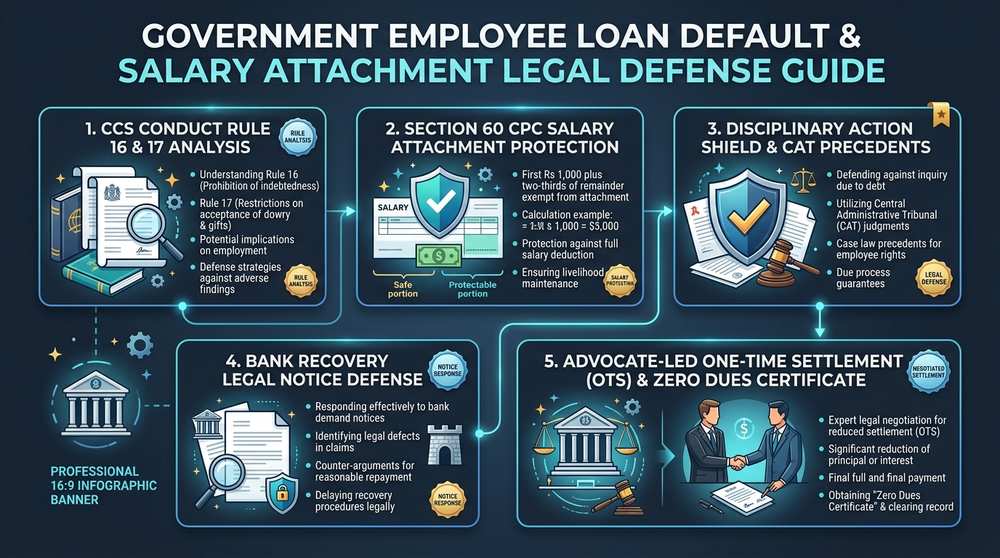
5. Government Employee Debt Defense & Resolution Visual Roadmap
The visual roadmap below details the structured 5-stage institutional process through which public sector employees transition from collection harassment and salary attachment threats to complete debt extinguishment under a legally verified One-Time Settlement.
6. The 4-Stage Advocate Defense Protocol for Government, Defense & PSU Personnel
When confronting aggressive bank recovery actions, government employees cannot afford passive delay or informal verbal arguments with collection agents. Retaining experienced debt defense legal advocates ensures an aggressive, institutional buffer that insulates your department and career from collateral damage:
Stage 1: Cease-and-Desist Notice & Anti-Harassment Injunction
Advocates serve an immediate statutory legal demand on the bank's Managing Director, Zonal Collection Head, and Principal Nodal Officer. The notice formally places the bank on record regarding illegal employer contact, cites RBI Fair Practices Code violations, and warns of criminal defamation and damages suits if workplace communications do not immediately cease.
Stage 2: Invoking Section 60 CPC & DDO Protection Filing
Counsel prepares a comprehensive legal brief detailing the employee's protected salary structure under Section 60(1)(i) CPC, establishing that non-basic allowances are statutorily unattachable and demonstrating that any extra-judicial demand served on the DDO is void ab initio.
Stage 3: Escalation to RBI Integrated Ombudsman Portal
If third-party collection agents persist in harassing the borrower's workplace or issuing threats of vigilance action, an expedited regulatory complaint is lodged on the RBI CMS portal (cms.rbi.org.in) under the category of "Harassment and Unfair Debt Recovery Practices". Banks face severe regulatory audits and monetary penalties for employer harassment.
Stage 4: High Court Writ or CAT Injunction (Emergency Protection)
In rare instances where a Public Sector Bank attempts unauthorized administrative recovery or where an overzealous administrative branch initiates unwarranted disciplinary queries, counsel files an urgent Writ Petition under Article 226 of the Constitution before the High Court or an Original Application (OA) before the Central Administrative Tribunal to secure protective interim orders.
This comprehensive legal framework strips the recovery agency of its coercive leverage, forcing the bank's Stressed Asset Resolution Group to engage in bona fide settlement discussions directly with our advocates.
7. Negotiating a Discretionary 45%–65% One-Time Settlement (OTS) Without Service Record Impact
The ultimate objective of debt defense is not merely halting harassment, but permanently extinguishing the underlying debt through an institutional One-Time Settlement (OTS). An OTS is a consensual, legally binding compromise agreement wherein the lender accepts a discounted lump sum or multi-tranche payment to close the loan account in full and final satisfaction of all claims.
For government and PSU employees, our advocates structure the OTS negotiation with critical institutional safeguards:
We secure 100% waivers on all accumulated penal interest, compounding late fees, and legal expenses, while negotiating a 45% to 65% reduction on the principal ledger balance based on the loan's NPA vintage.
The settlement terms incorporate strict confidentiality covenants, ensuring that the bank does not communicate with your employer, DDO, or department, keeping your Service Book and APAR/ACR entirely untainted.
We assemble documented evidence of genuine distress—such as medical records, family financial dependency, or sudden domestic emergencies—to justify discretionary compromise approvals before the bank's Zonal Settlement Committee.
Where lump-sum payment is not immediately feasible, we structure the compromised settlement amount across 2 to 4 manageable monthly installments aligned with your disposable salary inflow.
8. Sanction Letter Forensics, Direct Remittance, RBI ₹0 NDC Mandate & Bureau Trajectory
A critical hazard during loan settlement is falling prey to fraudulent settlement promises issued by rogue recovery agents. Tele-callers routinely generate unauthorized discount slips on fake letterheads to collect partial payments that are subsequently misapplied toward accrued penal interest rather than settling the loan. Government employees must never disburse settlement funds until the approval letter passes rigorous forensic verification.
- Official Bank Letterhead & Reference: The letter must be issued on official bank stationery with a verifiable central sanction reference number and the digital or physical signature of an authorized Scale-IV/Zonal Manager.
- Unambiguous Account & PAN Recital: The document must explicitly state your full legal name, permanent account number (PAN), employee identification, and the exact 16-digit loan account number.
- Absolute Debt Extinguishment Clause: It must explicitly state that upon receipt of the agreed compromised sum, all outstanding principal, interest, penal charges, and legal claims stand completely extinguished.
- Direct Loan Account Remittance: Payment must be made strictly via direct RTGS/NEFT to your specific loan account number or an official bank-stamped demand draft, never to third-party collection accounts.
Under RBI Circular RBI/2023-24/60, all commercial banks and NBFCs are legally mandated to deliver a formal No Dues Certificate (NDC) / Loan Closure Letter and update credit information companies (CIBIL, Experian, Equifax, CRIF High Mark) within 30 calendar days of receiving the agreed settlement amount. If a bank fails to issue the NDC within 30 days, the lender is legally required to pay a mandatory statutory penalty of ₹5,000 for each day of delay directly to the borrower.
Understanding CIBIL Bureau Reporting & Credit Score Rehabilitation
Following settlement, the bank updates credit bureau records with the status remark "Settled" or "Post-Write-off Settled" with a current outstanding balance of ₹0. While this results in a temporary credit score dip of 70 to 120 points, it completely eliminates default compounding and prevents any legal action. By obtaining a secured fixed-deposit credit card, keeping credit utilization below 30%, and maintaining timely utility payments, settled employees systematically rebuild their credit score back above 750 within 18 to 24 months.
9. Comparative Legal Matrix: Recovery Threats vs. Civil Court Decree vs. CAT Inquiry vs. OTS
Evaluating the legal reality versus recovery agent threats allows government and PSU employees to make confident, informed decisions regarding their debt resolution strategy:
| Resolution Mechanism | Legal Basis & Limitations | Salary & Service Impact | Typical Timeline | Final Legal Effect |
|---|---|---|---|---|
| Unilateral Bank Threats to DDO | Zero Legal Authority (Deficiency in Service & Tort) | Zero Legal Salary Deduction; Unlawful Harassment | Immediate / Coercive | Subject to RBI Ombudsman Penalties & Injunctions |
| Civil Court Execution (Order 21 CPC) | Section 60(1)(i) CPC Mandatory Wage Caps | 1st ₹1,000 + 2/3rd Salary & All Allowances Exempt | 2 – 4 Years | Judicial decree with strict 24-month execution limit |
| Departmental Inquiry (CCS Rule 16) | Requires Proof of Moral Turpitude & Corruption | No Major Penalties for Bona Fide Civil Debt Default | 6 – 18 Months | Quashed by CAT/High Court Precedents |
| Advocate-Led 55% OTS | Consensual Compromise Settlement Agreement | 100% Confidential; Zero Employer Notification | 15 – 30 Days | Complete debt extinguishment with official ₹0 NDC |
10. SettleLoans Legal Defense & Advisory for Government & PSU Personnel
Defending public service personnel against predatory debt recovery requires specialized advocates who master the intersections of banking regulations, Section 60 CPC wage attachment laws, Central Civil Services Conduct Rules, and Central Administrative Tribunal jurisprudence. SettleLoans provides complete, confidential legal protection for government servants across India: serving formal cease-and-desist notices to halt workplace harassment, safeguarding DDO payroll accounts, filing urgent escalations with the RBI Banking Ombudsman, and negotiating directly with bank zonal committees to secure 45% to 65% principal haircuts backed by official, bank-stamped No Dues Certificates.

Settle Loan is India's trusted debt relief and loan settlement platform. We help borrowers overcome financial distress by negotiating with banks and NBFCs to legally settle personal loans and credit card debts. With our transparent, performance-based approach, you can achieve debt freedom and regain your financial peace of mind.
COMPUTER
11. Frequently Asked Questions: Government Employee Loan Defaults & Salary Attachment
Direct, legally verified answers to critical questions regarding loan defaults, service conduct rules, salary attachment limits, and debt settlement for government and PSU personnel.
Can a bank directly instruct my Drawing and Disbursing Officer (DDO) to deduct my salary for a loan default?
No. A commercial bank or NBFC has zero administrative or legal authority to issue direct deduction mandates to a Drawing and Disbursing Officer (DDO), Pay and Accounts Office (PAO), or Treasury. A salary deduction can only be enforced if the bank files a civil recovery suit, secures a final judicial money decree, and obtains a formal Precept or Attachment Order under Order XXI Rule 48 of the Code of Civil Procedure (CPC) from a competent Civil Court.
Does an unsecured loan default trigger disciplinary action under CCS Conduct Rules?
No. Under Rule 16 of the Central Civil Services (CCS) Conduct Rules, 1964, departmental action for 'habitual indebtedness' requires proof that the employee's financial state has compromised their official integrity, involved insolvency declaration, or impaired public duty performance. A pure civil default arising from genuine personal, medical, or family hardship is not an act of moral turpitude and does not warrant disciplinary inquiry or service dismissal as confirmed by repeated Central Administrative Tribunal (CAT) rulings.
How much of a government employee's salary is legally exempt from court attachment under Section 60 CPC?
Under Section 60(1)(i) of the Code of Civil Procedure, 1908, the first ₹1,000 plus two-thirds of the remainder of the monthly salary is strictly exempt from civil attachment. Furthermore, under Section 60(1)(l), statutory allowances (such as Dearness Allowance, HRA, Travel Allowance, and Uniform Allowance) are entirely exempt from attachment. Additionally, under Section 60(1)(i) proviso, a salary attachment order cannot remain in force for more than 24 months in aggregate.
Can a bank recovery agent visit a government office, defense establishment, or PSU premises?
No. Under the Reserve Bank of India (RBI) Master Direction on Fair Practices Code for Lenders and circulars on recovery agent conduct, collection agents are strictly barred from entering a borrower's workplace, contacting colleagues, or disclosing debt details to departmental superiors. Trespassing on high-security defense or government premises also constitutes a serious criminal offense under the Official Secrets Act and Bharatiya Nyaya Sanhita.
Can an unsecured loan default lead to court martial proceedings for Indian Armed Forces personnel?
No. An ordinary commercial civil debt default on an unsecured personal loan or credit card is strictly a private civil dispute. The Army Act, Navy Act, and Air Force Act do not govern private contractual monetary disputes between a service member and a commercial lender. Court martial or military summary proceedings are restricted to military offenses and violations of military law, making recovery agent threats of military prosecution completely fraudulent.
Does a One-Time Settlement (OTS) get reported to my employer or recorded in my Service Book?
No. A One-Time Settlement (OTS) is a strictly private contractual compromise between the borrower and the financial institution. Commercial banks are legally bound by banking secrecy and data confidentiality laws. They do not notify your employer, DDO, or department of an OTS, and no entry is ever made in your Service Book or Annual Confidential Report (ACR/APAR).
Can a government employee's General Provident Fund (GPF) or Gratuity be attached for bank loan default?
No. Under Section 60(1)(g) and (k) of the CPC, Section 3 of the Provident Funds Act, 1925, and Section 13 of the Payment of Gratuity Act, 1972, statutory retirement benefits—including General Provident Fund (GPF), Public Provident Fund (PPF), Gratuity, and Commuted Pension—enjoy absolute statutory immunity from civil court attachment, bank liens, and decree execution.
What should a government servant do if a bank sends an intimidation letter to their office address?
Immediately engage debt defense legal counsel to serve a formal cease-and-desist statutory notice on the bank's Managing Director and Principal Nodal Officer. The notice should highlight illegal breach of customer privacy under RBI guidelines, Section 60 CPC protections, and civil defamation liabilities, while filing an emergency grievance on the RBI Integrated Ombudsman portal.
How does an advocate-led OTS protect a government employee's career progression and vigilance clearance?
By concluding a formal One-Time Settlement, the debt is legally extinguished and the bank issues a binding, zero-balance No Dues Certificate (NDC). This completely closes the civil dispute before any court decree or attachment proceeding can be initiated, ensuring that vigilance clearances, departmental promotions, and empanelment remain untainted.
What is the timeline mandated by RBI for issuing a No Dues Certificate after settlement?
Under RBI Circular RBI/2023-24/60, all scheduled commercial banks and NBFCs must release an official No Dues Certificate (NDC) and update credit bureau records to reflect a zero outstanding balance within 30 calendar days of settlement receipt. Failure to adhere to this timeline subjects the lender to a mandatory statutory penalty of ₹5,000 per day payable to the borrower.