- RBI Compounding Prohibition: The Reserve Bank of India Master Directions explicitly ban the capitalization of penal charges and forbid charging interest on penal interest across all commercial banks and NBFCs.
- Isolating Core Principal: A comprehensive financial statement forensic audit dissects the lender's ledger to eliminate artificial markups, including monthly late fees, NACH bounce penalties, legal notice surcharges, and bundled insurance add-ons.
- 100% Waiver on Non-Principal Accruals: Because penal fees represent uncollected accounting provisions rather than disbursed capital, bank Zonal Settlement Committees routinely concede 100% waivers on all non-principal dues during OTS negotiations.
- Statutory Contractual Defense: Section 74 of the Indian Contract Act, 1872 and the Usurious Loans Act, 1918 legally bar extortionate penalty enforcement, providing unassailable grounds to strike down compounding claims in court or conciliation.
- Mandatory 30-Day ₹0 NDC Delivery: Under RBI Circular RBI/2023-24/60, lenders must issue an authentic zero-balance No Dues Certificate within 30 days of settlement remittance under a statutory penalty of ₹5,000 per day of delay.
1. How Defaulted Balances Artificially Double in Banks
When a borrower experiences severe financial hardship and misses consecutive monthly installments on an unsecured personal loan, business line of credit, or credit card, the account enters a rapid institutional escalation cycle. Within twelve to twenty-four months of delinquency, borrowers are frequently shocked to discover that an original outstanding principal balance of ₹10 Lakhs has expanded on the bank's statement of account to ₹16 Lakhs, ₹18 Lakhs, or even ₹22 Lakhs.
This rapid inflation is rarely caused by genuine capital deployment. Instead, it is the mathematical consequence of automated core banking software compounding punitive fees, administrative surcharges, and secondary interest layers upon a static default. Commercial lenders and non-banking financial companies (NBFCs) program their ledger systems to automatically tack on an array of non-principal line items at every billing cycle:
Lenders levy an additional 2% to 3% monthly penal charge on top of the original contractual interest rate, effectively compounding default rates beyond 40% per annum without borrower re-authorization.
Automated presentation of Electronic Clearing Service (ECS) and NACH mandates against depleted accounts results in recurring bounce fees ranging from ₹450 to ₹900 plus GST per presentation instance.
Banks routinely debit the borrower's loan ledger for institutional advocate retainers, statutory legal notice drafting fees, and online arbitration initiation costs without judicial certification.
Unamortized credit shield insurance premiums, processing balance adjustments, and collection agency tracking expenses are quietly capitalized into the overarching debt claim.
When outsourced recovery agencies contact the borrower, they aggressively demand payment against this inflated gross sum, threatening civil litigation or criminal complaints. However, under established Indian banking regulations and civil jurisprudence, this entire secondary superstructure of penal levies is legally challengeable and completely negotiable.
2. Statutory & Regulatory Grounding: RBI Master Directions & The Indian Contract Act
Borrowers must recognize that the banking sector operates under strict statutory boundaries established by the Reserve Bank of India (RBI) and central commercial statutes. A bank cannot arbitrarily generate compounding penalties without violating regulatory mandates:
Under RBI Directive RBI/2023-24/53 (DOR.MCS.REC.28/01.01.001/2023-24), the Reserve Bank instituted revolutionary regulatory protections regarding default penalties across all Scheduled Commercial Banks, NBFCs, and Primary Urban Cooperative Banks:
- Prohibition of Capitalization: Penal charges for non-compliance with loan agreement terms must be treated strictly as operational charges and shall not be capitalized (added to the principal balance).
- Zero Interest on Penalties: Lenders are strictly prohibited from calculating further interest or compound interest on accrued penal charges.
- Fair & Non-Discriminatory Pricing: Penal charges must be reasonable, commensurate with non-compliance, and transparently displayed without hidden revenue-maximization motives.
- Exclusion from Contractual Rates: Penal levies cannot be introduced under the guise of an escalated contractual interest rate.
Civil Law Protections: Section 74 of the Indian Contract Act, 1872
Beyond RBI circulars, borrowers are protected by foundational civil contract law. Under Section 74 of the Indian Contract Act, 1872 (Compensation for breach of contract where penalty stipulated for), the law draws a strict distinction between legitimate liquidated damages and unconscionable penalties:
- Reasonable Compensation vs. Penalty: Indian courts, guided by landmark Supreme Court jurisprudence including Fateh Chand v. Balkishan Dass and Mulla Bux v. Union of India, hold that a contracting party cannot profit from a breach. A lender is only entitled to reasonable compensation for proven losses, not extortionate compounding windfalls.
- The Usurious Loans Act, 1918: Under Section 3 of the Usurious Loans Act, civil courts possess express statutory jurisdiction to reopen loan transactions, relieve the debtor of all excessive liability, and set aside unreasonable interest, compounding, or penal covenants where the transaction is unconscionable.
Check Your Loan Settlement Options
Answer 2 quick questions to evaluate your settlement eligibility.
1. What type of loan do you want to settle?
3. The 5-Stage Financial Statement Forensic Audit Methodology
To eliminate non-principal inflation, legal and financial specialists execute a comprehensive Financial Statement Forensic Audit. Rather than accepting the bank's summary outstanding balance, our advocates reconstruct the loan account transaction by transaction from the initial date of disbursement.
Stage 1: Reconstructing the Complete Transaction Ledger
Acquiring the unedited, full-tenure Statement of Account (SOA) directly from the bank core banking database. Every credit entry representing past EMI payments, partial repayments, and auto-debits is chronologically mapped against the original sanction schedule.
Stage 2: Segregating Core Principal from Accrued Overheads
Separating the actual disbursed principal capital from subsequent interest charges. By applying past repayments strictly against the principal amortization curve, the audit isolates the exact remaining net capital at risk.
Stage 3: Identifying & Flagging Unlawful Capitalization
Pinpointing every debit entry where penal interest, late payment surcharges, or NACH bounce charges were added to the principal balance to compute compounding interest. These entries are cataloged as regulatory non-compliances under RBI circulars.
Stage 4: Stripping Incidental & Legal Notice Overheads
Isolating internal collection fees, third-party recovery agency commissions, advocate notice debits, and unilateral insurance renewals that were debited without explicit borrower consent.
Stage 5: Generating the Certified Core Principal Certificate
Compiling the audited data into a formal, advocate-certified Forensic Audit Report. This certificate defines the authentic principal baseline and serves as the unassailable anchor for all subsequent compromise settlement negotiations.
By presenting a mathematically bulletproof forensic audit to the bank, the borrower immediately shifts the negotiation dynamic from defensive distress to structured regulatory compliance.
4. Bank Balance Sheet Accounting, NPA Provisioning & The Net Present Value (NPV) Equation
To understand why bank Credit Committees agree to wipe out 100% of accumulated penal charges, one must analyze commercial banking balance sheet mechanics under Reserve Bank of India prudential asset classification norms.
When a loan defaults beyond 90 days, it is classified as a Non-Performing Asset (NPA). Under RBI prudential norms, banks are strictly prohibited from recognizing uncollected interest or penal fees as income on their profit-and-loss accounts. Furthermore, the bank must set aside substantial capital reserves (provisioning) against the defaulted asset:
| Delinquency Aging Category | Overdue Days / Duration | RBI Mandatory Capital Provision | Bank Accounting Impact on Penalties |
|---|---|---|---|
| SMA-1 / SMA-2 | 31 to 90 Days Past Due | 0.40% – 5.0% Standard Reserve | Penal interest accrued on books |
| Substandard NPA | 91 Days to 12 Months | 25% Unsecured Provision | Income recognition halted; interest reversed |
| Doubtful Asset (D1 / D2) | 1 Year to 3 Years Default | 100% Full Capital Provision | Penal charges recognized as dead book value |
| Loss Asset / Technical Write-off | 3+ Years / Written Off | 100% Complete Balance Sheet Write-off | Removed from active ledger to off-balance memorandum |
Because uncollected penal charges have already been reversed from operating income and 100% provisioned on the balance sheet, recovering non-principal charges holds zero tangible economic value for the bank. When deciding whether to accept a compromise settlement, the bank's Stressed Asset Resolution Committee evaluates the Net Present Value (NPV) of Recovery:
Where C_t represents estimated recoveries, r is the discount rate, and deductions account for 3–5 years of court friction, advocate retainers, civil stamp duties, and capital locked in idle NPA provisions.
Litigating an unsecured loan claim in civil court to chase inflated penal charges incurs heavy court fees and takes years. Conversely, accepting an immediate One-Time Settlement (OTS) anchored strictly to discounted core principal releases locked provisioning capital back into the bank's distributable profit reserves.
5. Visual Forensic Audit & Settlement Roadmap: From Default to 100% Penal Waiver
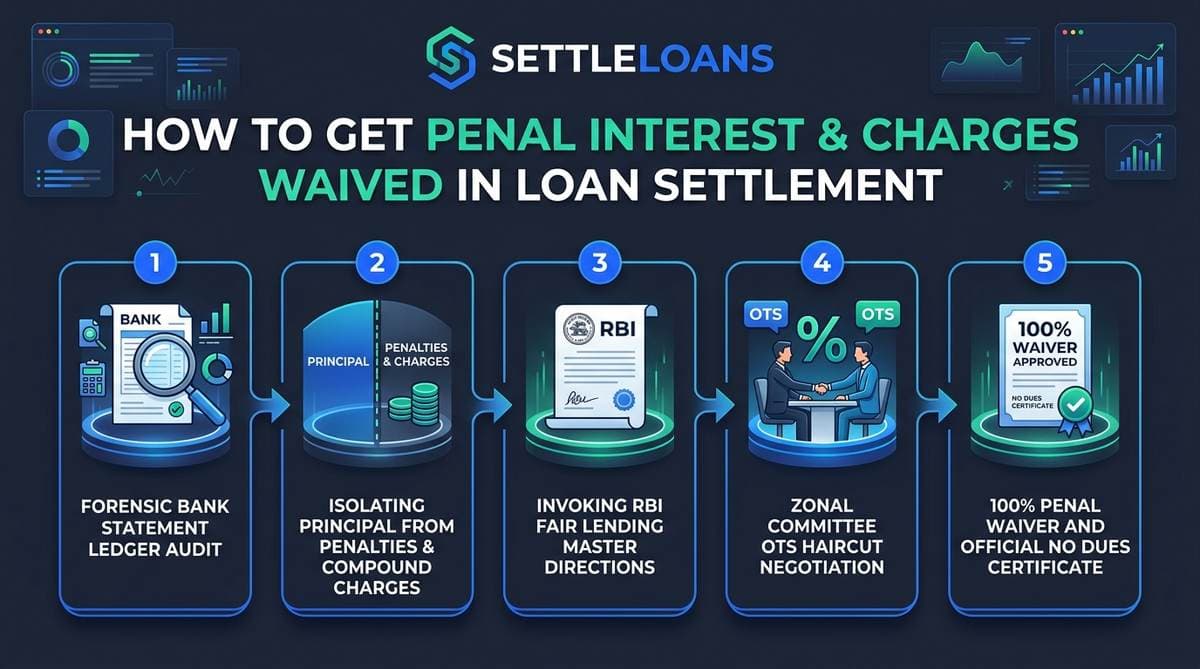
The comprehensive infographic below details the 5-stage institutional progression executed by debt resolution advocates: conducting the financial statement forensic audit, isolating uncapitalized penalties, invoking RBI Master Directions, negotiating before bank zonal committees, and securing complete 100% waivers on non-principal charges backed by an authentic No Dues Certificate.
6. Strategic Negotiation at the Zonal Settlement Committee: Forcing a 100% Non-Principal Waiver
Branch managers and call-center recovery agents possess virtually zero discretionary authority to grant substantial fee waivers. Frontline collection staff operate on commission-driven recovery targets and are incentivized to demand the gross inflated balance.
To secure a total 100% waiver on penal charges and a substantial 40% to 60% haircut on the core principal, debt defense advocates bypass third-party agents and submit a formal settlement proposal directly to the bank's Zonal Stressed Asset Settlement Committee:
Submitting the audited SOA breakdown demonstrating exactly where the bank's internal software violated RBI capitalization guidelines, stripping non-principal claims from the negotiation table.
Providing verified documentation—including income tax return (ITR) dips, medical discharge summaries, termination letters, or business loss audits—proving genuine inability to service contractual terms.
Navigating bank internal compromise settlement policies (OTS schemes) where Zonal Heads and Executive Directors have express institutional mandates to write off accrued penalties to recover liquidity.
Executing the compromise settlement before the National Lok Adalat, converting the OTS agreement into an unappealable judicial award that permanently bars future legal claims.
When faced with documented regulatory violations and proven insolvency, bank credit committees consistently approve 100% waivers on penal interest, late fees, and legal overheads as standard practice.
7. OTS Sanction Letter Forensics: Safeguarding Complete Debt Extinguishment
A critical vulnerability during debt resolution is the proliferation of fraudulent or unauthorized settlement letters issued by rogue recovery agencies. Unscrupulous tele-callers frequently issue fake settlement letters or informal WhatsApp confirmations to collect partial payments, subsequently crediting the money against penal interest while keeping the principal default active.
Before disbursing any agreed settlement amount, a borrower must conduct rigorous forensic verification of the One-Time Settlement (OTS) sanction letter against five essential institutional benchmarks:
1. Official Bank Letterhead & Zonal Signatory Seal
The letter must be printed on official bank stationery featuring registered corporate office details, unique reference numbers, and the physical or verified digital signature and employee code of an authorized Assistant General Manager (AGM) or Zonal Head.
2. Explicit Loan Account & Borrower Identification
The document must explicitly state the borrower's full legal name, Permanent Account Number (PAN), and exact 16-digit loan account number, leaving no room for multi-account ambiguity.
3. Complete Debt Extinguishment & Waiver Declaration
The letter must contain unambiguous legal covenants declaring that upon timely payment of the agreed settlement sum, the bank waives all remaining principal, 100% of penal interest, late fees, and legal charges, and considers the loan account fully closed.
4. Withdrawal of Legal Notices & Court Proceedings
The sanction terms must expressly stipulate that the bank will unconditionally withdraw all pending legal notices, Section 138 NI Act complaints, Section 25 PSSA proceedings, arbitration petitions, or civil recovery suits upon receipt of payment.
5. Clear 30-Day No Dues Certificate Timeline
The letter must formally specify the timeline (strictly within 30 calendar days) for releasing original documents and issuing the official zero-balance No Dues Certificate.
Never make settlement payments in cash to recovery agents, individual advocates, or third-party UPI addresses. All settlement remittances must be made directly to the bank via RTGS, NEFT, or an Account Payee Demand Draft drawn in favor of "[Bank Name] A/C [Your Loan Account Number]".
8. Settlement Remittance, RBI 30-Day No Dues Certificate Mandate & CIBIL Bureau Trajectory
Once the final settlement tranche is remitted in strict compliance with the OTS sanction letter, the borrower must secure conclusive proof of debt extinguishment. Under RBI Circular RBI/2023-24/60 (Responsible Lending Conduct – Release of Movable / Immovable Property Documents and Issuance of NDC), all regulated lending institutions are statutorily required to deliver a formal No Dues Certificate (NDC) / Loan Closure Certificate within 30 calendar days.
If the lending bank or NBFC fails to deliver your official No Dues Certificate or delays releasing original property/security documents beyond 30 calendar days without lawful justification, the lender is legally required to pay compensation of ₹5,000 for each day of delay directly to the borrower under RBI regulatory directives.
Understanding CIBIL Bureau Reporting & Score Rehabilitation
Borrowers must understand the precise mechanism of credit bureau reporting following a compromise settlement where penal charges are waived:
- Account Status Remark: The bank updates the account status across all four credit bureaus (CIBIL, Experian, Equifax, CRIF High Mark) as "Settled" or "Post-Write-off Settled", reflecting a current outstanding balance of ₹0.
- Halting Default Compounding: Although the "Settled" tag indicates a negotiated closure, it instantly terminates compounding default status and prevents further negative Days Past Due (DPD) accumulation.
- 12-Month RBI Cooling Period: Commercial banks observe a mandatory 12-month cooling window before considering new unsecured credit lines for settled accounts.
- Systematic Credit Rebuilding: By securing a fixed-deposit-backed credit card, maintaining credit utilization below 30%, and ensuring spotless on-time payments, borrowers reliably rebuild their CIBIL score back above 750 within 18 to 24 months.
9. Comparative Resolution Matrix: Forensic Audit vs. Unchecked Bank Recovery
Evaluating the stark mathematical and legal contrast between unrepresented debt negotiations and advocate-led forensic audit settlements demonstrates the vital importance of isolating genuine principal:
| Resolution Parameter | Unchecked Bank / Recovery Demand | Advocate-Led Forensic Audit Settlement |
|---|---|---|
| Baseline Balance Evaluated | Gross inflated balance including compound penalties | Audited core principal strictly isolated |
| Penal Interest & Surcharges | 0% waiver; demand full payment of all fees | 100% full statutory waiver under RBI guidelines |
| NACH Bounce & Legal Charges | Capitalized into demanded amount | Completely removed from settlement ledger |
| Core Principal Haircut | 0% to 15% token discount | 40% to 60% structured principal haircut |
| Effective Total Debt Relief | 10% to 20% on gross inflated balance | 55% to 75% total relief from gross balance |
| Legal Finality & NDC Guarantee | High risk of partial credit & ongoing claims | Official bank sanction letter & binding ₹0 NDC |
10. SettleLoans Legal Defense & Forensic Statement Audit Advisory
Navigating an inflated debt balance requires seasoned banking litigation advocates and forensic accounting specialists who understand bank core accounting software, the Indian Contract Act, and RBI Master Directions. SettleLoans provides complete nationwide representation: auditing bank statements, serving formal statutory objection notices, halting recovery harassment, and negotiating directly with bank Zonal Settlement Committees to eliminate 100% of non-principal charges backed by an authentic, bank-stamped No Dues Certificate.

Settle Loan is India's trusted debt relief and loan settlement platform. We help borrowers overcome financial distress by negotiating with banks and NBFCs to legally settle personal loans and credit card debts. With our transparent, performance-based approach, you can achieve debt freedom and regain your financial peace of mind.
COMPUTER
11. Frequently Asked Questions: Waiving Penal Interest & Charges
Direct, legally verified answers to essential questions regarding financial statement forensic audits, RBI Master Directions, and eliminating penal interest in loan settlements.
What is the difference between normal contractual interest and penal interest in a loan default?
Contractual interest is the agreed annual percentage rate (APR) charged for the cost of borrowing capital under the original loan sanction agreement. Penal interest (or penal charges) represents an additional punitive levy imposed by the lender when an EMI is delayed or defaulted. Crucially, under Reserve Bank of India Master Directions, penal charges are strictly punitive in nature and cannot be added to the principal balance or compounded with contractual interest.
Can banks legally compound penal interest on defaulted loan accounts in India?
No. Under the RBI Master Direction on Fair Lending Practice - Penal Charges in Loan Accounts (effective April 1, 2024), banks and NBFCs are strictly prohibited from capitalizing penal charges. Lenders cannot add penal charges to the principal ledger or compute further interest on penal charges. Any loan statement reflecting compounding on late fees or interest-on-interest is legally defective and subject to regulatory grievance redressal.
How does a financial statement forensic audit isolate the genuine principal balance?
A financial statement forensic audit involves an exhaustive, transaction-level examination of the lender's loan ledger from the date of initial disbursement. The auditor subtracts all cumulative EMIs paid towards principal, isolates the true remaining core capital, and segregates every non-principal line item—including monthly penal interest, NACH bounce penalties, collection recovery fees, legal notice charges, and bundled insurance markups. This generates an unassailable Core Principal Certificate used to anchor compromise settlement negotiations.
Why do bank settlement committees agree to waive 100% of penal interest and late fees?
Bank settlement committees readily waive 100% of penal charges because non-principal fees represent uncollected accounting accruals rather than out-of-pocket capital deployed by the bank. Once a loan is classified as a Non-Performing Asset (NPA), prudential RBI accounting norms mandate that uncollected interest and charges be reversed from the profit-and-loss account. Recovering the genuine principal balance yields higher Net Present Value (NPV) recovery than litigating disputed penalty claims over several years in civil courts.
What legal protections under the Indian Contract Act prevent excessive penalty charges?
Section 74 of the Indian Contract Act, 1872 explicitly prohibits the enforcement of extortionate or disproportionate penalty stipulations in contracts. Indian courts consistently hold that a lender is only entitled to reasonable compensation for actual financial loss caused by default, rather than punitive windfalls. Furthermore, the Usurious Loans Act, 1918 empowers judicial authorities to reopen loan accounts and recalculate balances where interest or cumulative charges are found to be excessively harsh or unconscionable.
How do I ensure the bank's OTS sanction letter completely waives all penal claims?
You must forensically examine the official One-Time Settlement (OTS) sanction letter before paying any settlement sum. The letter must explicitly state that the agreed settlement amount represents the full and final discharge of all liabilities, specifically confirming that all accrued penal interest, bounce charges, legal fees, and incidental costs stand 100% extinguished and waived with zero residual recourse.
What is the statutory timeline for receiving a No Dues Certificate after paying the settlement?
Under RBI Circular RBI/2023-24/60, all commercial banks and NBFCs are legally obligated to issue an official zero-balance No Dues Certificate (NDC) and update credit bureau records within strictly 30 calendar days of receiving the final agreed settlement tranche. If the bank fails to issue the closure certificate within 30 days without lawful cause, the lender must pay statutory compensation of ₹5,000 per day of delay directly to the borrower.
How does waiving penal charges in a settlement affect my CIBIL score and credit rebuilding?
When a loan is settled after stripping all penal charges, the bank reports the account status to credit information companies as 'Settled' with an outstanding balance of ₹0. While this causes a temporary credit score drop, it immediately terminates compounding default status and prevents further negative DPD reporting. Borrowers can restore their credit score back to 750+ within 18 to 24 months by establishing disciplined credit habits through a secured credit card backed by a fixed deposit.