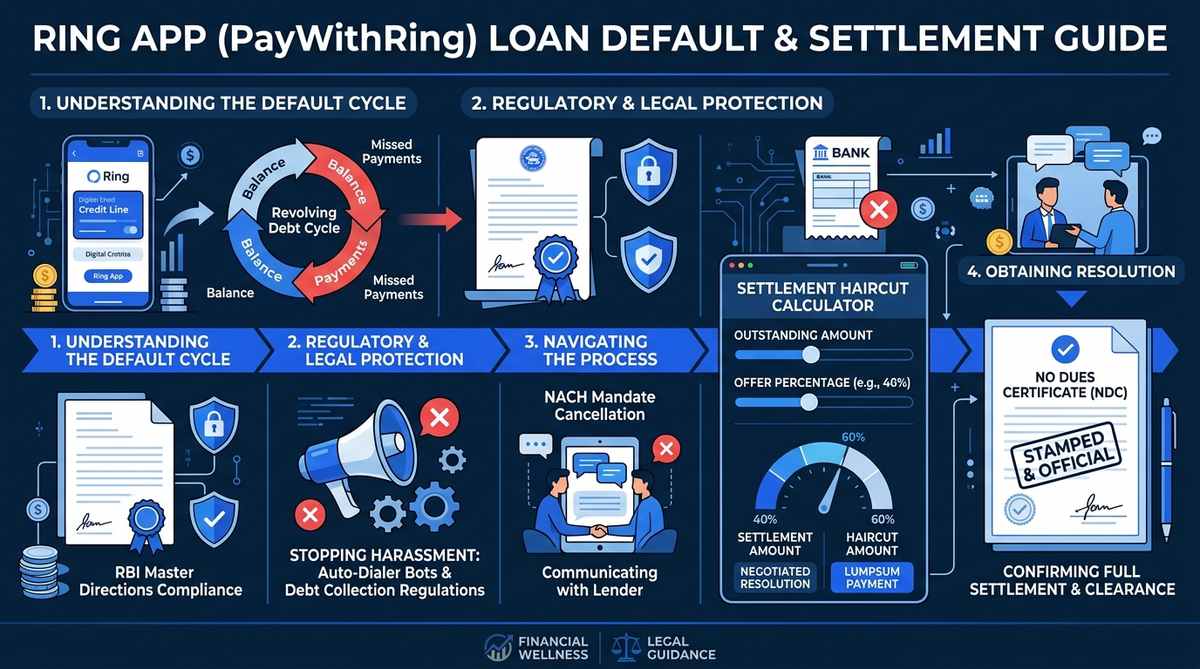
- Underlying Regulated NBFC: Ring App (PayWithRing) is a digital lending application operated in partnership with Si Creva Capital Services Private Limited, an RBI-registered NBFC. All legally binding compromise settlements and No Dues Certificates must be issued by the NBFC.
- Halt Automated Bot Calling: Relentless auto-dialer calls, WhatsApp warnings, and third-party contact scraping violate RBI Digital Lending Guidelines. A formal legal cease-and-desist notice halts collection harassment immediately.
- Revoke NACH Mandates: Exercising your statutory right to cancel e-NACH mandates through your bank prevents repeated debit presentation penalties while debt talks are underway.
- Realistic 40%–60% Haircut: Unsecured digital credit lines reaching Non-Performing Asset (NPA) status qualify for large principal debt waivers alongside complete cancellation of all penal interest and bounce charges.
- Statutory ₹0 NDC Delivery: Under RBI Circular RBI/2023-24/60, Si Creva Capital must issue a stamped No Dues Certificate and update credit bureau records within 30 calendar days post-settlement.
Ring App High-Velocity Credit & Compounding Penalties
The Ring App (branded as PayWithRing and operated alongside Kissht by Onemi Technology Solutions Private Limited) represents a fast-growing segment of digital revolving credit in India. Targeted extensively at young salaried professionals, freelancers, self-employed merchants, and gig economy workers, Ring delivers instant digital credit lines ranging from ₹5,000 to ₹2,000,000 via quick UPI-based merchant scan-and-pay transactions and direct cash transfers.
Unlike traditional fixed-tenure loans, Ring functions as a revolving credit facility. It is underwritten primarily by its RBI-registered NBFC partner, Si Creva Capital Services Private Limited, alongside co-lenders like Poonawalla Fincorp. Repayment cycles are ultra-short, typically 15 to 30 days. When financial distress strikes due to job loss or illness, this revolving structure quickly turns into an aggressive compounding debt cycle.
Upon default, Ring's automated systems instantly impose steep daily penalty rates, late payment charges, and automated transaction fees, which can quickly inflate the ledger balance by 50% to 100% within a few billing cycles. Simultaneously, automated predictive dialers and AI collection bots execute dozens of daily calls, triggering severe psychological distress. Under the Indian Contract Act, 1872, defaulting on an unsecured digital credit line is strictly a civil dispute. Distressed borrowers hold robust statutory rights under Reserve Bank of India (RBI) regulations to stop harassment, demand an audit of inflated fees, and negotiate a binding One-Time Settlement (OTS).
Ring App Delinquency Lifecycle: DPD 1-30 to NPA Stage
Si Creva Capital categorizes defaulted credit lines into progressive Days Past Due (DPD) stages. It operates under RBI IRACP norms and Ind AS 109 Expected Credit Loss frameworks. Understanding this aging process allows borrowers to time settlement talks for maximum financial relief.
During the early delinquency window (DPD 1 to 60), the fintech platform uses aggressive digital follow-ups, interactive voice response (IVR) auto-dialers, and outsourced recovery calling. However, once the default crosses 90 consecutive days, the account is classified as a Non-Performing Asset (NPA). At this stage, Si Creva Capital is legally mandated to create balance-sheet capital provisioning. The economic incentive shifts from routine collection to capital recovery via structured compromise settlements.
| Aging Stage | Days Past Due (DPD) | Ring / Si Creva Recovery Actions | Legal & Bureau Status | Settlement Haircut Potential |
|---|---|---|---|---|
| SMA-0 (Early Delinquency) | 1 – 30 Days | Automated AI robocalls, daily WhatsApp alerts, repeated e-NACH presentation sweeps. | Credit bureaus updated with 30 DPD; minimal legal exposure. | Negligible (Platform demands full overdue with penal fees). |
| SMA-1 (Mid Delinquency) | 31 – 60 Days | Intensive tele-calling, outsourced agency assignment, credit limit suspension. | CIBIL score drops sharply; formal demand notice served. | Low (Waiver of penal interest only on full principal payment). |
| SMA-2 (Pre-NPA Escalation) | 61 – 90 Days | Aggressive recovery calls, threats of home visits, legal warning notices issued. | Section 25 PSSA / Section 138 NI Act statutory legal demand notices. | Moderate (Discussions for 25%–35% total ledger waiver). |
| NPA (Substandard Asset) | 91 – 180 Days | Transferred to NBFC Stressed Asset Desk; mandatory Ind AS 109 capital provisioning. | Magistrate Court notice under Sec 25 PSSA; Lok Adalat conciliation notice. | High (40%–50% Haircut achievable). |
| Doubtful / Loss Asset | 181 – 365+ Days | Internal balance-sheet write-off; account assigned to specialized recovery desks. | Digital arbitration notices, Lok Adalat pre-litigation referrals. | Maximum (50%–60% Haircut achievable). |
When a Ring app loan remains defaulted past 180 days, the NBFC has absorbed full loss provisioning on its books. At this juncture, securing a lump-sum One-Time Settlement delivers an immediate cash write-back to the lender's balance sheet, giving senior risk officers strong mathematical justification to sanction 50% to 60% debt haircuts.
Check Your Loan Settlement Options
Answer 2 quick questions to evaluate your settlement eligibility.
1. What type of loan do you want to settle?
How to Stop Ring App Calling Bots & NACH Bounces
One of the most distressing aspects of defaulting on Ring App is the relentless barrage of automated notices. Digital lending platforms frequently deploy automated predictive dialers that trigger phone calls every 20 to 30 minutes from rotating virtual numbers. In many instances, outsourced agency personnel threaten to contact employer HR desks, message friends on social media, or circulate shaming notices to family members.
These aggressive tactics directly violate the RBI Digital Lending Guidelines (2022) and the RBI Master Directions on Recovery Agents. Regulated entities and their agents are strictly prohibited from accessing mobile contact lists, making persistent harassing calls, using abusive or threatening language, and contacting borrowers outside the statutory window of 08:00 AM to 07:00 PM.
Concurrently, Ring's automated treasury systems often present e-NACH auto-debit mandates repeatedly against the borrower's bank account. Each failed debit triggers return penalty charges of ₹250 to ₹500 from the borrower's bank, while Si Creva Capital adds its own bounce fee of ₹500 to ₹1,000 plus GST. Over three months, these repetitive sweeps can drain tens of thousands of rupees.
Borrowers can immediately regain financial control through three actionable legal measures:
1. Cancel NACH Auto-Debits via Destination Bank
Under NPCI circulars, every account holder possesses clear statutory rights. You have the right to instruct your bank in writing or via net banking to cancel or suspend the e-mandate registered to Si Creva Capital. This halts future bank bounce fees immediately.
2. Issue a Formal Legal Cease-and-Desist Notice
Serving a formal advocate notice to Si Creva Capital's Principal Nodal Officer mandates the immediate cessation of third-party calling bots and directs all notices exclusively to formal written email channels.
3. Escalate Violations to the RBI Ombudsman (CMS Portal)
Documenting call frequency, WhatsApp screenshots, and unauthorized contact attempts, and submitting them through the RBI Integrated Ombudsman portal (cms.rbi.org.in), compels the NBFC to enforce immediate compliance under threat of regulatory penalties.
Si Creva Capital One-Time Settlement Valuation Matrix
Under the RBI Master Direction on Compromise Settlements and Technical Write-offs (DOR.STR.REC.20/21.04.048/2023-24), NBFCs must maintain transparent, board-approved compromise settlement frameworks. When evaluating settlement proposals for defaulted Ring app credit lines, Si Creva Capital applies an analytical Net Present Value (NPV) recovery formula.
Digital micro-credit lines carry zero collateral. so, the NBFC evaluates an immediate lump-sum settlement offer against the uncertain present value of judicial recovery. After factoring in advocate retainers, court fees, and collection overhead, an OTS is often financially superior for the lender.
Where C_t represents estimated recoveries, r is the discount rate, and deductions account for 3–5 years of court friction and capital locked in NPA provisions.
Realistic Ring App Settlement Haircut Slabs by Delinquency Aging
| Credit Facility Type | Delinquency Bucket | Penal & Bounce Waiver | Principal Haircut Range | Target Settlement Offer |
|---|---|---|---|---|
| Ring Merchant Line / UPI Credit | 90 – 180 Days (NPA) | 100% Full Cancellation | 30% – 45% Principal Waiver | Offer 40%–50% of used Principal |
| Ring Merchant Line / UPI Credit | 181 – 365+ Days (Doubtful) | 100% Full Cancellation | 45% – 60% Principal Waiver | Offer 35%–40% of used Principal |
| Ring Personal Term Credit | 90 – 180 Days (NPA) | 100% All Penal Interest | 30% – 45% Principal Waiver | Offer 45%–55% of Book Dues |
| Ring Personal Term Credit | 180+ Days (Written Off) | 100% Penal & Bounce Fees | 50% – 65% Principal Waiver | Offer 30%–35% of Total Dues |
Ring App (PayWithRing) Loan Default & Settlement Blueprint
Defending Against Aggressive Recovery Under RBI Law
Borrowers facing default often encounter unlawful recovery tactics from third-party collection agencies assigned by fintech platforms. Recovery agents may attempt to misrepresent civil default as a criminal offence, threatening arrest, police complaints, or visits by recovery squads. Under Indian law, genuine financial inability to service an unsecured loan cannot be converted into a criminal prosecution.
The Supreme Court of India in landmark precedents (including ICICI Bank Ltd. v. Prakash Kaur and Anita Suresh v. Union of India) has established that financial institutions and NBFCs cannot employ musclemen or extra-judicial intimidation for debt recovery. Under Section 354D, 503, and 506 of the Indian Penal Code (and corresponding provisions of the Bharatiya Nyaya Sanhita), criminal intimidation, cyber-stalking, and unauthorized harassment of family members constitute punishable criminal offences.
also, the Reserve Bank of India's Fair Practices Code mandates that: (a) Agents cannot contact borrowers outside the 08:00 AM to 07:00 PM window. (b) Access to contacts, photos, or media stored on borrower smartphones is strictly prohibited. (c) Any physical visit must be preceded by formal written notice and conducted strictly by IIBF-certified DRA personnel carrying valid authorization badges. (d) Shaming borrowers in front of family, neighbors, or workplace colleagues is an actionable regulatory violation.
Step-by-Step Guide: Settlement with Ring App & Si Creva
Executing a legally secure and cost-effective One-Time Settlement with Ring App requires a structured, evidence-backed strategy:
1Financial Hardship Audit & Evidentiary Dossier Preparation
Compile comprehensive documentary evidence showing bona fide financial incapacity. Relevant documents include pink slips or layoff notices, medical discharge summaries, business GST filings showing revenue declines, or bank statements showing depleted liquidity. This establishes that the default is non-wilful and qualifies for compromise relief under RBI rules.
2Revoking NACH Mandates & Directing notice Channels
Submit an e-mandate cancellation request to your bank to stop automated debit presentation fees. Issue a formal notice to Si Creva Capital directing all notice to official written email channels or designated legal counsel, establishing an auditable paper trail.
3Submitting Formal Hardship Petition to NBFC Nodal Desk
Submit a structured compromise petition addressed to Si Creva Capital's Stressed Asset Settlement Committee. Cite RBI Master Directions and propose an opening settlement offer at 25% to 35% of total outstanding ledger dues to establish room for talks.
4Counter-talks & Credit Committee Approval
The NBFC will initially reject low offers and propose minor discounts. Experienced legal counsel counters by showing that settlement funds are being pooled from third-party relatives or asset liquidation, steering the committee toward the target 40% to 60% principal waiver band.
5Forensic Audit of the Stamped OTS Sanction Letter
Before making any payment, verify the settlement records carefully. Ensure the NBFC issues an official OTS Sanction Letter on Si Creva Capital letterhead. The letter must state your loan account numbers, sanctioned amount, payment deadlines, and covenants confirming full debt discharge and legal withdrawal.
6Direct Account Remittance & Enforcing ₹0 NDC Delivery
Remit the agreed settlement funds directly into your designated loan account via RTGS/NEFT. Under RBI Circular RBI/2023-24/60, the NBFC is legally bound to deliver your No Dues Certificate and update credit bureaus within 30 calendar days.
Section 25 PSSA, Digital Arbitration & Lok Adalat
When a Ring app credit line crosses 60 to 90 days of non-payment, the lending NBFC issues statutory notices. These notices fall under Section 25 of the Payment and Settlement Systems Act, 2007 (PSSA) for dishonoured NACH mandates. The lender may also issue notices invoking private digital arbitration in Mumbai or Delhi.
A Section 25 PSSA notice is a statutory precursor to a Magistrate Court complaint, not an arrest warrant. Responding through counsel within the 15-day statutory window detailing bona fide commercial hardship, challenging excessive penal fees, and opening compromise talks protects your legal standing while halting litigation escalation.
Regarding unilateral digital arbitration notices, landmark Supreme Court rulings (including Perkins Eastman Architects DVM v. HSCC (India) Ltd. and TRF Ltd. v. Energo Engineering Projects Ltd.) affirm that unilateral arbitrator appointments by lenders without mutual consent are legally invalid. Legal counsel can challenge arbitrator jurisdiction under Section 12 and Section 14 of the Arbitration and Conciliation Act, 1996, effectively halting ex-parte cases.
also, Si Creva Capital regularly participates in quarterly National Lok Adalats organized by District Legal Services Authorities (DLSA) under the Legal Services Authorities Act, 1987. In Lok Adalat sessions, NBFC agents carry pre-approved settlement mandates (often offering 45% to 60% debt waivers). The resulting settlement award holds the legal force of a binding Civil Court Decree with non-appealable finality, permanently dismissing all pending claims.
| Resolution Avenue | Legal Mechanism | Haircut Potential | Typical Timeline | Judicial Finality |
|---|---|---|---|---|
| Direct NBFC OTS | Compromise agreement under RBI Master Directions. | 40% – 60% Debt Haircut | 15 to 30 Days | Binding private contract with ₹0 NDC. |
| National Lok Adalat | Judicial conciliation before sitting judge and panel. | 45% – 60% Debt Haircut | Single-day session | Civil Court Decree (Zero appeal). |
| Arbitration Defense | Contesting unilateral digital arbitration in distant venues. | Variable (Converts to OTS) | 3 to 9 Months | Subject to Section 34 challenge. |
| Section 25 / 138 Defense | Magistrate court compoundable cases defense. | 35% – 50% Debt Haircut | 2 to 6 Months | Formal withdrawal and case disposal. |
Authenticating Ring App Settlement Letters & ₹0 NDC
A serious risk in digital debt recovery involves rogue collection agents issuing fake settlement letters or demanding cash / personal UPI transfers. If a borrower transfers funds against an unverified or verbal offer, the NBFC credits the money toward outstanding penal charges, leaving the default open and compounding.
Borrowers must verify that the OTS letter is printed on official Si Creva Capital Services letterhead. It must show the Corporate Identification Number (CIN: U65923MH2017PTC292497) and Mumbai office address. It must also include a unique proposal reference number, authorized signatory designation, employee code, and corporate seal.
The sanction letter must confirm that payment of the agreed sum discharges the account with zero further liability. Under RBI Circular RBI/2023-24/60, Si Creva Capital must deliver the No Dues Certificate (NDC) within 30 calendar days. It must also cancel all security mandates or pay statutory relief of ₹5,000 per day of delay directly to the borrower.
CIBIL Score Trajectory & 18-Month Recovery Plan
Settling with Ring App updates your status across all four credit bureaus (CIBIL, Experian, Equifax, CRIF High Mark). The account is marked 'Settled' or 'Post-Write-off Settled' with an outstanding balance of exactly ₹0. While this causes an initial drop of 70 to 120 points, it halts compounding default charges.
Under RBI compromise directives, a mandatory 12-month cooling-off window applies before fresh unsecured credit lines can be approved. However, a 'Settled' record with ₹0 balance is vastly superior to an active, compounding 'Default' status that degrades credit scores every month and invites ongoing legal action.
Borrowers can systematically restore their credit score to 750+ within 18 to 24 months. You can secure a fixed-deposit-backed credit card (FD card) and maintain credit use below 25%. In addition, ensure on-time payment records on all living utilities and surviving financial debts.
Why Distressed Ring App Borrowers Trust SettleLoans
Resolving defaulted digital credit lines requires skilled advocacy. SettleLoans halts third-party harassment through immediate cease-and-desist notices. We defend against Section 25 PSSA summons and challenge unilateral arbitration notices. also, we negotiate directly with Si Creva Capital's Stressed Assets Desks to secure maximum lawful waivers and authentic ₹0 No Dues Certificates.

Settle Loan is India's trusted debt relief and loan settlement platform. We help borrowers overcome financial distress by negotiating with banks and NBFCs to legally settle personal loans and credit card debts. With our transparent, performance-based approach, you can achieve debt freedom and regain your financial peace of mind.
COMPUTER
FAQs: Ring App (PayWithRing) Loan Settlement
What is the Ring App (PayWithRing) loan settlement process and how does it work?
The Ring App loan settlement process is a formal compromise mechanism governed by RBI Master Directions on Compromise Settlements. When a borrower defaults on a Ring digital credit line and the account crosses 90 days past due (NPA status), the lending NBFC (primarily Si Creva Capital Services Pvt Ltd or partner institutions) evaluates the unrecoverable debt. Through structured legal talks, the borrower and lender agree on a discounted lump-sum payment (typically 40% to 60% haircut on outstanding dues). Once remitted directly to the NBFC account, an authentic stamped No Dues Certificate is issued, closing the liability permanently.
How can I stop Ring app automated calling bots and recovery agent harassment?
Under RBI Master Directions on Recovery Agents and RBI Digital Lending Guidelines (2022), fintech platforms and their partner NBFCs are prohibited from using abusive language, making persistent automated robocalls, contacting borrowers before 8:00 AM or after 7:00 PM, or contacting non-guarantor family members and references. Borrowers can stop harassment by serving a formal legal cease-and-desist notice to Si Creva Capital Services, revoking app contact permissions, and filing a statutory complaint with the RBI Integrated Ombudsman on cms.rbi.org.in.
Who is the underlying RBI-registered NBFC behind the Ring App?
The primary regulated entity underwriting credit lines on the Ring App (PayWithRing) and its sister brand Kissht is Si Creva Capital Services Private Limited, an RBI-registered Non-Banking Financial Company (NBFC-ND-SI). Certain credit lines may also be co-funded by partner institutional lenders like Poonawalla Fincorp or MAS Financial. All formal settlement talks, legal notices, and No Dues Certificates must be executed directly with the registered NBFC, not third-party recovery vendors.
How can I stop repeated NACH auto-debit bounce fees from Ring app?
Borrowers can stop recurring NACH bounce penalties by exercising their statutory right under NPCI procedural guidelines to revoke or suspend the e-mandate directly through their destination bank branch or internet banking portal. Concurrently, during compromise settlement talks, legal counsel demands a 100% complete waiver of all accumulated bounce fees and penal interest under RBI Fair Lending Practice rules.
What percentage of debt discount or haircut can you negotiate on a defaulted Ring loan?
On defaulted Ring app credit lines overdue beyond 90 to 180 days, borrowers can realistically negotiate a 40% to 60% waiver on total ledger balances. Because digital credit lines are completely unsecured with high loss provisions absorbed under Ind AS 109, the NBFC prefers recovering core principal via an immediate One-Time Settlement rather than chasing small debts through costly litigation.
Can Ring App or Si Creva Capital file a police FIR or arrest a defaulting borrower?
No. Defaulting on a digital credit line or personal loan is strictly a civil dispute arising from breach of contract under the Indian Contract Act, 1872. Police authorities have no statutory power to register an FIR or make an arrest for genuine financial inability to pay. Any recovery caller threatening police action or arrest is violating the Indian Penal Code / Bharatiya Nyaya Sanhita and RBI Fair Practice Codes.
What should you do if you receive a Section 25 PSSA or Section 138 notice from Ring?
A statutory legal notice under Section 25 of the Payment and Settlement Systems Act (PSSA) for a bounced e-mandate is a 15-day formal demand, not an arrest warrant. Borrowers should promptly engage legal counsel to send a detailed reply establishing bona fide financial hardship, highlighting predatory interest calculations, and offering an amicable One-Time Settlement. These matters are routinely resolved through compromise before court escalation.
How does settling a Ring app loan impact your CIBIL score?
Upon settlement payment, the NBFC reports the loan status as Settled or Post-Write-off Settled to TransUnion CIBIL, Experian, Equifax, and CRIF High Mark, reducing the outstanding balance to ₹0. While this temporarily lowers credit scores by 70 to 120 points, it halts compounding default history. Borrowers can restore their credit score to 750+ within 18 to 24 months through disciplined secured credit management.
How do I verify that an OTS settlement letter from Ring is genuine?
An authentic settlement letter must be issued on the official corporate letterhead of the lending NBFC (such as Si Creva Capital Services Pvt Ltd), containing the borrower name, registered loan account number, sanctioned settlement figure, payment deadline, authorized signatory designation, corporate seal, and an explicit clause confirming full waiver of residual balance and closure upon payment.
Within how many days must Ring App provide the No Dues Certificate after settlement?
Under RBI Circular RBI/2023-24/60, regulated financial entities are legally obligated to release the formal No Dues Certificate (NDC) and update credit bureau records within 30 calendar days of receiving the full settlement amount. Failure to comply makes the lender liable to pay relief of ₹5,000 per day of delay directly to the borrower.
Official Regulatory References & Statutory Circulars
- Reserve Bank of India (RBI): Guidelines on Digital Lending (DOR.CRE.REC.66/21.07.001/2022-23)
- RBI Master Direction: Compromise Settlements and Technical Write-offs (DOR.STR.REC.20/21.04.048/2023-24)
- Si Creva Capital Services Private Limited: Fair Practices Code, Grievance Redressal & Nodal Officer Details
- Reserve Bank - Integrated Ombudsman Scheme, 2021: Portal for Complaints on Digital Lending Harassment & Excessive Fees
- National Legal Services Authority (NALSA): Legal Services Authorities Act, 1987 — National Lok Adalat Conciliation Framework