- Total Ban on Musclemen Repossession: The Supreme Court of India in Prakash Kaur and Shanti Devi Sharma strictly prohibits banks from employing strong-arm agents or physical force to seize vehicles.
- Mandatory Statutory Notice Protocols: Lenders must serve a 60-day loan recall notice, a pre-repossession warning, a verified inventory sheet, and a 30-day pre-sale auction notice before selling any vehicle.
- Challenging Rigged Distress Auctions: If the bank auctions the car below fair market value without approved valuation reports, the borrower cannot be saddled with the resulting artificial shortfall balance.
- Achieving ₹0 Shortfall Settlements: Legal advocates utilize lender procedural violations, consumer court damages, and criminal trespass filings to force commercial banks to waive residual shortfall balances to ₹0 with a clean No Dues Certificate.
- Post-Auction Unsecured Reclassification: Once the secured vehicle is auctioned, remaining shortfall debt converts into an uncollateralized unsecured loss asset on bank balance sheets, drastically increasing bank motivation for compromise settlement.
1. The Reality of Car Loan Default Repossession in India: The
Defaulting on a vehicle loan in India exposes middle-class families and small business operators to one of the most aggressive debt collection ecosystems in the financial sector. When unforeseen economic disruptions—such as acute business losses, job retrenchment, medical crises, or inflation-driven cash flow shortfalls—cause a borrower to miss two or three consecutive equated monthly installments (EMIs), commercial banks and Non-Banking Financial Companies (NBFCs) quickly shift from automated payment reminders to active recovery protocols. Unlike unsecured personal loans where recovery relies on tele-calling or civil litigation, car loans are secured by a contractual hypothecation charge registered on the vehicle with the regional transport authority under the Motor Vehicles Act, 1988.
However, lenders exploit this hypothecation clause far beyond its legitimate legal bounds. Rather than following statutory recovery procedures, major private lenders (including HDFC Bank, ICICI Bank, Axis Bank, Kotak Mahindra Prime, Tata Capital, Mahindra Finance, and Bajaj Finance) routinely deploy third-party recovery agencies. Borrowers find themselves ambushed on highways, intercepted outside workplaces, or confronted at residential parking lots at odd hours. The vehicle is towed away or driven off under duress, leaving the borrower stranded without transportation while they have already paid substantial down payments and years of interest.
The crisis worsens several weeks later. Borrowers assume that losing their vehicle extinguishes their debt obligation. Instead, the bank conducts an opaque, private distress auction—frequently selling the car to favored scrap dealers or used-car syndicates at 40% to 60% below genuine market value. The bank then applies the meager auction proceeds against exorbitant accumulated penalty charges, overdue interest, repossession fees, yard parking costs, and legal charges, leaving a massive unpaid deficit known as the residual shortfall balance. The lender then issues an aggressive legal demand notice or initiates arbitration demanding that the borrower immediately pay lakhs of rupees for a vehicle they no longer possess. Understanding your statutory rights under Indian jurisprudence is the essential first step toward invalidating these manufactured shortfall claims.
2. Supreme Court Mandates & The Complete Ban on Forceful Seizure: Prakash Kaur, Shanti Devi Sharma & Magma Precedents
The most critical principle governing auto loan recovery in India is that a hypothecation agreement does not grant a lender the right to take the law into its own hands. In a constitutional democracy governed by the rule of law, banks and financial institutions cannot deploy physical force, goons, musclemen, or deceptive tactics to dispossess a citizen of their property. The Supreme Court of India and various High Courts have repeatedly condemned strong-arm repossession practices and established binding legal precedents that hold banks criminally and financially accountable.
The Supreme Court held that banks cannot employ musclemen or recovery agents to forcefully repossess vehicles on the road. The apex court ruled that recovery must follow due legal process, stating that extra-judicial seizure violates fundamental civil liberties and constitutional rights under Article 21.
The Supreme Court reaffirmed that banks are strictly liable for the unlawful, abusive actions of their recovery agents. The court ruled that lenders cannot wash their hands of criminal acts, harassment, or humiliation inflicted on borrowers during repossession attempts.
A three-judge bench of the Supreme Court held that even when a loan agreement contains a repossession clause, physical dispossession without civil court authorization or proper statutory notice is unlawful and constitutes a grave deficiency in service.
The Supreme Court established that repossession is only valid if preceded by reasonable, transparent notice giving the borrower an opportunity to repay arrears, followed by a formal pre-sale notice with fair valuation before any auction takes place.
When recovery agents intercept a vehicle on the road or tow it without borrower consent, their actions constitute criminal offenses under the Bharatiya Nyaya Sanhita (BNS) / Indian Penal Code (IPC), including Criminal Trespass (Section 329 BNS / Sec 441 IPC), Theft (Section 303 BNS / Sec 378 IPC), Extortion (Section 308 BNS / Sec 383 IPC), and Wrongful Restraint. Furthermore, under the Consumer Protection Act, 2019, State and National Consumer Disputes Redressal Commissions regularly award punitive damages ranging from ₹2 Lakhs to ₹10 Lakhs against banks for unauthorized vehicle seizures.
Check Your Loan Settlement Options
Answer 2 quick questions to evaluate your settlement eligibility.
1. What type of loan do you want to settle?
3. RBI Fair Practices Code & Mandatory 60-Day Pre-Sale Notice Protocols
The Reserve Bank of India (RBI), through its Master Directions on Fair Practices Code for Lenders and circulars on the engagement of recovery agents, has established stringent procedural prerequisites that every regulated bank and NBFC must satisfy before initiating repossession of any hypothecated asset. Lenders routinely bypass these requirements, giving borrowers conclusive grounds to challenge subsequent recovery demands.
To execute a legally defensible vehicle repossession and sale, a lender must strictly adhere to the following chronological regulatory framework:
Formal Default & Loan Recall Notice (60-Day Opportunity)
The bank must issue a written notice granting the borrower a minimum period to cure the payment default. The notice must specify the exact overdue amount, separating base principal from penal charges and unapproved administrative fees.
Pre-Repossession Notice & Official Identity Verification
Prior to taking physical possession, the lender must serve a pre-repossession intimation. Recovery personnel must carry valid bank authorization letters, employee photo identity badges, and police station intimation slips. Repossessions between sunset and sunrise (night-time towing) are strictly forbidden under RBI guidelines.
Post-Repossession Inventory & Condition Protocol
Immediately upon possession, the bank must prepare an exhaustive inventory document signed by independent witnesses, detailing vehicle mileage, fuel level, exterior/interior condition, audio systems, and all personal belongings left inside the vehicle. The borrower must be furnished a copy immediately.
30-Day Pre-Sale Valuation Notice & Right of Redemption
Under Section 176 of the Indian Contract Act, 1872, the pawnee/lender must provide reasonable notice of sale to the debtor. RBI rules mandate a 30-day pre-sale notice specifying the reserve valuation determined by an approved government valuer, the date and venue of public auction, and providing the borrower the legal right to redeem the vehicle by settling the loan.
4. How Banks Undervalue Repossessed Cars & Fabricate Artificial Shortfall Claims
The fundamental mechanism through which banks manufacture post-repossession shortfall debts is the rigged distress auction. In an open and transparent secondary automobile market, a two-year-old vehicle might command a market price of ₹7 Lakhs. However, when repossessed by a bank or NBFC, the vehicle is moved to an unauthorized holding yard where it sits exposed to weather damage for months while daily yard parking fees (often ₹300 to ₹500 per day) are continually billed to the borrower's loan ledger.
When the bank eventually conducts an auction, it is rarely a publicized open tender. Instead, closed private auctions are held with empanelled wholesale used-car traders. The bank sets an artificially depressed reserve price—sometimes as low as ₹2.5 Lakhs to ₹3 Lakhs—justifying it as "as-is-where-is distress valuation." Once sold at this fraction of true value, the bank's recovery ledger calculates the residual shortfall through predatory accounting:
By inflating bogus operational charges and depressing auction revenue, a borrower who originally owed ₹5 Lakhs on a ₹7 Lakh car finds themselves without the vehicle and facing a legal demand notice for an additional ₹3.5 Lakhs shortfall. Indian courts have repeatedly ruled that banks acting as fiduciaries cannot benefit from self-created auction distress at the borrower's expense.
5. Car Repossession & Shortfall Settlement Process: Step-by-Step Resolution Roadmap
Understanding the chronological trajectory of an auto loan default—from initial delinquency through repossession defense to final shortfall extinguishment—empowers borrowers to seize control of legal negotiations:
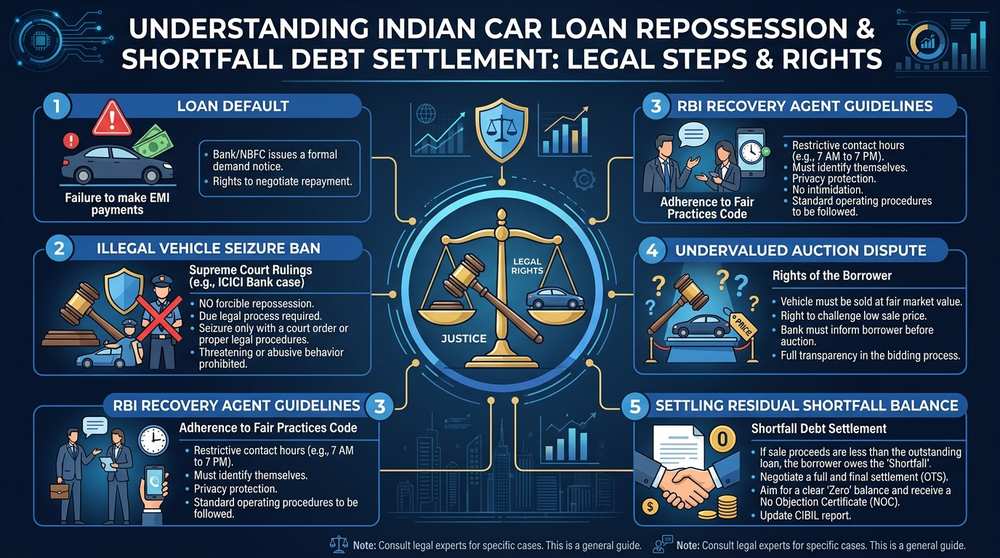
6. Strategic Legal Defenses to Invalidate & Settle Shortfall Balance to ₹0
When a bank or NBFC issues a legal notice demanding payment for a post-repossession shortfall, unrepresented borrowers often panic and consider paying. However, experienced debt defense advocates utilize the lender's procedural misconduct to dismantle the shortfall claim entirely, forcing the bank to execute a ₹0 full-and-final settlement. The core legal arguments include:
If the vehicle was repossessed without a valid court warrant or by third-party agents not authorized in writing, advocates issue an immediate criminal counter-notice for criminal trespass, theft, and intimidation under the Bharatiya Nyaya Sanhita. Facing the threat of FIR registration against senior bank officials and zonal recovery managers, the bank's legal team rapidly shifts toward damage control and amicable debt closure.
Under Section 176 of the Indian Contract Act, 1872, failure to provide reasonable, advance notice of sale forfeits the lender's right to claim any shortfall deficit from the pledgor/debtor. If the bank auctioned the vehicle without serving a verifiable 30-day pre-sale notice with proof of postal delivery, the entire shortfall claim is legally extinguished as an unrecoverable statutory forfeiture.
Advocates obtain retrospective independent valuation reports (utilizing IRDAI-approved motor vehicle surveyor assessments and insured declared value / IDV benchmarks from current insurance policies). Demonstrating that the bank sold the asset at 50% below true market worth creates an actionable claim for commercial negligence and consumer deficiency, offsetting any alleged residual deficit.
If the bank refers the shortfall claim to a sole arbitrator, advocates challenge the arbitrator's appointment under Section 12(5) of the Arbitration and Conciliation Act and the Supreme Court Perkins Eastman precedent. Because unilateral arbitrator nominations by banks are void ab initio, the bank cannot obtain an enforceable arbitral award without expensive court proceedings under Section 11.
7. NPA Accounting, Net Present Value (NPV) & Bank Compromise Settlement Formulas
To understand why commercial banks and NBFCs agree to waive substantial vehicle loan shortfall balances or settle them for ₹0, one must analyze the institutional accounting mechanics governing Non-Performing Assets (NPAs) under RBI prudential norms. Once a car loan defaults past 90 days, it is classified as a Substandard Asset. Once the collateralized car is repossessed and auctioned, the loan loses its secured classification.
The remaining shortfall balance becomes an uncollateralized unsecured loss asset. Under RBI provisioning mandates, banks must set aside 100% of the shortfall amount from their operating profits as risk provisioning. To recover a ₹3 Lakh shortfall through a civil recovery suit, the bank faces an uphill battle: paying 5% to 8% court fees, spending ₹50,000 to ₹1,00,000 on advocate retainers, and waiting 3 to 5 years in subordinate civil courts with no guarantee of recovery against an individual with no liquid assets.
Where C_t represents estimated residual shortfall recoveries, r is the bank's internal discount rate (typically 12%–15%), and deductions account for 3–5 years of court litigation friction, legal fees, and 100% locked loss-asset provisioning capital.
When the Net Present Value (NPV) calculation yields a net negative or negligible recovery expectation—especially when countered by advocate-led consumer and criminal complaints—the bank's Zonal Settlement Committee determines that executing an immediate ₹0 compromise settlement or nominal token closure is far more profitable for their quarterly balance sheet than maintaining an uncollectible NPA.
8. Settlement Sanction Letter Forensics, RBI ₹0 NDC Mandate & CIBIL Restoration
Achieving an agreement with the bank is only half the battle. Borrowers must ensure that the settlement is executed with absolute legal rigor to prevent rogue collection agencies from reviving the shortfall debt years later. Every vehicle loan shortfall settlement must culminate in a formal, digitally verifiable One-Time Settlement (OTS) Sanction Letter issued on official bank letterhead.
Mandatory Clauses in an Auto Loan Shortfall Settlement Letter
- Explicit Account & Vehicle Identification: Exact mention of the Loan Account Number, Vehicle Registration Number, Chassis Number, and Engine Number.
- Full and Final Extinguishment Clause: Confirmation that upon execution of the settlement terms (whether ₹0 or a negotiated token amount), all residual claims, shortfall balances, interest, and legal costs stand fully satisfied and extinguished.
- Withdrawal of Legal & Arbitration Cases: An explicit covenant that the bank shall unconditionally withdraw all pending legal notices, arbitration references, execution petitions, and Section 138 NI Act cheque complaints within 30 days.
- RTO Hypothecation Release & Form 35: Commitment by the lender to issue Form 35 and a formal NOC for removal of hypothecation from transport records if applicable.
Under RBI Circular RBI/2023-24/60, regulated lenders are legally mandated to deliver a formal No Dues Certificate (NDC) within 30 days of settlement fulfillment. Failure to issue the NDC within 30 days attracts statutory compensation of ₹5,000 per day of delay payable directly to the borrower. Once the NDC is issued, the bank must update credit bureaus (CIBIL, Experian, Equifax, CRIF High Mark), reporting the account balance as ₹0. While the status will reflect "Settled" or "Repossessed / Settled," ongoing delinquency stops immediately, enabling credit score recovery back to 750+ within 18 to 24 months through secured credit card building strategies.
9. Vehicle Default Resolution Matrix: Unilateral Seizure vs Voluntary Surrender vs Advocate ₹0 OTS
Comparing the key resolution mechanisms allows borrowers to evaluate the strategic advantages of challenging illegal seizures and securing an advocate-negotiated compromise settlement:
| Resolution Pathway | Legal Vulnerability / Ground | Shortfall Liability Risk | Resolution Timeline | Legal Finality & Protection |
|---|---|---|---|---|
| Unilateral Musclemen Seizure | Violates Prakash Kaur & RBI Fair Practices | Massive (30%–60% inflated deficit demanded) | 6 – 18 Months | High risk of arbitration & persistent harassment |
| Unconditional Voluntary Surrender | Car surrendered without pre-agreed debt waiver | High (Bank auctions car and demands residual debt) | 3 – 9 Months | No legal immunity against post-sale shortfall claims |
| Advocate-Led ₹0 Shortfall OTS | Procedural violations leveraged to force full waiver | ₹0 (Residual debt 100% waived by bank) | 30 – 60 Days | Absolute finality; binding NDC & legal immunity |
| District Consumer Commission Suit | Deficiency in service & illegal seizure compensation | Negative (Court awards ₹2L–₹5L damages against bank) | 12 – 24 Months | Binding judicial order with punitive compensation |
10. SettleLoans Legal Defense & Car Loan Shortfall Advisory
Navigating the aggressive repossession tactics of major private banks and NBFCs requires seasoned legal advocates who specialize in banking litigation, the Motor Vehicles Act, Supreme Court debt recovery jurisprudence, and RBI consumer protection frameworks. SettleLoans provides complete legal defense for borrowers across India: drafting formal counter-notices against illegal seizure, halting recovery agent harassment, filing consumer court complaints, challenging biased arbitration references under Section 12(5), and negotiating directly with bank zonal authorities to secure complete ₹0 shortfall waivers backed by official, bank-stamped No Dues Certificates.

Settle Loan is India's trusted debt relief and loan settlement platform. We help borrowers overcome financial distress by negotiating with banks and NBFCs to legally settle personal loans and credit card debts. With our transparent, performance-based approach, you can achieve debt freedom and regain your financial peace of mind.
COMPUTER
11. Frequently Asked Questions: Car Loan Repossession Rules & Shortfall Settlement
Direct, legally verified answers to essential questions regarding car loan repossession, Supreme Court protections against illegal seizure, and residual shortfall debt settlement in India.
Can a bank or NBFC repossess my car forcefully using musclemen or recovery agents in India?
No. The Supreme Court of India in landmark judgments—including ICICI Bank Ltd. v. Prakash Kaur (2007) and Manager, ICICI Bank Ltd. v. Shanti Devi Sharma (2008)—has categorically ruled that banks cannot use musclemen, physical intimidation, or extra-judicial force to repossess vehicles. Any repossession must strictly adhere to due legal process, which mandates prior written demand notices, pre-repossession intimations, authorized bank personnel, and adherence to RBI Fair Practices Codes.
What is a car loan shortfall balance, and why does it occur after repossession?
A shortfall balance occurs when the money generated from the bank's auction sale of your repossessed vehicle is less than the total outstanding loan balance (principal plus accumulated interest and repossession costs). Banks frequently sell repossessed vehicles at distress auction prices 30% to 50% below fair market value, creating an artificial residual debt that they attempt to collect from the borrower through legal notices or arbitration.
Is it legally possible to settle a car loan shortfall balance for ₹0?
Yes. When a bank or NBFC conducts an illegal vehicle repossession (without proper notice, via unauthorized third-party recovery agents, or at midnight) and sells the asset below market value without giving you a 30-day pre-sale redemption notice, they commit severe regulatory and civil violations. Legal advocates leverage these statutory breaches, consumer court liabilities, and criminal trespass counterclaims to compel the lender to waive the remaining shortfall balance entirely (settling for ₹0) and issue an official No Dues Certificate.
What mandatory notices must a bank provide before repossessing and auctioning a car?
Under RBI Master Directions and Indian contract law, lenders must issue: (1) A formal 60-day Demand Notice or Loan Recall Notice giving the borrower an opportunity to regularize overdue EMIs; (2) A Pre-Repossession Notice specifying the intent to take physical possession; (3) An immediate Post-Repossession Inventory Sheet detailing vehicle condition and personal belongings; and (4) A 30-day Pre-Sale Auction Notice specifying the reserve price, auction venue, and the borrower's right to redeem the vehicle by paying outstanding dues.
What legal actions can I take if my vehicle was seized without court permission or prior notice?
If your car was forcibly seized, you have multiple legal remedies: (1) File a police complaint for criminal trespass (Section 329 BNS / Sec 441 IPC) and theft/wrongful dispossession against the recovery agents and bank executives; (2) File an urgent Consumer Protection complaint before the District Consumer Commission alleging unfair trade practice and deficiency in service with punitive damages; (3) Lodge an official complaint with the RBI Banking Ombudsman under the Integrated Ombudsman Scheme; and (4) Issue a formal legal notice seeking immediate restitution or total debt extinguishment.
Can an arbitrator pass an order against me for car loan shortfall recovery?
Lenders often invoke arbitration clauses to recover shortfall balances. However, under Section 12(5) of the Arbitration and Conciliation Act and the Supreme Court Perkins Eastman ruling, unilateral arbitrator appointments made solely by the bank without your written consent are legally void. Experienced advocates challenge the arbitrator's jurisdiction and present evidence of illegal seizure and distress valuation, forcing the bank to convert the claim into a zero-liability compromise settlement.
What happens if I voluntarily surrender my car to the bank?
Voluntary surrender involves handing over the vehicle keys and signing a surrender letter. However, surrendering your car does not automatically cancel your loan obligation. The bank will still auction the car and pursue you for any shortfall balance. If contemplating voluntary surrender, borrowers should negotiate a legally binding 'Full and Final Settlement Surrender Agreement' in advance, ensuring that handover of the car constitutes full debt satisfaction with ₹0 residual liability.
How does a car loan repossession and shortfall settlement affect my CIBIL score?
Vehicle repossession and shortfall settlement cause an initial credit score reduction of 80 to 140 points, with the account reported as 'Repossessed' or 'Settled' with an outstanding balance of ₹0. Crucially, obtaining an official settlement stops ongoing default compounding, clears active legal recovery tags, and allows you to systematically rebuild your credit score above 750 within 18 to 24 months.
Can a bank freeze my salary account or seize my house for an auto loan shortfall?
No. Once the hypothecated car is repossessed and sold, the residual shortfall becomes an unsecured monetary claim. A bank cannot arbitrarily freeze your external salary account or attach your immovable property without obtaining a formal decree from a competent Civil Court after a full trial, which takes 3 to 5 years. Banks almost never pursue full civil litigation for shortfall debts, preferring compromise settlements.
What is the timeline for the bank to issue a No Dues Certificate after shortfall settlement?
Under RBI Circular RBI/2023-24/60, all regulated commercial banks and NBFCs are legally obligated to release all original documentation, remove hypothecation marks with regional transport offices (RTO), and issue an unambiguous No Dues Certificate within 30 days of settlement completion. Failure to do so makes the lender liable to pay compensation of ₹5,000 per day of delay to the borrower.
How does the car loan shortfall deficit calculator work?
A car loan shortfall deficit calculator compares your total outstanding loan balance against the net vehicle auction proceeds after subtracting statutory depreciation and repossession costs. If the auction was conducted below fair market value, borrowers can legally challenge the deficit to settle the residual balance at a 50% to 100% waiver.
What should I do if I receive a car loan shortfall recovery notice?
When you receive a car loan shortfall recovery notice, do not panic or pay blindly. Demand an audited certified copy of the vehicle auction valuation report, verify whether mandatory 30-day pre-sale notices were served, and engage legal advocates to contest inflated penal interest and negotiate a final zero-balance settlement.