- Zero Judicial Validity: Indian courts never send informal PDF summons or arrest threats on WhatsApp from personal numbers.
- Criminal Forgery Penalties: Forging court records, judge signatures, or Lok Adalat stamps breaks Section 338 BNS and Section 466 IPC. It brings up to 7 years in jail.
- Verifiable on e-Courts: Every real case has a 16-digit CNR number on the e-Courts portal. Fake notices lack valid case data.
- Vicarious Bank Liability: Under RBI rules, banks bear full legal liability for deceptive acts by their collection agencies.
- Advocate-Led Defense: Legal notices and complaints stop harassment fast. They open the door to a 40% to 65% One-Time Settlement (OTS).
1. The Rise of Deceptive WhatsApp Legal Notices
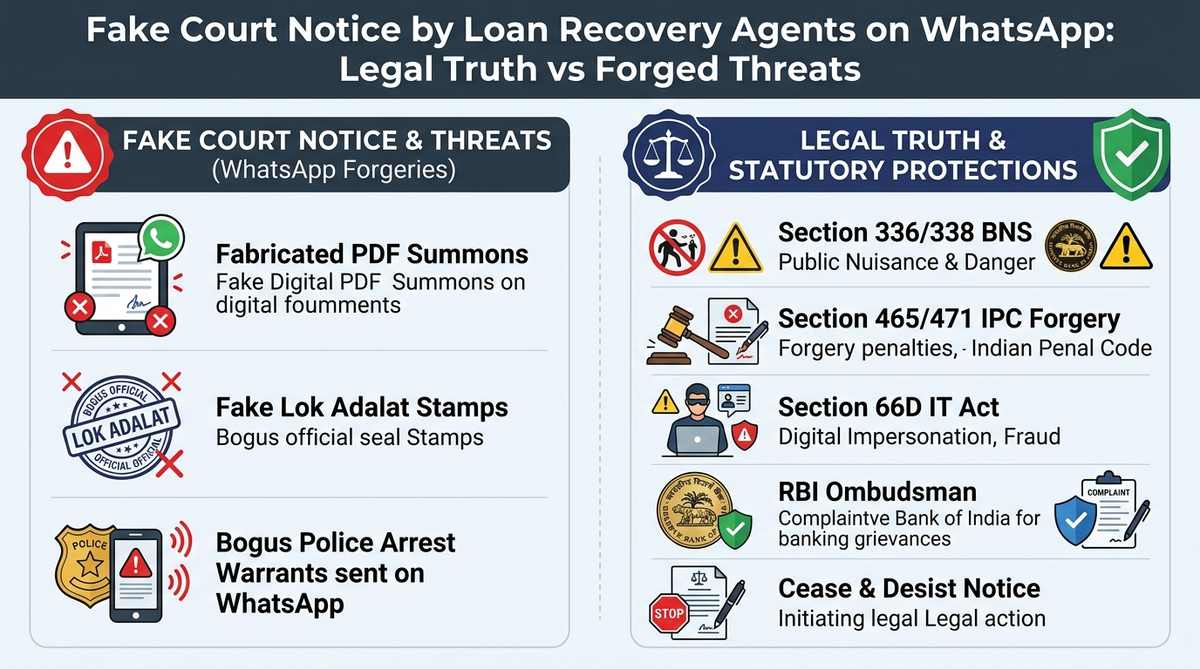
Many borrowers across India face an alarming collection tactic. Recovery agents send fake legal notices, false court summons, and phony arrest warrants on WhatsApp. Unregulated collection agencies try to create sudden panic. They paste fake Supreme Court emblems, bogus Lok Adalat seals, and fake judge signatures onto PDF files.
These fake notices aim to create an artificial legal crisis. Messages claim a Chief Judicial Magistrate signed an arrest warrant. They claim police are on the way to your workplace. They set 2-hour payment deadlines to push borrowers into panic. Fearing jail, many people take costly loans or spend family savings to pay.
Defaulting on an unsecured personal loan or credit card is a civil dispute. No magistrate, civil judge, or police officer issues arrest warrants on WhatsApp for an unpaid loan.
Third-party recovery agencies have zero judicial power. They are not court officers or police. Making fake court papers is a serious crime under Indian law.
2. Forensics of Forgery
You can identify a fake WhatsApp notice by checking a few clear signs. Real court notices follow strict rules under the Civil Procedure Code, 1908. Recovery agent fakes use cheap digital templates full of legal errors.
The biggest red flag is a missing Case Information System (CIS) Case Number Record (CNR). Under Supreme Court rules, every registered court case has a unique 16-digit alphanumeric CNR number. If a notice shows vague codes like "Case Ref: REC/2026/DL/9812" instead of a CNR number, it is fake.
Key Forensic Red Flags in Fabricated WhatsApp Legal Notices
1. Fake Lok Adalat Powers
Agencies send notices titled "Lok Adalat Arrest Notice". Under the Legal Services Authorities Act, 1987, Lok Adalats are voluntary forums. They have no criminal powers and cannot order arrests. Any arrest notice from a Lok Adalat is fake.
2. Urgent Deadlines and Direct UPI Demands
Real court summons give several weeks to respond. Fake notices demand payment in 2 to 4 hours. They include private UPI QR codes to steal money.
3. Mixing Civil and Criminal Laws
Fake notices often mix Section 138 NI Act, Section 420 IPC, Section 25 PSSA, and SARFAESI on one page. This messy drafting reveals an agent fake.
4. Blurry Seals and Fake Emblems
Forgers copy blurry images of the Ashoka Emblem and generic scales of justice. Real court summons carry physical stamped seals and clear official signatures.
Borrowers can check any notice on the e-Courts website (services.ecourts.gov.in). Search using the CNR number or party name. If no case appears, the document is an extortion attempt.
Check Your Loan Settlement Options
Answer 2 quick questions to evaluate your settlement eligibility.
1. What type of loan do you want to settle?
3. Statutory Criminal Protections
Sending fake court notices to collect debt is a major crime in India. Under the Bharatiya Nyaya Sanhita, 2023 (BNS) and the Indian Penal Code, 1860 (IPC), strict laws punish this conduct.
Key penal sections that apply to fake legal notices include:
Section 466 IPC / Section 338 BNS
Forgery of Court Records: Forging court papers carries up to 7 years in jail and fines. This is a serious, non-bailable offense.
Section 471 IPC / Section 340 BNS
Using as Genuine a Forged Document: Using a forged document as genuine carries the same penalty as making it.
Section 468 IPC / Section 336(3) BNS
Forgery for Purpose of Cheating: Forging court summons to trick a borrower into paying brings up to 7 years in jail.
Section 383/384 IPC / Section 308 BNS
Extortion: Putting someone in fear of arrest to demand money is criminal extortion. It carries up to 3 years in jail.
Sending forged files digitally also breaks Section 66D of the Information Technology Act, 2000. It also violates Section 170 IPC / Section 204 BNS for pretending to be a public officer.
In ICICI Bank Ltd. v. Prakash Kaur & Ors. (2007), the Supreme Court ruled that banks cannot use musclemen or forgery. Filing a formal criminal complaint puts direct liability on the agency and the bank.
4. Bank Balance Sheet Economics
To understand why agencies send fake notices, look at bank economics. Under RBI Prudential Norms (IRACP), an unsecured loan becomes a Non-Performing Asset (NPA) after 90 days of default.
Once an account is an NPA, the bank must set aside capital in mandatory provisions:
- Substandard Assets (NPA up to 12 Months): 15% provision on total unsecured debt.
- Doubtful Assets (NPA 12 to 24 Months): 100% provision on the full unsecured amount.
- Loss Assets / Written-Off Accounts: Complete 100% write-off on the bank balance sheet.
Filing a civil court case costs 1% to 3% in fees and takes 3 to 5 years. Because unsecured loans have no collateral, court litigation yields poor returns. Banks evaluate cases using the Net Present Value (NPV) recovery formula:
Here C_t is expected recovery, and r is the discount rate. Deductions include court fees, lawyer retainers, and funds locked in NPA reserves.
Settling the loan gives the bank a better return than court action. A 40% to 65% One-Time Settlement (OTS) unlocks cash and clears provisions. Agents send fake notices in a rush to claim commissions before the bank settles the account.
6. Step-by-Step Criminal & Regulatory Action
When you get a fake notice on WhatsApp, do not panic or argue with agents. Follow this step-by-step legal plan:
Step 1: Save Digital Evidence
Do not delete the chat. Take full screenshots showing the sender number, photo, and time. Save the chat history and the raw PDF file.
Step 2: File a Cyber Crime Complaint
Report the incident on cybercrime.gov.in under digital fraud and forgery. Keep the official complaint number.
Step 3: Serve a Legal Notice on the Bank
Have a lawyer send a notice to the bank Managing Director and Nodal Officer. Cite Section 338 BNS, Section 466 IPC, and RBI rules.
Step 4: Escalate to the RBI Ombudsman
If the bank fails to resolve the issue within 30 days, file a complaint on cms.rbi.org.in. The Ombudsman can penalize the bank and award compensation.
Step 5: File a Police Complaint
Submit a written complaint to your local police station. If needed, your lawyer can file an application under Section 156(3) CrPC (Section 175 BNSS) before a magistrate.
Taking legal action shifts the pressure back to the lender. Banks realize the severe legal risks and quickly move toward a fair settlement.
7. Civil Court Realities
To spot fake summons, you should know the legal rules for court notices. Order V Rule 9 CPC sets the exact procedure for serving court summons:
Real summons come through a Court Bailiff, registered post, speed post, or approved courier. The summons always includes a full copy of the plaint and supporting affidavits.
In In Re: Cognizance for Extension of Limitation (2020), the Supreme Court allowed electronic notices only under strict conditions. The court must approve electronic service first. The notice must come from an official email or registered lawyer.
An anonymous WhatsApp PDF demanding money in two hours breaks all Order V CPC rules. Knowing this helps you dismiss bogus threats with confidence.
8. Direct Bank Settlement Protocols
Never pay money directly to recovery agents or through unverified links. Agents often claim that paying ₹25,000 will cancel an arrest warrant. In truth, that money goes to penalties and agent fees, leaving the debt unpaid.
To close the loan permanently, work directly with the bank on an official One-Time Settlement (OTS):
1. Official Sanction Letter
Get a settlement letter on bank letterhead. It must state the agreed amount, waiver, and payment dates with an official signature.
2. Direct Bank Remittance
Pay money only to your official loan account via RTGS, NEFT, or Demand Draft. Never pay through third-party UPI links.
3. Bank-Stamped NDC & CIBIL Update
Get a stamped No Dues Certificate (NDC) within 30 days under RBI Circular RBI/2023-24/60. The bank will mark the debt as Settled.
After full payment, the bank updates credit bureaus. While a Settled mark causes a temporary score drop, it ends all legal risks. You can rebuild your credit score above 750 in 12 to 24 months.
9. Comparative Verification Matrix
The comparative matrix below details the crucial procedural, structural, and legal distinctions between authentic judicial summons and forged electronic notices dispatched by recovery agencies:
| Verification Parameter | Authentic Judicial Court Summons | Forged WhatsApp Recovery Notice | Applicable Legal Statute / Rule |
|---|---|---|---|
| Mode of Delivery. | Court Process Server, Bailiff, RPAD, Speed Post, or court-approved electronic service. | Unverified WhatsApp message or PDF from a private mobile number. | Order V Rule 9 CPC rules on summons. |
| Case Number & CNR. | Unique 16-digit CNR number verifiable on the e-Courts portal. | Missing number, fake reference code, or internal recovery tag. | e-Courts Case Information System standards. |
| Response Timeline. | Standard 30 days to appear in court and file a Written Statement. | Urgent 2 to 4 hour ultimatum demanding instant funds transfer. | Order VIII Rule 1 CPC timeline rules. |
| Penal Threat Content. | Formal civil suit notice with no arrest threats for debt default. | Threats of immediate police raids, arrest warrants, and workplace visits. | Section 338 BNS, Section 466 IPC, and Section 506 IPC. |
| Payment Instructions. | No payment demands in summons; cases are heard before the judge. | Demands immediate UPI payment, personal QR codes, or unverified links. | Section 468 IPC and Section 336 BNS on fraud. |
10. SettleLoans Legal Relief
Getting fake legal notices and arrest threats on WhatsApp can be stressful. At SettleLoans, our banking advocates and debt resolution experts protect borrowers. We file formal legal notices, issue Cease-and-Desist directives, and report rogue agencies. We also negotiate 40% to 65% One-Time Settlements with official bank No Dues Certificates.

Settle Loan is India's trusted debt relief and loan settlement platform. We help borrowers overcome financial distress by negotiating with banks and NBFCs to legally settle personal loans and credit card debts. With our transparent, performance-based approach, you can achieve debt freedom and regain your financial peace of mind.
COMPUTER
11. FAQs: Fake Court Notices & Recovery Agent Forgery
Clear, legally verified answers regarding forged WhatsApp court summons, Section 338 BNS / Section 466 IPC protections, and debt resolution procedures in India.
Can Indian courts serve legal summons or arrest warrants directly through WhatsApp?
Under Order V Rule 9 CPC, court summons must come through a Court Bailiff, registered post, speed post, or approved courier. Courts allow WhatsApp notice only during active cases with prior judicial approval. Even then, it needs a valid 16-digit CNR number on the e-Courts portal. Courts never send informal PDF arrest threats on WhatsApp from personal numbers.
Is sending a fake court notice or fabricated judicial seal a criminal offense in India?
Yes. It is a grave crime. Making fake court papers breaks Section 466 IPC and Section 338 BNS. It carries up to seven years in jail. It also violates Section 471 IPC (Section 340 BNS), Section 506 IPC (Section 351 BNS), and Section 66D of the IT Act.
How can I verify if a court notice received on WhatsApp is real or fake?
Real court notices contain a 16-digit CNR number, court room number, and judge name. Enter the CNR number on the e-Courts website (services.ecourts.gov.in) to verify it. If a notice lacks a CNR number or demands urgent UPI transfers, it is 100% fake.
Can National Lok Adalat issue an arrest warrant or police seizure order?
No. National Lok Adalats under the Legal Services Authorities Act, 1987 are voluntary conciliation bodies. They cannot issue arrest warrants or direct police raids. Any notice claiming a Lok Adalat issued an arrest warrant is completely fraudulent.
What immediate legal steps should I take after receiving a fake court notice on WhatsApp?
Do not delete the chat. Take full screenshots showing the sender number, date, and time. Save the raw PDF file. Do not make panic payments. Have a lawyer send a notice to the bank and file a complaint on cybercrime.gov.in.
Is the lending bank legally responsible for fake notices sent by outsourced recovery agencies?
Yes. Under RBI Circular RBI/2022-23/108, banks and NBFCs are strictly liable for the actions of their collection agencies. Borrowers can file a complaint with the RBI Integrated Ombudsman to demand action and compensation.
Can I go to jail for defaulting on an unsecured personal loan or credit card?
No. Unsecured loan default is a civil matter under the Indian Contract Act, 1872. You cannot be jailed for honest financial inability to pay. Arrest only applies in proven loan fraud or Section 138 NI Act cheque bounce cases.
How does legal representation by SettleLoans resolve the dispute and protect the borrower?
SettleLoans lawyers issue a formal legal notice to bank leadership. This stops third-party collection harassment immediately. We expose fake notices and negotiate a 40% to 65% One-Time Settlement with an official No Dues Certificate.